Pages

Sunday, March 06, 2011

Mystic in the garden


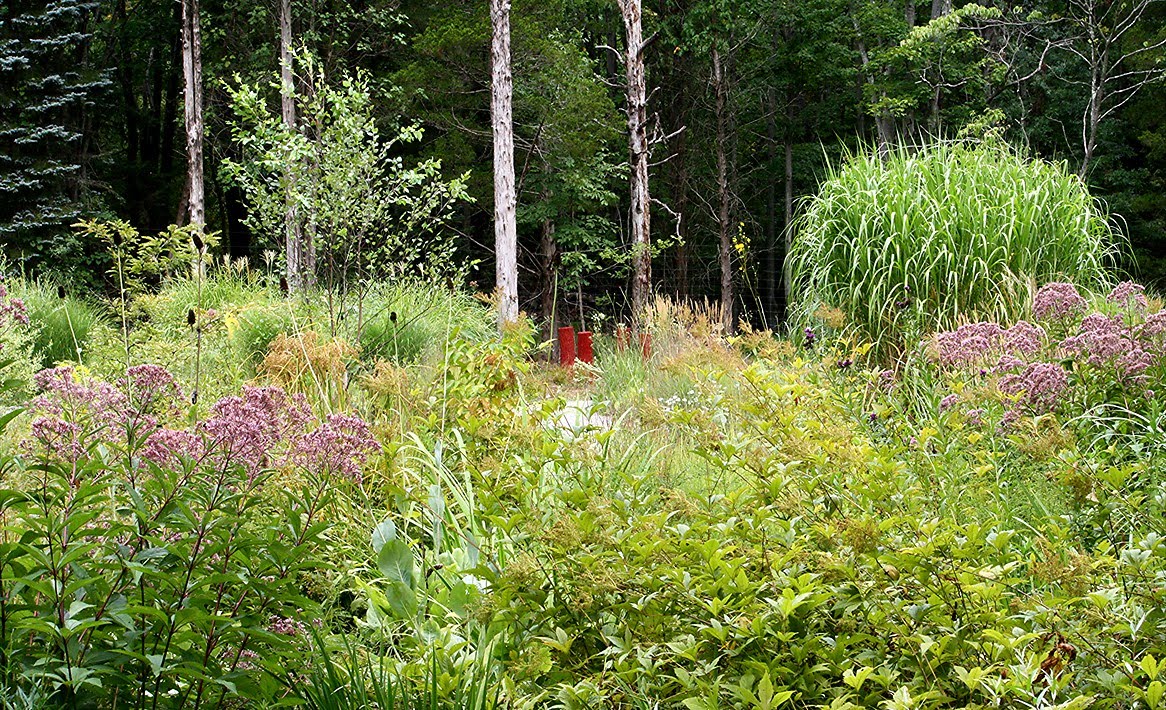
The circle of red logs was my first deliberate attempt to evoke ambiguity, uncertainty, questioning. Some immediately recognize it as a memorial to the Native Americans who lived in these hills, others simply see it as a red complement to the green of the garden, others don't know what to make of it. That's okay.


Marc Rosenquist's bronze sculpture, added this summer, serves a similar purpose, because its shape is ambiguous. What is it meant to depict, if it does depict anything? The ambiguity, I hope, moves the mind from a simple appreciation, to curiosity, at least, and perhaps toward questions of meaning.


Ultimately, I'm aiming for a sense of mystery, perhaps even for an encounter with the unknowable, or an echo of that. I realize this is not a very fashionable notion, except in limited circles, in current days.


Photos of bark paths by Ragnar Naess

Sunday, February 13, 2011

Gone fishing ...

Thunderstorm approaching over vineyard in Mendoza wine country, a rare event in this part of Argentina, a moment to be savored
... well, not exactly fishing, but we are on an exploration of parts of Argentina and, now, Uruguay, collecting lots of photos and post material, but no time to be thoughtful right now. I must say the flora of the Uruguayan Monte is astonishing, full of exciting discoveries. More to come when we return to the US, shortly ...

Tuesday, January 25, 2011

The High Line: Section 2

The High Line's Section 1 ends in a field of Prairie Dropseed (Sporobolis heterolepis). Section 2 will open this spring.
The High Line is a long-ago abandoned elevated rail line being converted into an aerial park in Manhattan. With plantings designed by Piet Oudolf, Section 1 opened to great success last year. Here is a video preview of Section 2, which will open this spring.

Friday, January 21, 2011

Sunrise on new snow: watching from inside

Another four or five inches of light snow fell last night. Being born in the south where snow might be seen once in five years, I still delight in it, even after several storms in a row. But I haven't wanted to walk through this. Instead, I watch from inside the house.


The garden is almost gone, buried under layers of ice. The surrounding forest trees are much more prominent now and will have to carry the bulk of interest until spring. Even the structural elements--the gravel paths, stone walls, the pond--are invisible until the spring thaw.


The dark, leaden scaffolding of Baptisia australis (below) is still holding its own well against ice and snow, but the grasses are getting ragged and are ready for burning. The disappearance of most of the vegetable garden points up need for more structure at this time of year. The hornbeam hedge I started last year will make a strong winter statement, once it attains its "hedgeness."


And some other structural elements (columns, mounds, geometric shapes--of pruned shrubs, wood, stone, perhaps) may give just enough entertainment to the eye--strong, simple shapes contrasting with the busy, almost chaotic lines of the forest trees--without interrupting the view into the woods.


But on a day like today, the ethereal tracery of the trees, the washes of early morning sun light, the glimpse of the hill on the opposite side of the valley, just visible through the forest, are enough.

Wednesday, January 12, 2011

New snow: sense of place


Unity of house and garden was uppermost in my mind when we moved to Federal Twist Road at the start of 2005. The mid-1960s house, raised on a man-made hillock above the surrounding wet, is low and long, with a low roof line and wide eaves that give it a hooded look from the distance. The house was painted a taupe color that blends well with the surrounding woods. It was clear from the start that this house could only overlook a naturalistic garden, a garden appropriate to this place.

In a photo taken last fall (below), the looming presence of the house dominates the garden yet blends easily into the wooded setting. In the growing season, a screen of grasses and mature trees surrounding it make it  recede into the background, almost disappear.


But that's all about how the house looks from the outside. Although the style of the garden responds most directly to its external appearance, most garden viewing takes place inside the house, particularly in winter months and inclement weather.

Throughout December, when holiday activities kept me in our Brooklyn house -- really just a series of painted boxes with limited views out -- for the better part of a month, I found myself literally craving these woodland views. I guess I have to admit that old cliche about the healing quality of nature is true, much as I want to dismiss it as trite and sentimental.

Now I'm spending a week in the country. On this winter weekend, with accumulating snow keeping me inside, I've been made acutely aware that outside is inside too, so I set about making a photographic record of the visual unity of house and garden -- but this time from the inside looking out.

Though the living room and study give all-encompassing views of the garden and surrounding landscape through a window wall ...


 ... in fact, each room in the house, including kitchen and bathrooms, offers substantial views out.

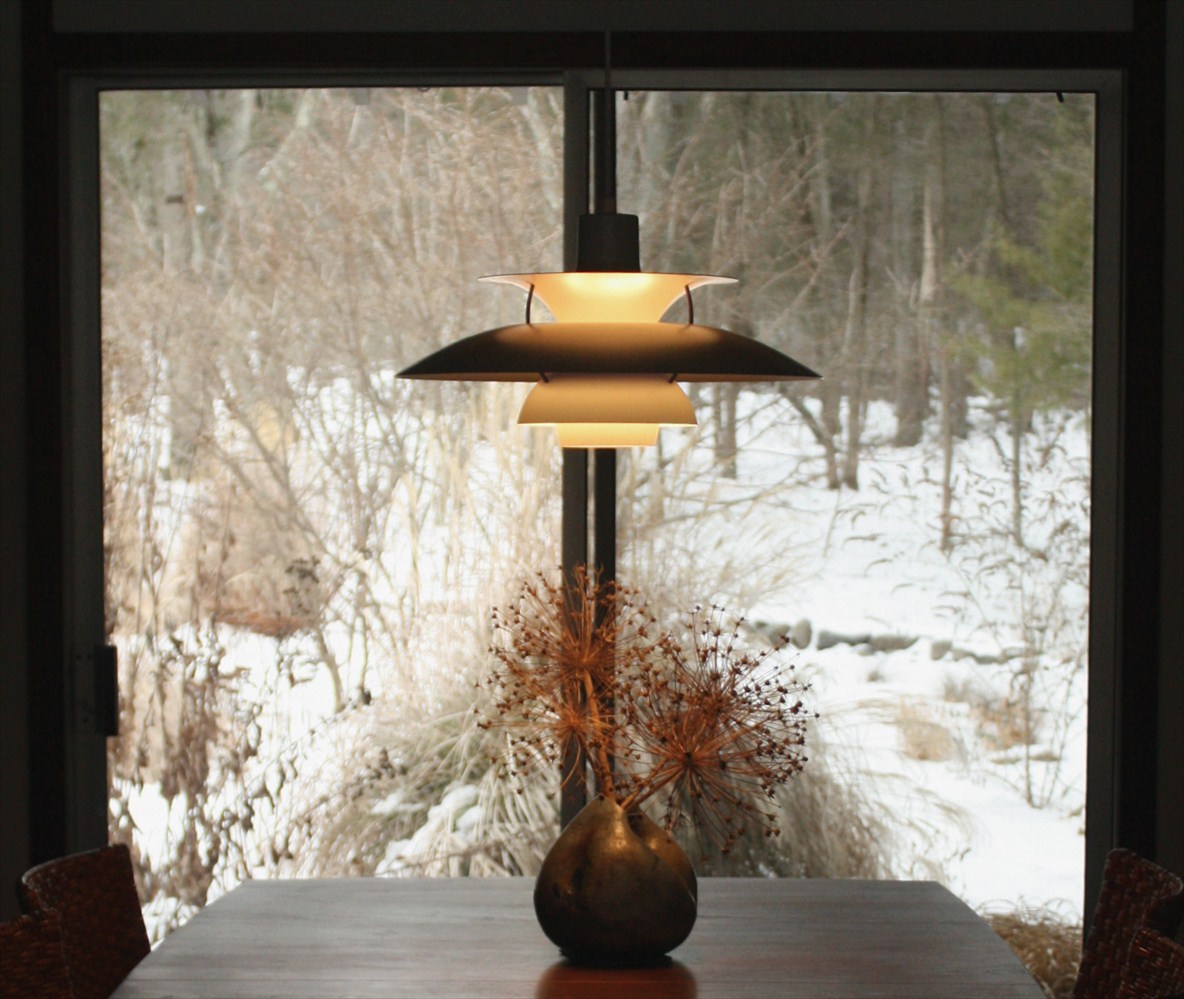
The dining room view out the opposite side toward the driveway and Federal Twist Road ...


... the guest bedroom, with a view onto the gravel terrace, across the garden, into the woods ...


... the master bedroom window, looking out the far end of the house to an old stone row ...


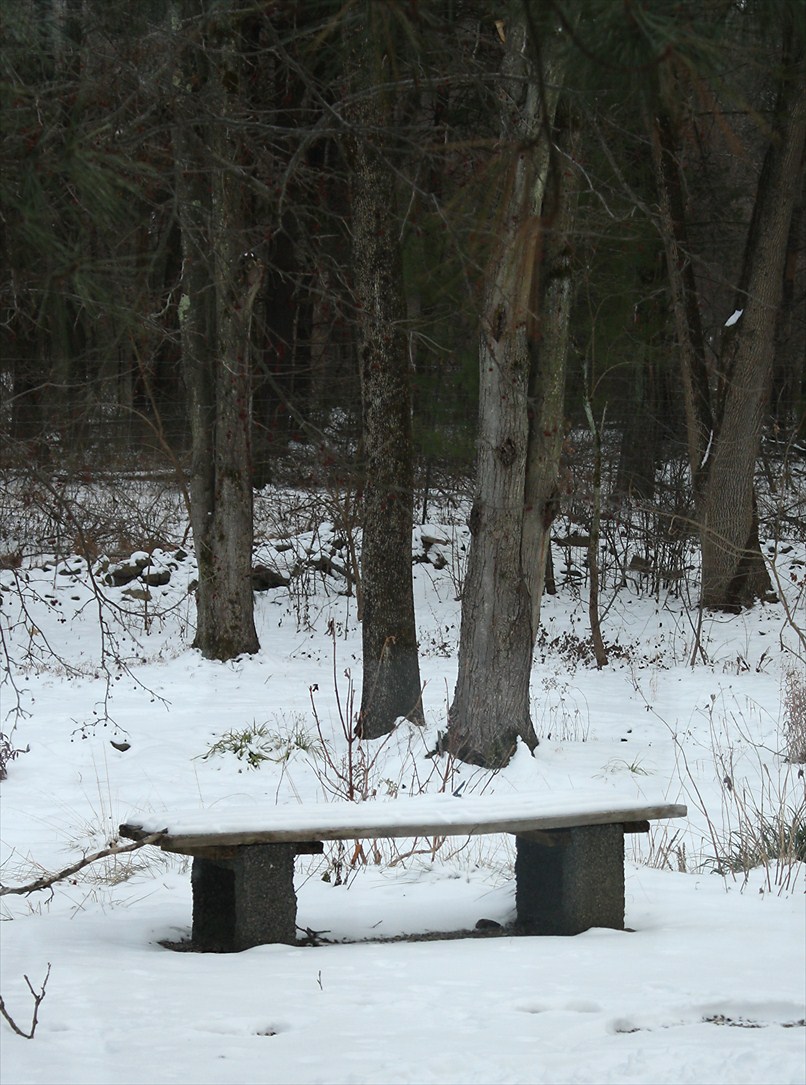
... the view out the side window of the study, onto the woodland garden, and a simple, rustic bench made of two 60s-era concrete blocks and planks ...


... and another view out the back of the study to one of three Sycamores planted as saplings when the house was built in 1965 (note the colors and textures of the bark, repeated in the background landscape!).


Sense of place is what this garden is about. I was intrigued when Peter Holt quoted Claire E. Sawyers (The Authentic Garden: Five Principles for Cultivating a Sense of Place) because it introduced me to the Japanese concept of wabi-sabi. As I wrote to Peter, "I've been trying to put this into words, and thanks to you, I've discovered my garden fits into this centuries-long tradition--another little miracle... like reading my own autobiography written by dead people from another culture and another time."

Sawyers suggests that westerners' longing to create Japanese gardens comes from a confusion of those gardens' specifically Japanese cultural  influences with their more universal wabi-sabi character, which is admiration for things or places that can be characterized as humble, transient, beautifully worn, with the patina of use and age, the natural, the unpretentious, the familiar seen in a new way.

As one authority, she quotes Lenord Koren (Wabi-Sabi for Artists, Designers, Poets and Philosophers): "Wabi-sabi represents the exact opposite of the Western ideal of great beauty as something monumental, spectacular, and enduring. Wabi-sabi is not found in nature at moments of bloom and lushness, but at moments of inception or subsiding. Wabi-sabi is not about gorgeous flowers, majestic trees, or bold landscapes. Wabi-sabi is about the minor and the hidden, the tentative and the ephemeral..." I might even add, the informal.

Thus, Sawyers suggests that one way to cultivate sense of place is to use humble materials, materials that through nature or culture are appropriate to the site. Our house is very much at one with this landscape and this garden. It's a simple house, really a profusely fenestrated shed-like structure; built of wood and stone, and colored much like the bark of a tree in winter, it takes on the character of the woodlands and garden surrounding it. It welcomes the outside in, in almost any direction you look. Very much a wabi-sabi relationship of house and garden, I think.

The wide, over-hanging eves and part of the window frame in the next photo give that fact a hard  reality, contrasting the ordered, rigid, yet simple man-made structure with the looseness and complexity of the grasses and trees.


So what does this Japanese artistic concept of wabi-sabi have to do with my house, grasses and woods? I'd say it gives me a theoretical and historical context, it gives me a place to belong, makes me part of a group, though not necessarily a Japanese only group.


Not at all, certainly, for we in North America have a long tradition of naturalistic planting through imports such as Jens Jensen, a German who came to America and became an early advocate of prairies and managed natural landscapes, and our own native Frank Lloyd Wright, who gave us the concept of the "prairie house," of which my own is a descendant, and who also brought much of the Japanese aesthetic to his work. And, of course, more recently, the work of Oehme, van Sweden Associates, who pioneered American naturalistic planting over the last decades of the 20th century, and continue to do so.

In most ways, I'm doing nothing that hasn't been done by others for decades. With one possible exception, because I do carry one aspect of my "naturalistic" approach to the extreme, doing virtually nothing to improve a difficult, heavy clay soil or very poor drainage. The plants must be capable of adapting to these conditions or they languish and die. Ironically, two grasses from different continents are among the most successful:  panicums, from North American, and miscanthus, from Japan.


We really don't even need the term wabi-sabi since these ideas have become a part of our garden culture by osmosis, percolating into our history and culture through innumerable routes.

But the Japanese source of the term is a useful reminder and prod to appreciation of classically Japanese detail such as the irregular line and asymmetry of the bare dogwood in the foreground of the photo below, and to the detail of our house, which owes much to Japanese influence.


The point of all this? That the garden is indeed part of the house, and the house a part of the garden. This relationship dictates the naturalistic look and style of the garden. Japanese influences are pervasive, but they have been thoroughly assimilated into the the local context of a wild wood in western New Jersey.

Sunday, December 26, 2010

Emily Dickinson: Radically complex and cryptic

Emily Dickinson's house
Phil and I visited Emily Dickinson's home in Amherst, Massachusetts, on December 11. I had missed the New York Botanical Garden's exhibition Emily Dickinson:  The Poetry of Flowers, but I think I probably experienced more of the real Emily--the person Holland Cotter refers to in his New York Times review as a "radically complex, sometimes cryptic writer and a troubled and troubling thinker as familiar with despair as with exhilaration, who found in nature reminders of death as much as of life"--by visiting her house, standing in her bedroom (a poignant, deeply moving moment), and walking the small landscape where she chose to live her increasingly reclusive life.

Emily lived most of her life here in the house she and her family knew as the Homestead.


Her bedroom is in the upper left, and from it, she had a view of the small woods and path toward her brother's house. This small landscape and path was most of Emily's world. She sometimes would take her niece Maggie to her room, lock the door, and say to her, "This is freedom." National Public Radio has a very informative web page and podcast by Lynn Neary, which I recommend you visit for a perceptive view into Emily's world.

The woodland path between Emily's home and her brother's more stylish Italianate villa.

Emily's brother Austin was a prominent member of Amherst society, so his house was a center of social and intellectual life during that time. Emily was a frequent visitor there, and it was a center of her limited social life. Some of Emily's garden was probably in this area--we know the path was there during her lifetime--though there is also ample space for gardening around and behind the house, as well as a large lawn to the opposite side.

The large lawn on the opposite side of the Homestead
 Much is unknown about Emily's motivations and her life. You can find the answers to some questions here.

Austin's house
Almost none of Emily's poetry was published in her lifetime, though there is ample evidence she viewed it with great seriousness, and at times reached out for encouragement from others who's opinion she valued.

This is a disturbing and haunting story, and I've carried a picture of Emily's austere bedroom in my mind's eye since that visit. One of her poems:

I heard a fly buzz when I died;
The stillness round my form
Was like the stillness in the air
Between the heaves of storm.

The eyes beside had wrung them dry,
And breaths were gathering sure
For that last onset, when the king
Be witnessed in his power.

I willed my keepsakes, signed away
What portion of me I
Could make assignable,-and then
There interposed a fly,

With blue, uncertain, stumbling buzz,
Between the light and me;
And then the windows failed, and then
I could not see to see.

Saturday, December 18, 2010

Light and Color

Aster laterifolius, Rudbeckia maxima

I'm still waiting for those mornings with hoar frost, or at least a covering of snow. But no such luck yet.

At the end of November, when I looked closely, after a week away in the deep South, I found quite a bit of color. The kind of color Rick Darke documents so carefully to explode the myth there's no color in late fall and winter.

Sanguisorba canadensis, Lysamachia ciliata 'Firecracker'

Light too. These photos are interesting for their use of backlighting in some cases, and for direct sun light in others--but the warm, low light of autumn, so different from the harsh overhead summer sun.

Silphium perfoliatum

Miscanthus sinensis 'Gracillimus'

Mettuccia struthiopteris

Inula racemosa 'Sonnerspeer', Miscanthus 'Gracillimus'


Eupatorium purpureum, Rudbeckia maxima, Silphium perfoliatum, assorted miscanthus

Miscanthus, a true lover of wet clay - it's everywhere

Sanguisorba canadensis, Scirpus cyperinus

Hydrangea quercifolia

Miscanthus again

Acorus ogon

Aster laterifolius, Aster tartaricus 'Jin Dai', Eupatorium perfoliatum, Spartina pectinata marginata

Bergenia and Box

Sanguisorba canadensis, Lysimachia ciliata 'Firecracker'

Miscanthus 'Gracillimus'

Saturday, December 04, 2010

These fragments I have shored against my ruin


Okay, take that title with more than a bit of irony. It's a favorite quote from T.S. Eliot I use whenever I get a chance, but we're not talking about the end of the world here.

My post yesterday (Is gardening only a hobby?) elicited an interesting comment from Anne Wareham in England. Someone sent her a podcast link via Twitter, saying the podcast might change my mind about the state of gardening in the USA.

The podcast is a moving interview by Andrew Keys, in fact his inaugural podcast in a series for Horticulture magazine, with Lynn Felici-Gallant, who is leaving her garden after several years. A poignant interview, one that clearly demonstrates real gardening is alive in the good ole USA. (One point of light amid the darkness, if you'll excuse my bleak metaphor).

Andrew is a really good interviewer, and the podcast has a high production value. Click on the Radio Garden logo above to listen. For more on Andrew, check out his blog, Garden Smackdown.

Friday, December 03, 2010

Is gardening only a hobby?

This is it. I have no lawn.

Well, in the USA it's hard to think of it in any other way, isn't it? Just check iTunes for garden podcasts, or any media directory. What category do you find "gardening" in?

I was listening to Ken Druse's Real Dirt podcast recently. I always enjoy Ken's podcasts, especially his interviews. Last week he talked to Bart Ziegler, gardening columnist for the Wall Street Journal. Ziegler's is a thoroughly enjoyable gardening column, far superior, in fact, to most available in US media. I like the guy, so please don't think this is an attack on him, or on Ken.

But at the end of the interview, Ziegler's closing remarks just set my teeth on edge. Well, actually, it started earlier. Ziegler talked about his "yard," not about his "garden." Not a mortal sin, I suppose, but so revealing about American attitudes toward gardening.

Okay, the offending words that set me off:

"Learn to relax. It's only a garden. This is not brain surgery. It's supposed to be a hobby, it's supposed to be enjoyable, and if you end up driving yourself crazy, it's neither of those..."

In context, there's nothing wrong with this, I agree. But in the US, it's come to be almost the only acceptable attitude toward gardening. We mow our lawns (we all have lawns, don't we?), we spray Roundup on the dandelions, we grow native plants if we're of a certain political persuasion, we grow vegetables to feed ourselves (the newest widely condoned fad), we may even weed if we're "serious" gardeners. Hell, we may even sit and take pleasure in our yards (or gardens ... but most of us think using the word "garden" may be pretentious).

There's far more to it than this. Gardening has a long and illustrious history--thousands of years--as a very important part of human culture, often as the place for practice or contemplation of spirituality, aesthetics, philosophy (the "good life"), even politics--yet our culture relegates it to the "hobby" category. What happened?

Can anything be done? If you're interested, take a look at this website:  thinkinGardens. The people here are at least trying to change things. The site is British, of course, but gardening is much more highly valued there than here. So take it where you can get it.

LinkWithin

Related Posts with Thumbnails