Pages

Showing posts with label wet clay. Show all posts

Tuesday, May 05, 2009

Euphorbia palustris

Euphorbia palustris has proven to be an early spring winner in my wet clay environment. Most plants that like my conditions get off to a slow start and come into their own much later in the season, in July to August. But this water lover is a real early season gem. I think I should develop a list of golden plants for this early season. They really brighten the view of my perennial plantings, most of which are just emerging from the ground as a kind of rough stubble.

The largest Euphorbias are about 30 inches tall. I have two planted with the variegated Calamagrostis 'Overdam', a combination that works well.

This plant is in its second full year. Lots of sun seems to be to its liking. Two planted in the shade have hardly grown at all.

Sunday, December 28, 2008

Garden Diary: Stripped Bare

Entrance path to future woodland garden
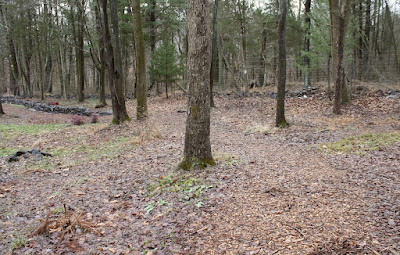
The path meanders through trees toward the main garden

After a major ice storm and rain, the garden is stripped bare of all except hardscape, battered grasses, and mud. Yesterday a heavy fog, brought by a warm front that ended the snow cover, gave the opportunity to measure this year's progress toward creating a sense of mystery, a journey, a narrative - mostly independent of the plantings so prominent in other seasons. The photos in this post were taken yesterday, and you'll see snow and fog in them, and this morning, where you see no snow and no fog. To see detail, you'll need to click on the photos to enlarge them.

Entering through the Woodland Path
To get a sense of narrative, of some as yet untold story, it's best to enter the garden by way of the woodland path. This starts at a gate on the right end of the house and circles around through the woodland garden to the main garden at back. This is a wood chip path shown in the two photos above, and below, where you can see the path meeting a long curving stone wall that carries the view deep into the garden.


The stone walls added this year, and a long, narrow, canal like pond have created structure that controls the movement of both the eye and the body, giving the woodland entrance to the garden a firm direction and flow. Curves do it all... the curving path and wall through the woods, around the end of the house, into the large garden at back (below)...


the curves of two stone walls that enclose the view on the left and right...


the curve of the pond (below) directing the eye along the natural drainage flow across the garden and into the woods beyond...


and the curve of the wall lining the long path (below) as it begins its circle of travel around the entire garden...

... all moving a visitor forward while restraining movement to the limited space between the two curving walls. The fog enhances the sense of mystery, but the structure itself is beginning to suggest a journey.

These views show me I need evergreens to achieve better screening both in summer and especially in winter. I've been reluctant to try anything evergreen in my wet clay (I don't want to spend scarce money on expensive shrubs likely to die, or worse, live long, lingering, ugly deaths). But looking at these photos, I'm convinced it's time to take the risk.

A Second Entrance: Steps
During the the short transit through the woodland garden, a second entrance, from the terrace behind the house, reveals itself (okay, it's only a start).


Built of local stone, these low steps will give access directly from the back of the house onto a soft wood chip path, circling immediately around the stone wall directly to the pond, then continuing out into the middle of the garden.


The rather barren area at the foot of the steps has been planted with a variety of groundcover plugs (tiarella, phlox stolonifera), bunches of Ostrich fern (Matteuccia struthiopteris), and legacy daffodils, but it needs winter color. I'm considering willows (maybe Salix alba 'Britzensis') and some form of red twig dogwood, in bunches. You get the idea.


Continuing into the garden (below), glancing to the right, you see the space opening up, looking back over to the pond and the wall at the base of the house ...


... and further right, a small bridged drainage channel to carry off excess water and provide habitat for more bog plants ...


... such as the three Salix alba 'Britzensis' below. I've rooted cuttings of these and should have a virtual wall of them here next year.
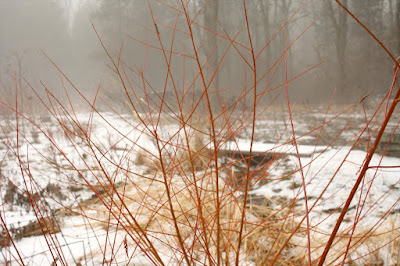


And at the end of the wall, the dried remains of a flower of Ligularia japonica (from Plant Delights, where else?).

Next, a Corylopsis spicata and a colony of Lobelia cardinalis (no pictures, nothing to look at now), then my log pile, the remains of a few of the many trees we cut to open a space for the garden, and now a valuable wildlife habitat.


And at the very end of the path, a view of the slope going up to the house, blousy with miscanthus.


This "story" may never be told, not in a finished way. I'm just trying to ask the right questions, to set the stage.

Tuesday, August 05, 2008

Plants for wet clay: August 3


Late Sunday afternoon I made a quick tour of the garden and confirmed some of the keepers in my wet clay soil (mostly baked clay in July and August). First the old standbys, Filipendula rubra 'Venusta', Rudbeckia maxima, Miscanthus gracillimus (above and below). And now a major new addition, proven through winter, is Liatris pycnostachya, a little bluer in the photos than in reality. And above, an elegant spray of a native Scirpus. Below, in the foreground, a Hybiscus moschuetos not yet in bloom.


Joe Pye Weed and some rapidly naturalizing hemp agrimony (Eupatorium cannibinum), give a colorful background, and contrasting shape, to the Liatris wands.


Last, white Physostegia virginica, yellow Patrinia scabiosifolia, and the giant leaves of Silphium terebinthinaceum. The Physostegia really thrives in the wet, as does the Silphium, which stubbornly refuses to flower (much) in its third year; no great loss since its foliage alone is enough for me. The Patrinia is surviving, but will take another year to prove its mettle.

Wednesday, July 23, 2008

Pycnanthemum muticum: a plant for wet clay


One of my favorites - Pycnanthemum muticum, mountain mint. Soft silver foliage by early July, at least in western New Jersey, loads of insects, highly fragrant, mixes well with other perennials or grasses, particularly well in a meadow. No insect damage. Deer proof. Does well in heavy wet clay as well as drier situations. Good close up and at a distance.


Wednesday, June 18, 2008

Iris versicolor: a plant for wet clay and sun

My specialty, by necessity, is plants that thrive in wet clay (I won't even call it soil) and sun. I've tried Iris versicolor, a native in my area of New Jersey, for three years, and it has passed the test. I'm sure my plants, some of which came from Lowe's, others from the Millersville University Native Plants in the Landscape conference, do not have local genetic provenance, but so it goes.Some have grown into sizable clumps and this year, for the first time, the plants have formed a community of sufficient area to make a pronounced visual impression - a field of starry blue flowers. The bloom period has lasted for about three weeks, though some plants blossom at different times, apparently because of the relative wetness of their locations, and perhaps length of exposure to direct sun, some being closer to woodland edge than others.Most of these plants were inserted directly into the existing matrix of vegetation - so they have had to compete for space and nutrients with little to no attention from me. If I have time, I do try to clear some space around the plants to give them some advantage over their neighbors, but that extra care hasn't proven to be necessary, at least in this environment. The last photo shows a drift of Iris versicolor with grass, Winterberry holly (Ilex verticillata 'Berry Nice' - hate that name!), miscanthus, and a clump of unknown Siberian iris.

Monday, March 03, 2008

Rudbeckia maxima: a Plant for Wet Clay and Sun

Extraordinarily large leaves of glaucous blue, towering spires sturdy enough to outlast a winter of ice, each topped by a floppy daisy flower in mid-summer and protuberant seed cones all the way to spring: these are the chief aesthetic attributes of Rudbeckia maxima. I had read that this was a difficult plant, so I was surprised to find it flourishes in my wet clay soil in full sun.


Now I have learned that the plant originates in the piney woods and plains of Arkansas, extending through Louisiana, into Texas, and prefers plenty of moisture, sun, and heat. I may garden a thousand miles to the northeast, but I can offer this strange plant conditions similar to its native habitat. Though the rudbeckia dies completely to the ground each winter, it returns with great vigor as soon as the temperature rises. It even endures saturated clay through several months of winter.

Rudbeckia maxima's vertical form works well with many tussock grasses such as panicums and miscanthus, and its blue-grey foliage is complemented by the burnished red of Lysimachia ciliata 'Firecracker'.

In my garden space, surrounded by dark woods, the plant's structure and bright flowers present a stiff, colorful figure against the background of the woods.


For more details on this outstanding plant, check out the Brooklyn Botanic Garden website.

Sunday, February 03, 2008

Garden Diary: The Wet Prairie in February - a Turning


I woke just in time to see the garden covered in hoar froast on this Sunday morning, the day after Ground Hog Day. Yesterday was mostly cloudy, following heavy rains, and the air was saturated with moisture. The ice crystals caught sideways sunlight streaming through surrounding forest, leaving a visual remnant that recalls Andy Goldsworthy at work.

This is the first day since winter arrived that I've felt a sense of the coming spring. Though we face many weeks of winter yet, there's been a turning. Here are a few images. Click on the photos to see the ice crystals up close.


Saturday, November 03, 2007

Garden Diary: Slow Gardening

This garden is slow to take shape. I have to compare photos from 2006 and 2007 to realize the progress. The first photo from late June last year shows a rather desolate area, with the spot where I burned debris from tree felling clearly visible at back.


This year, with a deer fence up, another year's growth, and another long season of planting, the picture is dramatically different.


Closer views show the plant matrix clearly emerging and, for the first time, giving a substantial show of texture and color. (Click on the photo above to see the detail.) The Joe Pye Weed, Rudbeckia maxima, water irises, and Lysimachia ciliata 'Firecracker' have come through two seasons with great tenacity in this difficult environment...


while the monardas (Blaustrumpf and Jacob Cline) and Liatris pycnostachya are new and only next spring will tell how they survive or thrive.


Think of the garden as the bottom of a bowl, with surrounding dark forest - a darkness that seems to "swallow" color. Brightness is needed to stand out against the dark trees, and the monarda do that well, especially the red Jacob Cline.


Even better for contrast against the dark are Rudbeckia maxima, with bright yellow blossoms on 6-foot stalks. And their large glaucous blue leaves are a plus. I added 14 more this fall. If the Silphium terebinthinaceum, planted as plugs 18 months ago, flower next year, they should add to the mid-summer brightness.


The lysimachia 'Firecracker' thrives, and I believe can outcompete the most aggressive weeds (not the rushes!) so I plan to add a substantial new planting next spring.


Here it contrasts with rudbeckia stems in the foreground and various panicums further back. All of this in heavy clay, wet for 10 months out of the year.

LinkWithin

Related Posts with Thumbnails