Pages

Showing posts with label Salix koriyanagi 'Rubikins'. Show all posts

Saturday, September 29, 2012

Tracking fall


Last year's freak snow storm in late October unexpectedly crushed the garden. I've decided to track the progress of autumn, not knowing what will happen over the next few weeks. As time passes, as many plants decline, the garden becomes a garden of light.*

The tall feathery light catchers at top center are Salix koriyanagi 'Rubikins' which I cut to the ground each spring.


The plants become less important, merely visual armatures for light to work on, transforming the dissolution and effects of entropy into a kind of beauty.

Panicum 'Shenandoah' front, Miscanthus gracillimus back.
I think this is a cultural and historical phenomenon; it wasn't always so. We learn to see this as beauty (though some don't).

Miscanthus giganteus, Rudbeckia maxima seed heads.

Rudbeckia maxima scaffolding, self-seeded Silphium laciniatum behind.

Looking down the bank toward the pond, with candles of Sanguisorba canadensis brightening the shade.

Miscanthus having a party.

White asters coming into bloom. The blue haze is Panicum 'Dallas Blues'.

Also Panicum 'Dallas Blues', a nice complement to the dried wine stain of Joe Pye Weed.

Filipendula, a splendid plant for structure, texture and color (except in bloom).
* Credit where credit is due. Anne Wareham called my attention to this with the remark, "We garden with light."

Sunday, May 09, 2010

Garden Diary: End of April, First week of May

This is a personal post to record what's happening here in this year, and to help me articulate for myself what I'm doing in the garden. You're welcome to read it if you find it of interest.

A brief, early heat wave has pushed the garden's growth so fast it's a little scary. No time for all the tasks I thought I needed to get done. All these photos were taken last weekend, and this weekend I already see several inches of new growth and greater definition of forms as the plants emerge from the undifferentiated green carpet of garden.


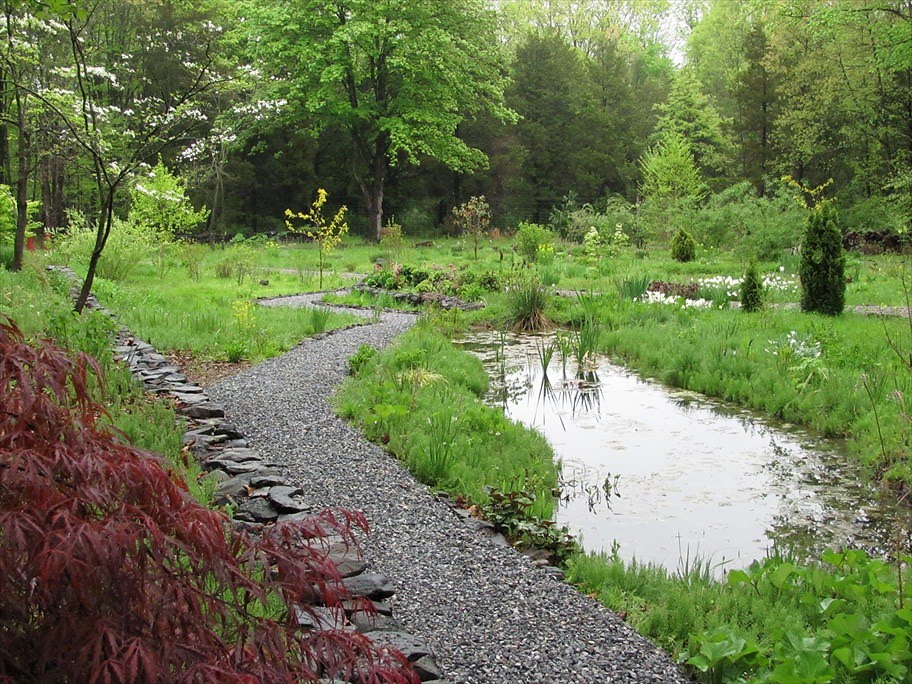
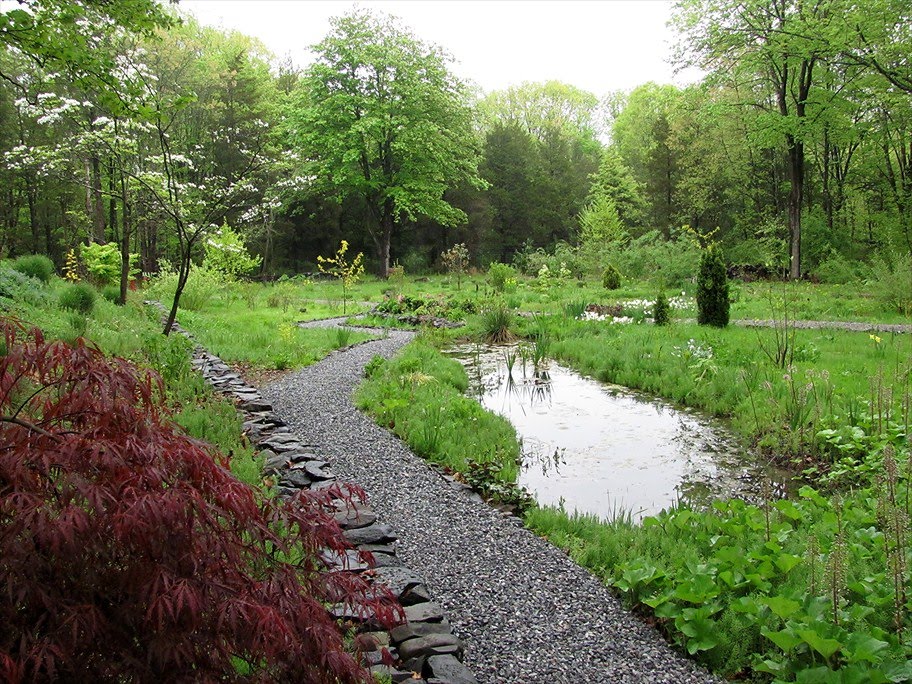
The graveling of the path by the little pond is almost complete. This is the base course, to be following by a layer of so-called "river washed" pea gravel.


The next view is foreshortened using a small lens aperture. The willows at the back (Salix koriyangi 'Rubikins') are flayling in the wind. Three more to their left will soon obscure the view of the deer exclusion fence.


Below, on the right, the long, low curved stone wall has been given much greater visual prominence by the gravel path. This is now a major visual "armature" of the garden, creating a contrast between its rather severe, and serene, formality and the wildness of the central "prairie."


Here the direction of the stone path points directly toward the location of a second raised stone planting bed to be built further out in the garden; this will continue the "curving diagonal" begun with the pond and existing planter, across the garden toward the back left corner, where a new hornbeam hedge and sitting area will be. (I should credit Peter Holt for pushing me to do this.) This diagonal element also carries the eye toward the opening in the woodland wall (barely visible here) at the back, which is the major focal point of the landscape and the point to which all things "flow" visually. It's also the point to which all drainage flows and, as I've mentioned in other garden diary posts, the natural drainage pattern is what dictates the overall form of the garden.


Backing up to the woodland entry garden (below), which isn't yet properly planted, you can see how this area is a path of flow for storm water around the raised mound on which the house was built. I just transplanted five large Rodgersias to the top of the curved stone wall, next to the cut-leaf Japanese maple. The bank is now covered by Deschampsia 'X' seeded five years ago, but I hope to turn it into a shrubbery of hydrangeas, buckeye, and other plants with foliage that will be fun to observe close-up while walking along the path.

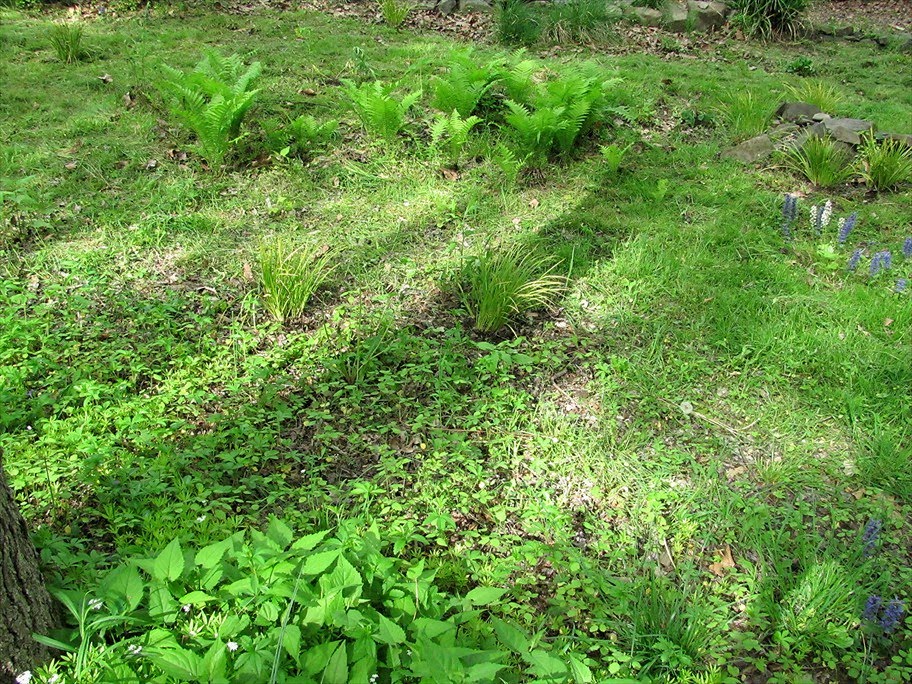
The lower area has been cut to allow newly planted Senecio aureus, Acorus gramineus 'Ogon', and existing colonies of Matteuccia struthiopteris, pulmonarias, sweet woodruff, and ajuga to get a head start.


Potential for more planting here. The Kriengeshoma palmata on the right has filled in since this photo was taken last weekend and the Chionanthus virginicus above it has leafed out and formed flower buds.


Aster divaricatus at the base of the tree (a couple of spreading colonies of this), newly planted Acorus 'Ogon', and Mattuecia struthiopteris.


Collision of Pulmonaria 'Samouri' with other ground covering plants. We'll see how much human intervention is needed here over the next few years. The pulmonaria does so well I expect I'll plant more next year.


And here Ajuga 'Caitlan's Giant' being invaded by sweet woodruff. It looks like the sweet woodruff has the upper hand. Who knows? As it gets hotter, the sweet woodruff takes it easy, and the ajuga gets larger, so this story hasn't ended yet. Time will tell.


Arisaema triphyllum ... it grows all over, popping up year after year, with new colonies appearing all the time. One of my native stalwarts, with highly decorative, bright red fruits in the fall.


Another native, Podophyllum peltatum, also in spreading colonies, but it's a slow spreader.


Back to the "Main Axis." Something for me to think about.


I'm reading Henk Gerritsen's Essay on Gardening, and I feel I've found a kindred spirit, though his knowledge of plants is formidable and far surpasses mine. In a sense, he's telling me the story of my garden, or his version of it. He's done it already.

Sunday, April 04, 2010

Garden Diary: The prairie garden in black & white

This is the garden in early spring, after all the herbaceous plants have been burned or cut down. I rendered several photographs in black and white to emphasize the underlying structure of this wet prairie garden, and to help decide what to do to add meaningful structure at such bare times of the year.


The photo above shows a  large network of intersecting lines that make the underlying structure of the garden:  three stone walls on the right and left, as well as one at the base of the bank from which the photo was taken, another major diagonal formed by the narrow pond and its visual extension in a long stone planter filled with 'cloud' box woods and Bergenia, a diagonal line of Arborvitae (Thuja occidentalis) along the path on the right, and an evolving 'screen' of deciduous woody shrubs at the back.


Above in close-up you can better see the screen of the shrubs. Three high-pruned Salix sachalinensis sekka (Japanese Fantail willows) appear to be small blooming trees on the right (they are not). The lack of color, even without fine resolution, clearly reveals the varied structures, shapes and textures of the shrubs. Further to the left, in the center of the photo, are two thin twigged willows (Salix koriyanagi 'Rubikins'), all verticals, with a structure that waves gracefully in the wind. Yesterday, I took long cuttings and planted them further to the left to create a screen of five evenly spaced willows. These will stand immediately in front of a line of five Arborvitae. My intention is to extend the screen with a hedge of European hornbeam (Carpinus betulus) starting a few feet beyond the Rubikins willows and continuing for ten or twelve feet. After a further space, there will be a smaller hedge perpendicular to the longer hedge.


In the photo above you can see how the hornbeam hedges will form a corner that will visually terminate the garden at the far side, creating an enclosed space that I want to enhance with a 'forest' of various hydrangeas.


Above, a view of the far 'corner' taken from a position slightly to the right reveals how the right angle of hornbeam hedges will extend the line of the distant stone wall, then turn to the right to join with the rows of shrubby greenery across the back side of the garden.


Another shift in point of view to the right, above, almost shows another focal point--one not visible in the photo: a circle of dark red painted logs. The red, unfortunately, shows as black in these photos. And below, the main path, newly paved in gravel, has become a prominent geometric feature, far more so than when covered in wood chips.


A color photo, taken in July of last summer, just to show the dramatic difference when the herbaceous vegetation is at its full.


And next two more photos ... one in black and white taken today, contrasting with a color photo from last summer, taken from approximately the same position. Here you can clearly make out the dark red circle of logs in the distance.


Here is a photo taken from the opposite end of the garden, just inside the enclosure that will be formed by the hornbeam hedges. You can clearly see on the left the slant of the land, which becomes rapidly steeper as you near the Lockatong Creek about 1200 feet below the house. The rough, stubble field will soon be invisible beneath the wet prairie of the summer of 2011.


Below the three Japanese Fantail willows clearly show their high pruning. They require rather frequent pruning down below, where new growth continues to emerge throughout the season.


A view toward the house from the far end of the garden shows the need for embellishment of the view, particularly the wooden fence leading up to the house (made necessary to prevent deer from entering the garden). Cutleaf sumac on the bank will provide some interest. I've already dug holes for two new groups of Japanese Fantail willows, which will add visual interest as well as a feeling of intimate enclosure to that garden entry point.


Note the circle of red logs on the right above, and in the center below. This metaphorical feature will be a focal point of the 'private' space that will be formed by the hornbeam hedges and the 'forest' of hydrangeas between this viewpoint and the path.

LinkWithin

Related Posts with Thumbnails