Pages

Showing posts with label Sculpture in the garden. Show all posts

Sunday, August 07, 2011

Garden Diary: Yellow to Mauve, with Sound

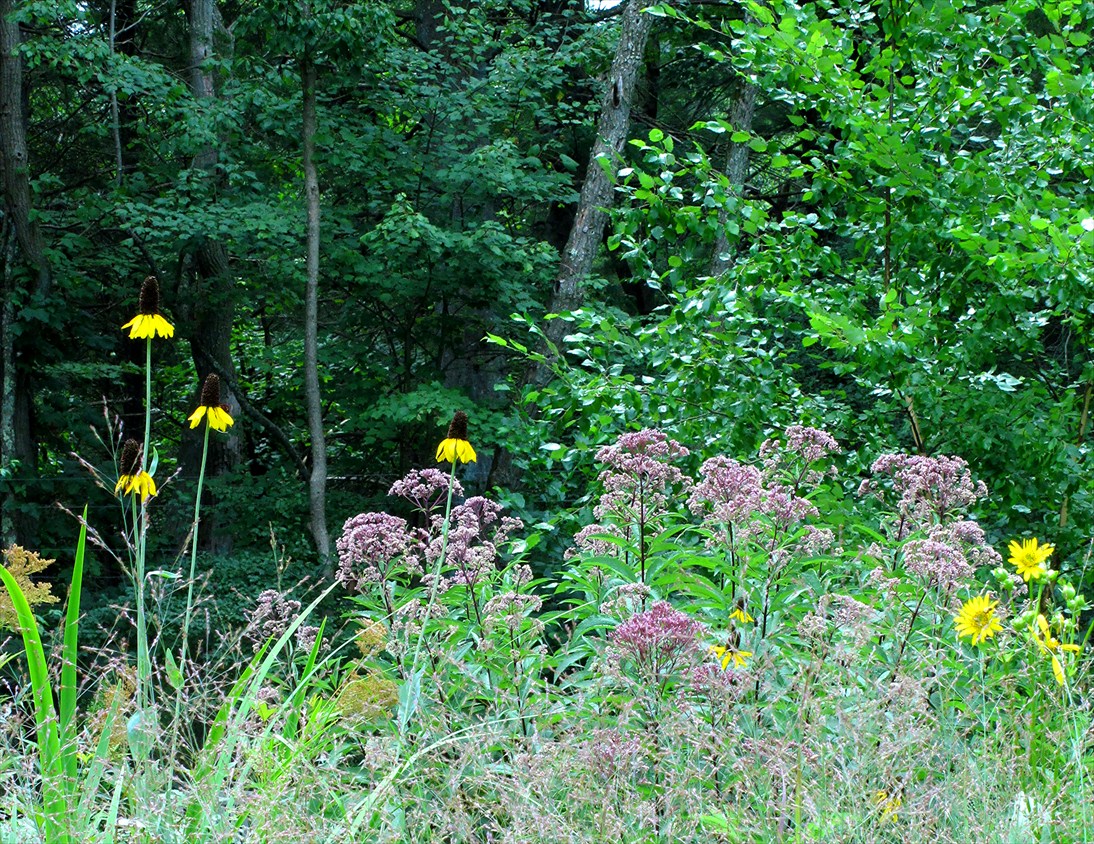
High summer and ample rain have given me a garden almost profligate. The large prairie plants have grown even taller than in past years and spread by self-seeding into new areas. The invertebrates, the insects, appear to be thriving, usually more apparent by the sounds they make than their visibility, with healthy populations in good balance. That I had no problem with Japanese Beetles this year, only a few, I attribute to a diverse invertebrate community in equilibrium.

Angelica gigas, a honeypot for insects from Heronswood

The tall yellows continue and now they've been joined by the mauves--broad masses of Joe Pye Weed (Eupatoriadelphus maculatus), intense and transient deep violet of Iron Weed (Vernonia), somewhere in between a few Prairie Blazing Star (Liatris pycnostachya), which survive only in propitious locations, not being as successfully competitive as some of their neighbors; even my only Angelica gigas, a dark, burnished, purple-almost-brown. As these colors fade through August, the grasses have just begun to put on their late summer fireworks.


I've linked a short video of the garden to this photo. Take a look (click on the photo above), and you'll see a panning shot across the garden from the raised position of the house. This gives a good overview, but it really misrepresents the garden, which looks entirely different when you walk down into it. Looking at the video, you'd have no idea a network of rather wide gravel paths, and other smaller paths, run through the plantings. You see much more of the intricate detail only by walking through, and the rest of this post will take you on that walk.


Here are several views of the main path across the garden showing the plantings beginning to overflow the edges, a desirable state of affairs to my thinking.


Vernonia, Eryngium yuccafolium, Aster tartaricus 'Jin Dai', Silphium terebinthinaceum, Rudbeckia maxima, Physostegia virginica, Panicum, Hemerocallis crowd the path edges.


This isn't planned color, and I make no excuses for it. My interest is line, mass, form, movement, visual tone in the sense of emotion more than color. Above, the tall Rudbeckia maxima on the left, fluffy aging flower heads of Queen of the Prairie (Filipendula rubra) below it contrasting with the sword-like leaves of the early spring Iris pseudocorus, then a bunch of Joe Pye Weed, which really is much more colorful than this photo shows, and Cup plant (Silphium perfoliatum) on the right, all softened by the gauzy screen of flowering Switch grass (Panicum virgatum 'Shenandoah').


Further down, form, texture, and the enormous variations of green make an entirely different effect, less impressionistic, more literal in a comic sort of way. Paddle-shaped leaves of Prairie Dock (Silphium terebinthinaceum) and giant coneflower (Rudbeckia maxima) make a busy show of themselves against a background of now silver Mountain Mint (Pycnantheum muticum) and Panicum 'Dallas Blues'.


I want masses of white Obedient Plant (Physostegia virginica 'Miss Manners', above) and have more growing on for planting after the weather cools. My goal is to treat the Pycnantheum and Physostegia as a groundcover, and spike it here and there with red to orange Daylilies (Hemerocallis). I suppose I'm more a creature of fashion than I'd like to think, and have unconsciously absorbed a liking for hot colors--though it's not just a matter of fashion; in my intensely green garden, the spots of brilliant color add a pleasing depth and complexity, passion smoldering in dark recesses.


You might think they would clash with the very different color scheme of the garden as a whole but, because their blossoms tend to occur in isolated spots, and are highly transient, they don't. Hemerocallis also seem to do well in a highly competitive garden environment, and the other plants hide their tattered, unattractive foliage after the blossoms pass.


On to the sound part of this post's title ...  All these plants attract hordes of insects, and their movements and sounds are entertaining and stimulating, sensuously and intellectually. At this time of year, these "incidental" insect performances happen against the constant roar of cicadas emanating from the wall of woods surrounding the garden. The sounds come in rhythmic waves, as the insects answer one another. And the night sounds, of course, choruses of frogs serenading. 


The audible landscape is like a separate world ... one I can't understand at all but perhaps understanding isn't necessary. You can just give yourself over to the sound, "rest" in it like a giant sonic cushion of vibrant air.


About eight feet off the main path Marc Rosenquist's sculpture, though not mauve or purple, certainly associates easily with those colors. These daylilies are the last to bloom of about fifteen planted throughout the middle of the garden. You see them from one angle and ...


... from another you don't. Again, a demonstration of the need to walk around to see the plants from various points of view.


The pathway across the middle of the garden. Another way to get up close to the plants. I'm adding yet another, less obvious path branching off from the left of this area to make it possible to get deep within the plantings.

 
A European grass, Molinia caerulea 'Skyracer', with tall, delicate flower stalks, crowds the entrance path, so close it touches you, but so light and airy you don't mind a little crowding (well, some do).


Last weekend we added this small new entry path on the opposite side near the house. We put it in by violent means, just digging across trying avoid established plants. I don't really like it; it's too neat and tidy. The edges need to be muddied and planted, and some larger plants will have to be moved next spring. Then, perhaps it will look a part of the garden.


This is the view up toward the house from the new small path ...


... and here a glance off to the side.


Tuesday, August 10, 2010

Marc Rosenquist: Getting it in


Once we decided on the sculpture by Marc Rosenquist, we had to figure out how to get it into a garden in full growth. Before knowing exactly where we wanted to position it, or how far it would have to be transported, Marc and Gail brought it over in their Range Rover. Little did they know what awaited--how to move a 300 to 400 pound bronze object several hundred feet along a curving gravel path, through plants, and into position in a fully grown garden. We had to improvise.

But first things first.

The Visit
We had visited Marc's and Gail's home a couple of weeks before to see his collection. We didn't know we were doing more than exploring, just looking and thinking. I particularly liked this bumpy ball.


I knew just where this one would go. It has a natural or a "found object" quality, and it evokes suggestions of mysterious origins--excavation of an archaeological artifact, a giant nugget of minerals, a mysterious object dug out of the ground, a weird boulder of argellite (our local stone), possibly a carefully shaped message from the past. And it has a certain playfulness about it.

Ironically, after talking to Mark and Gail, I discovered that Marc's father, an airline pilot, often took the family on archaeological digs, and this sculpture just happens to be a scaled up replica of a relatively common Pre-Columbian object, though no one knows its purpose, if it had one. So I suppose my intuition, at least in this case, was right.

Marc also has several elongated sculptures I believe he calls "trees." This one was resting against a large tree trunk when I first saw it. Here you see it leaning beside a white doorway, not a great background. But this one would be perfect as a vertical element, either mounted as an upright, or leaning against a tree on the edge of the garden, where it would be a surprise, visible only on close observation.


Here's the top, showing the texture and striations in the bronze.


And here is another of the "trees," just lying on the ground.


This was another favorite (for scale, think large, four or five feet long). Obviously, it needs a position in the open.


A close-up of the surface texture ...


Okay--this one too. Again I can find thematic connections with my garden's "story," and it would look very good over in a dark corner near the woodland edge, or as a feature in the woodland garden (to be) ... a giant, overscale object, five feet in diameter?


But we ultimately decided on this one. A strange object, humorous, evocative, threatening in a way. Attractive here in the open on Marc's and Gail's lawn, but in my garden it would always be partially hidden by plants. William Martin has suggested I need a bunch of these, in different sizes, scattered about the garden. I like that idea. Marc?


And this, perhaps on the terrace, in some kind of axial arrangement ...


Speaking of axial arrangement, look at the two together. That's a powerful combination, really defining the space in a way that pulls the whole landscape toward a focal point.


Marc's and Gail's garden is arranged along the banks of a small stream. Not minimal at all, quite profuse really, but treated as a minimal element in relation to the lawn and the house complex. So very different from Federal Twist, where the garden rushes up to the house in a wave of vegetable force ("vegetable" in the old sense:  "Had we but world enough, and time . . . /My vegetable love should grow/Vaster than empires and more slow." - Andrew Marvell, To His Coy Mistress.). And the point of this ramble? Just that sculpture can be used in different ways in different environments.


Marc, Gail, and Phil in our ramble around their lawn ...


Marc, pondering a question, just looking, perhaps wondering whether he really wants to lose a work that's been in his life for 20 years?


The terrace, very Italian, and they love Italy ... not really relevant to this post ... or is anything irrelevant?


The terrace is part of the story, after all ... where we talked, settled in, and made the deal ...


Getting it in Place
As I was saying at the start, we had to move this heavy object several hundred feet. Marc, also being a fine wood craftsman, had brought boards cut to the right length to roll it out of the Range Rover to the ground.

I believe it was Gail who thought to bring a rug and quilt. So as Marc rolled the piece along the gravel path, he made frequent stops so Gail could alternately move the rug or the quilt from the back to the front, then Marc would roll it a little further. About half way down to the garden, I joined in the rolling, thinking I would be of help, but not realizing Gail had the really hard job.

Finally we got it to the back side of the garden, eyeballed a path through some semi-sacrificial plants, and slowly, and very carefully, tumbled it end over end into place.


Photos at Federal Twist courtesy Gail Deery

Coda - Some of Marc's Other Work

Gail sent me a few pics of Marc's other work, mostly metal, some in wood ...


Grants/Awards

1992- Printmaking Fellowship Award, Rutgers Center for Innovative Print and Paper, Mason Gross School of the Arts, Rutgers University, New Brunswick, NJ
1990- National Endowment of the Arts, Sculpture Award,
1990- New Jersey State Council on the Arts, Visual Arts Grant, NJ
1990- Louise Cramer Award, Philadelphia Museum of Art, PA
1988- New Jersey State Council of the Arts, Visual Arts Grant, NJ
1982- New Jersey State Council on the Arts, Visual Arts Grant, NJ
1980- Ford Foundation Grant, New York, NY
1979- Ford Foundation Grant, New York, NY

Selected Exhibitions

2005- “Sculpture Selection,” Harrison Street Gallery, Frenchtown, NJ
2003- “New Jersey Prints,” Mason Gross School of the Arts, New Brunswick, NJ
2001- “Off the Wall,” Bristol-Myers Squibb Gallery, Princeton, NJ
1993- “Fellowship Recipients,” Mason Gross School of the Arts, Rutgers University, NJ
1992- “Sculpture,” Larry Becker Gallery, Philadelphia, PA
1991- “Marc Rosenquist,” solo exhibition, Larry Becker Gallery, Philadelphia, PA
1991- “New Jersey State Council on the Arts Fellowship Exhibition,” Bristol-Myers Squibb Gallery, Princeton, NJ
1991- “September Survey,” Larry Becker Gallery, Philadelphia, PA
1990- “Gallery Artists,” Larry Becker Gallery, Philadelphia, PA
1990- “Art Now, Contemporary Philadelphia Artists,” Philadelphia Museum of Art, Philadelphia, PA
1989- “Gallery Survey of Artists,” Larry Becker Gallery, Philadelphia, PA
1989- “Introducing,” Larry Becker Gallery, Philadelphia, PA
1987- “Six Sculptors,” 55 Mercer Gallery, New York, NY
1986- “Solo Exhibition, Marc Rosenquist,” Educational Testing Center, Princeton, NJ
1986- “Outdoor/Indoor,” Ramapo College, NJ
1985- “Recent,” New Jersey State Museum, Trenton, NJ
1984- “Iron Cast,” Pratt Institute Gallery, New York, NY
1984- “Public Art Trust,” Washington Square Park, Washington DC
1983- “Sculpture,” 14 Sculpture Gallery, New York, NY
1982- “S/300,” Philadelphia Art Alliance, Philadelphia, PA
1981- “Newark Museum Third Biennial,” Newark, NJ
1981- “Sculpture 1981,” Grace Gallery, New York, NY

Collections

New Jersey State Council on the Arts
Newark Public Library
Jersey City Museum
Newark Museum
Dietrick Collection
The Jane Voorhees Zimmerli Art Museum
New Jersey State Museum
Rutgers University
Dieu Donne Paper Inc.
The Montclair State Museum
Philadelphia Savings Fund Collection
Judith and David Brodsky Collection

LinkWithin

Related Posts with Thumbnails