Yesterday was the last day of spring.
This photo, taken shortly after the first day of spring, around the end of March, shows the garden after all the grasses had been burned, leaving a blank slate. Seeing this image from a time in late June, I rather like the minimalist, barren look.
 The next photo, taken on June 21, from a similar point of view, shows the change just twelve weeks can bring. One of the characteristics of a mostly grass and herbaceous perennial garden is the empty void of early spring. Another is the almost magical transformation the barren ground undergoes, giving forth a shape-shifting landscape as the plants emerge from the flat plain of earth, some towering to 14 feet by high summer.
 Moving out into the garden, some of the theme plants begin to emerge from the blur. Below Filipendula rubra 'Venusta' - certainly the most prominent plant in the garden at this time of the year - appears in a 40-foot drift across the middle of the garden. Glaucous mounds of Rudbeckia maxima foliage add a quirky touch. I think of them as vegetable hippos. This is another theme plant, but it won't make its most important contribution for a few more weeks, when its flower stalks will climb to six or seven feet, each with a single skyward facing yellow daisy.
 Moving further to the right, a Miscanthus giganteus is rapidly gaining height in the left background.
 Filipendula with Astilbe 'Purple Lance' and narrow, feathery wands of Liatris pyncnostachia in front of the Filipendula ...

Another point of view with the Filipendula, next to a planting of Calamagrostis 'Karl Foerster', just coming into bloom ...
 Moving to the middle of the garden, looking back toward the house, gives a sense of the scale of the planting. This point is probably about 250 feet from the house, obscured by a screen of London Planes and dogwoods. On the right is another theme plant, Joe Pye Weed, gaining height for its period of bloom in late July.
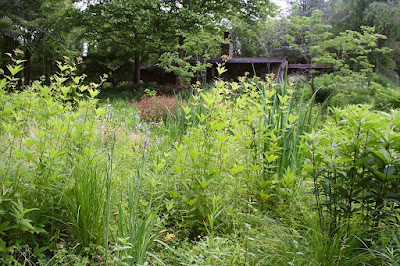 Turning clockwise, more Joe Pye Weed, Vernonia (planted from broadcast seed), and Miscanthus purpurescens in the foreground, and that single Miscanthus giganteus now on the far right.
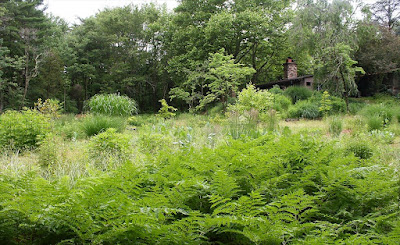
 A view from the far end of the garden, from behind a bank of bracken, looking back toward the house. This end of the garden has a low profile until later-developing plantings - Silphium terebinthinaceum, more Joe Pye, Rudbeckia maxima, Panicum 'Dallas Blues' and 'Cloud Nine' - gain height. Masses of Mountain Mint (Pycnanthemum muticum), with silvery foliage in late summer, and white Physostegia virginiana 'Miss Manners', invisible now, are dotted across a ground of pasture grasses, which have the grace to turn a light brown in summer, helping the garden to read as "meadow."
 Continuing toward the left, a planting of Miscanthus 'Silberfeder', a hybrid petasites, and more Mountain mint (Pycnanthemum muticum) ...
 And the same planting from the opposite side ...
 After a wet spring and three weeks of almost daily rain, the soil is totally saturated. That these plants can live in such a hostile environment, much less thrive, is amazing ... but also proof that matching plants to existing conditions makes a garden possible just about anywhere on this earth.
This photo, taken shortly after the first day of spring, around the end of March, shows the garden after all the grasses had been burned, leaving a blank slate. Seeing this image from a time in late June, I rather like the minimalist, barren look.
 The next photo, taken on June 21, from a similar point of view, shows the change just twelve weeks can bring. One of the characteristics of a mostly grass and herbaceous perennial garden is the empty void of early spring. Another is the almost magical transformation the barren ground undergoes, giving forth a shape-shifting landscape as the plants emerge from the flat plain of earth, some towering to 14 feet by high summer.
 Moving out into the garden, some of the theme plants begin to emerge from the blur. Below Filipendula rubra 'Venusta' - certainly the most prominent plant in the garden at this time of the year - appears in a 40-foot drift across the middle of the garden. Glaucous mounds of Rudbeckia maxima foliage add a quirky touch. I think of them as vegetable hippos. This is another theme plant, but it won't make its most important contribution for a few more weeks, when its flower stalks will climb to six or seven feet, each with a single skyward facing yellow daisy.
 Moving further to the right, a Miscanthus giganteus is rapidly gaining height in the left background.
 Filipendula with Astilbe 'Purple Lance' and narrow, feathery wands of Liatris pyncnostachia in front of the Filipendula ...
Another point of view with the Filipendula, next to a planting of Calamagrostis 'Karl Foerster', just coming into bloom ...
 Moving to the middle of the garden, looking back toward the house, gives a sense of the scale of the planting. This point is probably about 250 feet from the house, obscured by a screen of London Planes and dogwoods. On the right is another theme plant, Joe Pye Weed, gaining height for its period of bloom in late July.
 Turning clockwise, more Joe Pye Weed, Vernonia (planted from broadcast seed), and Miscanthus purpurescens in the foreground, and that single Miscanthus giganteus now on the far right.
 A view from the far end of the garden, from behind a bank of bracken, looking back toward the house. This end of the garden has a low profile until later-developing plantings - Silphium terebinthinaceum, more Joe Pye, Rudbeckia maxima, Panicum 'Dallas Blues' and 'Cloud Nine' - gain height. Masses of Mountain Mint (Pycnanthemum muticum), with silvery foliage in late summer, and white Physostegia virginiana 'Miss Manners', invisible now, are dotted across a ground of pasture grasses, which have the grace to turn a light brown in summer, helping the garden to read as "meadow."
 Continuing toward the left, a planting of Miscanthus 'Silberfeder', a hybrid petasites, and more Mountain mint (Pycnanthemum muticum) ...
 And the same planting from the opposite side ...
 After a wet spring and three weeks of almost daily rain, the soil is totally saturated. That these plants can live in such a hostile environment, much less thrive, is amazing ... but also proof that matching plants to existing conditions makes a garden possible just about anywhere on this earth.


