Pages

Showing posts with label iris versicolor. Show all posts

Monday, May 21, 2012

Bright sun, too bright

Too bright ... for good photos, that is ...

I just can't seem to get to the garden at the right time, so here it is in mid-day golden sunlight, which washes out all detail and most color differentiation. But you can see the flow.


The red Japanese cutleaf maple in the corner above forms a sequence with a large community of Lysimachia ciliata 'Firecracker' midway out, then another large swath of lysimachia on the far side (not visible here). It's occurred to me I can use the rhythm created by these red dots of color as "gravitational cores" around which I can develop extensive plantings of water irises (Sibirica, Virginica, Versicolor, Ensata) for more color early in the season.


They'll draw the eye to the less easily seen detail. I already have quite a few irises; you can just make out some in photos above and below. A broader distribution in small groupings and individually, with the lysimachia masses to draw attention to them, would be a pleasing addition at this time of year. Siberian irises will work particularly well because their saturated colors have much better definition against the complexity of plant forms, as you can see below. (These four plants have grown quite large and divided into thirds would easily make a dozen ... a good start on iris expansion.)


In contrast, the Iris virginica below looks washed out (the color is pretty to the eye, but disappears when photographed).


The lysimachia communities also serve as reference points, enabling a viewer to better judge relative distance and scale, particularly now when the garden is harder to read, with low, relatively uniform plant height.


Textures and forms can be easily differentiated only up close ... here, Carex muskingumensis with highly reflective leaves of Darmera peltata, and the flatter, matt surface of Petasites visible in the background.


You can just make out the third lysimachia community beyond the chairs.


A sunset shot, when the light is much better, taken with my phone camera. Sometimes fuzzy is good, even looking directly into the sun.


Sunday, June 13, 2010

Walk about

A mid-day walk about the garden ... on Friday, June 11, about 1:30 pm ... Much too bright for photos, but there you are ...


Black gamecock iris, a Louisiana iris ... I think ... bought at a local farmer's market last year.


What iris? You've got me. It grows by the pond, and I anticipate a large clump in a few years.


Pond edge ... Lysimachia nummularia, Equisetum arvense,a baby Jewelweed (Impatiens capensis, wild impatiens) ...


Bold foliage, needed to bring definition to the haze of grasses, the matrix of grasses, shapes emerging from the background noise, order from chaos ...


Salix alba 'Britzensis' (below, not the River birch on the right above), which needs to be coppiced to get those colorful canes for late winter and spring, but I've grown so fond of the exuberant explosion of growth I delay, and delay ...


Filipendula rubra 'Venusta', which has naturalized with great vigor, Calamagrostis acutiflora 'Karl Foerster', Vernonia fasciculata (Prarie ironweed) in the background, a clump of Chelone 'Hot Lips' ...


The 'late prairie' or a simulacrum thereof, with emerging Rudbeckia maxima, Silphium perfoliatum, Silphium terebinthinaceum (Prairie dock), Physostegia 'Miss Manners', Inula racemosa, Panicum 'Dallas Blues', Panicum 'Cloud Nine', Calamagrostis a. KF, Pycnantheum muticum, and on and on ...


Foliage of Silphium terebinthinaceum ...


Eryngium yuccafolium (Rattlesnake master), soon to be underplanted with Sesleria autumnalis and Bergenia 'Bressingham Ruby'--will that work? If not, I'll replace the bergenia.


An evolving 'meadow' area ...


Looking back toward the house (yes, it's there).


Inula racemosa, which is seeding around, just as I want, next to Miscanthus 'Silberfeder.'


Bracken and the bank of M. 'Silberfeder'. I know bracken is supposed to be a bad invasive, but this colony has stayed in place for five years. It does grow into the path, but that's easily pulled out. The fall color is miraculous.


As the garden reaches a new stage of maturity, with small trees and shrubs now taking a more prominent place, and as I incorporate more shaded forest edge into the garden, it's developing a more complex character, and becoming a place to find a variety of different environments, with different emotional landscapes. Here, as we near the darker west side of the garden, trees cast heavy shadow at mid-day, lighting the foreground planting of Miscanthus s. 'Silberfeder', Petasites 'x Dutch', Pycnantheum muticum, and Lysimachia ciliata 'Firecracker' like a beacon.


The massed foliage shapes and textures are what make this planting. Later in the season, the Pycnantheum turns gray and white, creating an even more dramatic contrast of color.


The space below is where I intend to put a new raised stone planting area, a long and curvy one, to continue the line of the pond and existing raised stone planter nearer the house. In winter, this will appear as a broken diagonal snaking across the garden plain, almost a geologic feature. I've cleared the area of most large plants in anticipation of construction later in the summer.


Entering the woodland edge on the west side of the garden, one feels a cool respite from the sun drenched open garden.


Looking back across to the far side where the circle of red walnut logs signals its message - a metaphor of the life of the aboriginal people who once lived and hunted these hills. Next year I want to add Miscanthus giganteus behind to create a wall of complementary green and to screen the deer fencing (practical matters never go away).


A screen of Filipendula, approaching bloom...


And Silphium laciniatum (Compass plant), Silphium perfoliatum, Rudbeckia maxima, Vernonia ...


Ligularia japonica growing up through the gravel of the path, an exotic for sure, but appropriate to its place ...


Looking into the woodland garden (in progress) at the side of the house ...


And back toward the Ligularia japonica ...


Now looking across the width of the garden toward the tall cedars, and the circle of red logs ...


Friday, June 05, 2009

Garden Diary: What the rain can do

We're had so much rain this spring - gentle, consistent rain over two or three days at a time - that I'm thinking this must be what an English spring is like. The perennials are larger than usual for this time of year. My garden - a wet prairie - develops slowly, starting as almost a blank slate, progressing through a green rubble phase, then gradually developing distinguishable shapes and colors as the large perennials add height. All the rain has accelerated this process. I'm hoping there won't be a down side to this: floppy plants that will get too tall too fast, then fall over. I don't like staking.

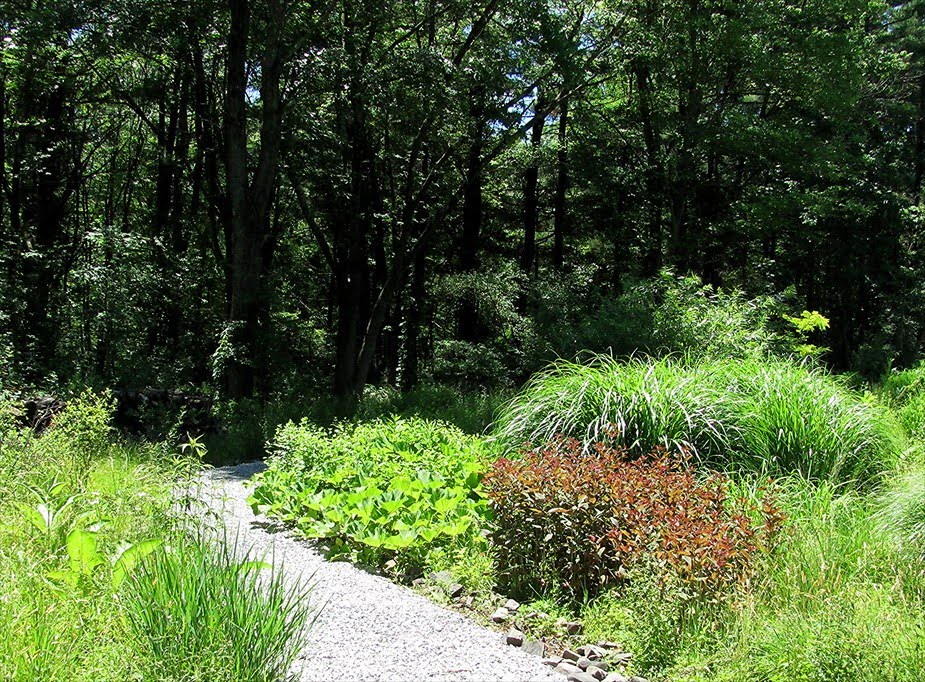
The quality of light that comes with this weather is just about perfect for garden viewing. On these cloudy days, some plants literally glow against the dark background of the woods. Filipendula rubra 'Venusta' is especially beautiful with its jagged leaves like shards of bright green that catch what little light there is, working some internal refractory magic, and transmitting it to the eye as a strange chartreuse ... almost radioactive, with the glow of Vaseline glass, given an unearthly radiance by addition of uranium oxide. You can see the Filipendula above and below with Iris versicolor.

The garden's a study in green possibilities this year. Here the big floppy glaucous leaves of Rudbeckia maxima in the foreground contrast (clash?) with the Filipendula. In a few years, the row of Thuya occidentalis behind will make a dark screen to hold the exuberance of the garden planting.


Iris pseudacoris and Lysimachia ciliata 'Firecracker' below... This image was taken in light rain; note the blue reflecting off the upper surfaces of the Lysimachia foliage. Nestled beside it is a Sanguisorba canadensis, which will take over in late summer when the Lysimachia tends to collapse.

Last year a few Coreopsis grandiflora appeared on a small elevated area the original owners used as a vegetable garden. I leave this uncut to develop as a meadow, cutting it only after the wildflowers have gone to seed. It's working; there are many more Coreopsis this year, and probably other self-seeded rovers to come.

In these two views across from the back of the wet prairie you can just make out the Coreopsis in the far left corner. The large tussock-shaped grasses - mostly Miscanthus - are beginning to add more visual interest and color to the scene. The verticals of Silphium terebinthinaceum and Inula racemosa 'Sonnerspeer' will be visible over the next two months, as will tall Panicum 'Cloud Nine' and 'Dallas Blues'.


Stepping a little further back, a planting of Miscanthus 'Silberfeder', a hybrid Petasites, and Pycnantemum muticum (not yet visible) comes into view. I 'stole' this combination from a photo of an Oehme and Van Sweden design I saw in a book, and I'm very pleased with it so I give them credit. Here, again in the Petasites, is that screaming green of the Filipendula.

Moving around to the opposite end of the garden, the Thuya hedge to be, like the stroke of a pen, contains the wildness. The center area is filled with Filipendula, though the resolution of the photo doesn't clearly show that. Click on the photo to enlarge and you can see it.

In the next view, you can just make out a circle of six red logs (from a fallen walnut tree). This is intended to be a reference, a memorial if you will, in memory of the Lenni Lenape, the native Americans who inhabited this area over the past several thousand years. You can see it better if you enlarge the photo. I wanted this feature to be subtle enough to fade into the background, but I also want it to be visible enough to lead a visitor to ask, "What is this." I have some anecdotal evidence most visitors get the point. The red color also makes a practical focal point.


Next a photo of Angelica archangelica (bought as Angelica gigas; beware labels), which I hope will seed and make a colony. You can also make it out in the photo above.


One final note ... I took these photos in the rain yesterday. Today it's still cloudy but the rain has stopped, and the colors are not nearly as brilliant as yesterday. I've always known gardens look good in the rain. What I didn't realize is that the rain actually changes the quality of light and color

LinkWithin

Related Posts with Thumbnails