Pages

Showing posts with label meaning in the garden. Show all posts

Saturday, June 23, 2012

Not Nature, an Entertainment

The Federal Twist garden is a man-made glade in the woods - we cut down many trees to make it - hemmed in on all sides by tall trees. It looks appropriate to the place, as a glade looks appropriate in a forest. With much rain and sun this season, the plants have grown rapidly. Now that we've passed the first day of summer, the eye can wander across mutable, seemingly endless patterns, an artificial landscape of daily changing topography as mounding plants mound higher and the tall, spiky ones grow into towers. This is pleasurable, an entertainment.

Though I call the garden naturalistic in style, it is not nature. It's an entirely artificial creation, a metaphor (or metaphors). Hard to see that, I admit, because the materials that make up this artifice are living plants.

It's a quiet theater of a sort. Looking out from the raised position of the house, the garden plants are on display, light pouring in from the sky above, plants much like actors playing their garden roles, rising and falling, living and dying, catching words of light and throwing them into your eyes, words like tones, like music, more than language.

High view over garden
The garden exists by visual differentiation from the surrounding woods, and that difference arises from several causes, some so obvious they hardly bear mention ...

Petasites, Darmera, Carex muskingumensis around the pond create their own topography
 ... open space, plants unlike those in the forest, intentional juxtaposition of contrasting shapes and structures, sweeps of massed plants forming fields of texture, washes of color, creating a new topography of continual change, and plants growing in clumps and individually, creating patterns, a contrived order that doesn't exist in the forest.


I walk about the house, catching a glimpse here, there. I'm grateful to be able to live in this place for a while (nothing's forever I know). The Filipendula ulmaria, in a 30 foot clump near the pond, have been white-topped for three weeks now. When backlit by morning sun, the Filipendula rubra, an even larger mass, become translucent like some miraculous wrought jewelery, turning feathery pink at top, above a setting of angular, upward pointed leaves resembling chartreuse shards of glass.

Filipendula ulmaria massed by the pond

Filipendula rubra with its angular, translucent foliage and pink flowers just coming into bloom

It's been frustrating to find a way to photograph the fine detail, textures, color variations that make the garden. I can see it, but it's impossible to photograph. Thursday, as sunset faded into twilight, I used a tripod and small aperture lens setting on a quick walk around. The increased depth of field and longer exposure better captures the real view, though any photographer will tell you it's never the same.

Details, details ... glaucous, big-leaved Rudbeckia maxima, like awkward characters on a stage ...


The red circle of walnut logs in the meadow area have their own role to play ...

Waves of flowering in the meadow, with a predetermined end - to be cut at end of summer after seeding ...


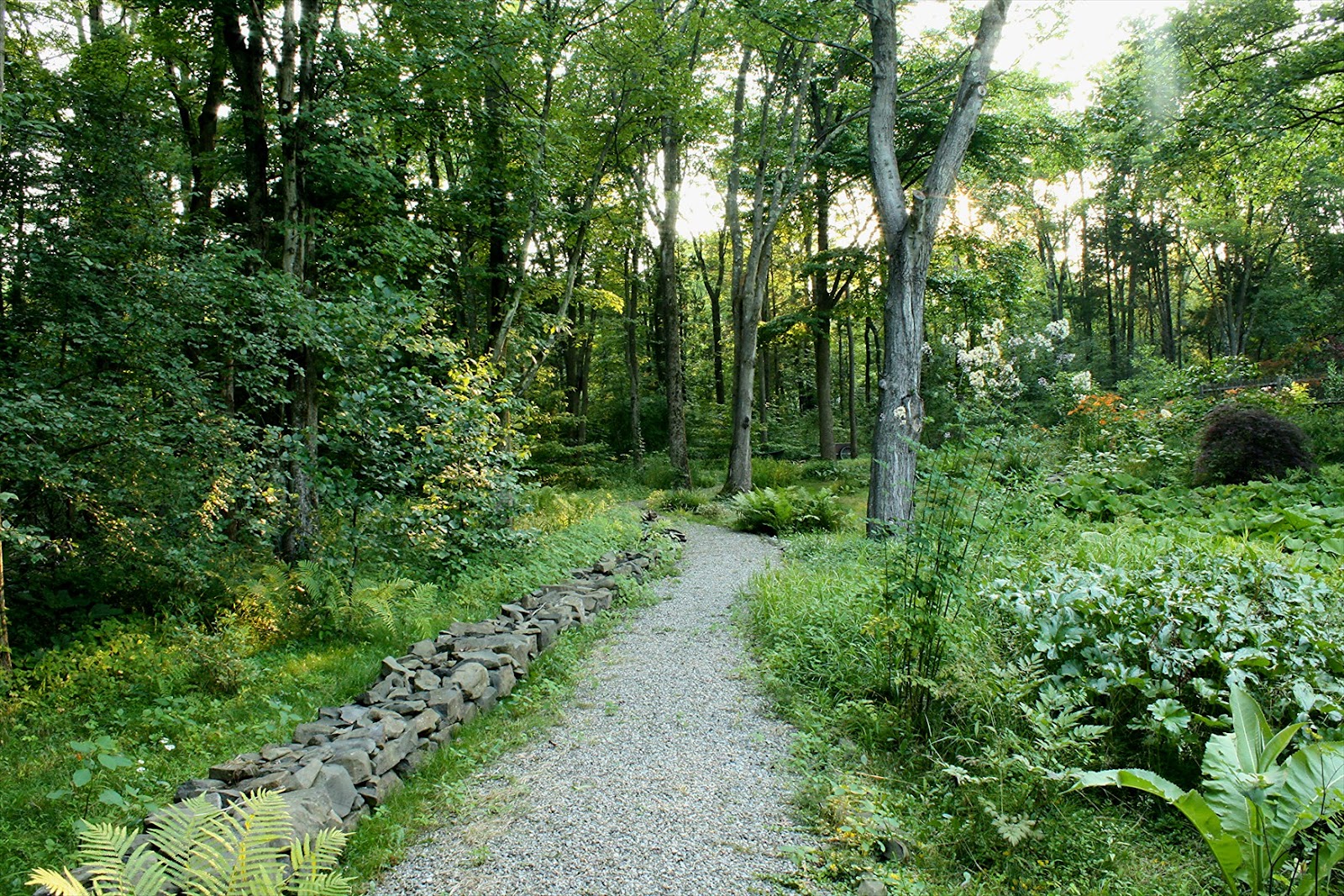
Entry to the woodland garden

A glance back across the open glade ...

Friday, May 25, 2012

Rain, rain

Endless rain, seemingly, has everything shooting up at amazing speed, including weeds. Local grasses are in flower, creating a kind of foggy haze over the garden. Once these early grasses turn brown, they'll give it the look of a meadow, and the rapidly emerging perennials will stand out against the tawny background.

Something to look forward to because, frankly, I'm bored by all this.

In the first few years, I thought technique alone--experimenting with a garden in a most inhospitable place, going about it without any soil improvement, relying only on "right plant, right place," and editing out the failures--would be enough, but it isn't. I need more from the garden. The "idea" of sustainability is poor sustenance.


I've been thinking a lot about the importance of emotions in gardens (seeing gardens, making gardens, designing gardens) so it's disquieting to have sunk into this funk. I think the problem may be this:  I need people in my garden, need a conversation, stimulation, insight. In a pinch, a tranquil sunset will do.

But for now, a photo tour, also boring because photos fall far short of the reality of being in the garden.

So ... to list the plants, across the pond, Darmera peltata, Petasites x hybridus, Japanese irises, Carex muskingumensis. The large foliage plants are a prime source of interest (at times, even pleasure) in this early season.


Darmera with Ligularia japonica ...


Across the way, a Cercesis canadensis 'Hearts of Gold' planted last year and in the distance, poison Hemlock (Conium maculatum) in flower. It will quickly die and turn an unpleasant brown. Unlink most of the large plants, this one does not retain structural interest, so I'll cut it as soon as seed has matured. There's plenty coming up below it.


Thank goodness for Marc Rosenquist's sculpture. It adds another level of complexity (dare I say meaning?) to the garden. It asks questions, makes me think, suggests metaphors, sparks fantasies of swirling motion (a wheel, a galaxy, the Axle Tree?), raises issues of taste, of aesthetic appropriateness. It reaches outside the garden.


View from the back, looking toward the woodland garden. One of many Filipendula rubra 'Venusta' is just to the right of Marc's sculpture, which has become a place, a reference point. I could even say it links the garden to the rest of the world, to ideas of art, history, culture, the universe.


Bracken, one of my favorite plants, is a legacy plant. It may have been here a century or more. Who could know? It was here before my garden certainly. People give it a bad rap because it tends to spread at the edges. Not nearly as invasive as many other plants, and it moves slowly.


This isn't a pretty picture but you can see the developing L-shaped Hornbeam hedge and the bench it's intended to surround. Someday it will define an end to this corner of the garden, and hide the deer exclusion fence behind.

That hedge, should it ever come to pass, may also become an artifact, like Marc's bronze, that adds to a conceptual appreciation of the garden. I want it to work at multiple levels. In the present, as a visual demarcation of one corner of the garden (with the unavoidable question of what lies beyond), as a spatial device to give an emotional sense of safety and enclosure, and practically, as a screen to hide the deer fence. To anyone with a little knowledge of gardening history, it will also refer to a centuries old garden culture, to the entire history of British gardening, beyond that to Renaissance Italy and even ancient Rome, creating a conversation between those traditions and my naturalistic garden. (On further thought, that's a heavy burden to put on a hedge, but I suppose it can serve as a reminder of the more formal elements of Western gardening tradition.)


Below, the serpentine wall seen from the area of the bench. I need to work on this. The Petasites japonicus is growing over a well drained wastewater leaching field and isn't entirely happy here. The stone wall, as a reflection of the Hornbeam hedge, might itself suggest a more appropriate planting, but one I'm not yet aware of.


A 180 degree turn gives a view across the garden. Siberian irises here will be divided and spread across the field. The ordered row of Thuja occidentalis across the garden has to be seen in the context of the Hornbeam hedge and the stone walls throughout the garden.


I don't mean that there is any specific meaning intended here. But I do enjoy evoking aesthetic and cultural references, and seeing my garden as an embodiment of the historical concept of "garden," of finding a place in garden culture, so that Rome and Rousham hover in the background and are present with me. I can't control what it might be for others.


And then, the garden is simply a place to sit, perhaps alone ...


... or in conversation.


The planting below speaks to the emotional power of images. Years ago I saw a photo of an Oehme van Sweden-designed planting with Miscanthus 'Silberfeder' in the background and mixed Pycnanthemum muticum and Petasites massed at its feet. Though I'm not yet able to define the emotional appeal of that planting, even many years later, I felt it was appropriate for this spot, not least because the environmental conditions were suitable, but also because I loved the shapes of the plants and their effect in combination. It's most effective later in the season, when the Pycnanthemum turns white and the Miscanthus is in bloom.


Perhaps the key to the interest of this planting is its playfulness, with the dramatic contrast of the large, funnel-shaped leaves against the very small ones. But it's also more than playful. It recalls some of the more frightening children's fairy tales. The growth is so vigorous, it's almost threatening. At the least, stimulating in an aggressive way.


Though the bracken is very different, it has much the same aggressive in-your-face effect ...


... like a wave about to wash over you.


The circle of red logs ... merely decorative? Gardens don't speak in sentences, so you have only emotional affect to go on. And of course a long tradition of associations with circles, and with the color red.


A strange planting, some intentional, some not ...


... dominated at the moment by Poison hemlock ... is this for some witch's brew? Is this a Maurice Sendak garden? Perhaps there's something to that connection, a certain outsized, exaggerated quality. More so later in the season when many plants grow much larger than people. Then I've noted some visitors prefer to stay near the house, safely removed, up on the little hill.


Straight lines and curves ...


... forms emerging from the chaos of early summer grasses ...


... box and Bergenia, footed by a sedum found in the wettest part of the garden ...


... and irises.


Wednesday, October 05, 2011

As the rains ...

Balder's Traume by Anselm Kiefer
As the rains continue, and I look out on the garden, I have mixed feelings. It looked so much better in July and August. Though autumn is normally its peak season, the recent tropical storms and waves of heavy rain continuing day after day, with almost no breaks for plants to dry and spring back, have changed it into a wet, soggy mass pierced by the leaning towers of tall perennials. But, as I said, my feelings are mixed, some negative, some positive. This is the process of living and dying, to be repeated again in another year.

So much depends on the weather, the light, the wind. The garden has yet to show what it will be this autumn in its visual aspect, tossed about as it has been these last weeks, but the meaning of what I see now is clear:  while the visual experience of the garden may be diminished, garden as symbol remains a potent source of meaning.


In a blog comment Anne Wareham recently questioned how we can develop the skills "to know exactly when naturalistic tips into too messy." As I watch the effects of the weather, Anne's follow-on remark--"This boundary may change as our 'eye' changes as well as when the light and weather change..."--is certainly accurate, as far as it goes. The line between ripe and rotten is a changeable one, depending on what you might want from your garden.

Of course a garden first should be appealing to the senses, should give pleasure. But it can offer other things, perhaps something more than prettiness? When messiness comes, that doesn't mean the end of the garden year I think. The images of disarray contain useful information, lessons to be learned.


So where is the dividing line between naturalistic garden--"wild" garden--and too much disorder? That line is wiggly and it moves all over the place. The constancy of change is just about all one can be certain of.

I'd like to adopt a term William Martin used to describe my garden to get to the point I want to make. When he referred to the "flowing 'emergentness' of the whole," he opened my eyes to something I hadn't been able to put into words. Awkward as the phrase is, that flowing emergentness is what this garden is about, and it can only be perceived over time, through the seasons. It can't be seen in one photograph, or in one visit. So I guess I'm one of the few who can experience it. And my blog readers, of course, if they look at my incessant reports on my own garden!

I drive a lot, and I always pay close attention to the vegetation along the roadside. I'm excited when I see pattern emerging naturally, pattern that I'm sure reflects some underlying organizing principle--seed distribution, wind, aspect, soil type, moisture level ... and though I do decide where most plants go in the garden, I'm looking for that kind of "found" order, an order in precarious balance with disorder.

So the garden now, after a long time of bad weather, tends toward disorder, and, with the constant moisture, toward disintegration and decay. The level of disorder is certainly greater now than at this time last year. Yes, it's messy ... entropy in action.

Messiness is like noise. Or perhaps a better comparison is with my tinnitus. I have a ringing in the ears. At times, it's in the forefront of my consciousness and can be maddening, but most of the time I'm unaware of it. Likewise the experience of the garden depends on focus and awareness. I can walk out of the house and, looking across the garden, even in rain, experience visual pleasure or a kind of depression. After the rain, I can walk thorough it and see "vignettes" of order and disorder. If I keep the long-term perspective of the year in mind, I can see this as just a stage in an annual cycle of growth, decline, decay and dissolution, the "messiness" of death, then regrowth. All is order in the large scale. All of this is appropriate to this place in the woods of western New Jersey.

I yearn for extremes. In fall, I want to see the late winter garden, flat and empty after I've burned and cut what's left. I suppose that's my final answer to the decline from romantic decay into messiness. Take what lessons, what messages, are offered, then wipe it away and let it start again.


Knowledge of the plants and their ecology also plays an important role in appreciation of a naturalistic garden, and in differentiating between the effulgence of growth and messiness of disintegration. While growing plants in appropriate conditions (right plant, right place) does not necessarily make an attractive garden (some "native plant" gardens are indeed unattractive exercises in ecological correctness), seeing plants growing in appropriate conditions is educational and provides useful information. Moreover, awareness of the processes and patterns of plant growth in communities, and the changes in communities caused by competition, distribution of resources (soil, moisture, light vs. shade, exposure), and weather contribute to an understanding of the process of the garden over many years. You can see the past and the future when looking at the garden. Photographs can be a bad thing if they capture only some passing fantasy of a garden, a phantom that doesn't really exist. (Too many pretty flower pictures, scenes shot from just the right angle.)

How to appreciate such a garden? To someone not familiar with the plants I know it's simply a mass of undifferentiated, undulating green, but to anyone with knowledge of prairie perennials and grasses there is plenty of interest. So detailed plant knowledge is certainly one skill needed to appreciate such a garden.

Knowledge of plants also helps one see the garden in four dimensions, so to speak, because it forces you to be aware of time, and changes over time. Messiness and decay, punctuated by strongly structural plants, can maintain visual interest and "extend the season" of the garden, even on occasion carrying it from the merely visual to the intellectual, even the emotional, as with the Japanese concept of Wabi Sabi.

Which brings us finally to the matter of personal disposition and perception. What do you, or I, choose to see at the moment? What filters are we viewing the garden (or the world) through? This brings us close to the difficult concepts of psychology and aesthetics. In this case, it's probably wise to limit the inquiry to what is "appealing to the senses" in some way. Take this painting by Anselm Kiefer as a starting point.


This is certainly appealing to the senses, though in a rather horrific way. It powerfully draws you in, makes you ask questions. Can a garden work in this range of emotions? I think it can, and most likely when it's in a state of disintegration. And a "conceptual" garden with a message certainly can.

Here are two garden photographs from a couple of years back, full of decay and signs of dissolution, even with some of the same colors and something of the mood of the Kiefer painting, but with autumnal coloring and spot lighting that create an entirely different emotional response. Unlike the Kiefer painting, they do not evoke a barren, destroyed landscape, though they do seem to be moving in that direction.


The garden photos have that "beatific" sunlight slanting through the trees, as if something godly might be lurking off to the side. Is some kind of physical beauty ... haze, slanting rays of sunlight ... necessary to meaningful engagement with the garden (not speaking of the "acts" of gardening here)? It's certainly good for a start, to draw you in, but I don't think always necessary.

Depending on what you bring to it, the garden can set off ruminations on many things, including reminders of banishment from the Garden of Eden, apocalyptic images of destruction, or simply the natural cycle of life (perhaps they're the same?). What do I want to see today? What can I see today?

It may be no surprise if I tell you my first "garden" was a cemetery, a beautiful ground blessed by huge Southern Magnolias, full of mysteries from the past, hints of unknown stories, ancient (to me as a young boy) monuments of lichened stone, some thrilling and beautiful, some with mysterious messages in Latin and Hebrew, row upon row of markers for the Confederate dead. It was my safe place, my refuge from a frightening world. Strangely, I always associated that cemetery with life, never with death.

LinkWithin

Related Posts with Thumbnails