Walking through the garden, seeing it in three (four) dimensions, is very different from looking at the photos in this post. The moving plains of plantings, changing perspective, perceived changes in relative sizes make a visit to the garden much more rewarding than two-dimensional photos frozen in time. I invite anyone in the area, or just passing through, to contact me. I welcome your visits and your suggestions.

Twilight is best time in the garden now. Several hours either side of midday the direct sunlight, heat, and severe contrast between dark, shadowed woods and the bright open garden make walking less than pleasant and photography almost impossible.

The tall yellow tipped verticals -- Silphiums and Rudbeckias -- are mostly in bloom now, and that bright color shows best in the fading light of evening.


Filipendula rubra 'Venusta' (above) is fading from Pepto-Bismol pink to a much more pleasant copper ...

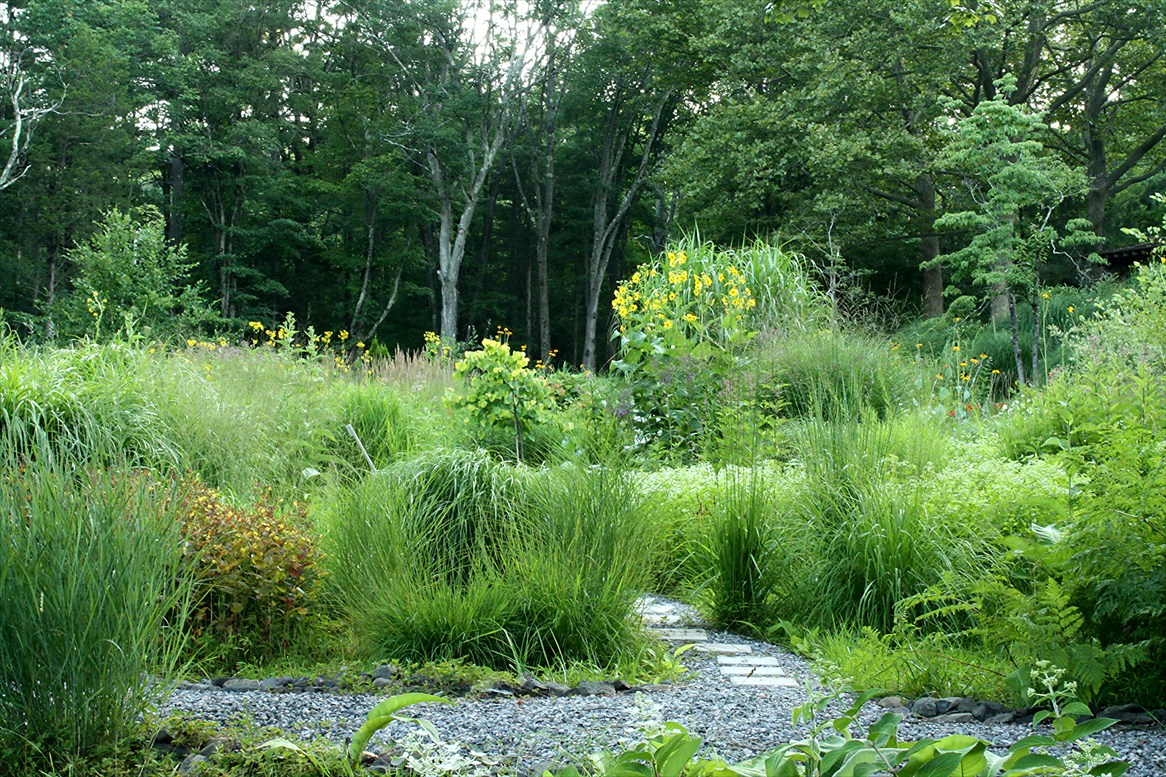
... and along the path the orange daylillies are in bloom. Even in midday, but particularly at sundown, that orange punches through the masses of green and carries the eye to the small, delicate, star-like flowers of the Silphiums (perfoliatum, terebinthinaceum, lacinatum) and Rudbeckia maxima. (Yes, I will have to do something about the color clash with the Astilbe taquetii 'Purple Lance' low down on the right).
The daylilies are particularly suitable to naturalizing in grasses, and I intend to add more on both sides of the path, starting right now. Eight more are going in today. I'm also transplating more of the wild daylilly (Hemerocallis fulva) into the garden (there are plenty on the road in front of the house). I don't particularly care for daylilies as plants. Apart from their bright flowers, their tattered foliage can be a real negative in the garden. By treating them purely as a design element, and planting them where their declining foliage isn't very noticeable, they can be quite useful. I don't try to remember their names. As long as they are orange to red, I don't care.

A mass of red-purple daylilies adds some midsummer interest to the area around Marc Rosenquist's sculpture. More are there, but the camera's not seeing them. These have been around for a couple of years now. I admit they'd be more effective if they were taller, but I'm willing to live with this kind of compromise in the garden.

White too becomes very evocative at twilight and Obedient plant (Physostegia virginiana 'Miss Manners') makes the start of a low-level field of brightness that, if planted in profusion, could really light up the dry end of the garden as darkness falls. I've tried to get more but it's hard to find around here. Last time I ordered white, I got pink!


Prairie dock (Silphium terebinthinaceum -- how do you pronounce that?) with its hard round buds (above left), Rudbeckia maxima with exaggerated black eyed Susan flowers, more terebinthinaceum, then Cup plant (Silphium perfoliatum), the large plant blooming behind the Miscanthus.
Sorry there's not much to give a sense of scale. Most of these tall yellows are several feet above my head. (The grey back of the "Wave Hill" chair above does give some visual clue of the comparative scale of a human body.) The garden is about one acre in size.

This shot gives a better idea of how the orange daylilies could become an effective component of the "prairie" planting (I realize Hemerocallis has never been considered a prairie plant) ... call it modified prairie, then.

Eryngium yuccafolium, form emerging from incipient chaos ...

Entrance to the central sitting area, a mass of Mountain mint (Pycnantheum muticum) center right ...

... and a new Redbud (Cercis canadensis 'Hearts of Gold') in the center, a recent replacement for a moribund Magnolia grandiflora 'Little Gem', which continued to put out elaborate lemony scented flowers, but just looked a wreck. Yes, that's a bunch of Inula racemosa 'Sonnerspeer' that's seeded in beneath it. I'll decide which ones stay next spring.

Above, more self-seeded Inula 'Sonnenspeer' stand sentinel over a planting of Pycnantheum muticum.


View from the other end ...


Rising from a planting of Veronicastrum virginicum is one lone, and persnickety, Compass plant (Silphium laciniatum). I think the garden just doesn't get enough light to make these happy. They always fall over and have to be rescued with long stakes. I hate staking. But since they're self-seeding now, I'll wait and see how the seeded ones develop. If they find the right place, and perhaps are shorter, they may become a useful part of the garden. But if they pass away, so be it. These are too much trouble.


A view across the garden showing Marc's sculpture from the "back" side (back, in this case, means looking generally in the direction of the house).

Speaking of which ... the house, an integral part of this garden. The mostly dead dogwood on the left was cut and removed today.

That's how things go at the garden on Federal Twist Road this July 17th. Have to go. Some neighbors are coming over to see the garden at twilight.


