Pages

Showing posts with label Rosemont. Show all posts

Monday, March 15, 2010

Eranthis hyemalis

A bank of Winter Aconite (Eranthis hyemalis) has remained a fixture of early spring since we've lived in the area of Rosemont, New Jersey. Just across from Green Sergeants Covered Bridge, the last remaining public covered bridge in New Jersey, thousands of Winter Aconites bloom under the foundation mount of an 18th century stone house. Who knows how long these tubers have been multiplying on this bank? An interesting bit of botanical archaeology awaits someone with the knowledge to find out.


Saturday, May 09, 2009

Ancient Redbud in Rosemont


Rosemont is a small hamlet in western New Jersey. The Rosemont Burial Ground, which dates back to the 18th century, is nestled among low hills in a small valley descending to the Delaware. The grave of William Bray, who collected the boats for George Washington's crossing of the Delaware on Christmas eve, 1776, is the most notable grave site.


Each spring, a venerable Redbud (Cercis canadensis) bursts into profuse bloom near the back of the burial ground. This is the largest, and oldest, Redbud I've ever seen. The trunk is short - the tree probably owes its longevity to its low profile - but about 30 inches in diameter. This must be a notable tree of its type, deserving of preservation efforts.

Sunday, January 07, 2007

Time, mystery and the gardener


The passage of time transforms a garden. We all know that. Plants grow larger, change shape. Spatial relationships change. Light usually diminishes as plants mature. Colors change with the seasons. While these changes can be observed with all plants, they are perhaps most visible with herbaceous perennials, which display all their changes in a single season, emerging from the earth in spring, maturing, flowering, then dying in fall.

But more subtle alterations occur in the appearance of plantings during the growing season. The crystal clear light of spring and early summer morphs into a moving spotlight of sun by high summer, bleaching colors at mid-day, lessening contrasts of shape and form, generally blurring differences in the character of plants.

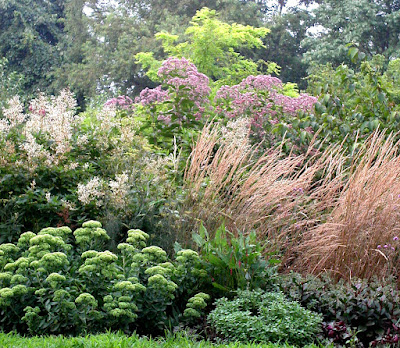
Weather conditions too make for quite dramatic changes in appearance. The photo above was made in my Rosemont garden on a hot, very humid, windy day in late July 2003. You can see drama in the wind buffeting the Calamagrostis acutiflora 'Karl Foerester', introducing an element of chaos and excitment, the haze of humidity in the air, especially in the background, tinting the trees slightly grey-blue, the foreshadowing of autumn in the fading blossom of the Persicaria polymorpha as the cloud-white plumes become spotty with brown of early decay, in contrast with the vitality of Joe Pye Weed (Eupatorium maculatum 'Gateway') in full bloom - shades of those hot scirocco winds in Italy (but this is in the Delaware River Valley).

The tranquillity of the second photo, of the same scene, taken almost a year later in 2004, but in early summer, serves to emphasize the dramatic nature of the first, and clearly demonstrates how local climatic conditions can change the nature of your garden.


In the second image, the cool temperature, still air, low humidity, freshness of foliage, and the vitality and unblemished colors of newly grown cells - in contrast to the fading white bloom of the persicaria in the first photo - lend a peacefulness and clarity totally different from the first. I'd even go so far as to say the weather, light, wind, humidity, and time of year are as much a part of the garden scene as the plants. They're all part of a whole, but you have to look at the whole, not just the parts, to see it.

More obviously, the tree (Robinia pseudoacacia 'Freesia'), has grown taller over the intervening year, the Joe Pye Weed, so prominent in the first image, hasn't yet attained height and is totally invisible behind the persicaria, as is the calamagrostis, yet the catmint (Nepeta 'Walker's Low') has fattened into glorious clumps of gray with dozens of ascending purple spires.

All of this is obvious to anyone who looks, possibly even banal. But for me it's emblamatic of the mystery of the interrelatedness of everything living. Starting with energy from sunlight, water, earth, the human eye and hand, life in all its varied forms.

The last photo, taken later in the summer of 2004, shows the same scene in larger context. Here the rapidity of growth is even more evident. The catmint is spreading like a sea, the Sedum 'Herbstfreude' is in bloom, and a new area of the garden has been planted in the distance to the left. The changes that have taken place in just over one year are striking, perhaps even threatening a return to total wildness, and demonstrate just how precarious is the order of a garden, calling out for the gardener, who, of course, is part of all this too.

Tuesday, December 27, 2005

Far Garden in Rosemont: Almost Instant Gratification

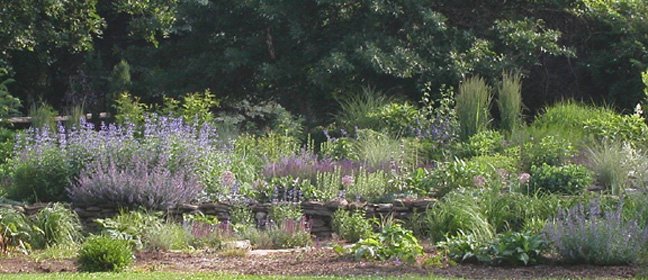
The Far Garden at Rosemont - "far garden" because it was relatively far from the house - shows how quickly a herbaceous perennial garden can reach maturity. In only 18 months from installation of the first plants, I had a new garden that was entirely satisfying aesthetically and visually. Not really mature, because plant communities undergo a continuous process of succession, but certainly giving the appearance of a fully grown garden. The first photo shows the garden in early summer of 2004, one year from the start of planting.


I started this garden to block the view of a neighboring house. (Okay, if you're a passionate gardener, you know I really started it simply because space for another garden was available.) A wet drainage swale provided the opportunity; the contour of the land, which dipped and rose moving away from the house, brought to mind a pleasing arrangement of plants at varying elevations. I had the area dug out with a backhoe, and built two parallel stone walls about 30 feet apart, suggesting an old barn foundation. This gave me a sunken garden surrounded by stone, and two raised planting areas on each side. The next photo shows the initial excavation in the fall of 2002, with the dry-laid stone wall finished on one side.


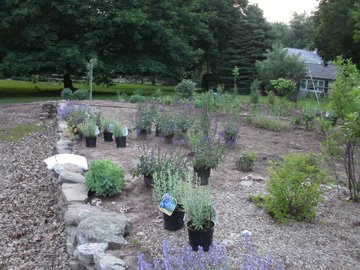
Planting started in the spring of 2003 and continued through that summer and fall. The next photo shows an initial rather random layout of the first plants. Doesn't look like an auspicious beginning, does it? In fact, the garden presented a bleak picture for the first few months.


The plant selections weren't all my own: I had a lot of help. While browsing in Barnes and Noble, the cover of Designing with Plants by Piet Oudolf and Noel Kingsbury caught my eye. I was powerfully moved by the book: its photographic details of plant shape, texture, color, structure, and the rampant, almost tactile, beauty of the Oudolf garden photos. The big plantings recalled an Alice in Wonderland world. Huge plants, many towering well above human height, brawny Joe Pye Weed topped by looming purple flower heads, broad mounds of persicaria polymorpha crowned in foamy white, strict verticals of calamagrostis acutiflora 'Karl Foerester', grasses bending and sighing in the wind. The planting images, and the appreciation for all stages of a plant's life - even death in winter - hit my bullseye. This was my "wish book."

As I began the Far Garden, I was discovering a theoretical approach and practical direction for my efforts. I read more about European research matching plants to existing conditions - really just selecting plants appropriate to the local ecology. In Noel Kingsbury's stimulating, well informed writings, in particular, I learned of work done at the Weihenstephan Institute in Germany that resulted in a seminal work, Perennials and their Garden Habitats by Richard Hansen and Friedrich Stahl, which rigorously associated plants with their natural habitats, based on field trials carried out over many years. Stephen Lacy's "The New German Style" on the Horticulture website (see links) captures very well the essence of the New Perennial movement, tells the role of Hansen and Stahl in the movement, and offers a fascinating update, and stunning photos, on current German practices in such places as Munich's Westpark.

I gained the confidence to try gardening on my unimproved soil, for the most part heavy clay, very wet through winter and well into spring - selecting plants that by virtue of their natural habitats, would probably thrive in this environment. Instead of trying to recreate my soil by adding tons of compost and manure, improving drainage, building fences to break the wind, I decided to try a new approach - tilling the soil surface two times to turn under the grass, followed by close planting and weed suppression. I had learned from earlier experience that newly tilled ground in my area would quickly sprout millions of crab grass seedlings come hot weather. So I was forced to use a pre-emergent herbicide until the newly planted perennials covered sufficiently well to do their own weed suppressing. (Okay, we don't approve of chemicals, but I used them judiciously, only a couple of times.)

By the summer of 2004, I had a new garden that looked quite respectable, even under attack by an army of Japanese beetles.


Friday, December 23, 2005

I Dislike the Phrase "Sustainable Design" but ...

Since moving from Brooklyn to the country six years ago, I discovered an exciting, new approach to gardening. It revealed itself slowly, via books by Piet Oudolf, Henk Gerritsen, and Noel Kingsbury. In five years, I established a garden in the hamlet of Rosemont, New Jersey, that relied on the principles and plant predilections of what has been called the New European Style of Perennial Gardening. This met my practical needs (heavy clay soil, windswept location, enormous deer population, limited time), as well as my aesthetic preferences (more on that later). We sold the house and garden last year, and now I'm starting a new garden in an even less propitious location, on Federal Twist Road - thus the name of this blog.

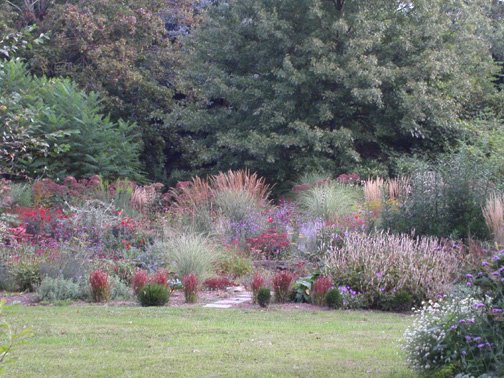
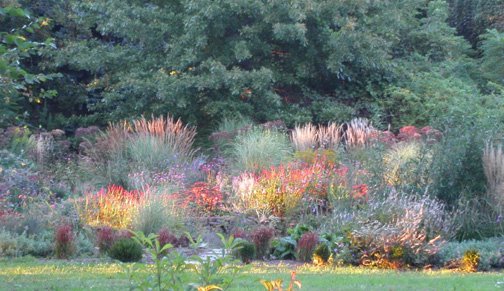
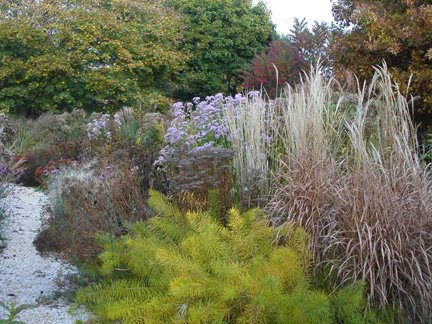
Just as the house went on the market, I discovered I was selected by Horticulture magazine for the Grand Prize in their home gardening category (I have doubts about how serious that competition was). The photo above, taken on a foggy September morning, was the one selected for publication.

I hope to use this medium to explore where these and other gardeners and plantsmen and women have led me, to learn, and to share ideas with like-minded gardeners (actual or virtual). I dislike the sound of the phrase "sustainable design," but that's what it's about. Any suggestions on how to talk and write about a gardening style (philosophy?) that, as of yet, has no name?

LinkWithin

Related Posts with Thumbnails