Pages

Showing posts with label Joe Pye Weed. Show all posts

Sunday, August 26, 2012

August 19 - Straight, Tilted, Curved

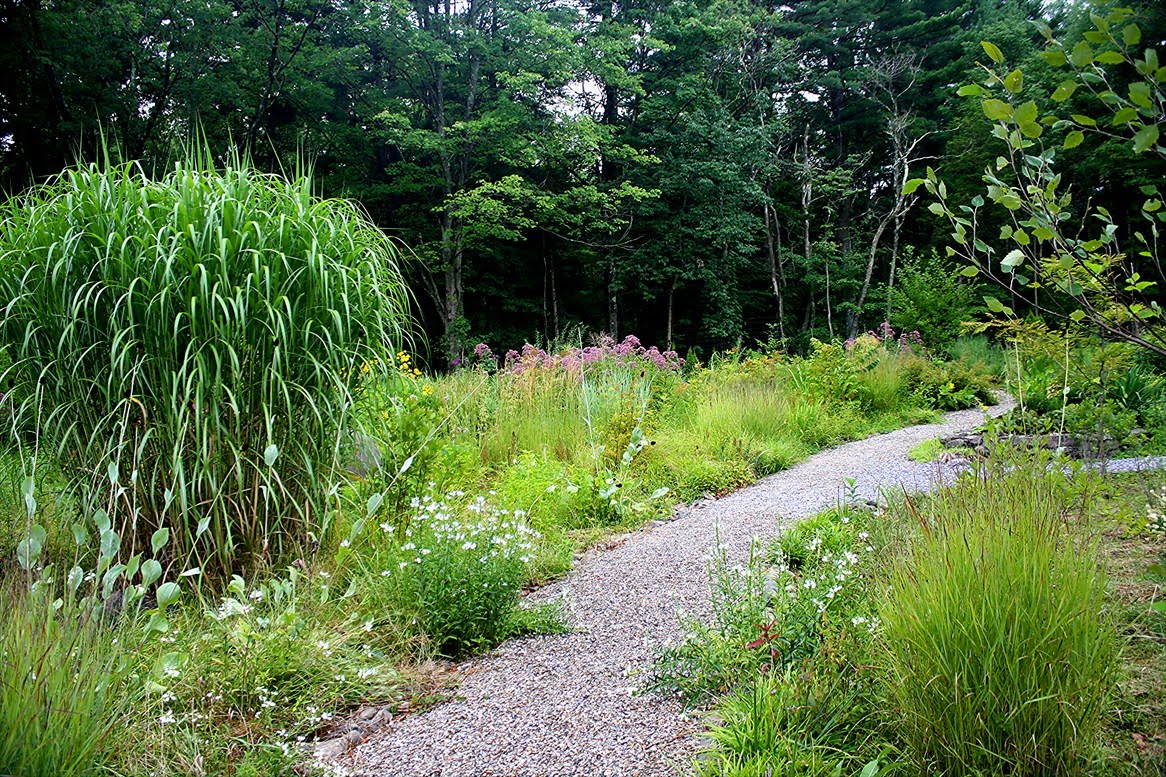
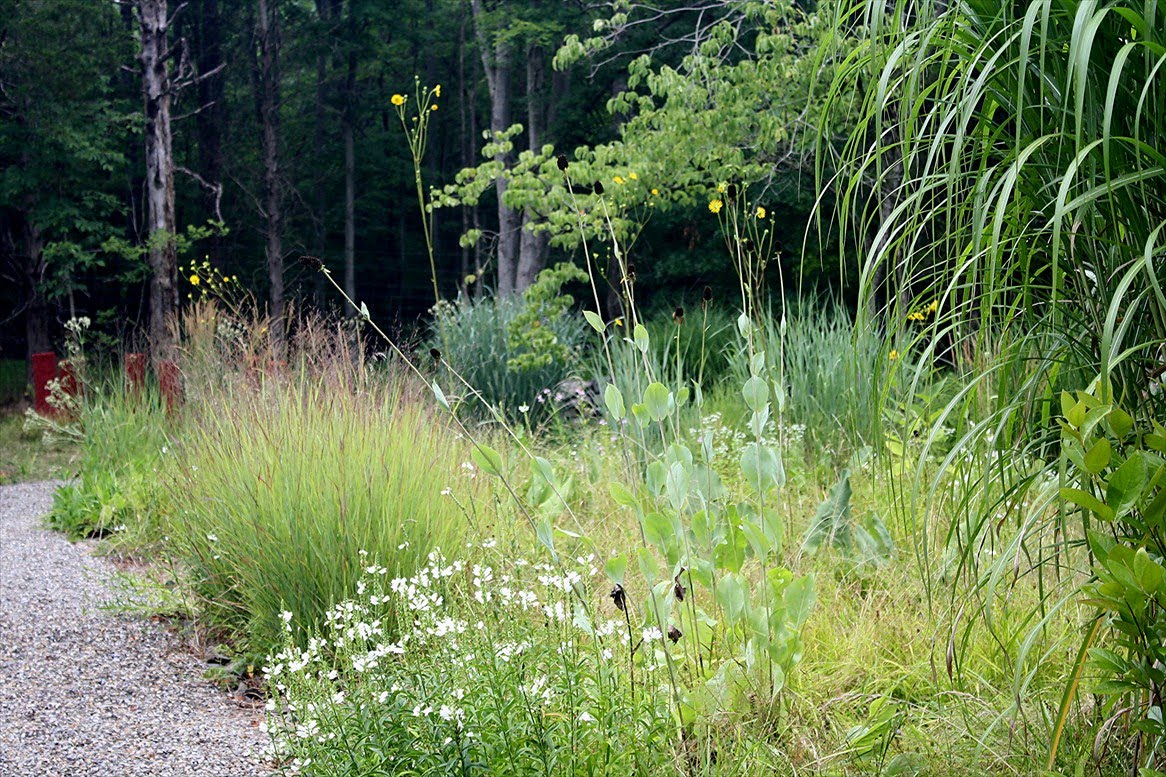
Most of the very tall plants at Federal Twist have blossomed leaving an interesting interplay of verticals, diagonals and curves.


As the season progresses, the plant communities take on greater complexity. But the strong lines imply an underlying structure and order.


It's messy, no finely manicured edges here, but it entertains me and gives me pleasure ...


... sensuous delight ...


... new thoughts, new ideas ...


... and feelings I can't express ...


... the interplay of chance and intention ...


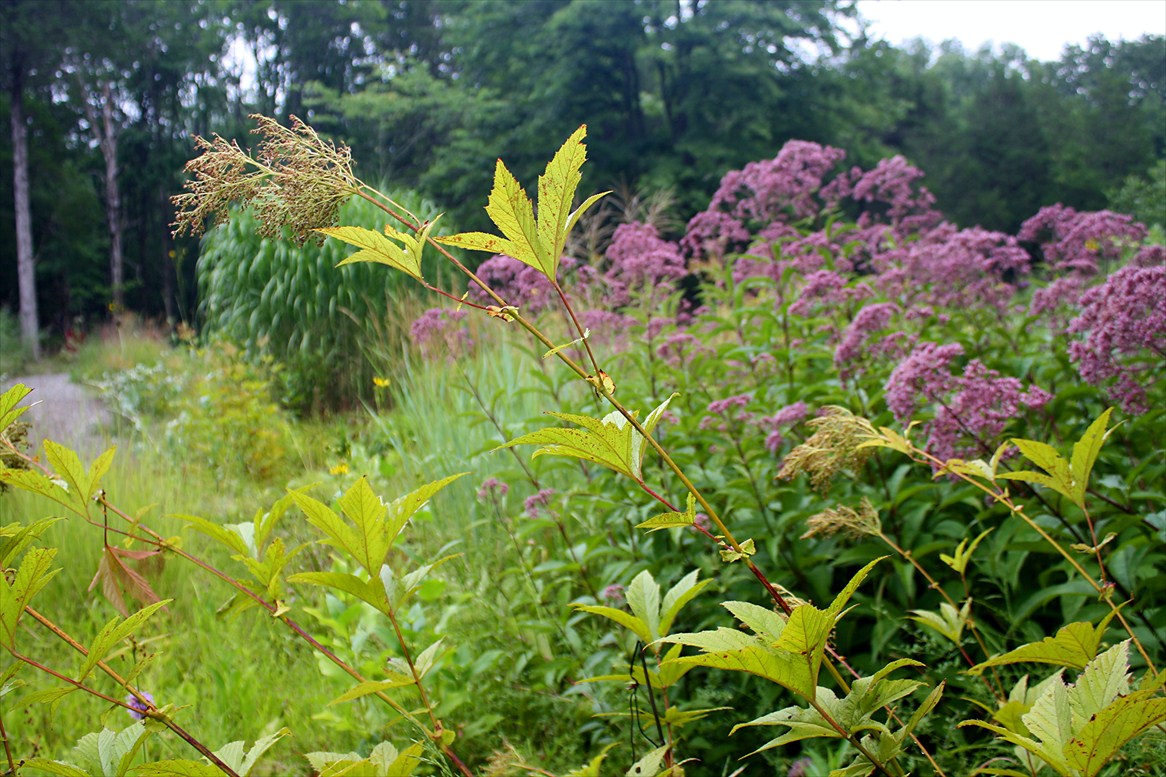
I planted none of this Eupatorium perfoliatum (above). Rather, it planted itself. I'm just a line editor.

Here too (below), many of the plants seeded themselves ...


... and many of these were planted intentionally. Can you tell the difference?


An accident ... the great blue lobelia doesn't belong here, certainly not next to the box wood ... but I just couldn't pull it out. Perhaps next year.


Intention and chance ... the first plants to be put in here were Rudbeckia maxima; others followed, mostly without my help. The cloud of Filipendula I planted a couple of years later.


I wish I could say the juxtaposition of the Joe Pye Weed and the Sanguisorba was intentional. Was it? I can't remember, but I do like it.


One last chance surprise just caught my eye as I was passing - a molting praying mantis.


Saturday, July 28, 2012

The Incredible Shrinking Man


I say I don't have a lawn, but I suppose I do--a very tall lawn, a simulacrum of a tall grass prairie, highly modified. Modified in very specific ways to grow on my wet land perched on the rim of the Delaware River Valley. To see my garden as lawn, it's helpful to imagine yourself very small, like the incredible shrinking man, walking among blades of grass that have become like giant trees.

Indulge my little conceit, a lawn of very large plants, many not grasses. The Rudbeckia maxima and the scrim of fading Filipendula below are taller than you are. So taking a walk through--not across--the lawn at this time of year is a thoroughly three-dimensional experience.

Unless you're a giant, the Rudbeckia maxima and Filipendula venusta behind it are taller than you are.
This kind of lawn has several advantages. You don't have to water it. Even with day after day of over-90-degree temperatures, and little rain, it's doing fine. After several years of growth, the roots have gotten deep enough to reach what water remains well underground.

You can  hide in this lawn--totally disappear, just like the incredible shrinking man, and no one in the house can see you. Need I enumerate the advantages? A fine place for dalliance, though that's not likely to happen at Federal Twist, except among the bugs and butterflies and frogs. A fine place for peeing outside too; that's good for driving away groundhogs. And it adds nitrogen to the soil.

Nor do you need to feed it. The plants stay in place over winter, so their goodness returns to the soil. After burning and chopping in spring, the detritus adds organic matter to the earth. It's certainly not self-maintaining, but care is infrequent, and not too much work.


It plants itself. Above, self-seeded Vernonia with Hydrangea arborescens by the pond ...


Another self-seeder, Silphium perfoliatum, on the right by the path. It, too, is taller than you. The lone Liatris is from one of several experimental corms I haphazardly put into the ground last winter. I see I should add many more.


Bees love it.


Filipendula, Joe Pye Weed, and Cup Plant (Silphium perfoliatum) above. Now that the Filipendula has faded from garish pink, it blends in well, and it remains a great structural plant. Structure is important to maintaining a tall lawn and keeping high visual interest. Flowers are a frill, nice but secondary.


Breaks in the tall field of planting create voids, corridors of view, and relative perspective. Here the tall Rudbeckia maxima, Miscanthus giganteus, Cercis canadensis 'Hearts of Gold', Filipendula, Calamagrostis acutifolia 'Karl Foerester' (l to r) tower over daylilies planted amid shorter grasses and carex, other low plants. Your eye can move freely among the taller plants and roam the open spaces, knowing potential for freedom, anticipating change, seeking the new (or old), reconnoitering routes to elsewhere. Then behind it all, the wall of forest, setting the boundary, but with its own interstices leading into a darker world.


So another advantage of this kind of lawn: it offers opportunity for daydreams, psychic mini-vacations. Make of the spires of Thuja what you will. But do notice the silver white bloom of the Pycnanthemum muticum, buzzing with hundreds of bees and wasps, so fragrant it opens the door to another sensual world.


Traveling the main path across the lawn is almost like moving through a three-dimensional simulation. All the tall yellows and purples shift relative position as you move through the field, and the sharp orange and red daylilies play visual tricks, sometimes moving closer, at other times receding, adding to the perception of depth.


This lawn gives pleasure in many ways, some quite subtle, but you have to bring a certain sensibility, attention to detail, openness, moments of stillness. These little emotional pleasures require a contemplative state of mind, then they come, transient re-cognitions, like meeting dear friends from the past.


Daylilies planted out in the field of grasses are virtually invisible until they bloom. (Some flowers are important, and I want to add 50 or 60 more daylillies.) They offer transient visual delight, surprises, like giving a child a bright colored object.


Moving on to the far end of the garden, where a layer of rock under the surface makes a dryer, leaner planting environment ...


... and the plant community is different. More of the "legacy" plants were left in place (Timothy grass and other pasture grasses, Blue-eyed grass, bracken, assorted Persicaria), so the character of the planting is different.Those tall plants not yet in bloom beside the paving are Inula racemosa 'Sonnenspeer', another prolific self-seeder.


Prairie dock (Silphium terebinthinaceum) with big, paddle-shaped leaves gives this area a unique solidity and mass, and a bit of humor. They seem to impose themselves on the landscape, squat down on the ground almost like uninvited guests who decide to take up more room than anyone else. Or like strange animals from another planet.

Miscanthus 'Silberfeder', daylilies, self-seeded Vernonia, the circle of red logs, Calamagrostis acutifolia 'Karl Foerester', dying Poison hemlock (Conium maculatum), Eryngium yuccafolium (l to r).
I was twelve when I first saw The Incredible Shrinking Man. It was a formative experience of my childhood. I remember Scott Carey, at the end of the movie, disappearing into the grass of the lawn as he continued to shrink, the grass having become like a forest. He'd become an explorer of the infinitesimal, perhaps to find a door to infinity.

Eryngium yuccafolium.
This fired my imagination far more than anything I had ever heard at the Southern Baptist Church. It still does.


No, I don't imagine I've become Scott Carey when I walk through towering plants, but I do feel some of that sense of mystery and discovery.


Contemplating this scene, watching the changes from season to season, from year to year, I recall those feelings I had over 50 years ago as I watched Scott Carey receding into invisibility.


Here today, gone tomorrow.


The path out ...


... and the path in.


At the end of the movie, Scott Carey stands at the window screen of his basement, about to walk out into the natural world to meet his fate ...


... and he speaks this monologue:

Scott Carey: I was continuing to shrink, to become. . .what? The infinitesimal? What was I? Still a human being? Or was I the man of the future? ... So close – the infinitesimal and the infinite. But suddenly, I knew they were really the two ends of the same concept. The unbelievably small and the unbelievably vast eventually meet – like the closing of a gigantic circle. I looked up, as if somehow I would grasp the heavens. The universe, worlds beyond number, God’s silver tapestry spread across the night. And in that moment, I knew the answer to the riddle of the infinite. I had thought in terms of man’s own limited dimension. I had presumed upon nature. That existence begins and ends in man’s conception, not nature’s. And I felt my body dwindling, melting, becoming nothing. My fears melted away. And in their place came acceptance. All this vast majesty of creation, it had to mean something. And then I meant something, too. Yes, smaller than the smallest, I meant something, too. To God, there is no zero. I still exist!

Sunday, August 15, 2010

Garden Diary: Starting August


With the coming of August 1, we're at the peak of a hot, very dry summer, stressful in the extreme. But most of the established plants have required no supplemental water. They've been established long enough to weather these difficult conditions, even though most of them are water lovers, or at least tolerant of a lot of moisture. Right now I have to remind myself I have a "wet" garden, a "wet" prairie because it's do damn dry. Only perennials newly planted this year, and a few shrubs, hydrangeas mostly, planted in dry areas, have shown obvious signs of wilting, though a few perennials in open, exposed areas have died.
 

Along the main path, plants are most exposed because they don't have the shelter of other plants on all sides, but even there, most damage occurred during one period of 100+ degrees. So what has fared well, and what not so well? Certainly the Miscanthus giganteus below is doing fine, as is the Rudbeckia maxima; though some seed stalks are rather horizontal, that has nothing to do with lack of water.


Continuing along the path, various Panicums (switch grasses) and Physostegia virginiana (False Dragonshead, Obedient Plant) are at their prime. No obvious signs of stress so far.


Looking back along the path, you can see a thriving community of Joe Pye Weed (Eupatorium purpureum) in the distance, along with more panicums and other plants not visible. Some small, newly planted Hemerocallis, obscured on the right, are looking bedraggled (downright ugly), but will likely come back larger next year ... Hemerocallis is, I find, a fine stress tolerator. It simply disappears underground if conditions get bad, but almost always returns ...


... another view back toward the paths on either side of the pond, converging at the end of a raised stone-walled planting bed with boxwoods and bergenias. And, unplanned, thriving Patrinia scabiosifolia and Lobelia syiphilitica that self-seeded and will be moved at the end of the hot season. (You'll see those clearly in photos below.)


Looking in the opposite direction, and moving clockwise around the garden, another view of the driest area, located over the extremely well drained wastewater leaching field, filled with Panicums, Pycnantheum muticum (Mountain mint), Rudbeckia maxima, Silphium terebinthinaceum (Prairie dock), all getting by on the brief, occasional rain showers we see at two to four week intervals (sometimes longer) ...


One of my favorites, in the foreground, Filipendula rubra 'Venusta' (Queen of the Prairie) looking its best in its aging gold, weeks after its pink cotton candy blossoms have faded, more Joe Pye ... both doing very well in spite of drought, probably because the planting is so close here the ground is completely shaded ...


One of the interlopers in the stone planter with the boxwoods and bergenias, Lobelia siphilitica, just coming into blossom ...


And the other interloper, Patrinia scabiosifolia, at peak bloom for about 10 days now ...


Back on the path beside the pond, where I'm gradually planting the bank, which looks full here (cameras lie), with Hydrangea Annabelle, a golden Catalpa, Miscanthus gracillimus and, in the distance, a Japanese maple. Only the hydrangea has suffered, but it was planted in high summer and has no established root system. Plants like this one require lots of spot watering.


More views of the "wet" end of the garden. Not really wet now, but certainly very wet for three out of four seasons ... Horizontal bands of Spartina pectinata 'Marginata', Filipendula in its late summer gold, and Joe Pye Weed towering in the background ...


Light pink spots of the European Eupatorium cannibinum, Inula racemosa 'Sonnerspeer' tall with yellow daisies running up its vertical stem, Miscanthus purpurescens on the right, and Miscanthus 'Silberfeder' on the left ... come fall, this will be an area of high color, the M. purpurescens in flaming colors (well, usually, we'll see) ...


The shiny silver flowers of Pycnanthemum muticum in bloom, the old stalwart Joe Pye again, and Vernonia fasciculata (Ironweed) at the dry end; notice this Joe Pye is much smaller and less vigorous than its counterparts at the "wet" end of the garden ...


Self-seeded Silphium perfoliatum (Cup plant) ...


Back side of garden--the big mass of Miscanthus 'Silberfeder', Pycnantheum muticum, and low to the ground, a hybrid Petasites for big foliage effect ... the Petasites, a water lover, is showing damaged leaves from the dry heat ...


I don't know where that white phlox came from, but it returns larger every year. If I wanted to plant an area in phlox, it would probably die en masse. I attribute this one's success to the protection and shaded roots of the surrounding plants.


An interesting combination that demonstrates the value of foliage colors--blue of Panicum 'Dallas Blues' on left, green of Joe Pye Weed, right, gold of Filipendula behind. Look closely and you'll see a Miscanthus flowering at the back edge of the Panicum. If I don't cut this out, my Panicum will be gone in two or three years. Miscanthus is much more competitive and will completely take over. At back curving to the left are high stalks of Silphium lanciniatum, so tall they lean precariously, even with some staking.


Shifting the view to the right brings more Filipendula into view ...


... then Eupatorium perfoliatum (Bonset), one of my favorite native wild flowers, about to burst into umbelliferous clouds of white. This Eupatorium has seeded about this year, I think because or our early warm, wet spring. If it's naturally this agressive, I'll have to resort to hand pulling selected plants--"weeding like a cow" as Henk Gerritsen so aptly put it. At front with the Filipedula is the one remaining Liatris pyncnostachia, a beautiful plant, and appropriate to this plant community, but I fear, not competitive enough to survive in the long term. It seems to want less competition, so I may give it another try in more open areas.


The new Marc Rosenquist sculpture through a screen of Calamagrostis and Panicum ...


Some day I must do a post on humorous plants. Rudbeckia maxima climbs toward the sky with a single upward facing daisy flower, then becomes this lanky, gawky plant cartoon for the rest of the season, and many of the seed stalks remain erect throughout winter ... humorous, but a lovely color and a delight throughout the entire year ...


A giant bouquet ...


Here a native rush in all its complex beauty. These have been here from the start and continue to appear year after year. I haven't identified it with any specificity (it may be Scirpus cyperinus--wool grass, marsh bulrush, cotton grass bulrush), not being a native plant expert, but it's probably the most reliable native plant in the garden, and looks like a delicate piece of vegetable jewelery at the height of its blooming season, which is now.


Just a pretty detail with willow (Salix 'Rubykins', Eupatorium perfoliatum, Vernonia fasiculata, Filipendula, Liatris) ... remember, the camera lies ...


Same scene, broader view, slightly different point of view ... see how the camera lies?


What a peaceful scene Joe Pye Weed can make ...


Another camera lie, catching colors and forms through a small aperture ... lie, yes, perhaps a little lie, a bubbameister, a little lie that, perhaps, has a story to tell, even a bit of truth, something for the gardener to learn ...


That's it for August 1. Next diary entry is in the works.

LinkWithin

Related Posts with Thumbnails