Pages

Showing posts with label Miscanthus 'Gracillimus'. Show all posts

Thursday, September 23, 2010

Autumn

This first day of autumn the tall trees surrounding the garden cast deep shadows. A morning walk is a study in dark and light, a good time for looking about. It's virtually impossible to capture these extremes of lighting in photographs, but just sitting in the shade looking out into the sunlit garden can be quite pleasant, as can strolling through dappled shade.The contrast of dark and light is what makes the garden special at this time of day. So this is the compromise--slightly overexposed photos with bleached colors. You, dear reader, will have to use your imagination.

Here, the first picture shows the space and broad view of the garden. This is hard to do successfully, as you've probably noticed if you spend much time reading garden blogs. Most only give you small pictures of single plantings, or limited vignettes, rarely the big picture.So take a look at the dramatic contrast between light and dark. Yes, I'm striving for a kind of drama in the garden, a stage set with creative lighting (supplied by the sun alone) and theatrical scrims made of vegetable matter.


Landscape or garden? Both, really. These views show the lay of the land, or rather the undulations of the vegetative growth of this season, as the perennials have reached their peak and begun the time of slow decline, losing chlorophyll, just starting to show their flashes of color. We aren't there yet, but the fading greens and shift toward yellow, red and gold is beginning to be apparent.

It's a good time, too, to see how shapes work in the landscape. The spear-like foliage in the foreground below starts a rhythm echoed by the finer grasses behind, the Arborvitae, and in the distance the tall Junipers and a single Blue spruce. Next year I'll add more Japanese and Siberian irises, which hold their form well, and late, and give thought to ways to repeat these patterns across the garden.


As has been done here, in the offset line of Arborvitae ...


Hard to tell in the view below, but the bank rising to the house remains a problem, still unfinished after five years. The right end in almost full sun is planted mainly with Miscanthus gracillimus (some are the real thing; others seed-grown unknowns sold as gracillimus; caveat emptor!), which have done well and make a pleasing cloud-like picture. The opposite end, in the dry shade of three large sycamores immediately adjacent to the house, is less amenable to easy solutions. I want a mass of hydrangeas, and will continue to attempt that next year. A rainy spring and summer would help.Those I've put in are languishing.


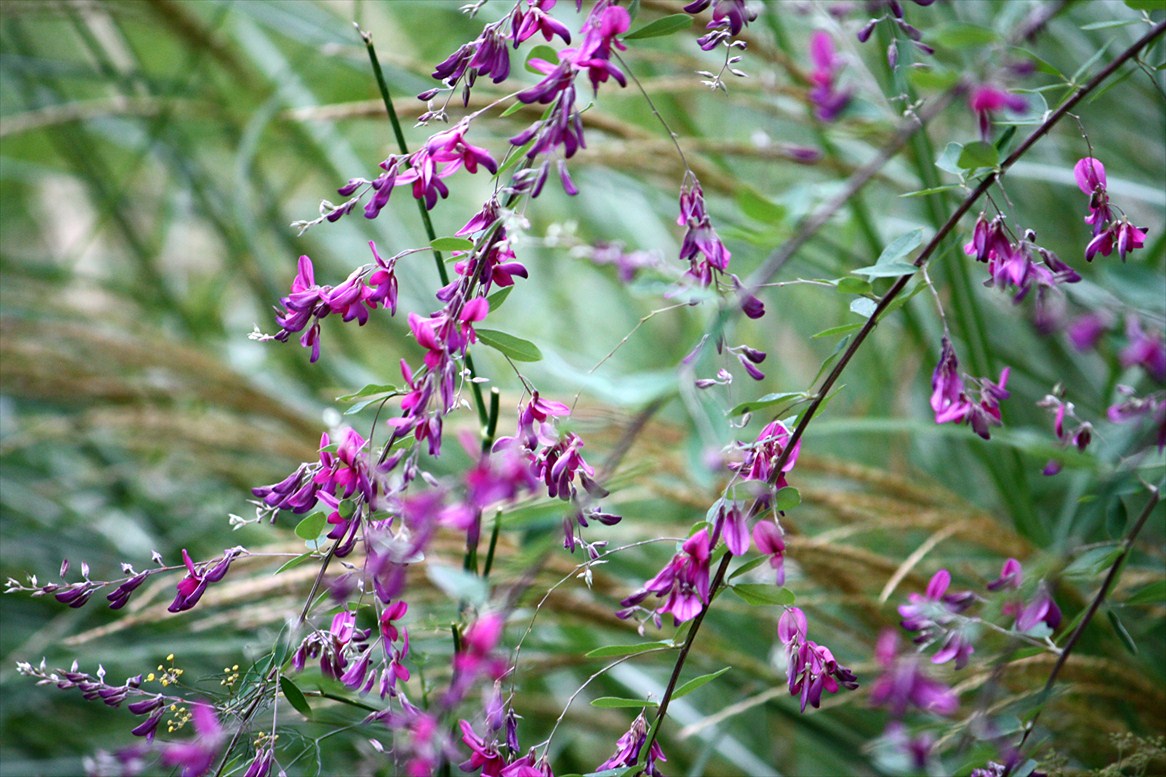
For late color and longer interest, I've added several Lespedezas; these are in their first year, and I expect them to grow much larger and flower more profusely in years to come. I'll probably add one or two more, scattered among the Miscanthus, to get a bank of September color. I stole this plant idea from Bruce's garden at Paxson Hill Farm (thanks, Bruce) and from a magnificent specimen at Chanticleer.


Here they make a channel of color running up to the four Adirondack chairs on the terrace.


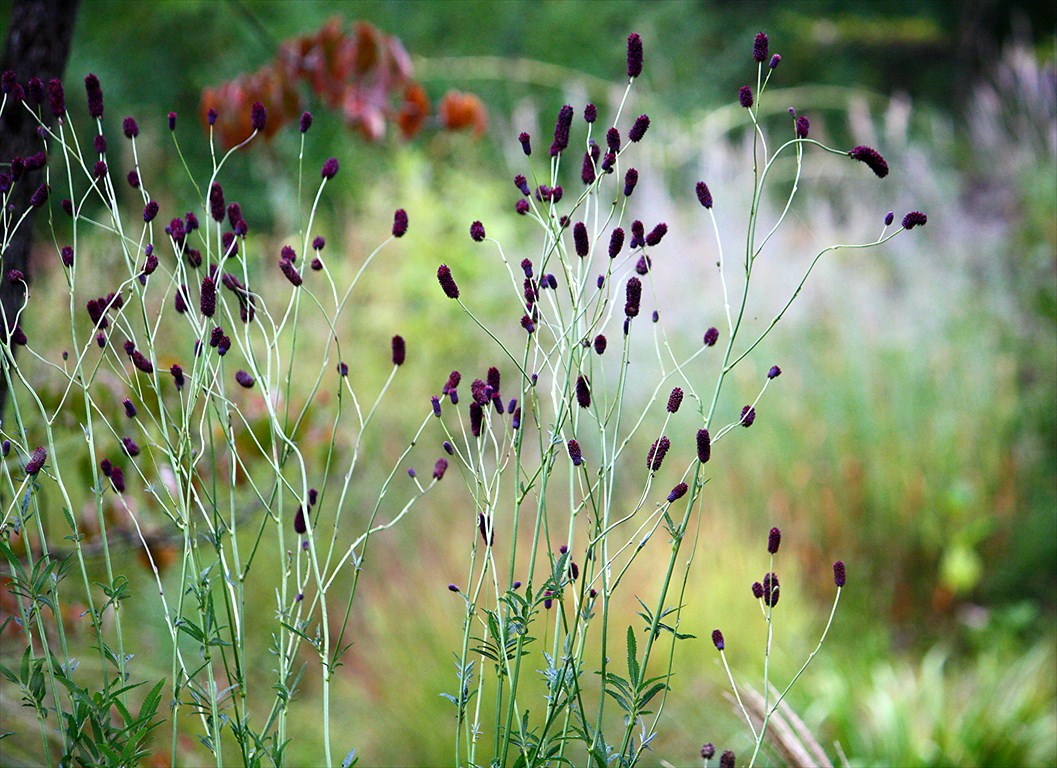
Details out in the garden--here, Sanguisorbas on the long path across the garden ... 


 ... Pycnanthemum muticum (Mountain mint) in its late summer silver with Arborvitae ...


Vernonia altissima 'Jonesboro Giant' in flower (though not as tall as last year because of drought), Rudbeckia maxima seed heads and foliage at its feet, and just a glimpse of Miscanthus purpurescens on the left ...


Here the Miscanthus purpurescens with species Veronicastrum  and increasingly  ubiquitous Rudbeckia maxima (it's become a theme plant) ...


Massed Miscanthus 'Silberfeder' and Pycnanthemum muticum in shade on the left, and on the right the new back area under development. The newly planted Hornbeam hedge will form a right angle behind the bench in the distance ...


... and that same planting of Miscanthus 'Silberfeder', Pycnanthemum muticum, and Petasites seen from the back of the garden, looking in the direction of the house (which is obscured by the plants) ...


After several tries, asters are establishing. I want more, and have several in a holding bed beside the house. If we have a break in the heat, I'll plant them out in the garden later in the fall ...


That same community of Miscanthus purpurescens shown above, here from the opposite side, where it adjoins the newly paved sitting area; this is one of my favorite grasses. I hope to find a way to darken the concrete pavers and gravel quickly, perhaps using a nutrient solution to encourage algae growth in the cooling days of fall. Or maybe I'll just smear them with mud over winter.


Another Miscanthus purpurescens surrounded by asters and Pycnanthemum muticum ...


... and a second view in the same direction, showing the circle of red walnut logs marking the eastern limit of the garden ...


... a fortuitous combination of Pycnanthemum and Siberian iris ...


... and Calico aster (Aster longifolius), a native, which grows everywhere I don't pull it out ...


... a view from the bench, which was shown above, toward the circle of logs ... more hydrangeas are going in here. So far 'Limelight' appears to be the most successful in this difficult area. The view of the unattractive fence in the back left will be blocked by Japanese Fantail willow (Salix sachalinensis 'Sekka') and Miscanthus giganteus.


Looking back into the garden from the easternmost path--asters, Miscanthus purpurescens again, Rudbeckia maxima, drying Joe Pye Weed, bracken ... from this direction, the plants are backlit, glowing with refracted light of the sun.


Marc Rosenquist's sculpture surrounded by various asters, Eupatorium coelestinum, Chelone 'Hot Lips' and big leaved Rudbeckia maxima, Silphium perfoliatum, and Inula 'Sonnenspeer' in the background, all backlit by sunlight in a striking way.

Here the colors of fall have really begun. Two bunches of Panicum 'Shenandoah', another of my favorites, showing streaks of red, to either side of a Viburnum plicatum (a small tree I cut down when we cleared the land; now I recognize its beauty and utility as it's coming back). The red plant at the front is Seedbox (Ludwigia alternatolia), a native I'm encouraging wherever it chooses to grow.


Behind in the darkening shadows are many Filipendula rubra 'Venusta' in their subtle autumn colors and spires of (you should have guessed it) Rudbeckia maxima.

So the decrescendo of summer, as the flowers lessen and colors fade, becomes a crescendo to an autumn to be closely watched, if I can judge from the past three years. I have to remember this was a summer of severe drought. I don't know what will happen. The uncertainty of the garden year remains, and that's not bad.

Thursday, September 16, 2010

Rusty browns, spots of color, waving fans


"You should see his garden. Well, it’s not really a garden. There are all of these plants, and he’s built paths so you can walk around and see everything.” That’s what he said, or words to that effect.

This was a house guest last weekend, talking about my garden to his friends. At first I felt a little miffed …(yet another person who defines a garden in such a traditional way, he doesn’t see my garden as a garden), but I quickly got over that. Later that afternoon, I asked him about the remark, really out of simple curiosity. I don’t believe I ever succeeded in convincing him that I wasn’t offended, that I only wanted to know what he meant. After several starts and stops, I came to understand that he sees a garden as a clearly delineated space, usually not a very large space, with plantings that are regular, possibly patterned, certainly discernibly structured--a space existing in visible isolation from its surroundings, perhaps surrounded by a fence or a wall. Perhaps something with a more traditional, gardenesque selection of plants--dahlias, roses, mums, for example. He would probably be very comfortable in the Medieval garden, the hortus conclusus, at the Cloisters museum in upper Manhattan. I would too. I love that garden, but that’s not what would suit my modernist house in the woods of western New Jersey.

My garden’s lack of clearly demarcated boundaries, large size, and amorphous shape left him a little uncertain, perhaps uneasy too. After I pressed him, he told me my garden was more a “landscape” because it was so large, so naturalistic in contrast to his usual sense of garden. I can’t say I disagree, though I do think it’s still a garden. To use an analogy, mine is more a Richard Strauss tone poem than a J. S. Bach fugue.

There is pattern and order, order emerging from what could have been disorder, in my garden. In the photograph at the top of this post, particularly if you look at it as a two-dimensional picture, you can see repeated fan shapes, repeated patterns almost like layers of scenery on a stage. The Japanese fantail willow at the background sets the motive, a fan shape repeated by the massed grasses, Joe Pye Weed (Eupatorium purpureum) and, in the foreground, Miscanthus and Lespedeza, all fan shapes in this two dimensional view ... Of course, the wind blows, the rain falls, and patterns disappear, others appear ...

Order too, in placement of plants, not at regular intervals, but to create groupings, communities of plants of the same kind, to echo shapes, to achieve an aesthetically pleasing distribution of forms, textures, colors.

So, as to what was visible last weekend ... here are two prominent natives in this area, Boneset (Eupatorium perfoliatum) and Wool grass (Scirpus cyperinus) ...


... bold textures of  large, brassy foliage (below), Viburnum mariesii, Joe Pye Weed, Filipendula rubra, contrasting with whisps of Panicum 'Shenandoah' and more Boneset seeding around, the Boneset a reminder of the importance of chance in this garden; if it works, keep it, if not, move it or just pull it out.


I'm sure elizabethm at Welsh Hills Again would see this as a mess; I like her blog, but she doesn't like prairie gardens. At this small scale, not being able to focus in on the detail, I have to say it appears to be. But if you're in the garden, you can see more detail, and more subtle variations in texture and color, perceive movement, the force of air stirring emotion.


One way to sort it out visually:  look at detail and throw the background out of focus. Here Sanguisorba tenuifolia ...


 ... silken flowers of early blooming Miscanthus ...


... bruised blues and purples of Lespedeza thunbergii 'Gibraltar' planted last fall ...


... mounding miscanthus and Patrinia scabiosifolia on the terrace overlooking the garden, and purposely blocking the view ...


... I suppose this is that jumble time of year ... everything growing to the max ... with a few cones of Arborvitae (Thuja occidentalis) holding the line, so to speak ...


... then suddenly, looking at the ancient crab apple (it must be over 40 years old) I'm into fall. Clearly this is a sign the year is nearing its end.

Wednesday, October 01, 2008

Garden Diary: the bank


No, not that bank. Not the one about to collapse into financial ruin. This is the bank around the house; the one that lifts the house above the wet garden below.

I has a rather wild and woolly look. I've been working on a planting of Miscanthus sinensis 'Gracillimus' and Pycnanthemum muticum, with a few scattered perennials mixed in for other season interest - Joe Pye, Baptisia australis, sanguisorba, a few legacy peonies - and a focal Viburnum plicatum 'Mariesii' at the corner, and it's all just fine until autumn when the miscanthus flowers and starts falling apart. At this time of year, I wish I could stop the flowering and just keep the simple mounded shape.


Visually, miscanthus is appropriate. It complements the strong Japanese influence in the design of the house (built in the mid 60's), or I like to think so. But I'm also thinking about replacing it with a lower, more lasting structured panicum such as 'Shenandoah'. Or taking a complete change in course.

The bank is the only planting area I have that isn't saturated most of the year, so I could take advantage of that and grow a mixture of flowering and berried shrubs (caryopteris, hollies) and an entirely different selection of perennials. Maybe a steppe planting like the one at Lady Farm? Whatever I do, I want a planting that will look good in all seasons and will last years with little maintenance.

I do want to keep the dogwood screen at the bottom of the bank. They are great for wildlife, mainly as perches for all kinds of birds, even hummingbirds, and they provide a sense of shelter - a "treehouse" effect - and separation from the garden proper.

Any suggestions?

LinkWithin

Related Posts with Thumbnails