Pages

Showing posts with label Matrix planting. Show all posts

Monday, May 09, 2011

Spring walkabout


Til now, posts on these garden walkabouts have only appeared in summer and fall. Spring just wasn't a good time in the garden on Federal Twist. The site is cold and wet, and most of the perennials that thrive in these conditions get a late start. Only this year is the garden beginning to show significant early season interest.


A part of the change is simply maturity. The communities of plants have had a few years to grow together, forming large masses varying subtly in height, texture and color. I've also added shrubs and small trees--while keeping the largest areas open for perennials only, essential for easy planting management--which provide a sense of scale, and a few evergreens, whose dark silhouettes contrast dramatically with the lighter spring greens and golds of the herbaceous perennials.


Right now the morning sun backlights much of the foliage, looking for all the world like fractured stained glass, and the broken light filtering through the partially leafed trees imbues the space with a sense of peace and optimism. The wind gently whispers; humming birds alight in the aged dogwoods that screen the garden view from the house. It's a most pleasant, but of course, transient scene, a momentary Eden which passes quickly enough ...


... passes, for me that is, to the "mechanics" of the garden, for example, structure, contrast in color and form, garden management practices ...

The graveled paths encircling the planted areas, like the dark evergreens, give a visual weight to the garden ... the stone walls, a hard mineral background contrasting with the soft vegetable tissues ...


It's far too early for the pond to be overgrown with vegetation. For a while, the there's a clean edge and the water surface reflects the sky, a distant dogwood (below), or serves as a simple foil for Camassias planted around the pond's perimeter. It's taken three years for these to settle in and get going. Now I see I should plant more, and in other parts of the garden, especially since they echo the form of the hybrid Petasites flower spikes, which are blooming at the same time.


Less photogenic, but essential to understanding another aspect of garden mechanics--the maintenance or management process--are the spreading mats of perennials. Here, an example of matrix planting, Symphyotrichum puniceum (formerly Aster puniceus or Swamp aster) has formed a wide circular mat that out competes many of the less desirable grasses.


And here, large masses of Filipendula rubra 'Venusta', which have been a strong and stable presence for several years now, even though the soil is crowded with a variety of competing plants. If you want to manage large areas rather than "garden" individual plants, you'll have to learn what plants are appropriate to your conditions. That knowledge isn't always easily available, so a willingness to experiment, and to fail, is necessary. I used to have a community of Liatris pyncnostachia mixed in with the Filipendula. It was a stunning combination, but the Liatris gradually succumbed to competitive pressure and has all but disappeared.


"Nature's first green is gold," Robert Frost, that great and cynical observer of Nature, wrote. To build on that golden theme of early spring, I added three Sunburst Honey Locusts (Gleditsia triacanthos 'Sunburst) in the early days of the garden. They've not grown much, but each spring their brilliant foliage beckons like finely hammered artifacts of gold. I don't want them to become large trees; these golden poles are fine.


Then I discovered the wonderful non-native Euphorbia palustris, which I've scattered around to create more pools of golden color, and I may add more. Note here too (below)  the thickly growing mass of violets--functioning here as another important garden management tool--ground cover (matrix planting again).


The more distant view from the raised terrace outside the house shows fine detail to the naked eye but not to the camera. What you do see is the void in the forest in which the garden exists, and that void is a defining characteristic of this garden:  a clearing in the woods, a safe place, though a tentative safety that might vanish in the blink of an eye.


Gardens are like that, constantly changing, threatening loss of control, running away from you if you aren't paying attention.

Tuesday, May 05, 2009

Garden Diary: Competitors, Stress Tolerators & Ruderals

Having worked for several years to establish a matrix of plants that will be at least partly self-sustaining, I can see some progress this spring. At this stage, I'm still keeping pretty much anything that covers the ground and prevents random germination from the seed bank.

Thanks to Noel Kingsbury's books, I now know I'm trying to orchestrate a bunch of competitive perennials, stress tolerators, and those opportunistic ruderals, plants that take advantage of any open ground in the early stages of a planting, where they thrive until extinguished by larger or more competitive neighbors.

The picture below is of one of several Filipendula rubra 'Venusta' that have settled in well and are slowly spreading. I'd judge these to be moderate competitors; they are slowly covering more ground, but they don't self-seed at all.

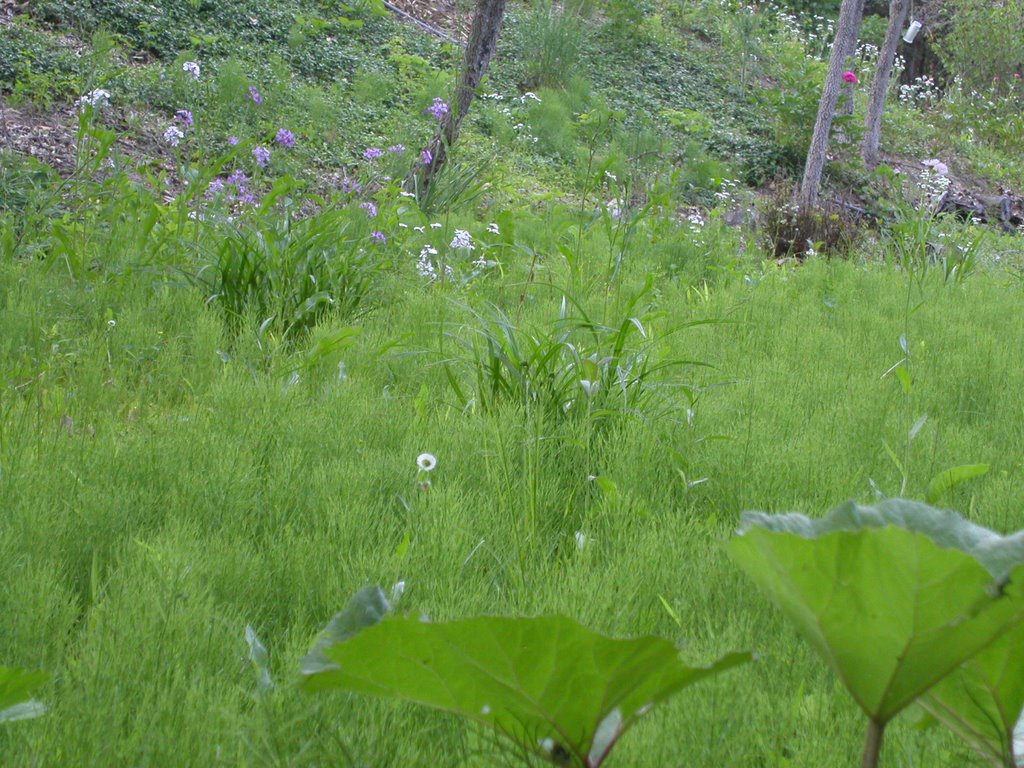
Next is another sample of a matrix planting, primarily Petasites hybridus, native Equisetum arvense, native Lysimachia nummularia, and at the far edge, Carex muskingumensis, Darmera peltata, cimicifuga (actea), and thalictrum. The equisetum, though highly invasive and a competitor par excellence, will wither away in a month or so, leaving room for a really disgusting ruderal, Japanese stilt grass (Microstegium vimineum), to intrude.

The vertical wands rising from the petasites are flowers, which you can see more clearly in the next photo.


The next two photos show views turning clockwise about 150 degrees.


The more "finished" matrix above contrasts markedly with another garden view below. Here is where the filipendula I opened with grows, along with other large wet prairie perennials such as Eupatorium purpureum (Joe Pye Weed), Liatris pyncnostachya, Rudbeckia maxima, assorted wetland irises, sanguisorbas, miscanthus, panicums, and other plants too numerous to list. Obviously there are no early perennials to make an attractive matrix planting here. This area won't reach its potential until July.


Here is where I need to develop spring plantings that will give interest and good coverage early in the season, then disappear, or at least tolerate shade cast by the larger perennials later in the season (spreading stress tolerators is what I need). More bulbs (stress tolerators) can certainly help, especially daffodils. Native persicarias especially like this area as the season progresses, so some early persicarias, such as Persicaria bistorta 'Superba', may be helpful. And, of course, a blanket of astilbes would give both color and interesting, long-lasting structure.

I'm open to suggestions.

Sunday, November 23, 2008

Groundcovers: lessons from Italy


In my never ending quest to find groundcover solutions to "hands-free" garden maintenance (I know, no such thing), I've been browsing through photos of groundcovering wildflowers and grasses I saw in Italy a few years ago. Looking forward to spring in western New Jersey, there may be lessons - certainly not ideas for specific plants - but observable growth habits, mixtures of forms and colors, that I can take from the Italian countryside.

I took these photos in late April of 2003 on a roadside just below Todi in Umbria. Previously we had always traveled to Italy in the fall, so this was my first experience of the Italian spring. I was amazed to find so many plants well adapted to the stressful environment of a busy roadside. Above and below is an unidentified Hawksbit (Leontodon). Notice the roadside gravel in the image below. This plant is growing only a foot or so from the traffic.


A striking carpet of grasses and a plant I can't identify (below). I can imagine this matrix of chaos and geometry in the foreground of a Renaissance tapestry or painting.


Italian bugloss (Anchusa azurea, I think), also right beside the road...


and a closeup showing more of the intense blue ...


Corn poppy (Papaver rhoeas) growing out in the field ...


and beside the road with short, early grasses ...


I'm guessing this is a sanguisorba, but you tell me ...


All of this was adjacent to Tiber River Park ...


We couldn't see the Tiber. This was the view.


I imagine these matrices of plants were transient. It would be revealing to see what plants - if any - were growing along this roadside after the hot, dry summer. Though climate change hasn't yet brought Mediterranean summers to western New Jersey, I'm sure I'll need to consider a succession of cool and hot weather plants to get a weed suppressing cover through the entire growing season.

Sunday, May 28, 2006

The Matrix


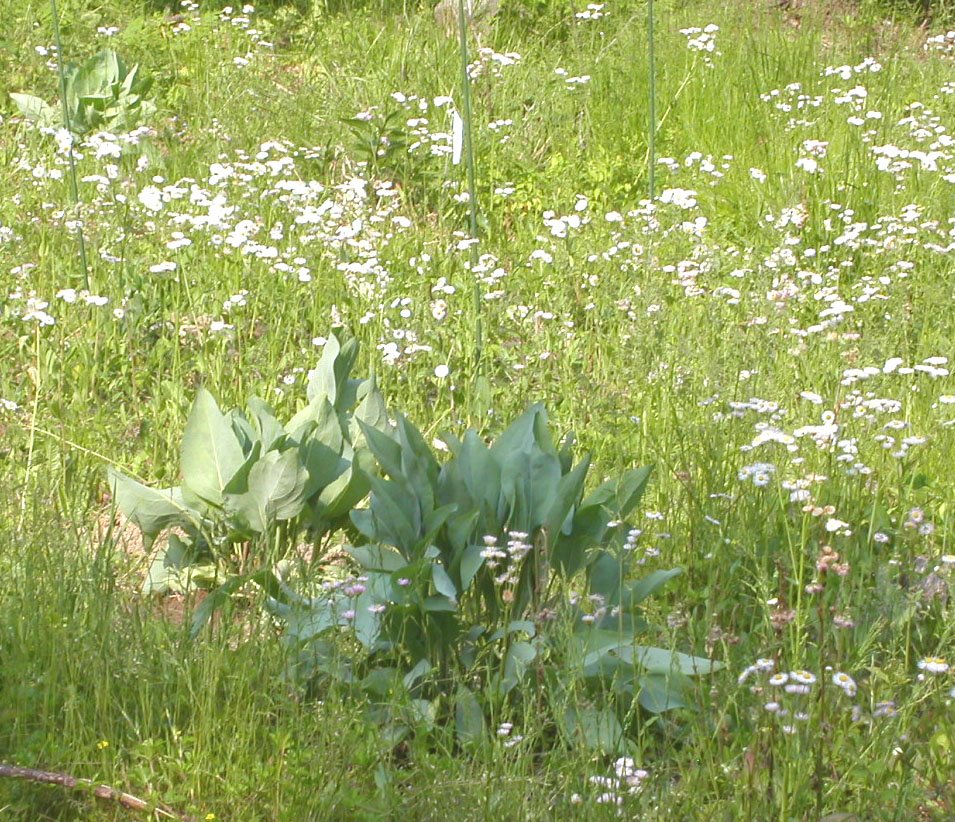
I'm planting in a matrix of native plants. Since I've cut trees to allow more light, I'm finding all sorts of changes in the "legacy" plants at Federal Twist. This week, I discovered Blue Eyed Grass for the first time since we moved here. I suppose it's emerged because of the brighter conditions. But the Blue Eyed Grass is only an incidental pleasure. The major components of the natural matrix are, at present, fleabane (Erigeron philadelphicus), a large, isolated colony of Equisetum arvense in a very wet area, numerous Carex and Scirpus species, and early season grasses I haven't yet identified. The matrix of equisetum is thriving and now forms an attractive blanket of soft texture that contrasts with the bulky form of Petasites japonicus and the sword-like spires of assorted irises that like the damp conditions.

I feel compelled to say a few words in defense of the fleabane. It's not the prettiest flower in the world, but in mass, it lights up the grasses and creates a lot of visual interest from a distance. I'm interested in using short-lived ruderals like fleabane to help prevent seeding of more pernicious weeds. I'm even hoping to displace some of the poison ivy and multiflora rose that keep so many visitors from walking in the garden. Over time, I expect the fleabane to gradually disappear as intentionally introduced plants become established and take up more garden space.

Placed amid the matrix of native grasses, carex, and sedges, plants with strong, easily "read" structure help give the emerging garden a recognizable intent and sense of order. Last year's planting was mainly experimental. Though I've researched plant selections, I really won't know what can grow here, in unimproved conditions, and what can survive deer browsing, without experimenting. One plant that came through the winter with flying colors is Rudbeckia maxima. The large, prominent, glaucous leaves are the main attraction. Planted in groups, and scattered in apparent random patterns, the rudbeckia will provide a strong visual interest throughout the year. The flowers, on tall spires, add vertical contrast, and with their long-lasting seed heads, remain attractive long into winter.


I ordered a flat of Silphium terebinthinaceum, which should thrive in my conditions. About half of them are growing. Their mature foliage, which is low but very large, should complement the rudbeckias, and their later bloom should add another feature later in the season. Do deer like to eat silphium? I'll let you know.

The verdict is still out on various Joe Pye Weeds, which I love. The emerging shoots have suffered some nibbles. Since this plant isn't a favorite of deer, I'm hoping the browsing damage is a result of the deer "taste testing," and the majority of plants will reach maturity and flower. Several Eupatorium cannabinum seem to be growing well with no damage so far.

The ornamental grasses, of course, are deer proof. More on that later.

LinkWithin

Related Posts with Thumbnails