Pages

Showing posts with label Wallace Stevens. Show all posts

Wednesday, January 09, 2013

Moving to WordPress


After six years with Blogger, I'm having serious technical problems and I'm no techie. Perhaps Blogger bogs down after several years of use?

I've decided to move View from Federal Twist to WordPress.

I'll provide a new address within the next few weeks. Meanwhile, posts will continue here, and the old blog will remain accessible.

Now for some diversion:

Anecdote of the Jar

I placed a jar in Tennessee,
And round it was, upon a hill.
It made the slovenly wilderness
Surround that hill.

The wilderness rose up to it,
And sprawled around, no longer wild.
The jar was round upon the ground
And tall and of a port in air. 

It took dominion every where.
The jar was gray and bare.
It did not give of bird or bush,
Like nothing else in Tennessee.

  - Wallace Stevens

From Wikipedia:  'This famous, much-anthologized poem succinctly accommodates a remarkable number of different and plausible interpretations ... Helen Vendler ... asserts that the poem is incomprehensible except as understood as a commentary on Keats's "Ode on a Grecian Urn", alluding to it as a way of discussing the predicament of the American artist, "who cannot feel confidently the possessor, as Keats felt, of the Western cultural tradition." Shall he use language imported from Europe ("of a port in air", "to give of"), or "plain American that cats and dogs can read" (as Marianne Moore put it), like "The jar was round upon the ground"? [He vows] "to stop imitating Keats and seek a native American language that will not take the wild out of the wilderness."'

Has American gardening also been in the same predicament? Should we continue to use models "imported from Europe" (oh, how many times have I read that Americans want English gardens!), or "seek a native American [garden] that will not take the wild out of the wilderness"? 

Noel Kingsbury and many others have noted that many American gardens are surrounded by woodlands, and this is one distinguishing characteristic.

I don't mean to be abstruse (though I'm doing just that) but when I stumbled upon Helen Vendler's comments on this old favorite poem, I was struck by a parallel concern in American gardening.

Sunday, April 08, 2012

Easter morning - a garden story


"Complacencies of the peignoir, and late
Coffee and oranges in a sunny chair ...
... mingle to dissipate
The holy hush of ancient sacrifice ...

We live in an old chaos of the sun,
Or an old dependency of day and night,
Or island solitude, unsponsored, free ...
Deer walk upon our mountains, and quail
Whistle about us their spontaneous cries;
Sweet berries ripen in the wilderness;
And, in the isolation of the sky,
At evening, casual flocks of pigeons make
Ambiguous undulations as they sink,
Downward to darkness, on extended wings."

from Wallace Stevens, Sunday Morning


This is it, folks. A life of grace given in mystery. We go gentle on this old earth, or should. It's all we have.

Seeking completion, and something like beauty and my own kind of salvation (I'll be 67 on Monday), I've been thinking about that empty space across the garden; you see it more closely below ...


... the space on the other side of the far path ...


 ... it needs a stone wall, a wall of "ambiguous undulations" to frame the garden's story - a visual halt before the woods begin, perhaps a serpentine wall  of undulating height to build a little movement, rising gently to meet the understory of Viburnum prunifolium catching the morning light, reaching up to the trees. A wall to set the garden, in this bare state, in silent motion.

(Thanks to Emily for reminding me of Andy Goldsworthy.)

After realizing readers were interpreting this post as religious (christian), I've amended it. 
This is not a religious posting.

Saturday, July 05, 2008

Garden Diary: sunny morning


Gardening in a woodland makes opportunities for structure - I mean spatial structure in the broadest sense - hard to come by. Here the planes of plant material carry the eye away from the house toward the woodland, left balancing right, and trees climbing to loftier heights with increasing distance, creating a focal point centered by the Miscanthus 'Morning Light' in the foreground. I learn to take my garden structure where I find it, then work to strengthen it - a difficult thing to do in this wild garden. So much depends on where you stand, the time of day, the season ... and I should add, on the selective eye of the camera.

In a very real sense, this view is 'created' by the position of the camera, the backlighting of the dogwood and Miscanthus in the foreground in contrast to the dark foliage of the trees behind, the centered grass and, very importantly, the cropped edges of the photo. The real garden doesn't have this frame, so the 'focusing' effect of the grass is far less pronounced. But this example does show the possibilities in using structural elements to direct attention, create spatial contrasts, and connote meaning (Miscanthus 'Morning Lignt' = radiance?). I am reminded of a poem by Wallace Stevens.


I placed a jar in Tennessee
And round it was, upon a hill.
It made the slovenly wilderness
Surround that hill.

The wilderness rose upon it,
And sprawled around, no longer wild.
The jar was round upon the ground
And tall and of a port in air.

It took dominion everywhere.
The jar was gray and bare.
It did not give of bird or bush,
Like nothing else in Tennessee.

Sunday, April 23, 2006

Shaping the woods, opening the sky


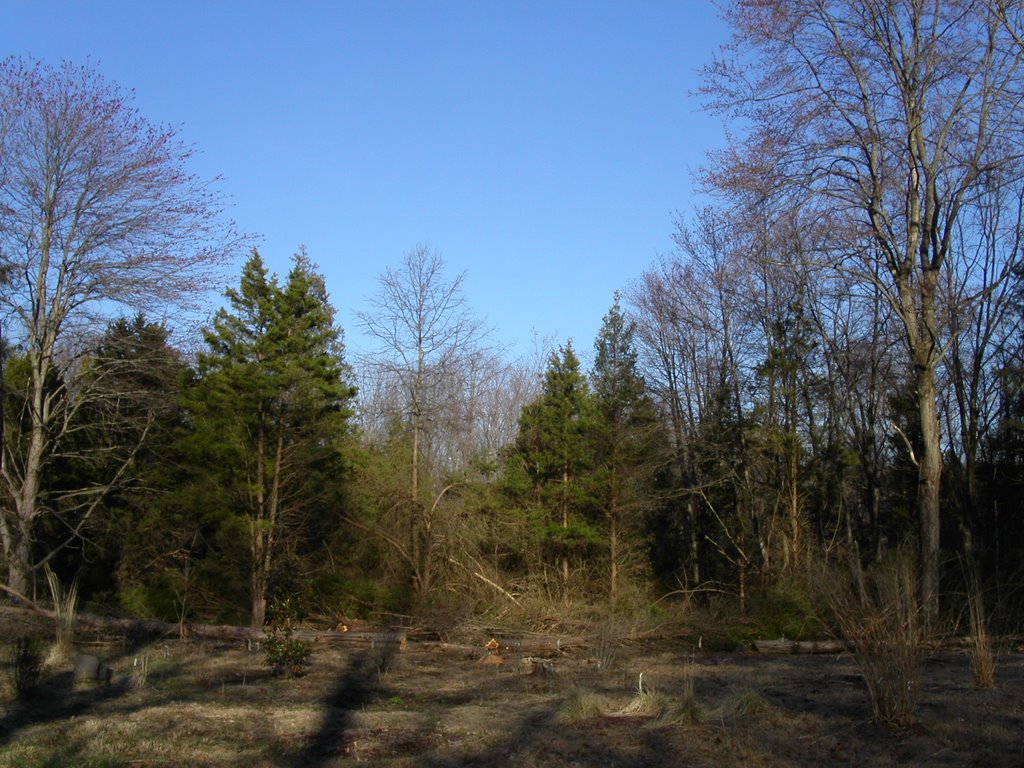
Here on this slope falling toward Lokatong Creek, the open field was left to grow wild 40 years ago. Small, randomly seeded cedars that look like pretty green sculptures in photos from the 1960s, grew into looming, scraggly, 60-foot trees coming right up to the house.

Cutting enough to create a ring of open space has been a costly and complicated chore. The ground is wet, very wet, through winter and well into summer, so felling the trees is the easy part. Moving them is almost impossible. No heavy equipment can get through the mud. Last year a crew manually moved and chipped 30 or 40 trees. I kept several truckloads of chips to create soft paths through the future wet prairie. This year I cut more cedars myself, then realized this 61 year old person doesn't have the energy, strength or time to do the rest of the job.

So I called in Tim and am waiting for his estimate. We discussed possibilities. Sustainable approaches appear to be the easiest to accomplish and the least costly. Fire is the easiest, and certainly appropriate for a prairie planting, but the danger of fire in the middle of the woods is too great. The plan is to cut up the trees into 30-inch logs, saving the largest ones for rustic seats, and to build a chevron-shaped wall of stacked logs on the back of the garden. This gives me a screened composting and utility area as well as hidden space to dispose of the tree limbs (good cover for wildlife too). The angle of the chevron relative to the house has to be just right, though. I hope it can follow the angle of the tree tops as they recede toward the vanishing point of the new perspective we're creating.

I'd seen stacked log walls in photos of other gardens and had already thought about using some such "natural" feature to help give structure to the wildness (think of Wallace Steven's poem - "I placed a jar in Tennessee and round it was upon the hill. It made the slovenly wilderness surround that hill").

Though the ground is a mess of fallen trees, the sky has opened like an eye above the emerging field and the back line of deciduous maples, oaks and chestnuts forms a noticeable circular border that appears to surround the house (an illusion). The woods are more open too, more like the older forest at the sides of the house, allowing the eye to move into the distance through the interstices between the trees.

I want to continue thinning out the cedars (I'll leave a few) over the coming years, making a more open, park-like area around the house, but there will be plenty of brush and undergrowth to encourage wildlife.

LinkWithin

Related Posts with Thumbnails