Pages

Showing posts with label Vernonia fasiculata. Show all posts

Sunday, August 07, 2011

Garden Diary: Yellow to Mauve, with Sound

High summer and ample rain have given me a garden almost profligate. The large prairie plants have grown even taller than in past years and spread by self-seeding into new areas. The invertebrates, the insects, appear to be thriving, usually more apparent by the sounds they make than their visibility, with healthy populations in good balance. That I had no problem with Japanese Beetles this year, only a few, I attribute to a diverse invertebrate community in equilibrium.

Angelica gigas, a honeypot for insects from Heronswood

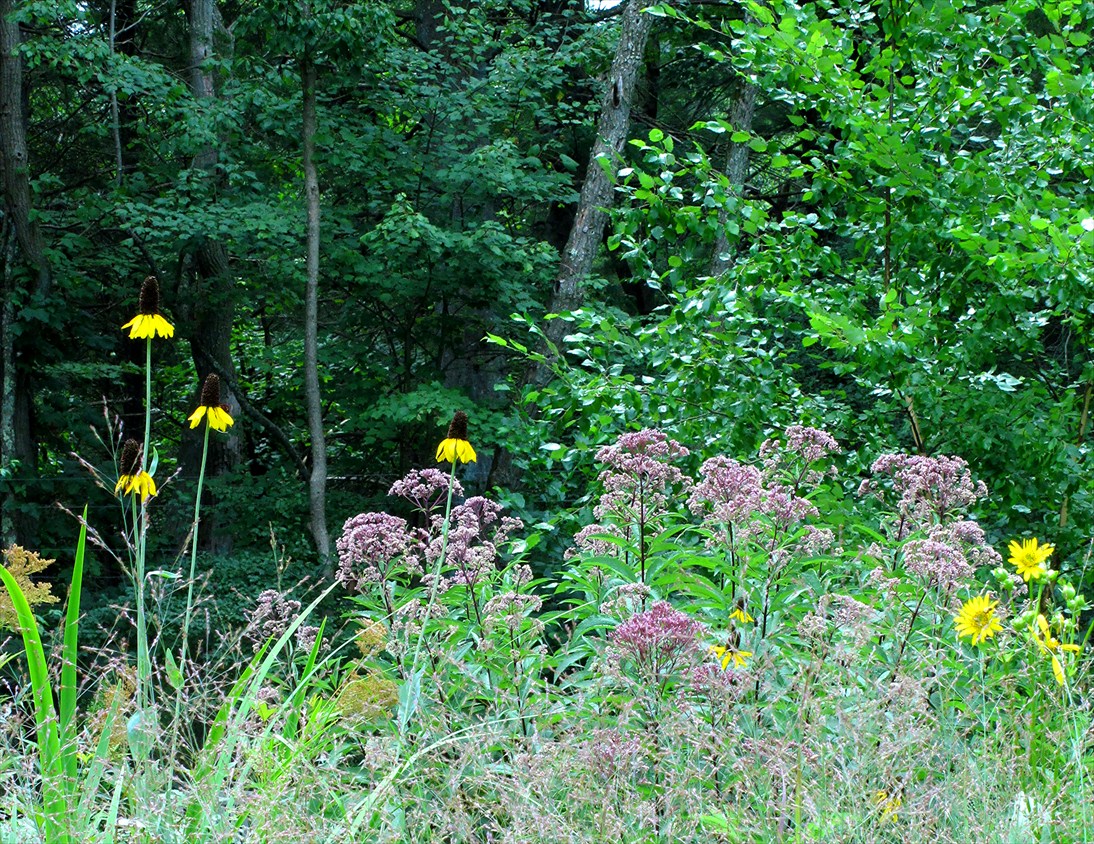
The tall yellows continue and now they've been joined by the mauves--broad masses of Joe Pye Weed (Eupatoriadelphus maculatus), intense and transient deep violet of Iron Weed (Vernonia), somewhere in between a few Prairie Blazing Star (Liatris pycnostachya), which survive only in propitious locations, not being as successfully competitive as some of their neighbors; even my only Angelica gigas, a dark, burnished, purple-almost-brown. As these colors fade through August, the grasses have just begun to put on their late summer fireworks.


I've linked a short video of the garden to this photo. Take a look (click on the photo above), and you'll see a panning shot across the garden from the raised position of the house. This gives a good overview, but it really misrepresents the garden, which looks entirely different when you walk down into it. Looking at the video, you'd have no idea a network of rather wide gravel paths, and other smaller paths, run through the plantings. You see much more of the intricate detail only by walking through, and the rest of this post will take you on that walk.


Here are several views of the main path across the garden showing the plantings beginning to overflow the edges, a desirable state of affairs to my thinking.


Vernonia, Eryngium yuccafolium, Aster tartaricus 'Jin Dai', Silphium terebinthinaceum, Rudbeckia maxima, Physostegia virginica, Panicum, Hemerocallis crowd the path edges.


This isn't planned color, and I make no excuses for it. My interest is line, mass, form, movement, visual tone in the sense of emotion more than color. Above, the tall Rudbeckia maxima on the left, fluffy aging flower heads of Queen of the Prairie (Filipendula rubra) below it contrasting with the sword-like leaves of the early spring Iris pseudocorus, then a bunch of Joe Pye Weed, which really is much more colorful than this photo shows, and Cup plant (Silphium perfoliatum) on the right, all softened by the gauzy screen of flowering Switch grass (Panicum virgatum 'Shenandoah').


Further down, form, texture, and the enormous variations of green make an entirely different effect, less impressionistic, more literal in a comic sort of way. Paddle-shaped leaves of Prairie Dock (Silphium terebinthinaceum) and giant coneflower (Rudbeckia maxima) make a busy show of themselves against a background of now silver Mountain Mint (Pycnantheum muticum) and Panicum 'Dallas Blues'.


I want masses of white Obedient Plant (Physostegia virginica 'Miss Manners', above) and have more growing on for planting after the weather cools. My goal is to treat the Pycnantheum and Physostegia as a groundcover, and spike it here and there with red to orange Daylilies (Hemerocallis). I suppose I'm more a creature of fashion than I'd like to think, and have unconsciously absorbed a liking for hot colors--though it's not just a matter of fashion; in my intensely green garden, the spots of brilliant color add a pleasing depth and complexity, passion smoldering in dark recesses.


You might think they would clash with the very different color scheme of the garden as a whole but, because their blossoms tend to occur in isolated spots, and are highly transient, they don't. Hemerocallis also seem to do well in a highly competitive garden environment, and the other plants hide their tattered, unattractive foliage after the blossoms pass.


On to the sound part of this post's title ...  All these plants attract hordes of insects, and their movements and sounds are entertaining and stimulating, sensuously and intellectually. At this time of year, these "incidental" insect performances happen against the constant roar of cicadas emanating from the wall of woods surrounding the garden. The sounds come in rhythmic waves, as the insects answer one another. And the night sounds, of course, choruses of frogs serenading. 


The audible landscape is like a separate world ... one I can't understand at all but perhaps understanding isn't necessary. You can just give yourself over to the sound, "rest" in it like a giant sonic cushion of vibrant air.


About eight feet off the main path Marc Rosenquist's sculpture, though not mauve or purple, certainly associates easily with those colors. These daylilies are the last to bloom of about fifteen planted throughout the middle of the garden. You see them from one angle and ...


... from another you don't. Again, a demonstration of the need to walk around to see the plants from various points of view.


The pathway across the middle of the garden. Another way to get up close to the plants. I'm adding yet another, less obvious path branching off from the left of this area to make it possible to get deep within the plantings.

 
A European grass, Molinia caerulea 'Skyracer', with tall, delicate flower stalks, crowds the entrance path, so close it touches you, but so light and airy you don't mind a little crowding (well, some do).


Last weekend we added this small new entry path on the opposite side near the house. We put it in by violent means, just digging across trying avoid established plants. I don't really like it; it's too neat and tidy. The edges need to be muddied and planted, and some larger plants will have to be moved next spring. Then, perhaps it will look a part of the garden.


This is the view up toward the house from the new small path ...


... and here a glance off to the side.


Tuesday, June 29, 2010

Extensive gardening: making the best of necessity

Gardening a large area of over an acre, only on weekends, and on unpropitious heavy wet clay, allows no time for intensive gardening, for achieving perfect edgings, astonishingly designed set pieces, carefully manicured, intensively maintained lawns and perennial borders. My gardening is of the extensive kind, much more like farming, and the limited time I have available, what with the exigencies of variable weather, often means moving from one problem to the next, and learning to live with some roughness around the edges. Who said naturalistic gardening is not labor intensive? Here are some photos showing what's happened in the past week, along with visible signs of necessary extensive maintenance.


Never having attended to planting at the top of the stone wall, I needed to kill bindweed and poison ivy that had become entwined with the existing plants. No getting around general destruction. Roundup (used very judiciously, in targeted areas, shown below) killed all growth at the edge, though I did manage to save one large Sanguisorba tenuifolia. Now to wait and see if it killed the roots of these two pestilential plants.


Selective cutting of the meadow grasses has begun (below). I do this after the wildflowers have gone to seed, and to reduce competition with preferred grasses and perennials--panicums, Filipendula ulmaria, Japanese and Siberian irises, Silphium perfoliatum. When time permits and materials are available, I want to add a small, one-person path wandering through this area, giving access to the pond side off to the left, and keeping the feet above the ever present wet from fall through early summer. Here is another example of extensive maintenance: the cuttings are left on the ground, to decompose in place, and over time, to increase the organic content of my mostly mineral clay. No time for nasty neat.


View across the garden. A 30-foot-long planting of Filipendula rubra 'Venusta' is in bloom on the right; the pink color looks rather faded in the bright afternoon light, but I grow this plant mostly for the sharply angular, almost chartreuse foliage, and for its vigor in my difficult soil. Sanguisorbas, Joe Pye Weed, Iris virginica in the foreground, further back Rudbeckia maxima, Lysimachia ciliata 'Firecracker', more irises. Most of this will be burned in late winter--another labor saving practice, and it's good for the grasses.


Looking across the pond, obscured by plant growth, toward the miscanthus bank, with the strip of intentional devastation caused by glyphosate. In the foreground is Panicum 'Heavy Metal' and 'Cloud Nine', more Silphium perfoliatum, Ligularia Japonica about to bloom at the front. The miscanthus makes a very good, though quite large, ground cover, helping keep undesirable plants under control.


More views of the filipendula, since it's the floral "star" of the moment. I'll like it much better when the pink fades to more subtle copper tones.


We've had increasing heat, without much rain, which is sending these Silphium laciniatum rocketing skyward (these are about eight feet tall now). They must have put on three feet of growth in the past week. These plants always flop when they get too tall. I'm hoping the lack of water will make them strong enough to stand on their own this year. We'll see; thunderstorms are predicted for today.


The silphium with more Rudbeckia maxima and Vernonia fasiculata. The ground surface shows where I've cut a path for walking through the plants (wide enough for one lone person). Yet another project is to add a gravel surface to make the path permanent.


Close-up of the silphium ...


No time for raking gravel back into place after storms or other disasters, thus the borders of rock (native, of course) to keep all in place. Eventually there may be ground covering plants bordering the path, but only as time permits, and only if nature cooperates. I don't mind the grasses.


Another vigorous plant that helps with spotty maintenance. Eupatorium cannibinum, a European eupatorium, seeds itself around, eventually making large masses if left to itself, but easily pulled out if not wanted. It obscures a multitude of sins. Here it's just coming into bloom.


Another useful plant, for the water's edge, that makes a lovely mass of color, shape and texture--Pontadera cordata. It's vigorous enough to outcompete the weeds.


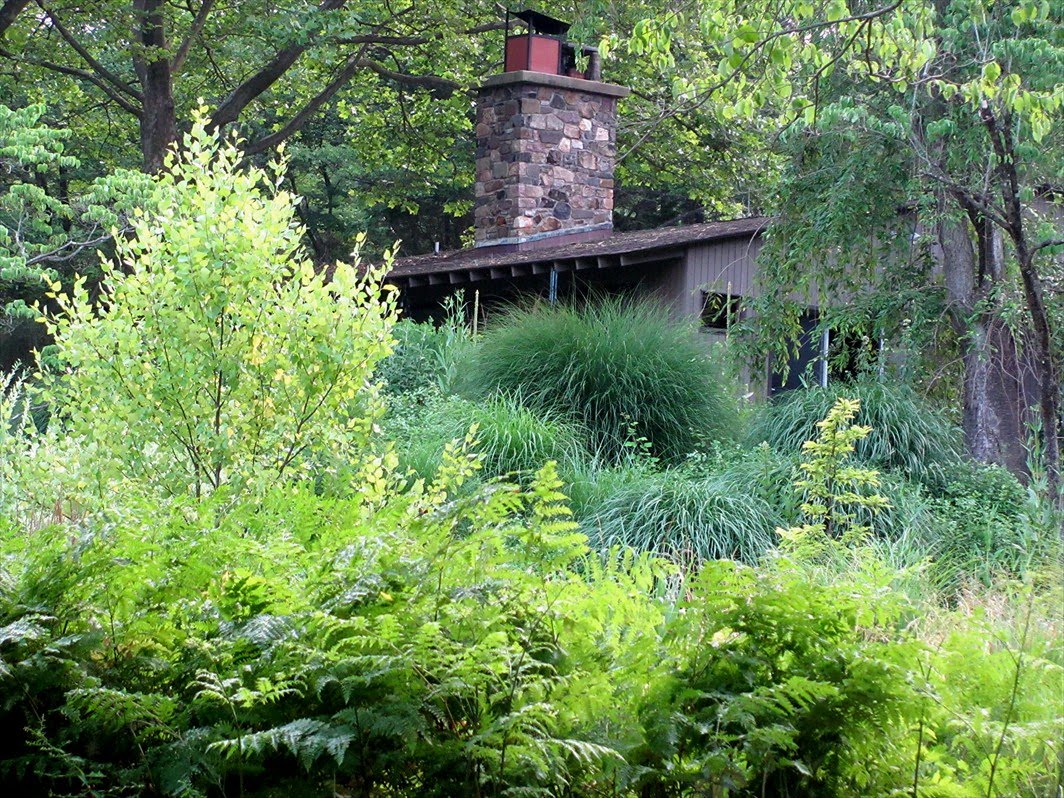
Much of my approach to extensive maintenance, in case you haven't noticed, is to use large, rather highly competitive plants, which just happen to be well suited to my conditions. Here the plants appear to be eating the house.


Miscanthus, willows, river birch - they cover a lot of ground.


LinkWithin

Related Posts with Thumbnails