Showing posts with label prairie. Show all posts
Wednesday, January 12, 2011
New snow: sense of place
Unity of house and garden was uppermost in my mind when we moved to Federal Twist Road at the start of 2005. The mid-1960s house, raised on a man-made hillock above the surrounding wet, is low and long, with a low roof line and wide eaves that give it a hooded look from the distance. The house was painted a taupe color that blends well with the surrounding woods. It was clear from the start that this house could only overlook a naturalistic garden, a garden appropriate to this place.
In a photo taken last fall (below), the looming presence of the house dominates the garden yet blends easily into the wooded setting. In the growing season, a screen of grasses and mature trees surrounding it make it recede into the background, almost disappear.
But that's all about how the house looks from the outside. Although the style of the garden responds most directly to its external appearance, most garden viewing takes place inside the house, particularly in winter months and inclement weather.
Throughout December, when holiday activities kept me in our Brooklyn house -- really just a series of painted boxes with limited views out -- for the better part of a month, I found myself literally craving these woodland views. I guess I have to admit that old cliche about the healing quality of nature is true, much as I want to dismiss it as trite and sentimental.
Now I'm spending a week in the country. On this winter weekend, with accumulating snow keeping me inside, I've been made acutely aware that outside is inside too, so I set about making a photographic record of the visual unity of house and garden -- but this time from the inside looking out.
Though the living room and study give all-encompassing views of the garden and surrounding landscape through a window wall ...
... in fact, each room in the house, including kitchen and bathrooms, offers substantial views out.
The dining room view out the opposite side toward the driveway and Federal Twist Road ...
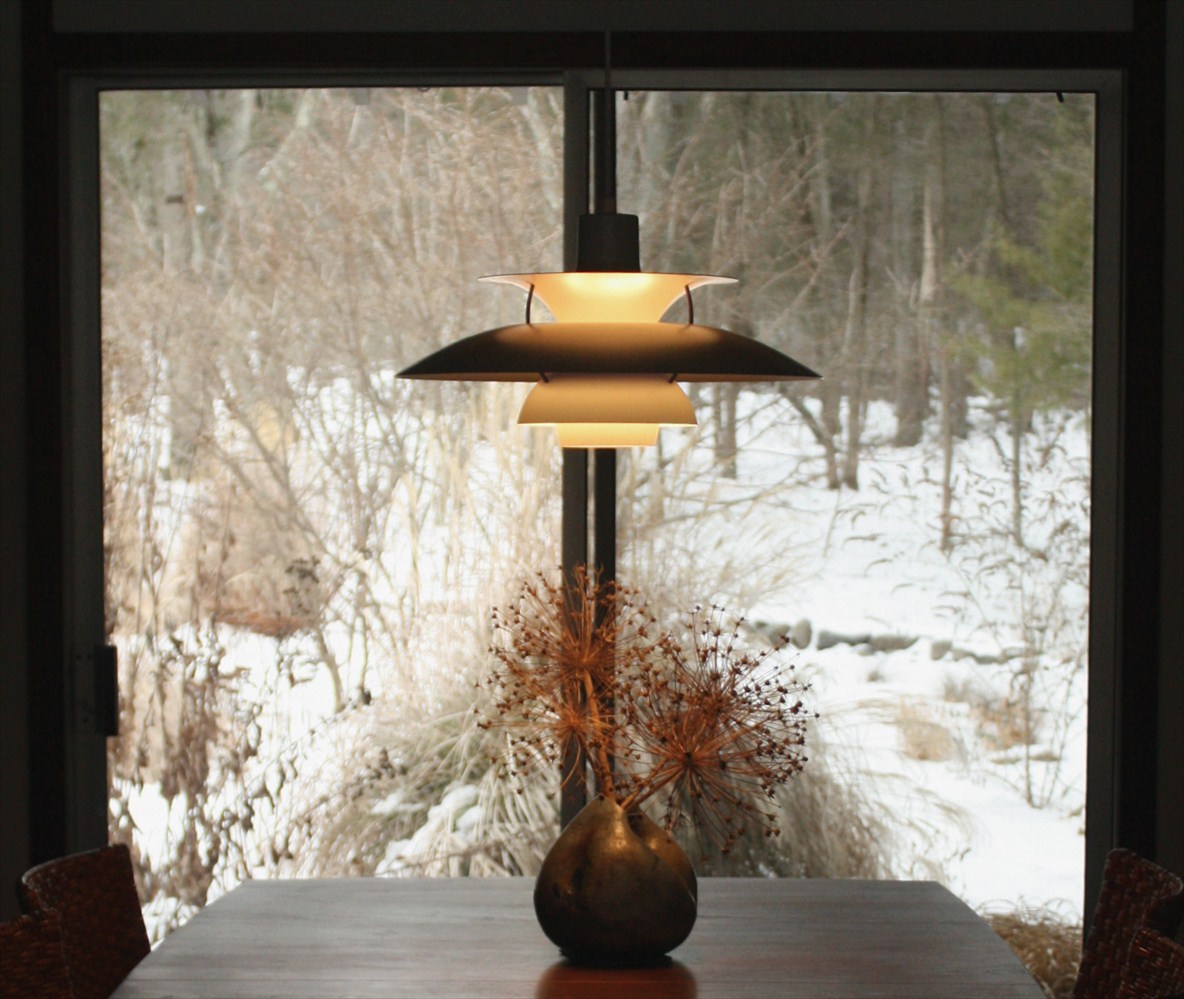
... the guest bedroom, with a view onto the gravel terrace, across the garden, into the woods ...
... the master bedroom window, looking out the far end of the house to an old stone row ...
... the view out the side window of the study, onto the woodland garden, and a simple, rustic bench made of two 60s-era concrete blocks and planks ...
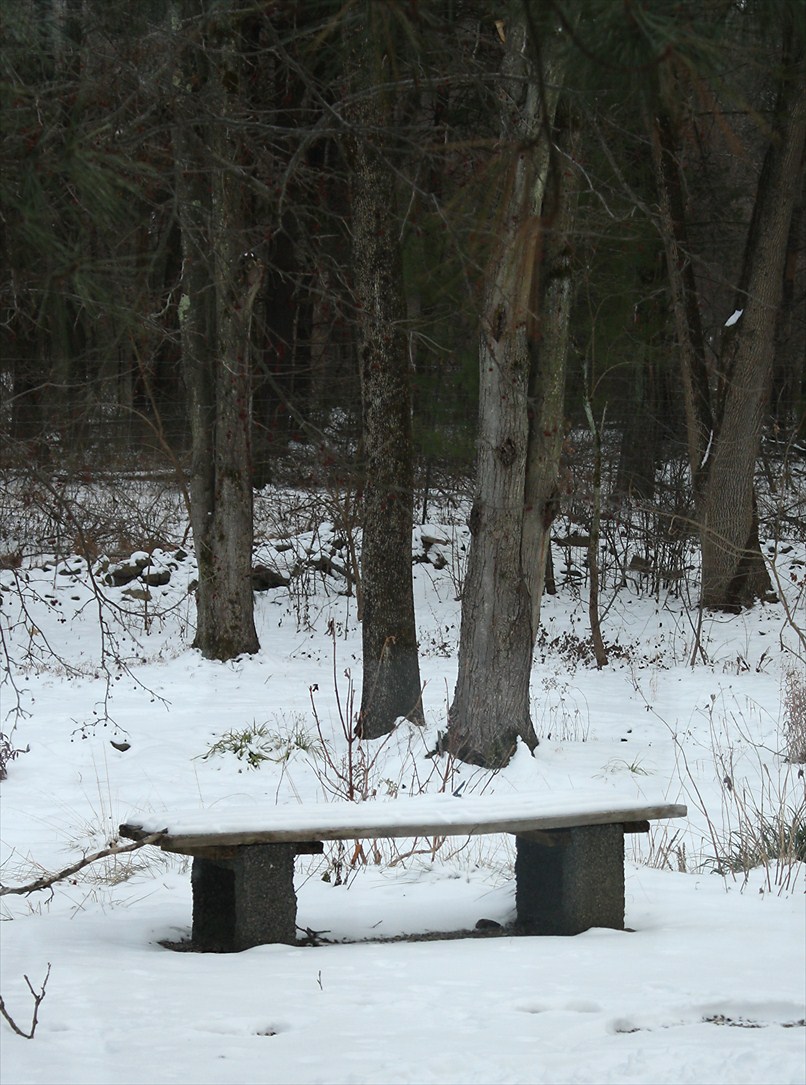
... and another view out the back of the study to one of three Sycamores planted as saplings when the house was built in 1965 (note the colors and textures of the bark, repeated in the background landscape!).
Sense of place is what this garden is about. I was intrigued when Peter Holt quoted Claire E. Sawyers (The Authentic Garden: Five Principles for Cultivating a Sense of Place) because it introduced me to the Japanese concept of wabi-sabi. As I wrote to Peter, "I've been trying to put this into words, and thanks to you, I've discovered my garden fits into this centuries-long tradition--another little miracle... like reading my own autobiography written by dead people from another culture and another time."
Sawyers suggests that westerners' longing to create Japanese gardens comes from a confusion of those gardens' specifically Japanese cultural influences with their more universal wabi-sabi character, which is admiration for things or places that can be characterized as humble, transient, beautifully worn, with the patina of use and age, the natural, the unpretentious, the familiar seen in a new way.
As one authority, she quotes Lenord Koren (Wabi-Sabi for Artists, Designers, Poets and Philosophers): "Wabi-sabi represents the exact opposite of the Western ideal of great beauty as something monumental, spectacular, and enduring. Wabi-sabi is not found in nature at moments of bloom and lushness, but at moments of inception or subsiding. Wabi-sabi is not about gorgeous flowers, majestic trees, or bold landscapes. Wabi-sabi is about the minor and the hidden, the tentative and the ephemeral..." I might even add, the informal.
Thus, Sawyers suggests that one way to cultivate sense of place is to use humble materials, materials that through nature or culture are appropriate to the site. Our house is very much at one with this landscape and this garden. It's a simple house, really a profusely fenestrated shed-like structure; built of wood and stone, and colored much like the bark of a tree in winter, it takes on the character of the woodlands and garden surrounding it. It welcomes the outside in, in almost any direction you look. Very much a wabi-sabi relationship of house and garden, I think.
The wide, over-hanging eves and part of the window frame in the next photo give that fact a hard reality, contrasting the ordered, rigid, yet simple man-made structure with the looseness and complexity of the grasses and trees.
So what does this Japanese artistic concept of wabi-sabi have to do with my house, grasses and woods? I'd say it gives me a theoretical and historical context, it gives me a place to belong, makes me part of a group, though not necessarily a Japanese only group.
Not at all, certainly, for we in North America have a long tradition of naturalistic planting through imports such as Jens Jensen, a German who came to America and became an early advocate of prairies and managed natural landscapes, and our own native Frank Lloyd Wright, who gave us the concept of the "prairie house," of which my own is a descendant, and who also brought much of the Japanese aesthetic to his work. And, of course, more recently, the work of Oehme, van Sweden Associates, who pioneered American naturalistic planting over the last decades of the 20th century, and continue to do so.
In most ways, I'm doing nothing that hasn't been done by others for decades. With one possible exception, because I do carry one aspect of my "naturalistic" approach to the extreme, doing virtually nothing to improve a difficult, heavy clay soil or very poor drainage. The plants must be capable of adapting to these conditions or they languish and die. Ironically, two grasses from different continents are among the most successful: panicums, from North American, and miscanthus, from Japan.
We really don't even need the term wabi-sabi since these ideas have become a part of our garden culture by osmosis, percolating into our history and culture through innumerable routes.
But the Japanese source of the term is a useful reminder and prod to appreciation of classically Japanese detail such as the irregular line and asymmetry of the bare dogwood in the foreground of the photo below, and to the detail of our house, which owes much to Japanese influence.
The point of all this? That the garden is indeed part of the house, and the house a part of the garden. This relationship dictates the naturalistic look and style of the garden. Japanese influences are pervasive, but they have been thoroughly assimilated into the the local context of a wild wood in western New Jersey.
Saturday, September 06, 2008
The Battery Bosque: prairie as metaphor

On a visit to the Battery in early August, I discovered a new garden designed by Piet Oudolf in my home town. My August 11 post described that pleasant, even exciting visit. Since then I've been thinking about the historical importance of the New York Battery, the appropriateness of this garden to the site and its history, and have wanted to explore these thoughts in more depth. Anne Wareham, on the ThinkinGardens website, has published helpful points to consider when visiting gardens. The following is a more thoughtful report on my visit to the Bosque garden using some of Anne's suggestions.
The Bosque garden at the Battery on the southern tip of Manhattan is a totally unexpected gift. Dirt paths flowing in a relaxed meander under the light cover of 140 London Plane trees define islands of perennial plantings. A grungy, neglected park has been remade through Piet Oudolf's design into a practical, durable, beautiful, and historically and culturally appropriate strolling garden that powerfully evokes the American prairies. (Suspend for a moment the dissonance created by the idea of a prairie on New York Harbor.)
Relatively small, at only 60,000 square feet, the Bosque garden is easy to navigate. The paths offer plenty of opportunity for rambling, moving toward and away from the harbor, or to get a better view out - to the water, back to the towers of downtown Manhattan, a glimpse of the expensive apartment towers continuing to rise in Battery Park City.
The Challenge
By any measure the Battery is a hostile place for a garden. The heavy pedestrian traffic and the exposed nature of the site - on the waterfront, with virtually no screening from wind, sun, and salt spray - wedged between heavily trafficked streets on the north and the harbor on the south, and with an extraordinary labyrinth of vehicular tunnels and infrastructure underground, would seem to militate against establishing a perennial garden here. What better designer than Piet Oudolf, who works in a vocabulary of plant materials characterized by sturdy geometric form, durable structure, and the ability to provide visual appeal even through winter weather? Because of the small size of the garden, the plants must do double and triple duty, maintaining their appeal for much longer than typical in most gardens. Though I did see some plants in less than pristine condition, such as Carex muskingumensis cut back to the ground, on the whole most plantings were thriving. Oudolf's perennial selections appear too be superbly adapted for this site.
The Meaning of the Place
Beyond the hostile environment, the multiple layers of historic and cultural associations present yet other challenges. The Battery sets off a kaleidoscopic burst of images and associations, making this a difficult place to design a garden appropriate to site, use and history.
Does it Work?
The Bosque garden must respond in a meaningful and satisfying way to all these challenges. This garden works, and it works on many different levels, from the most practical to the highly symbolic. (I was intrigued by the use of the name "Bosque". The word is used for small wooded areas that thrive in environmentally hostile areas along rivers in the southwestern U.S. and is derived from the Spanish, so it is an appropriate name in a metaphorical sense.)

The Bosque garden easily accommodates existing uses and features of the site. It works as a route of passage for the hundreds of thousands of tourists who pass it to reach the waterfront to view the Statue of Liberty or to reach the tour boats. Walkways direct the throngs from the heavily trafficked northern edge around Castle Clinton to the long queues for the boats, shown in the plan above from the Battery Conservancy web site. The garden edges this passageway, offering paths into the Bosque proper.
The garden also coexists comfortably with the large, rectangular East Coast Memorial, seen prominently in the plan above and the photo on the right, and a 40-foot-wide walkthrough fountain popular with children. By maintaining a low profile the garden easily plays the role of decorative background to the new fountain and the large, stiffly erect Memorial of stone monoliths with a giant stylized eagle.
Standards of maintenance in New York City parks are generally quite low. In this case, I'm sure the Battery Conservancy is responsible for much more attentive maintenance than usual. The plantings too, as is typical with Oudolf designs, tend not to require a great deal of care, and are durable on their own. Over several years now, the Garden of Remembrance, which is really nothing more than the separately named waterside edge of the Bosque garden, and the Bosque itself have survived and even thrived in spite of apparently difficult environmental conditions, so the plantings can be said to work, and work well, on a practical level. I have only seen them in August, normally one of the hottest and most climatically stressful months in the City, and they were in amazingly good condition.
Anyone familiar with Oudolf's work will recognize many of the plants in the Bosque garden, but the design is not stale or formulaic. This is a risk of Oudolf's technique, based as it is on rather rigid planting principles with masses of astilbes, grasses, scutellaria, and other perennials in his pallet. We have seen many of the plant combinations before, but they are put to appropriate purpose here. Nearer the more crowded areas, the plantings are relatively low, maintaining an open view, and actually keeping the garden below the level of consciousness of most tourists, who after all are here to see the sights, not to visit a garden. For most of these visitors, the garden works on an almost unconscious level, serving only as a pleasant environment through which to walk.
For those visitors who want a garden, the plantings are low, like a low surf (many are groundcover), near the heavily trafficked end of Battery Park. As you stroll along the winding paths of sandy soil - surprisingly not stone or concrete, which you would expect - moving toward the east where the Staten Island Ferry Terminal blocks further passage - the plantings gradually build, like large waves of water, becoming looser, bulkier, taller, and taking on complex geometric shapes, very different in character from the rest of the garden.
A Conceptual Garden of Allusion
While it works as simply a beautiful, diverse, and intriguing planting, the Bosque garden is also a conceptual garden that works through allusion. How much of this is due to intellectual intent or simply to location and context I can't say. It may be that the garden, in its simplicity, takes on resonances of meaning just because it exists in this historic place.
Regardless, in the mind of this viewer it successfully negotiates the complex world of cultural symbols associated with the Battery and the concept of "America" epitomized in the Statue of Liberty and Ellis Island. The idea of "prairie" recalls a range of images, emotions, and stories emblematic of American history, from the "fruited plains" of the anthem "America" to the artistic vision of Willa Cather's My Antonia set in the prairies of North Dakota, and could be seen to refer to innumerable other stories set in the American prairies. The symbolic journey begun at the Battery ends in a multitude of different places and times, but none more appropriate than the center of the North American continent, in words of William Cullen Bryant, in the place "for which the speech of England has no name". The prairie has become such a central concept in American culture and literature it is hard to visit this garden without finding one's thoughts turning to the many themes associated with the American prairie.
There is no doubt this is a highly artificial garden built in one of the most heavily used pedestrian areas in New York City, above rail and automobile tunnels, surrounded by the towers of downtown Manhattan. But it is a successful and beautiful garden that provides visual delight and respite. It meets the challenges of the site's use and exposure, and through the metaphor of the prairie, helps clarify the meaning of the historical and cultural clutter of the Battery's past.
The garden can be appreciated on the most basic level, as a collection of striking plantings and pleasant views. For those who bring an understanding of the history of New York City and the Battery, of the defining importance of the prairies (now mostly vanished) in American culture, and of the symbols that have become deeply embedded in American identity and the concept of Manifest Destiny, it offers a more meaningful, contemplative, and culturally self-critical experience.
(Photo of lower Manhattan and plan of the Battery are from The Battery Conservancy website. Other photos from August 11 post and Phillip Saperia.)
Friday, February 29, 2008
Garden Diary: To Burn or Not to Burn?
I ordered a flame gun this winter and want to use it on my grasses. In years past, I've cut the grasses into two-inch pieces and left them in place as a mulch. This year, to reduce the labor, and to adopt a practice more appropriate to a prairie, I want to burn them. When I do that, I'll face at least two months looking out at charred and shredded "biomass." Not a sight I want to contemplate. This morning about an hour after sunrise, I saw this Chasmantheum latifolium, with its spangles of seed heads. Still quite attractive. I suppose I should just load up on novels and gardening books, put my flame gun into action, and plan to do a lot more reading until spring comes. If I wait much longer, the new growth will emerge, and burning will be out of the question.
Labels:
Chasmantheum latifolium,
ornamental grasses,
prairie
Subscribe to:
Comments (Atom)