Pages

Showing posts with label Silphium. Show all posts

Monday, September 24, 2012

In another light


Fall arrived this past weekend. The sun was shining full at a low angle, bringing the first intimations of the season's glowing golds, yellows, oranges and reds, stippled by purple asters, black seed heads, fruits and berries that announce the end of the garden year. The fermenting fragrances of autumn soon will begin to rise from the earth.

This set of sun-lit photos contrasts with the twilight photos in the previous post. Click on this link to see that post.

Leaf-strewn terrace overlooking the garden. The worn blue stone paving dates to the mid-1960s giving the modest sitting area a patina of age.


Late blooming Lespedeza thunbergii 'Gibraltar'.


Geranium 'Rozanne'.

Steps down to the garden, of native argillite stone.

The small pond surrounded by mounds of debris just heaved out.

The bank up to the house, still a work in progress.

As the sun drops behind the trees, theatrical shafts of light create moments of transient radiance.


Panicum virgatum 'Shenandoah'.

Filipendula rubra 'Venusta' in its copper phase, asters yet to bloom behind.

The native Seedbox (Ludwigia alternifolia).

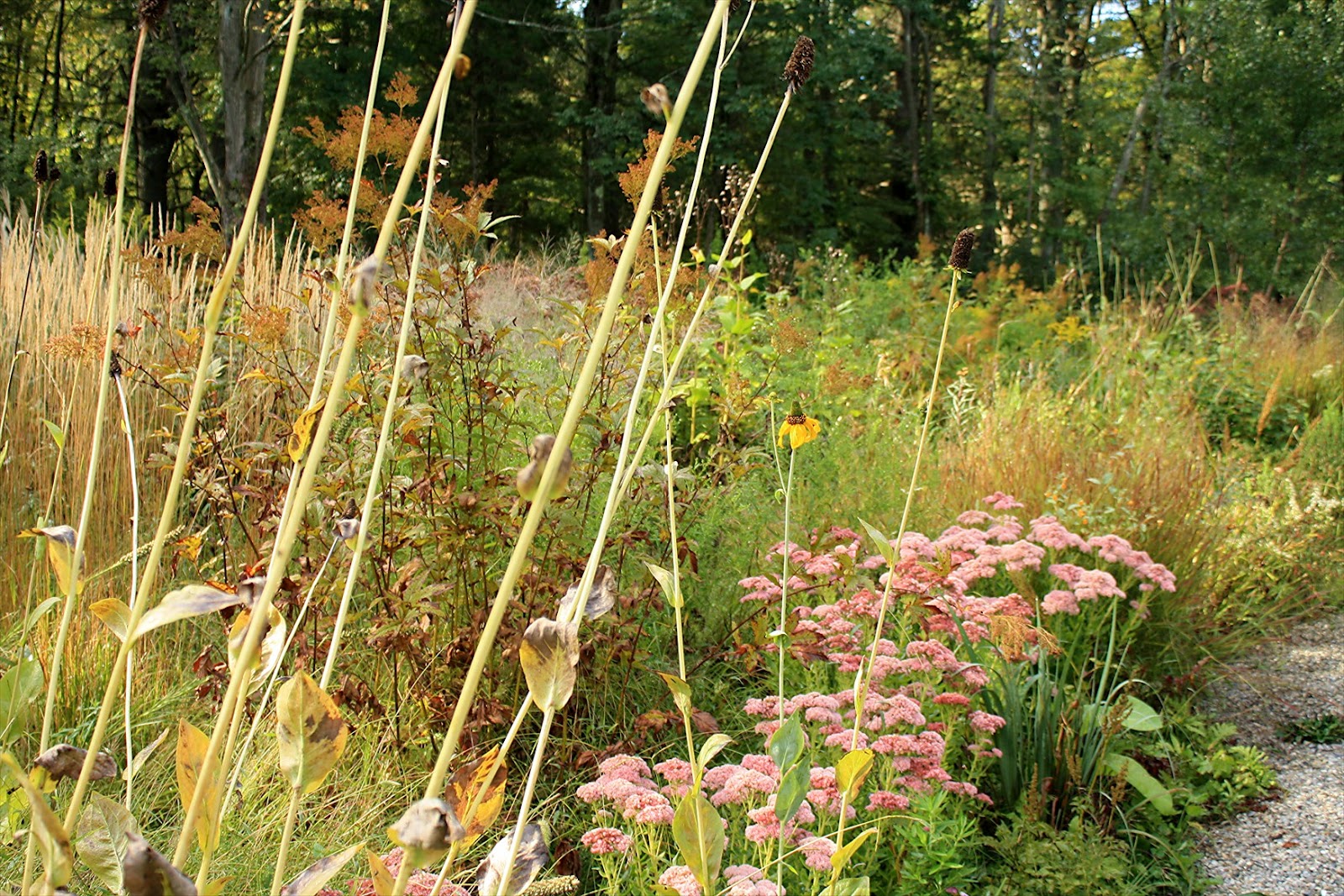
Rods of Rudbeckia maxima, Goldenrod, some of which I must pull out to control its spread.


Looking across the garden toward the east.


Tall Silphiums and Rudbeckias dominate here earlier in the season. More interesting ground level plantings are in the works ... orange daylilies in grass, Pycnanthemum muticum, Rudbeckia 'Henry Eilers'.

Serpentine wall.

Wave Hill chair with Miscanthus purpurescens on right.

Looking up toward the house. Is refuge in the house or is it in the garden?

Back path with partially planted area on the left. I just seeded Sorgastrum nutans, which is endemic to this site.

Miscanthus 'Silberfeder' and Inula racemosa 'Sonnenspeer'.


View across bracken toward six red walnut logs, with new Miscanthus giganteus making a partial wall behind.

Hidden path into interior sitting area.

Pycnanthemum muticum and Panicum.

A place to sit, like a nest among tall perennials.

Late blooming vernonia with asters and blue lobelia.


Pycnanthemum tenuifolium, naturally occurring on this site.

Vernonia seed heads.

Inula and Miscanthus purpurescens.


Looking toward the hidden terrace.

Mystical 'omphalos' of the garden.


The elevated box hedge slowly merging with the garden as perennials seed into the planting. I do have to control this.


Great blue lobelia randomly seeded in.

White Eupatorium perfoliatum and Great blue lobelia, with a large self-seeded Patrinia scabiosifolia between, randomly timed to grow tall and bloom next year. Hydrangea quercifolia behind.

Looking across to the woods. Patterns of light shift moment to moment.


Monday, July 28, 2008

Garden Diary: July Exuberance

The weeks are flying by and the garden is changing quickly. Since I see it only on weekends, the change seems faster. About two weeks back the cotton candy plumes of Filipendula rubra 'Venusta' had peaked and Rudbeckia maxima was just coming into bloom. The Filipendula plumes have alchemized to coppery webs and the Rudbeckia is dropping its petals, its slim stems all askew since the long dry spell suddenly ended with heavy thundershowers and violent winds five days ago.

Above is the entry to the wet prairie garden, by way of the small pond. Below is a photo tour, moving roughly clockwise around the garden.


In the foreground is a very old Viburnum plicatum I cut to the ground when we moved in and had to clear about 60 cedars to open the land to light. A mistake - the viburnum had taken the form of a small tree. I wish I had kept it. It's nearing three feet, so I look forward to having it again as part of a middle layer.

The 1965 house has a wall of floor-to-ceiling windows overlooking the prairie garden.

Moving clockwise ...

... further clockwise ...

... and again ...

Part of a rapidly growing colony of Physostegia virginiana. This end of the garden will be mostly white and green.

After two years, the first Prairie Dock (Silphium terebinthinaceum) to flower.

Joe Pye Weed through Panicum virgatum 'Cloud Nine' - a very popular panicum a few years back, but now hard to find in nurseries. So much clamour after "something new and improved," the old cultivars are forgotten.


And Rudbeckia maxima with Cloud Nine.


Ernst, at over 6 feet, illustrates my penchant for giant plants. I do have to put more work into the groundcover layer.


Still working on this planting of Pycnanthemum muticum, Miscanthus s. 'Silberfeder', and a hybrid Petasites japonicus. This is copied from an Oehme and Van Sweden design ("imitation is the sincerest ...")


Silphium laciniatum against Miscanthus purpurescens and Miscanthus gigantius.

The bridge carrying the cedar chip path to the back side, where the large planting of miscanthus-pycnanthemum-petasites marks the lower end of the prairie "circle."


Looking across the widest part of the prairie - about 250 feet - through a foreground screen of Spartina pectinata variegata (above) and through Salix alba Britzensis (below). The ribbon curls of the spartina are a nice contract to all the verticals; I should add more (but will divide and replant since it's rather invasive). The golden glow is Filipendula foliage.

LinkWithin

Related Posts with Thumbnails