Pages

Showing posts with label Panicum virgatum 'Shenandoah'. Show all posts

Friday, September 21, 2012

In the balance

My garden exists somewhere on the edge between a wild field and a cultivated garden. Knowing the nature of this place and the difficult conditions I was presented with when I first started the garden, I chose an experimental, naturalistic approach combining plants already on the site with new plants, many large enough to dominate, literally smother, competitors, some native, some not. The chief criterion was whether a plant could thrive in this place, not place of origin.

Mounding shapes like heaving waves, suggesting tumultuous motion, and evoking some anxiety perhaps?
But my intent was bedeviled by a tentativeness, by concern that this was contingent on a host of uncertainties, a risk, a bet, a gamble. It might not work. And I've worried about the wildness over the years, not knowing whether my garden would survive as garden, whether I could maintain that precarious balance between wild and cultivated.

Now I have enough years with it to know I can. Though I'm with the garden only a few days a week, and I don't particularly like standing in the pond pulling weeds or dripping with sweat in a pile of scratchy Miscanthus, I can from time to time intervene in the dynamic process of plant competition, make changes for the better. At times, rip out unsuccessful areas and make them anew. Now I feel much more at ease with the messiness, the lack of neat edges, the ungardened or partially gardened areas.

The long view - much more tranquil, especially with the strong verticals of the trees behind.
Many people, I realize, don't see a garden at Federal Twist. Some see a field of weeds and large, strange plants. Some become uneasy walking through it. Others "get it."

Since I don't really care for the labor of gardening, should I call this a garden an object of aesthetic or philosophical contemplation? One gardening acquaintance has called it a "creative mess." Is it?

The answer to both questions is "yes."

White candles of Sanguisorba canadensis light up the twilight.
It calls out to you to give it meaning.

You have to "find" the garden each time you look at it. I'm wary making comparison with paintings or photographs because they not at all the same, but it helps to look at the garden as an intentionally composed image. Simply taking a photograph does this, creating a frame that leads the eye to focus on individual details and find relationships within the framed image, and suggests the possibility of what lies outside the frame. It's a tool, so to speak, a way to learn how to look at the naturalistic garden.

Pattern and order ... in the first image you can see the mounding shapes of Miscanthus, Lespedeza, Oakleaf hydrangea, Joe Pye Weed, Filipendula and Golden rod, toward the back Miscanthus purpurescens in plumy flower. Added to this visual differentiation is the tumultuous emotional effect, a feeling almost of being tossed about by a sea of plants smashing together. A paradox, it seems, because all was quite still when I took that shot. Nothing is moving. The movement is only suggested by a seeming superabundance captured within that tight frame. The tumult and motion take place only in the mind of the observer, not in the garden.

With dense planting minor changes in position present new compositions.

A bit of dark water evokes dark thoughts.

Lespedeza thunbergii 'Gibraltar' veiled by Prairie cord grass, an alien and a native. Only the native is invasive!

The central garden, with a bronze sculpture almost hidden by the plants, a pleasant visual association, and vaguely evocative - but of what?

Raised planting of box extending back to the pond, joined to it by a mound of Oakleaf hydrangea, with irrepressible self-seeded Great Blue Lobelia and Eupatorium perfoliatum.

Swamp aster, Chelone 'Hot Lips', Conoclinum coelestinum.

The main path across the garden. Most of the verticals are Rudbeckia maxima.

Panicum 'Shenandoah' and Rudbeckia maxima.

Great blue lobelia (Lobelia siphilitica) naturalizing in grass.

An area of naturalized planting in grass - the dry end of the garden.

Walnut log circle, intended as a reminder of native inhabitants of this area. But such symbols don't really work. You bring your own meaning to it.

In the photo this view looks rather chaotic, showing the garden teetering on the edge between order and chaos, but in three-dimensional reality you can move around. The sense of spatial definition brings the view back into balance.

Rudbeckia maxima, a major theme plant, with my best ground cover, Miscanthus.


The low house on the hill broods over the garden.

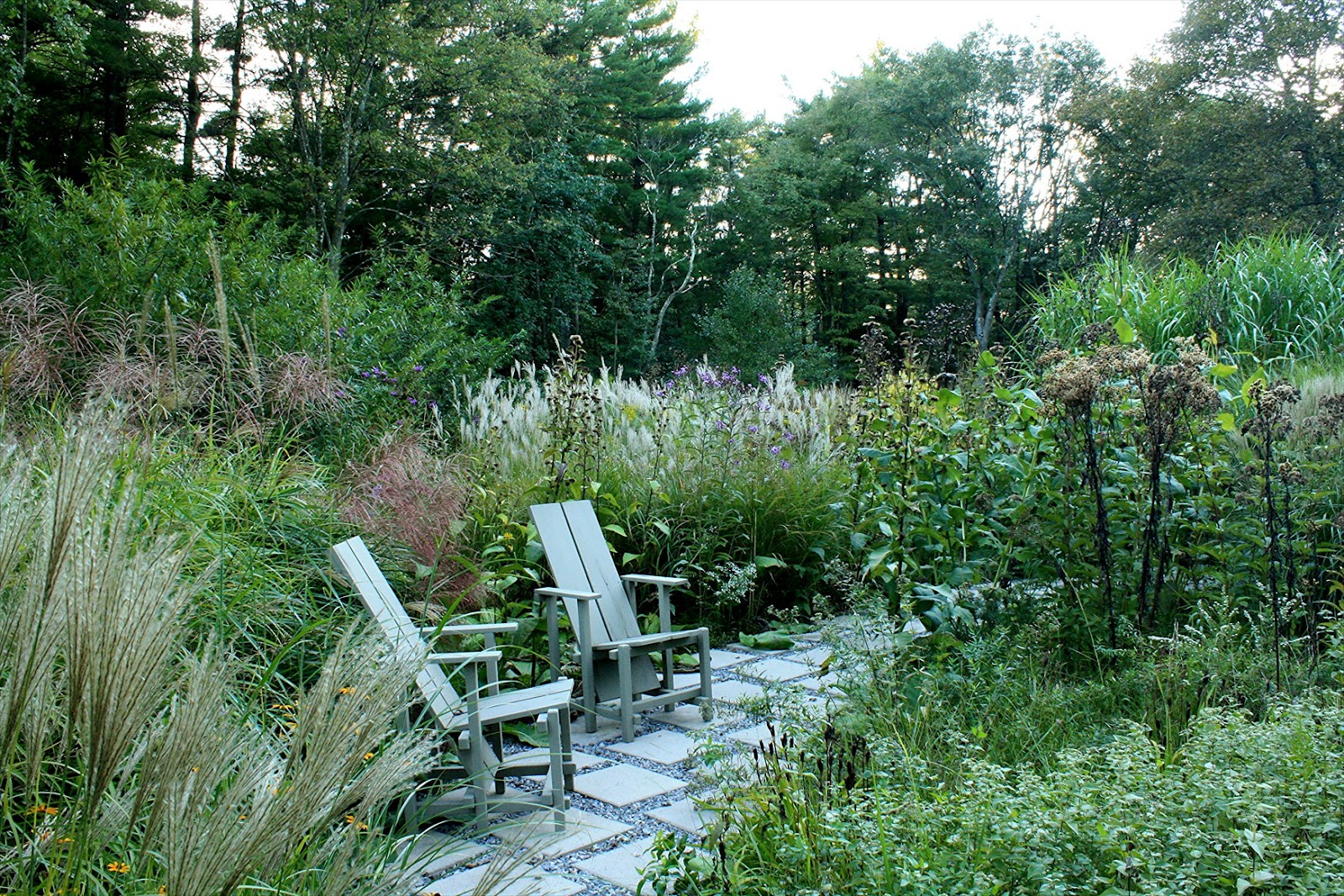
A seating area for disappearing into the plantings.


The bank going up to the house.


Sanguisorbas. They self-seed well. I want other varieties.


Thursday, September 30, 2010

Twilight in late September

As the sun drops low on the horizon, just enough foliage has fallen to allow bright shafts of sunlight into parts of the garden. Here it's about to disappear behind the roof of the house, casting the near garden into increasing darkness.


Further out in the garden, warm sunset light ignites the grasses--Calamagrostis acutiflora 'Karl Foerester', Panicum 'Shenandoah', Panicum 'Dallas Blues', Miscanthus purpurescens at back. This is a highly transient phenomenon, passing quickly into shade.


Here the light has shifted to the right, passing across another group of plants--Viburnum, more Panicum 'Shenandoah', Scirpus cyperinus, Lysimachia ciliata 'Firecracker', Sanguisorba canadense, and further right, an Iris pseudacorus and the foliage of a clump River Birch--then quickly fading...


... into gradual darkness. Amazing to think I'm actually watching the effect of the rotation of the earth in this little spot of garden--such a large thing manifesting in such a small and lovely way.


Now in shade, Sanguisorba flowers against the dried Scirpus cyperinus ...


... and behind, another ray spotlights a fading stand of Joe Pye Weed.


A little sea of grasses, out of the sun now, in muted colors lit by indirect light of the sky ...


Looking across the garden, where the woodland trees catch the last of the sun in their upper branches ...


Now the house glows with the approach of night. Outside, it's actually darker than it appears; my camera is overcompensating for the low light level, as you can see by comparison with the bright incandescent light inside the house.


Soon it will be completely dark. Soon it will be time to go inside and feel cozy.


Miscanthus 'Silberfeder', still like fireworks, even in dimming indirect light ...


The path to the new paved sitting area appears as I move around the garden ... (yes, the stepping stones need realignment) ...


Striking how colorful, in a subdued way, the mixed grasses and perennials can still be ...


as the earth continues to turn the sun under ...


... and the moon brightens in a darker sky.


The garden is made on a piece of earth, composed of soil, water, minerals, plants, built with labor, logic, and much emotion (passion perhaps?), but much more than that, composed too of space, mass and void, the very air we breath. It's the earth, the sun, the day, the night. Both motion and stillness.

Thursday, September 23, 2010

Autumn

This first day of autumn the tall trees surrounding the garden cast deep shadows. A morning walk is a study in dark and light, a good time for looking about. It's virtually impossible to capture these extremes of lighting in photographs, but just sitting in the shade looking out into the sunlit garden can be quite pleasant, as can strolling through dappled shade.The contrast of dark and light is what makes the garden special at this time of day. So this is the compromise--slightly overexposed photos with bleached colors. You, dear reader, will have to use your imagination.

Here, the first picture shows the space and broad view of the garden. This is hard to do successfully, as you've probably noticed if you spend much time reading garden blogs. Most only give you small pictures of single plantings, or limited vignettes, rarely the big picture.So take a look at the dramatic contrast between light and dark. Yes, I'm striving for a kind of drama in the garden, a stage set with creative lighting (supplied by the sun alone) and theatrical scrims made of vegetable matter.


Landscape or garden? Both, really. These views show the lay of the land, or rather the undulations of the vegetative growth of this season, as the perennials have reached their peak and begun the time of slow decline, losing chlorophyll, just starting to show their flashes of color. We aren't there yet, but the fading greens and shift toward yellow, red and gold is beginning to be apparent.

It's a good time, too, to see how shapes work in the landscape. The spear-like foliage in the foreground below starts a rhythm echoed by the finer grasses behind, the Arborvitae, and in the distance the tall Junipers and a single Blue spruce. Next year I'll add more Japanese and Siberian irises, which hold their form well, and late, and give thought to ways to repeat these patterns across the garden.


As has been done here, in the offset line of Arborvitae ...


Hard to tell in the view below, but the bank rising to the house remains a problem, still unfinished after five years. The right end in almost full sun is planted mainly with Miscanthus gracillimus (some are the real thing; others seed-grown unknowns sold as gracillimus; caveat emptor!), which have done well and make a pleasing cloud-like picture. The opposite end, in the dry shade of three large sycamores immediately adjacent to the house, is less amenable to easy solutions. I want a mass of hydrangeas, and will continue to attempt that next year. A rainy spring and summer would help.Those I've put in are languishing.


For late color and longer interest, I've added several Lespedezas; these are in their first year, and I expect them to grow much larger and flower more profusely in years to come. I'll probably add one or two more, scattered among the Miscanthus, to get a bank of September color. I stole this plant idea from Bruce's garden at Paxson Hill Farm (thanks, Bruce) and from a magnificent specimen at Chanticleer.


Here they make a channel of color running up to the four Adirondack chairs on the terrace.


Details out in the garden--here, Sanguisorbas on the long path across the garden ... 


 ... Pycnanthemum muticum (Mountain mint) in its late summer silver with Arborvitae ...


Vernonia altissima 'Jonesboro Giant' in flower (though not as tall as last year because of drought), Rudbeckia maxima seed heads and foliage at its feet, and just a glimpse of Miscanthus purpurescens on the left ...


Here the Miscanthus purpurescens with species Veronicastrum  and increasingly  ubiquitous Rudbeckia maxima (it's become a theme plant) ...


Massed Miscanthus 'Silberfeder' and Pycnanthemum muticum in shade on the left, and on the right the new back area under development. The newly planted Hornbeam hedge will form a right angle behind the bench in the distance ...


... and that same planting of Miscanthus 'Silberfeder', Pycnanthemum muticum, and Petasites seen from the back of the garden, looking in the direction of the house (which is obscured by the plants) ...


After several tries, asters are establishing. I want more, and have several in a holding bed beside the house. If we have a break in the heat, I'll plant them out in the garden later in the fall ...


That same community of Miscanthus purpurescens shown above, here from the opposite side, where it adjoins the newly paved sitting area; this is one of my favorite grasses. I hope to find a way to darken the concrete pavers and gravel quickly, perhaps using a nutrient solution to encourage algae growth in the cooling days of fall. Or maybe I'll just smear them with mud over winter.


Another Miscanthus purpurescens surrounded by asters and Pycnanthemum muticum ...


... and a second view in the same direction, showing the circle of red walnut logs marking the eastern limit of the garden ...


... a fortuitous combination of Pycnanthemum and Siberian iris ...


... and Calico aster (Aster longifolius), a native, which grows everywhere I don't pull it out ...


... a view from the bench, which was shown above, toward the circle of logs ... more hydrangeas are going in here. So far 'Limelight' appears to be the most successful in this difficult area. The view of the unattractive fence in the back left will be blocked by Japanese Fantail willow (Salix sachalinensis 'Sekka') and Miscanthus giganteus.


Looking back into the garden from the easternmost path--asters, Miscanthus purpurescens again, Rudbeckia maxima, drying Joe Pye Weed, bracken ... from this direction, the plants are backlit, glowing with refracted light of the sun.


Marc Rosenquist's sculpture surrounded by various asters, Eupatorium coelestinum, Chelone 'Hot Lips' and big leaved Rudbeckia maxima, Silphium perfoliatum, and Inula 'Sonnenspeer' in the background, all backlit by sunlight in a striking way.

Here the colors of fall have really begun. Two bunches of Panicum 'Shenandoah', another of my favorites, showing streaks of red, to either side of a Viburnum plicatum (a small tree I cut down when we cleared the land; now I recognize its beauty and utility as it's coming back). The red plant at the front is Seedbox (Ludwigia alternatolia), a native I'm encouraging wherever it chooses to grow.


Behind in the darkening shadows are many Filipendula rubra 'Venusta' in their subtle autumn colors and spires of (you should have guessed it) Rudbeckia maxima.

So the decrescendo of summer, as the flowers lessen and colors fade, becomes a crescendo to an autumn to be closely watched, if I can judge from the past three years. I have to remember this was a summer of severe drought. I don't know what will happen. The uncertainty of the garden year remains, and that's not bad.

LinkWithin

Related Posts with Thumbnails