Pages

Showing posts with label Eupatorium maculatum. Show all posts

Sunday, August 26, 2012

August 19 - Straight, Tilted, Curved

Most of the very tall plants at Federal Twist have blossomed leaving an interesting interplay of verticals, diagonals and curves.


As the season progresses, the plant communities take on greater complexity. But the strong lines imply an underlying structure and order.


It's messy, no finely manicured edges here, but it entertains me and gives me pleasure ...


... sensuous delight ...


... new thoughts, new ideas ...


... and feelings I can't express ...


... the interplay of chance and intention ...


I planted none of this Eupatorium perfoliatum (above). Rather, it planted itself. I'm just a line editor.

Here too (below), many of the plants seeded themselves ...


... and many of these were planted intentionally. Can you tell the difference?


An accident ... the great blue lobelia doesn't belong here, certainly not next to the box wood ... but I just couldn't pull it out. Perhaps next year.


Intention and chance ... the first plants to be put in here were Rudbeckia maxima; others followed, mostly without my help. The cloud of Filipendula I planted a couple of years later.


I wish I could say the juxtaposition of the Joe Pye Weed and the Sanguisorba was intentional. Was it? I can't remember, but I do like it.


One last chance surprise just caught my eye as I was passing - a molting praying mantis.


Saturday, May 17, 2008

Garden Diary: Speaking of Groundcovers

The experiment continues in the main garden - the wet prairie behind the house. Now that our cedar forest has become an open clearing, the light and air is changing the habitat that existed before. Though it makes for a rather messy look in spring and early summer, I'm leaving the established plant colonies such as bracken, sensitive fern, cinquefoil, violets, and equisetum to do their thing. In the newly opened spaces, ruderals (pioneer plants) have seeded in, and I'm leaving them too. I expect many of them to be here for several years until the more competitive species take over. With the passing years, and some judicious weeding to control such undesirable behavior as seeding into the crowns of established plants, I hope the natural process of plant succession and competition will result in the groundcover layer simplifying itself over time.

Here are some pictures of what's happening right now. First, a blanket of equisetum punctuated by a native Scirpus.


Though the equisetum is highly invasive, I like its soft, fuzzy effect seen from a distance, and its primitive character close up. I may as well; I couldn't get rid of it without some highly destructive intervention. And the Scirpus grows so large, and so profusely, it also behaves as a groundcover though on a much larger scale.

In wetter areas, sensitive fern, another "legacy" plant, slowly spreads. I guess it would be classified as a stress tolerator. It lives in very wet places where most other plants would languish. You can even see some pooled water here from a recent rain. Not an example of well drained soil!


Bracken and cinquefoil have covered this corner with two levels.


I know bracken has a reputation for being a real thug, but in my garden environment it is rather well behaved. And it's such an attractive structural plant I'd be happy to have more. In front of it is a carpet of cinquefoil in bloom. Not a beautiful plant, unless closely examined, but useful for covering large areas quickly.

Plants I want to suppress are multiflora rose and poison ivy (Toxicodendron radicans). They have no desirable qualities, in my view, and seem able to compete with just about anything in the plant kingdom, so I'm driven to digging and using Roundup in my struggle with these invaders.

Most of the large prairie-type plants I've inserted into the groundcover matrix - Eupatorium purpureum, Filipendula rubra 'Venusta', Liatris pycnostachya, Rudbeckia maxima, various Silphiums, and large grasses - have no trouble penetrating this dense cover. By midsummer, they'll begin to dominate the landscape and the less attractive lower level will disappear into the background.

Tuesday, November 20, 2007

Garden Diary: The Front Garden

The "front" of our house on Federal Twist - the facade facing the road - is actually the back. It presents a simple wall to visitors. The real front of the house is at the back, where an unbroken wall of floor to ceiling windows gives onto the main garden, and surrounding it, the woods.


The choice of where the front garden would be was predetermined by a barren gravel circle at the front entrance. The house is about 165 feet from the road, with open woods in between, so screening wasn't absolutely necessary, but added privacy was desirable since none of the windows are covered. Even more important, I wanted to create a focal point and add visual interest. The photo above is the front garden, still in progress, this past summer. The second photo shows the original front "garden" when we purchased the house in fall of 2004.

The house is a simple, shed-like structure, at least viewed from the side facing the road. The only notable front views out are from the kitchen window and sliding doors in the dining room. The original view out was onto a circular graveled area about 28 feet in diameter, with a mostly dead crab apple, a couple of scraggly burning bushes (Euonymous alatus), a line of arborvitae, and two Sedum spectabile 'Autumn Joy' eaten to the ground by deer. To the side were two rotting, frequently amputated Japanese cherries.

Looking out toward the road, the view of the woods was not without interest but also not particularly notable. We needed something to look at from inside the house, to provide additional screening in place of window and door coverings, and to make the facade facing the road more welcoming - something that would screen our uncovered expanses of glass, providing privacy, while signaling a greeting to visitors and giving clear direction to the house entry, which was hidden at the far end of a dark porch.

After we cleared most of the area, the first plant to go in was a large Ravenna grass (Saccharum ravennae), which I split in two - a discard of our friend Roberta, who found it overwhelming in her small Lambertville garden (I had put it there). This was in May of 2005. You'll have to click on the photo to see the two grasses in the wide expanse of gravel.
In the top photo you can see how, once the grass matured, its fountain-like shape and large size made it a welcoming gesture to anyone turning into the drive.

Planting continued through that summer of 2005, and by August was essentially finished. I used several Miscanthus (Gracillimus, Yaku Jima, Adagio), Joe Pye Weed (Eupatorium maculatum 'Gateway'), Persicaria amplexicaulis 'Firetail', catmint (Nepeta m. 'Walkers Low'), Sedum 'Matrona', Bluestocking monarda (Monarda d. 'Blaustrumpf'), a small lilac (personal request from Phil), Pennisetum a. 'Moudry', a few Japanese Blood Grasses (Imperator cylindrica rubrum), Aster laterifolius 'Lady in Black', Lychnis coronaria, purple smoke bush (Cotinus coggygria 'Royal Purple'), and an inkberry holly (Ilex glabra) to anchor one corner. I scattered seed of Verbena bonariensis and bronze fennel, and I kept two of the arborvitae, the legacy Sedum 'Autumn Joy', and self-seeded Eupatorium rugosum (a really invasive thug I'm now trying to eliminate). The first year planting looks scraggly but by the next spring it had filled out well, as you can see in the next three photos taken in late June 2006.


In 11 months, the Miscanthus, Joe Pye Weed, and Saccarum had grown into substantial islands of graceful foliage and the Nepeta 'Walkers Low', just passing its early prolific bloom, had relaxed into the contours of its surroundings like an old hand.

All of this was working on the large scale, creating a new space and transforming the house on Federal Twist into a place with a little more mystery than before.


On the smaller scale, details of flower and foliage shape and texture began to add interest - monarda busy with bees and butterflies ...


Purple smoke bush graced by the magenta of Lychnis coronaria ...


and the smoke bush again, with cat mint and Sedum 'Matrona' against a hedge of burning bush.

Under the gravel is clay, same as everywhere else at Federal Twist. Unlike the main garden at the back, this one is raised above the surrounding grade, so drainage is much better. Though it makes a very heavy planting medium, the clay is rich and, after only two years, it looks like some of the grasses will need to be divided next year.

To finish, a couple of views from this past summer ...

Sunday, January 07, 2007

Time, mystery and the gardener


The passage of time transforms a garden. We all know that. Plants grow larger, change shape. Spatial relationships change. Light usually diminishes as plants mature. Colors change with the seasons. While these changes can be observed with all plants, they are perhaps most visible with herbaceous perennials, which display all their changes in a single season, emerging from the earth in spring, maturing, flowering, then dying in fall.
But more subtle alterations occur in the appearance of plantings during the growing season. The crystal clear light of spring and early summer morphs into a moving spotlight of sun by high summer, bleaching colors at mid-day, lessening contrasts of shape and form, generally blurring differences in the character of plants.

Weather conditions too make for quite dramatic changes in appearance. The photo above was made in my Rosemont garden on a hot, very humid, windy day in late July 2003. You can see drama in the wind buffeting the Calamagrostis acutiflora 'Karl Foerester', introducing an element of chaos and excitment, the haze of humidity in the air, especially in the background, tinting the trees slightly grey-blue, the foreshadowing of autumn in the fading blossom of the Persicaria polymorpha as the cloud-white plumes become spotty with brown of early decay, in contrast with the vitality of Joe Pye Weed (Eupatorium maculatum 'Gateway') in full bloom - shades of those hot scirocco winds in Italy (but this is in the Delaware River Valley).

The tranquillity of the second photo, of the same scene, taken almost a year later in 2004, but in early summer, serves to emphasize the dramatic nature of the first, and clearly demonstrates how local climatic conditions can change the nature of your garden.


In the second image, the cool temperature, still air, low humidity, freshness of foliage, and the vitality and unblemished colors of newly grown cells - in contrast to the fading white bloom of the persicaria in the first photo - lend a peacefulness and clarity totally different from the first. I'd even go so far as to say the weather, light, wind, humidity, and time of year are as much a part of the garden scene as the plants. They're all part of a whole, but you have to look at the whole, not just the parts, to see it.

More obviously, the tree (Robinia pseudoacacia 'Freesia'), has grown taller over the intervening year, the Joe Pye Weed, so prominent in the first image, hasn't yet attained height and is totally invisible behind the persicaria, as is the calamagrostis, yet the catmint (Nepeta 'Walker's Low') has fattened into glorious clumps of gray with dozens of ascending purple spires.

All of this is obvious to anyone who looks, possibly even banal. But for me it's emblamatic of the mystery of the interrelatedness of everything living. Starting with energy from sunlight, water, earth, the human eye and hand, life in all its varied forms.

The last photo, taken later in the summer of 2004, shows the same scene in larger context. Here the rapidity of growth is even more evident. The catmint is spreading like a sea, the Sedum 'Herbstfreude' is in bloom, and a new area of the garden has been planted in the distance to the left. The changes that have taken place in just over one year are striking, perhaps even threatening a return to total wildness, and demonstrate just how precarious is the order of a garden, calling out for the gardener, who, of course, is part of all this too.

Sunday, November 05, 2006

Joe Pye Weed: Eupatorium purpureum subsp. maculatum 'Purple Bush'


A valuable perennial - one of my favorites. It's easy to grow anywhere that's a little damp, and it's rather deer resistant if you can help it get above deer grazing height by hiding it in ornamental grasses or providing early physical protection. Some survive the deer even without your help.

This is a plant with good structure - one of the strongest, easily standing up to heavy snow in my Delaware River Valley garden - beautiful umbelliferous flower heads, and distinctive foliage that makes a strong geometric statement. Though it grows in clumps, it's a good competitor and does very well in a naturalistic garden setting, easily holding its own among other aggressive plants.

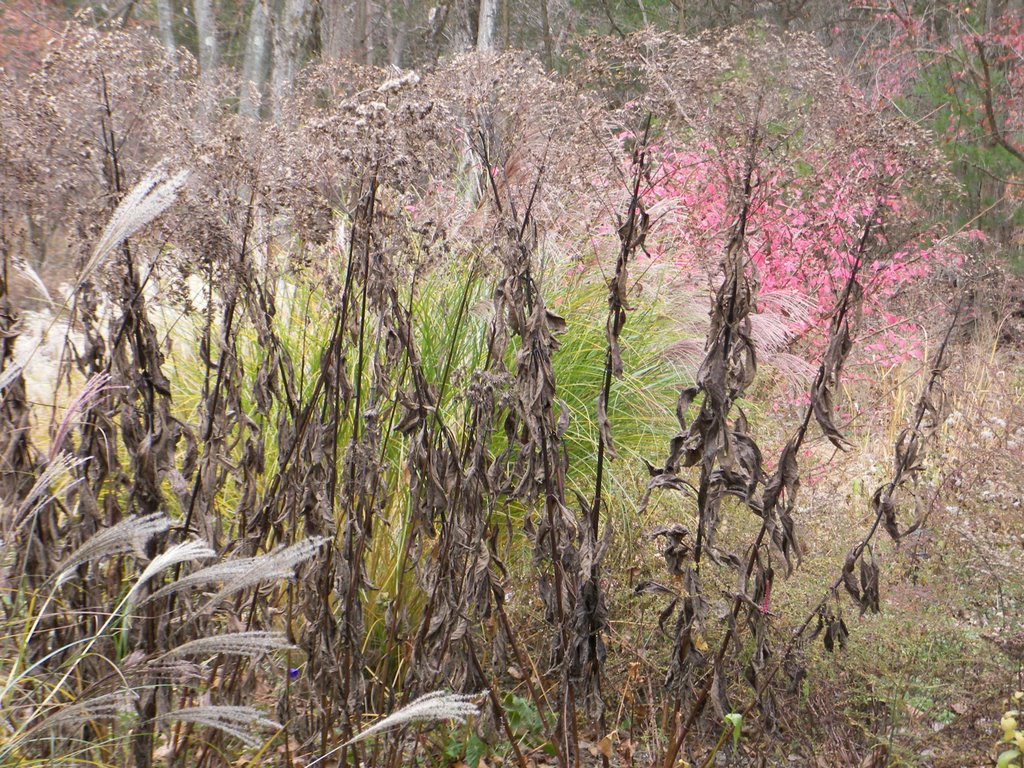
Joe Pye Weed is beautiful throughout the year, providing a pale creamy frosting of color as the buds emerge in early summer, large, sometimes huge, compound flower heads in late summer then, as weather cools, turning dark mahogany in autumn rain, and a leaden brown, almost black, as the weather cools.


It would be a mistake to cut it down in the fall. The darkening color makes it a good foil for the brighter ornamental grasses, and it stands tall, turning into winter sculpture in frosts, freezing rains, and snow.

Click on the photos to see more detail.

LinkWithin

Related Posts with Thumbnails