Pages

Showing posts with label Petasites japonicus. Show all posts

Saturday, April 04, 2009

Early aliens


Gardeners are often warned to avoid Petasites. I've even had a nursery refuse to sell it to me, and I agree I've seen it growing with such vigor I want to either cheer or run. In my garden - so far - it's been willing to spread slowly but seems easily controllable.


I have two kinds. One, sold as Petasites japonicus 'Giganteus' (above), with great round leaves, and another, sold as Petasites hybridus x Dutch (below), with roughly triangular leaves. The flowers of both are in bloom now. They're small, no more than three inches high and less wide, for the Giganteus.

The inflorescence of the 'x Dutch' hybrid is much smaller and strikingly different in appearance. Long blossoming stems will rise from the cone-like flowering body in the next few weeks, then wither as the foliage grows. I have no idea what the Petasites x Dutch was hybridized with, but its flowering behavior is dramatically different from its cousin. The flowering stems are similar in appearance to those of Darmera peltata, so I do wonder if the cross was made with some form of Darmera.

Maybe you know the answer.

Wednesday, August 27, 2008

Garden Diary: the August burst continues


The pond entrance to the garden should create a sense of mystery and draw a visitor on to see what's around the corner. The curves that direct the eye to the left are there now, finally, but the plantings aren't right. Shrubs need to be placed strategically to block views and the perennial plantings need more work, particularly to contrast large, textured foliage near the viewer (Petasites japonicus x 'Dutch', Darmera peltata, Ligularia 'Desdemona') with smaller foliage in the distance.


The August burst of plant exuberance continues with Joe Pye Weed, Liatris pycnostachya, Inula racemosa 'Sonnenspeer' continuing in flower while the spent bloom of Rudbeckia maxima and Filipendula add geometric interest and seasonal complexity.


The Inula in the foreground (below) and Rudbeckia maxima further back provide an interesting study in contrasting structure (not that these look particularly well together). I'm pleased with the Inula (I ordered 20), which have grown quite large in the first season, thanks to the big roots shipped by Bluestem Nursery (link at top) last spring. The basal leaves of this plant are about 30 inches long, and I expect them to be even larger next year. Walking among these is like communing with living vegetable gnomes designed by Paul Klee.


... and most of the Inula even flowered in the first year.

Sunday, October 22, 2006

Pycnanthemum muticum - a short history of an affair with a smelly plant


I've seen Pycnanthemum muticum for over two years at Paxson Hill Farm, a small specialty nursery just across the Delaware in Bucks County. It was always swarming with bees and other insects when in bloom, and I was definitely interested. But I never bought it.

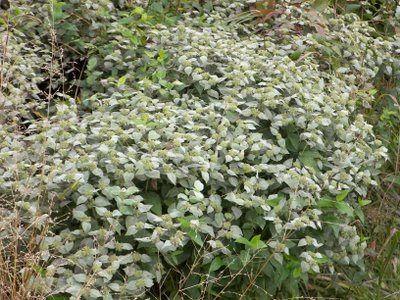
Then I saw it for sale on the website of Bluestem Nursery in British Columbia, which advertises it among a selection of perennials called 'Wolfgang's Picks' (Wolfgang Oehme of Oehme and Van Sweden). I did order a substantial number a year-and-a-half ago, but only about three survived the transit. Looking at these now mature plants I can see that the silvered texture of a mass in bloom could be a pretty, and deer-proof, sight.

Michael King's Perennial Garden Design, which I highly recommend for its valuable information on such little known (in the U.S.), innovative planting designers as Heiner Luz of Germany, has two photographs that convinced me I needed to give this extraordinarily aromatic plant a try on a big scale. One photograph is of a large group of mixed pycnantheum and Petasites japonicus, backed by a wall of Miscanthus s. 'Silberfeder', designed by the Oehme and Van Sweden firm. The other was of a mass planting of pycnantheum alone.

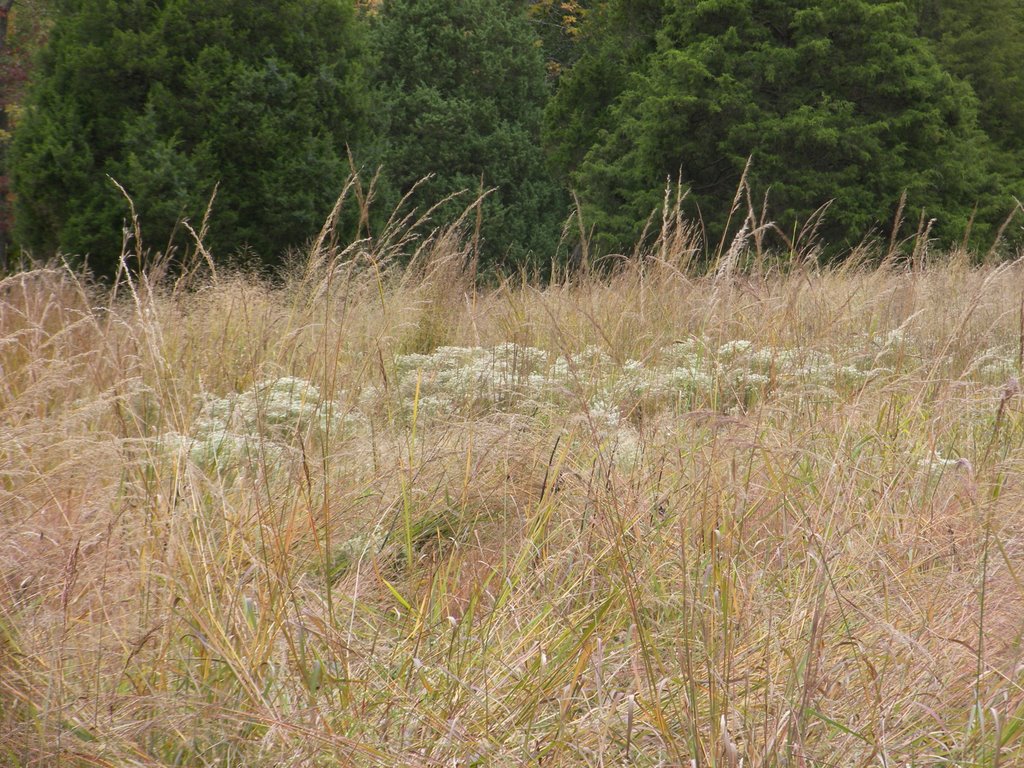
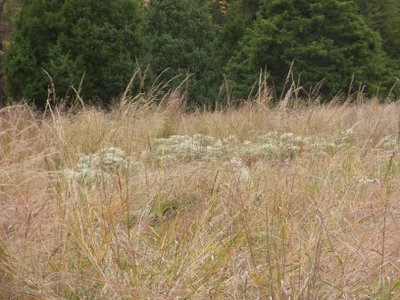
At Bowmans Hill Wildflower Preserve, I saw the plant in its natural setting, growing in tight communities in the open grass meadow (the photos above and below were taken at Bowman's Hill).

So I bought all the plants available at Paxson Hill Farm (only six or seven). In August, after Jessie and Brian's wedding, I traveled further upstate (New York) to Loomis Creek Nursery (you may have seen it featured in the lavish British magazine Gardens Illustrated a few months ago), where I had seen several gallon pots of Pycnanthemum muticum earlier in the summer. I bought 20. Later I found 10 more at Bowman's Hill.

They're all planted now, and I'm hoping for a rapid spread across my wet clay this winter. I know I have to wait a couple of years, at least, to get the effect I'm seeking. In addition to visual interest and a neat addition to wildlife habitat, I do hope the odor and taste of this plant will send deer fleeing. (I should know better).

I need about 30 more plants.
LinkWithin

Related Posts with Thumbnails