Thursday, May 19, 2011
Plants for wet clay: Zenobia pulverulenta
After a few years of growth, this shrub has grown large enough to make a significant visual effect. Zenobia seems to be a rather rare plant in cultivation, and the glaucous form isn't the only one. Some are simply green. I bought two at the Native Plants in the Landscape conference, a well known native plant gathering held annually at Millersville University in Pennsylvania, three or four years ago.
I was uncertain how the plant would fair in my often saturated, wet clay; its natural habitat, which is wet but apparently well drained, very acidic and low in nutrients, is quite different from conditions in my garden. So far my Zenobias appear to be thriving, vigorous, and in pristine condition. Their small, bell-shaped white flowers are borne in profusion in the summer, and the plants are bulking up into admirable specimens.
The lesson, I suppose, is that you can research a plant's origins and native conditions, but you can never successfully predict how well it will adapt to differing conditions in the garden. You just have to make educated guesses, and see what happens. Take a risk. There are serendipitous surprises.
Friday, June 04, 2010
Change?
It wasn't anything I would have expected. I've been attending the Native Plants in the Landscape Conference since yesterday (it ends tomorrow). This conference, held at Millersville University near Lancaster, Pennsylvania for the past 20 years, is one of the major native plant conferences in the US. Until this year, I've felt something of a heretic, never having been a purist where use of native plants is concerned.
This year there appears to have been a programmatic effort to question the lock-step approach to "natives only" that has characterized the native plant movement for so long in this country. This year, a definite theme seems to have emerged, beginning yesterday with the keynote talk by William Cullina, a well known author and Director of Horticulture/Plant Curator for the Coastal Maine Botanical Gardens. The title, "Unraveling and Re-raveling the Web of Life," only hints at a message I think long overdue--that the very concept of native plant is a changeable thing, subject to the changing conditions of the earth, in different times and places. Plants move in response to these changes, and their native ranges change over time. Cullina gently but persuasively broadened the definition of native, raising such difficult questions as whether isolated pockets of native vegetation on their way to extinction should be moved to new places, where the climate and conditions are more suited to their needs. The thrust of his talk was that the definition of what is native is not a simple or easy question to answer.
The second keynote talk of the day, "Perennial Plant Communities: The Know-Maintenance Approach," was really about plant sociology, plants growing in communities, though the word sociology was never used. (I think even our "experts" feel they have to be gentle, and do a little "dumbing down" to avoid alienating North American audiences.) This second keynote talk was given by Roy Diblik, co-owner of Northwind Perennial Farm in Wisconsin. Roy is the man who supplied Piet Oudolf with plants for the Lurie Garden in Chicago's Millennium Park, and he is quite a garden designer in his own right, having recently designed beautiful plantings for the Chicago Art Institute. He spoke about the necessity of growing plants in plant communities (another very important theme of this year's conference), and the need to move away from the awful American compulsion to dot a few plants about amid mounds of wood chips and mulch, toward a more natural style of planting based on intimate knowledge of plants and their individual needs. Roy's approach is very closely akin to the approaches to planting design I've read about for years in the works of English garden writer Noel Kingsbury, Piet Oudolf, the American design firm of Oehme & Van Sweden and, of course, many others in the "New Perennials" movement, and, before that, in the seminal work Perennials and Their Garden Habitats, originally written in German by Richard Hansen and Friedrick Stahl, and first published in English in 1991. The concept of plant communities, or course, raises the bar, so that we think holistically about systems of life and not about just individual plants, how communities function and grow, and how much labor is involved in their upkeep (not a lot since stable communities don't require a lot of human intervention). Roy also struck an extremely romantic note, stressing the emotional component of beautiful, carefully orchestrated plantings, and noting how ugly some native plant restorations are--because no consideration was given to these broader concerns of the garden, the gardener, and the garden visitor.
The third keynote talk, by Niel Diboll, owner of Prairie Nursery, and an acknowledged leader of the native plant revival, particularly prairie plants, declared war on the American lawn. With a passion and style that reminded me of a bible thumping preacher on a revival crusade, Diboll enumerated the extravagant costs of the American lawn in terms of what he called the four Es--esthetics, environment, energy, and economics. He's convinced the American love affair with the useless, polluting, environmentally sterile (no, environmentally harmful), and costly lawn will end, not because Americans will be converted to more ecologically sound beliefs, but because the cost of maintaining this socioeconomic shibbolith is simply too great and it will eventually collapse under the weight of its unsustainablility. Diboll's vision to use native plants to help restore the balance of nature, and the sanity of our insane culture, reflects a profound understanding of the complexity of plant communities, and of the need to think about planting in terms of community.
Larry Weaner was the major speaker this afternoon. His ostensible subject was incorporating ecological restoration techniques into landscape design. He, like Roy Diblik, emphasized the importance of understanding the whole plant community and its behavior over time. Larry's talk was much more technically detailed than Roy's, and he demonstrated the immense knowledge needed to create a successful meadow. Near the end of his talk, he also introduced the concept of allowing a certain element of chance to participate in the design of a planting (self-seeded plants, or plants introduced by animal life), an intriguing idea for the more conceptually oriented gardeners and designers in the audience. Weaner's talk helped elevate the conference to a new level of sophistication.
It was heartening to hear Roy Diblik recommend one of Noel Kingsbury's books. In the past, the Europeans have been virtually non-existent at this conference ... are we, perhaps, about to break the blood-brain barrier between British (and European) gardening and American gardening? Whether this new direction at the Millersville conference illustrates a new direction in the native plant movement, a maturing of the movement in general, remains to be seen. But it is certainly a hopeful and exciting change.
Wednesday, June 18, 2008
Iris versicolor: a plant for wet clay and sun
Wednesday, June 11, 2008
Delicate complexity of soil
Over 75% of the plants living on the earth benefit from symbiotic relationships with small, microscopic fungi attached to their roots. The fungi are referred to as micorrhiza (my-core-i-zuh). Though we usually can't see them - they are under ground and are very small - their beneficial effects on plants are real and substantial. One major benefit is an increase in delivery of phosphorus to the root system.One of the less well attended presentations at last week's Native Plants in the Landscape conference at Millersville University in Pennsylvania was "Micorrhizal Fungi: Hidden Friends of Plants." Dr. Roger Tai Koide of Pennsylvania State University described recent research that clearly demonstrates the benefit of such relationships to most plants.
The fungi grow very small, even microscopic, filaments - called hyphae (hi-fee) - that extend from the roots of plants into surrounding soil. These filaments, in effect, function as extensions of a plant's roots, and can effectively expand the root's surface area thousands of times. The photo above shows the white hyphae extending our from a root.
Does a gardener need to know about micorrhiza? Probably not, if you measure value only in direct utilitarian terms. But there is an important lesson to be learned from this bit of knowledge: our environment is extraordinarily complex and we can easily disrupt it if we blunder forward in ignorance, without considering what we do not know. There is a delicately balanced, invisible ecosystem underground that demands respect, perhaps even reverence.
Actually, there is one practical application for this knowledge, and there are probably many more. The highly invasive plant, garlic mustard (Alliaria petiolata), damages micorrhiza. Why this is remains a mystery. In addition to its ability to completely overwhelm native plant communities and to form a virtual monoculture over the ground surface, at least in North America, it has insidious underground effects, damaging the symbiotic relationships that benefit many other plant species... yet another reason to support efforts to eradicate garlic mustard from our environment.There is another mystery too. In its native European habitats, garlic mustard does not have this effect!
Saturday, June 07, 2008
Native plants: gardening without guilt
This is the first year I've come away from the Native Plants in the Landscape conference without feeling I am a total outsider, possibly even a spy, in a nest of native purists. (Just got back from the conference, held June 5 through 7 at Millersville University in Pennsylvania.) The native plant rattle in the American gardening community can be so extreme I hadn't realized before there are many, like me, who occupy a middle ground, even among conference attendees.C. Colston Burrell's opening presentation on the 20th Century Native Plant Movement in America was a refreshing, highly entertaining, and appropriately generalist take on this sometimes politically charged subject. Yes, native plants are important to maintaining local and regional ecosystems. No, we don't have to plant only natives so long as we are responsible and don't use species proven to be highly invasive and disruptive to the environment. Yes, aesthetics is a valid concern in gardening. After all, humans are part of the ecosystem too; we get to have a say. Yes, it's hard to define "native." But, no, the arrival of white Europeans on American shores isn't a good basis for a valid definition. Regional differences in plants, even plants of the same species, and local genetic provenance, are much more important.
This conference attracts numerous professional garden designers, experienced gardeners, and nursery men and women specializing in native plants, so the level of discourse tends to be quite high. I hope to report on one or two of the more specialized sessions I attended in another posting. I particularly enjoyed Don Knezick's "Genetic Integrity of Native Plants: Provenance is Forever" and Dr. Roger Tai Koide's "Mycorrhizal Fungi: Hidden Friends of Plants."
A highlight of this conference is the native plant sale, and it's one of the best. Nurseries from eastern Pennsylvania down into the Virginias offer perennials, shrubs and trees, many of which are rare in trade and difficult to find. I came back with four winterberry hollies (Ilex verticillata) - nothing rare in that selection but needed in my garden nevertheless, five Iris versicolor of sufficient size to divide into ten plants to join my late May/early June iris splash, two sizeable copper irises (Iris fulva) to go by the pond, two "Dolls eyes" baneberries (Actaea pachypoda) for the woodland garden, one Sagittaria latifolia to go into the pond, and ten Meehania cordata to try out as groundcover in the woodland. Okay, I confess, there's nothing particularly rare in my selections, but other offerings included Moosewood (Acer pennsylvanicum), various native gingers (formerly asarum, now hexastylis), all sorts of big leaf magnolias, Jeffersonia diphylla, and on and on.
If you live within driving distance of Millersville, consider the conference in 2009.
Saturday, October 14, 2006
Is planting Dahlia ‘Bishop of Landaff’ an immoral act?

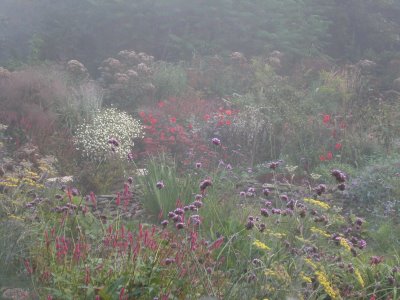
Look closely through the fog; the red blossoms near the center are Bishop of Landaff.
I support use of native plants in gardening. But I can’t find the visual richness and expressiveness I want with native plants alone. In my Rosemont Garden, and in my evolving garden on Federal Twist Road, I’m using both natives and non-natives. Where I live, that’s taking a political stand.
As preface, I want to say I attend the Native Plants in the Landscape Conference at Millersville University every year, I am a member of the Bowman’s Hill Wildflower Preserve near New Hope, Pennsylvania, a member of the Hunterdon Land Trust Alliance, and a supporter of the Plant Stewardship Index (see June 9 posting below). I believe the American nursery industry should not sell plants known to be highly invasive in local habitats, and it should do much more to educate its own staff as well as its customers in the growth habits and needs of plants.
The native plant movement has accomplished important work — conserving local species, preserving remnants of vanishing habitats, creating awareness of the need to protect threatened natural resources, and educating people about their natural plant heritage. And by insisting on the importance of using plants appropriate to the environment, rather than trying to alter soil and other conditions to grow plants not naturally suited to a given site, the movement has had a pervasive influence on gardening.
The New Perennial Movement — as practiced by Wolfgang Oehme and James Van Sweden in the U.S. and Piet Oudolf, Noel Kingsbury, Henk Gerritsen and many other European and American garden designers too numerous to mention — grew out of a long European tradition. Designers have been riffing on the concept of naturalistic gardening for more than a century, perhaps starting with William Robinson in the 19th century, and probably going back much further. The Germans, in particular, have done very important theoretical and practical work matching plants to habitats and testing their behavior under controlled growing conditions over many decades. This movement toward ecologically appropriate gardening has paralleled the native plant movement, and helped set the trajectory of 21st century gardening (at least for a time). For now, native is good. Constructing a drainage system and replacing your soil so you can grow bearded iris and lavender in a wetland is bad.
But in the face of this success, many native purists appear to be boxing the movement into a dead end. (For more on this subject, read Michael Pollan’s Second Nature, and "The aliens have landed! What are the justifications for 'native only' policies in landscape plantings" by A.E. Kendle and J.E. Rose of Reading University, published in Landscape and Urban Planning 47 (2000).)
By most definitions, a plant is native only if it arrived in its environment without human intervention — on the wind, in bird poop, or in some other way not involving human intervention. In North America, many native plant enthusiasts accept only those plants that preceded the arrival of white Europeans. In the UK, which was pretty much wiped clean of all its native species during the last Ice Age, the Channel delayed the return of many plants that were previously native. Because humans accelerated that process of return in the UK, bringing back plants that had survived the Ice Age in the more favorable environment of the Continent, previously native plants are now defined as non-native invaders. They would have returned by “natural” means, but they didn’t arrive in time.
Now that the earth’s population has reached over 6 billion, it is very difficult to attribute the arrival of a new species in any environment to "natural" causes. Human influence is simply too pervasive. This is a bad situation because it means all the native plants that will ever exist, exist now. The time and geographic doors have been shut. No new plants will be admitted to the native plant lists (at least in the most conservative circles).
Why is this a bad thing? Because the climate is changing, and human culture is changing natural ecosystems, constantly, in huge ways. So the number of native species will necessarily decrease over time, as species after species succumbs to an altered environment. Regardless of current preservation efforts, only a minute fraction of the earth’s land area will actually be preserved in so-called pristine condition.
What is wrong with this picture? Have we defined native plants in a way that will result in extinction of most native species unless we create isolated “plant zoos”? Are we moving toward preservation of native species only in highly artificial preservation environments, on pieces of landscape preserved from human development? But even preserved areas are subject to changing climate.
Perhaps our definitions are wrong. Perhaps the human race is a part of nature after all, and we make a huge mistake to see nature and humankind in eternal opposition. In fact, the landscape the first Europeans found on arrival in North America was not pristine nature, untouched by human activity. Native Americans had been managing the landscape for centuries, and the landscape that was first viewed by European eyes was, in fact, a managed landscape. It just looked different from the one they left on the other side of the Atlantic. The endless prairies in the American Midwest are a notable example. The prairies remained prairies only because fire burned them and buffalo grazed them. The native Americans saw the natural result of fires started by lightening, and started setting fires themselves to revitalize the land for grazing and to prevent growth of trees, which would have turned the prairies into forest within a generation. There are many who now argue that the very idea of a natural environment untouched by human culture is a fiction.
Much of the impetus of the native plant movement stems from fear of the effects of invasive species, many from far away places. But many plants of foreign origin thrive in our environment without becoming a problem — while some natives are quite invasive. The Ohio Department of Natural Resources asks: "Are all exotic plants invasive? No, most non-native plants are not invasive in natural areas. Of the more than 700 non-native plants in Ohio, fewer than 100 are known to truly 'invade' their natural settings." (Ohio DNR link)
Some studies have even demonstrated that exotic species can enrich habitats, adding new genetic material when local plant populations become weakened by inbreeding, and providing useful habitat for a variety of insect life. Not to mention their aesthetic value.
The answer, of course, is knowledge of a plant’s growth habits in different environments, knowledge we have far too little access to.
The United States National Arboretum does not equate non-natives with invasiveness. "In many cases, plants from other parts of the world are welcomed, manageable additions to our gardens. In the worst cases," it adds, "invasive plants like mile-a-minute, purple loosestrife, and kudzu ruthlessly choke out other plant life. Ultimately, invasive plants alter habitats and reduce biodiversity." But the Arboretum does not make the error of equating non-native with invasive. (National Arboretum link)
As climate change continues — and we know it will — after all, we are only in a temporary warm spell between periodic glaciations — what is native or not may come to have less meaning. Better to know what will thrive in the changing environment and creatively adapt to coming changes. I admit there are serious problems with some non-natives. The preserved woodlands surrounding my house are dotted with Berberis, Euonymus alata, and Rosa multiflora. But the threat from these non-native species is very small compared to that of our prolific native deer population, which is the source of the greatest destruction of native flora.
I don’t mean to diminish the importance of preserving native species and local genotypes. We need to do everything we can to preserve the genetic diversity of our biota. Preserving native plant populations, and renewing them, is a part of that. But moving plants from threatened environments to other areas where they will thrive is another part of that story. In some cases, that may mean moving a species across an ocean as climate and growing conditions change in a plant’s native range. Consider the Franklinia alatamaha. If Bartram hadn't collected it and propogated it in his garden in Philadelphia, it would be extinct now.
If we see human ecology as a part of the world’s ecology, for better or for worse, we are in a better position scientifically to manage change. The potential for harm is great, great enough to inspire fear of some terrible consequence of human action. But it does no good to deny the part humans play in nature, and to abandon hope for responsible action. Simply defining nature to exclude the human race is not an answer we can desire. That’s a wish for return to some pre-human paradise.
Last summer I attended an all day workshop on identification of native grasses and carex. As we walked the Bowman’s Hill Wildflower Preserve identifying plants, one woman kept asking, “Is it good, or is it bad?” (Meaning is it of native or non-native origin?) Her question points to how value driven the native plant movement has become. And some ardent adherents believe with an almost religious fervor. I exaggerate, maybe, but in many cases, belief has replaced scientific inquiry.
So was planting Dahlia ‘Bishop of Landaff’ in my country garden in Rosemont a churlish or an immoral act? I don’t think so.
Friday, June 09, 2006
Plant Stewardship Index
We went to the annual Native Plants in the Landscape conference at Millersville University last week. I attended two presentations on the Plant Stewardship Index.
The name makes you want to run for your garden spade? Don't.
Though I do not limit my plant selections exclusively to natives, I understand the value of preserving local, native plant genotypes, fighting invasive alien species, and saving natural lands from development. We have two exquisite watersheds in our little part of New Jersey - the Wickecheoke and the Lokatong. Both drain somewhere around 25 square miles, and share a rocky, picturesque plunge over their last few miles into the Delaware. These two watersheds, and the surrounding lands - particularly the sublime Rosemont Valley - need to be preserved.
Several local governments and nonprofit organizations are having success preserving farms and natural lands. But as more and more land is preserved, and development forces exert pressure to take the land for their own benefit (profit), it will become increasingly necessary to be able to show the value of preserving land, and to clearly demonstrate that preservation measures are improving the value of these lands.
Thus, the Plant Stewardship Index. This is a scientific tool that can be used to evaluate the value of natural lands, and to measure the efficacy of management measures used to improve the quality of these preserved lands. The PSI provides an index, a number, that indicates the quality of native habitat by measuring the numbers of plant species present.
It is a highly localized tool because its foundation is a list of plants that grow in a specific area, both native and non-native, each with a number assigned between zero and 10. Plants that are native, and that indicate a high quality habitat by their simple presence, have higher values. Such a list - consisting of over 4,000 plants - exists for New Jersey. It was developed by professional botanists meeting and coming to consensus on each plant's value as an indicator of high quality habitat. A similar list for Pennsylvania will soon be available.
A mathematical formula is used to calculate the PSI. It looks a little foreboding because it incorporates a statistical technique to assure more accurate results, but it's quite simple. Of course, calculating a PSI requires you to perform a survey of the land, and to be able to identify the majority of plant species living there. You don't have to actually count the numbers of individual plants in each species, just the presence of a species.
Bowman's Hill Wildflower Preserve (BHWP), just south of New Hope, Pennsylvania, has taken on the challenge of introducing the PSI to our area. This is a major undertaking for such an organization, and they deserve support. Many governmental and academic organizations have declined take on introduction of the PSI in New Jersey and Pennsylvania, so BHWP is doing a really good thing. They will soon make available on their web page all the information needed to calculate the PSI for a given piece of land. I understand this tool will be available to the general public. BHWP will also give a series of classes in use of the PSI and identification of native plant species. I intend to participate.
Here is the BHWP web address. Keep a watch for the PSI tool to appear in the very near future.
Bowman's Hill Wildflower Preserve