Pages

Showing posts with label Anne Wareham. Show all posts

Saturday, September 29, 2012

Tracking fall


Last year's freak snow storm in late October unexpectedly crushed the garden. I've decided to track the progress of autumn, not knowing what will happen over the next few weeks. As time passes, as many plants decline, the garden becomes a garden of light.*

The tall feathery light catchers at top center are Salix koriyanagi 'Rubikins' which I cut to the ground each spring.


The plants become less important, merely visual armatures for light to work on, transforming the dissolution and effects of entropy into a kind of beauty.

Panicum 'Shenandoah' front, Miscanthus gracillimus back.
I think this is a cultural and historical phenomenon; it wasn't always so. We learn to see this as beauty (though some don't).

Miscanthus giganteus, Rudbeckia maxima seed heads.

Rudbeckia maxima scaffolding, self-seeded Silphium laciniatum behind.

Looking down the bank toward the pond, with candles of Sanguisorba canadensis brightening the shade.

Miscanthus having a party.

White asters coming into bloom. The blue haze is Panicum 'Dallas Blues'.

Also Panicum 'Dallas Blues', a nice complement to the dried wine stain of Joe Pye Weed.

Filipendula, a splendid plant for structure, texture and color (except in bloom).
* Credit where credit is due. Anne Wareham called my attention to this with the remark, "We garden with light."

Monday, January 16, 2012

Garden Diary: Speaking of geometry (footnote to previous post)

I won't be doing anything like this since I won't see the garden from above. But food for thought.


A garden design from House and Garden in 1956, courtesy of Leaf magazine, via Anne Wareham, via Susan Cohan:

http://leafmag.tumblr.com/post/15726198647/a-vintage-patio-from-house-and-garden-february

Thursday, November 10, 2011

Garden of Light

"We garden with light!" - Anne Wareham
 
I thought the heavy, wet snow storm of October 28 (an extraordinary storm so early in the season) would have destroyed the garden, at least for the rest of this season, and for the most part it did.


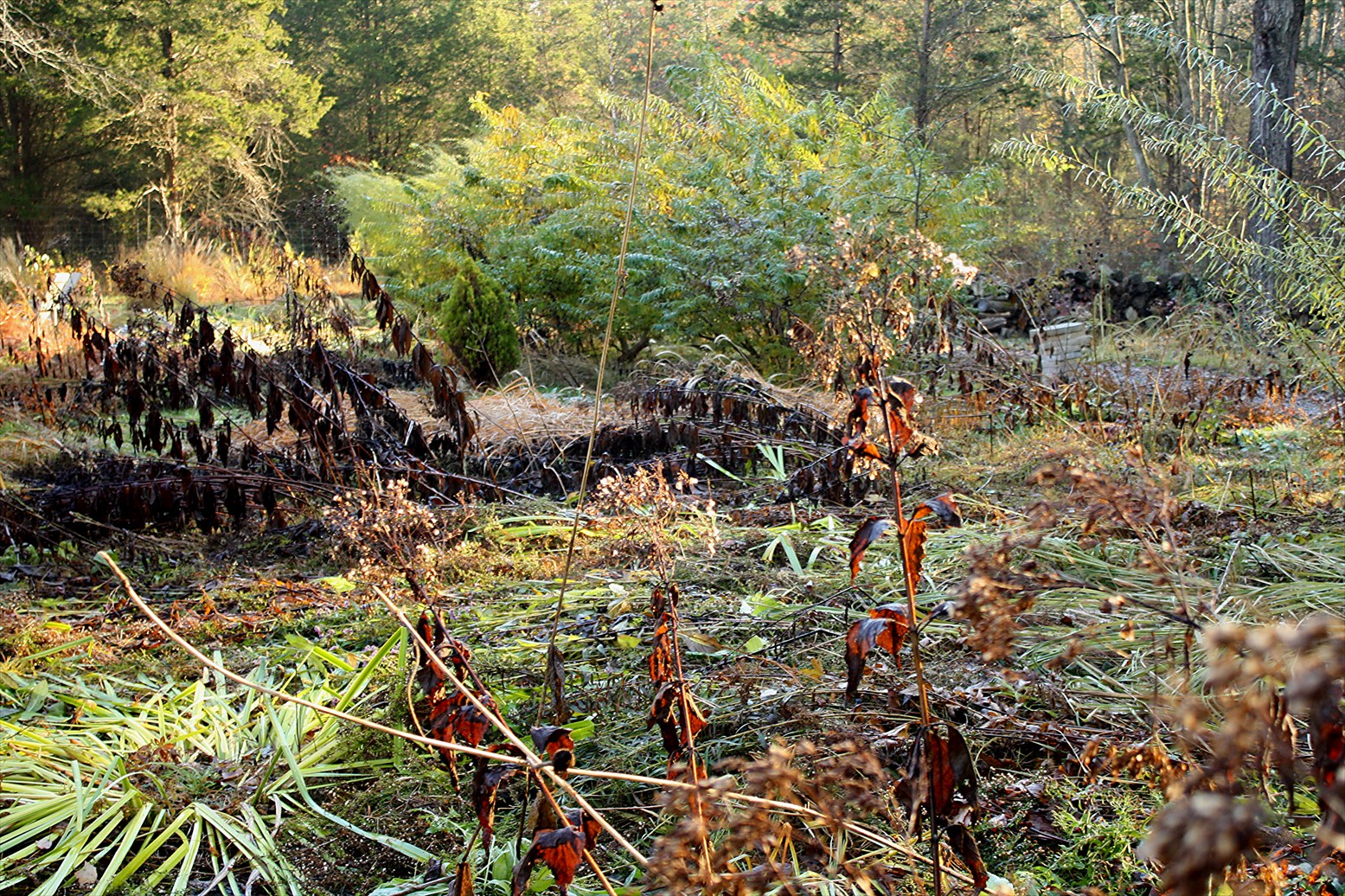
But the clear air and low sun yesterday morning showed the power of light to transform even a scene of ruin into a kind of beauty--light, and the frame of a camera, can create appealing pictures, even of colorful destruction, but a walk through the garden in the morning light was something much more special than I had expected, more than a series of pretty pictures; it was more about atmosphere, context, and illusion.


Certainly no one would call this a "flower garden."


A garden of light, perhaps?


Even this scene of apparent devastation has quite a bit of interest, for me anyway. A kind of botanical archaeology of the garden year. If you click on the image to expand it, you may see what I mean:  evocative contrasts of color, shape, and tone, like impasto on a canvas.

This morning encounter set me thinking about the limits many of us put on our use of the word "garden" because what I was experiencing, while certainly appealing to my senses and thought-provoking, wasn't typical of what most people seek in a garden visit. That is changing, I think, as more gardens imitate, or seek to replicate, the processes and "look" of wildness--gardens like the High Line in New York City or any of many gardens in the "New Perennials" style. As these new gardens become more popular, they may be leading to a gradual change in expectations.


The scene before me was of destruction in large measure--flattened plants, mangled grasses lying in heaps and broken spires, circles of green iris foliage looking for all the world like they had been exploded from their centers and laid out flat on the ground, leaning towers of rich leaden brown Joe Pye Weed, limber willows sprung back from their ice-covered flatness with feathery foliage still intact, the giant miscanthus badly battered but still mostly upright. It was a scene of colors and shapes clearly akin to a kind of abstract painting, some elements a result of intentional choice during planting of the garden, others completely random.


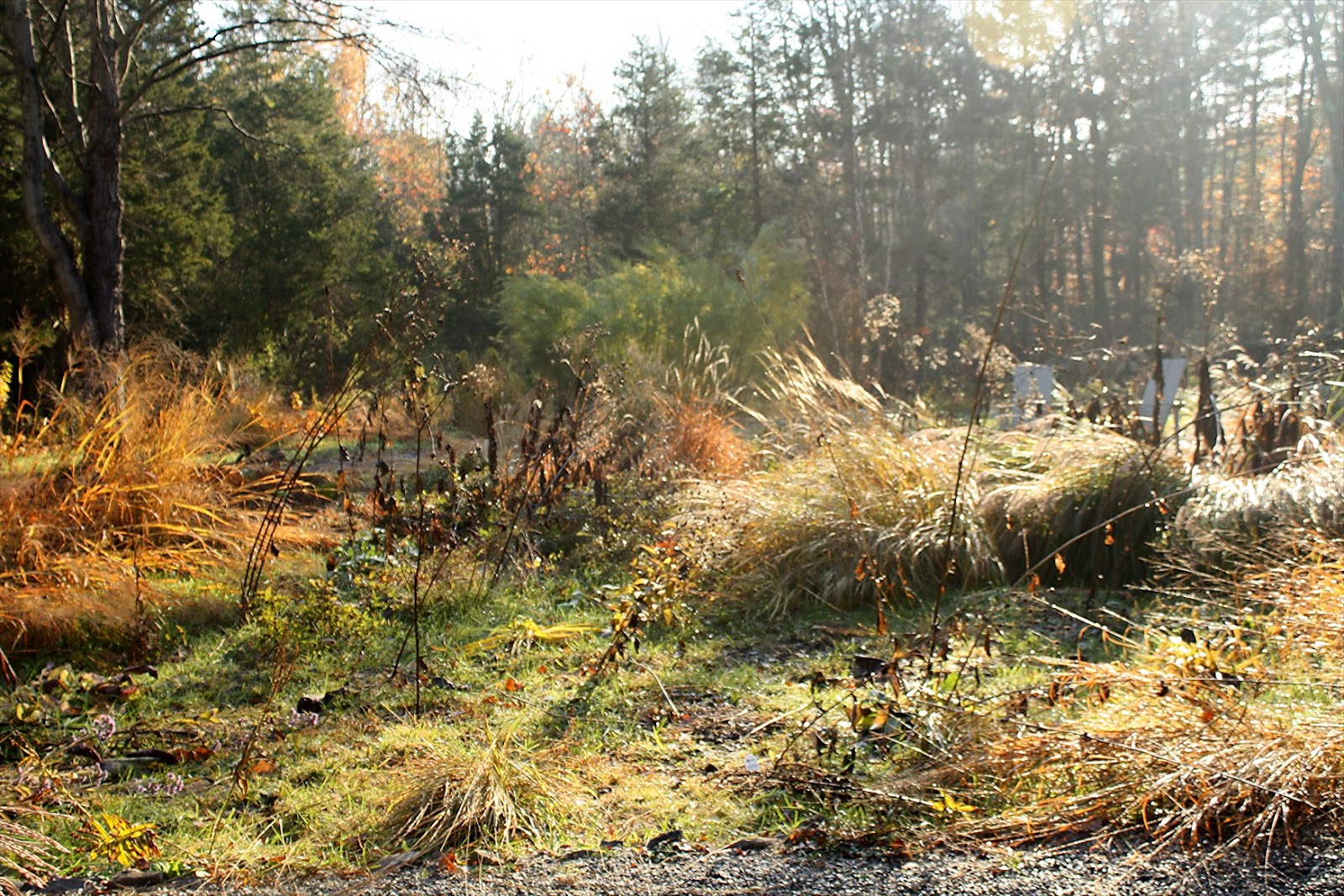
Grasses, even torn into such asymmetrical shapes, are one key to gardening with light. But not just any light; backlighting the tangled foliage makes such a damaged garden come to life. Grasses become like myriad and intricately shaped lanterns, catching the light, amplifying and transforming it through some process of inner refraction and building up of color effects into a bit of the ethereal, a hopeful glimpse into potential, the possibility of beauty in ruined things.


The opening of the woods as the leaves fall lets the light stream through in picturesque shafts of brilliance. Ironic though it may seem looking at these images, the pleasure of my garden is an old, and obvious, one, going back to the Picturesque tradition of the eighteenth and nineteenth centuries. Consider the effects of light, atmosphere, color, scene in the paintings of the Hudson River School, a vision of landscape, with a powerful dose of nostalgia for the past, that formed one of the most enduring myths of America. Much of my appreciation of the ruined garden is a similar romantic, even sentimental, feeling for  "nature," an old and very traditional sense of landscape characteristic of the American experience with the natural world--also my penchant for seeing the garden as a theatrical stage set, though one that takes years to make and that constantly changes. Smoke and mirrors, a human kind of seeming magic.


The spaces in the woods created by the fall of the leaves and the newly penetrating light bring a sense of release after a summer of profuse growth. This seems appropriate to the time of year. In summer, the focus is on the garden; the woods are simply a wall, an enclosure. Now, with the shortening days, the light of the sun streaming through the woods makes me raise my eyes from the low plain of the garden to the bright depths of the surrounding trees, to the wooded world beyond the garden, reawakening awareness of the interconnections of garden and natural world, of human culture with nature, present with past.


The smells were sweet that morning. The fragrances of autumn will soon become the odors of fermentation, rich, earthy, savory, but this day the early processes of slowing growth and decomposition were sweetly reminiscent of freshly mown grass or fresh cut hay.

So this is my goodbye to the garden for another year.

Wednesday, October 05, 2011

As the rains ...

Balder's Traume by Anselm Kiefer
As the rains continue, and I look out on the garden, I have mixed feelings. It looked so much better in July and August. Though autumn is normally its peak season, the recent tropical storms and waves of heavy rain continuing day after day, with almost no breaks for plants to dry and spring back, have changed it into a wet, soggy mass pierced by the leaning towers of tall perennials. But, as I said, my feelings are mixed, some negative, some positive. This is the process of living and dying, to be repeated again in another year.

So much depends on the weather, the light, the wind. The garden has yet to show what it will be this autumn in its visual aspect, tossed about as it has been these last weeks, but the meaning of what I see now is clear:  while the visual experience of the garden may be diminished, garden as symbol remains a potent source of meaning.


In a blog comment Anne Wareham recently questioned how we can develop the skills "to know exactly when naturalistic tips into too messy." As I watch the effects of the weather, Anne's follow-on remark--"This boundary may change as our 'eye' changes as well as when the light and weather change..."--is certainly accurate, as far as it goes. The line between ripe and rotten is a changeable one, depending on what you might want from your garden.

Of course a garden first should be appealing to the senses, should give pleasure. But it can offer other things, perhaps something more than prettiness? When messiness comes, that doesn't mean the end of the garden year I think. The images of disarray contain useful information, lessons to be learned.


So where is the dividing line between naturalistic garden--"wild" garden--and too much disorder? That line is wiggly and it moves all over the place. The constancy of change is just about all one can be certain of.

I'd like to adopt a term William Martin used to describe my garden to get to the point I want to make. When he referred to the "flowing 'emergentness' of the whole," he opened my eyes to something I hadn't been able to put into words. Awkward as the phrase is, that flowing emergentness is what this garden is about, and it can only be perceived over time, through the seasons. It can't be seen in one photograph, or in one visit. So I guess I'm one of the few who can experience it. And my blog readers, of course, if they look at my incessant reports on my own garden!

I drive a lot, and I always pay close attention to the vegetation along the roadside. I'm excited when I see pattern emerging naturally, pattern that I'm sure reflects some underlying organizing principle--seed distribution, wind, aspect, soil type, moisture level ... and though I do decide where most plants go in the garden, I'm looking for that kind of "found" order, an order in precarious balance with disorder.

So the garden now, after a long time of bad weather, tends toward disorder, and, with the constant moisture, toward disintegration and decay. The level of disorder is certainly greater now than at this time last year. Yes, it's messy ... entropy in action.

Messiness is like noise. Or perhaps a better comparison is with my tinnitus. I have a ringing in the ears. At times, it's in the forefront of my consciousness and can be maddening, but most of the time I'm unaware of it. Likewise the experience of the garden depends on focus and awareness. I can walk out of the house and, looking across the garden, even in rain, experience visual pleasure or a kind of depression. After the rain, I can walk thorough it and see "vignettes" of order and disorder. If I keep the long-term perspective of the year in mind, I can see this as just a stage in an annual cycle of growth, decline, decay and dissolution, the "messiness" of death, then regrowth. All is order in the large scale. All of this is appropriate to this place in the woods of western New Jersey.

I yearn for extremes. In fall, I want to see the late winter garden, flat and empty after I've burned and cut what's left. I suppose that's my final answer to the decline from romantic decay into messiness. Take what lessons, what messages, are offered, then wipe it away and let it start again.


Knowledge of the plants and their ecology also plays an important role in appreciation of a naturalistic garden, and in differentiating between the effulgence of growth and messiness of disintegration. While growing plants in appropriate conditions (right plant, right place) does not necessarily make an attractive garden (some "native plant" gardens are indeed unattractive exercises in ecological correctness), seeing plants growing in appropriate conditions is educational and provides useful information. Moreover, awareness of the processes and patterns of plant growth in communities, and the changes in communities caused by competition, distribution of resources (soil, moisture, light vs. shade, exposure), and weather contribute to an understanding of the process of the garden over many years. You can see the past and the future when looking at the garden. Photographs can be a bad thing if they capture only some passing fantasy of a garden, a phantom that doesn't really exist. (Too many pretty flower pictures, scenes shot from just the right angle.)

How to appreciate such a garden? To someone not familiar with the plants I know it's simply a mass of undifferentiated, undulating green, but to anyone with knowledge of prairie perennials and grasses there is plenty of interest. So detailed plant knowledge is certainly one skill needed to appreciate such a garden.

Knowledge of plants also helps one see the garden in four dimensions, so to speak, because it forces you to be aware of time, and changes over time. Messiness and decay, punctuated by strongly structural plants, can maintain visual interest and "extend the season" of the garden, even on occasion carrying it from the merely visual to the intellectual, even the emotional, as with the Japanese concept of Wabi Sabi.

Which brings us finally to the matter of personal disposition and perception. What do you, or I, choose to see at the moment? What filters are we viewing the garden (or the world) through? This brings us close to the difficult concepts of psychology and aesthetics. In this case, it's probably wise to limit the inquiry to what is "appealing to the senses" in some way. Take this painting by Anselm Kiefer as a starting point.


This is certainly appealing to the senses, though in a rather horrific way. It powerfully draws you in, makes you ask questions. Can a garden work in this range of emotions? I think it can, and most likely when it's in a state of disintegration. And a "conceptual" garden with a message certainly can.

Here are two garden photographs from a couple of years back, full of decay and signs of dissolution, even with some of the same colors and something of the mood of the Kiefer painting, but with autumnal coloring and spot lighting that create an entirely different emotional response. Unlike the Kiefer painting, they do not evoke a barren, destroyed landscape, though they do seem to be moving in that direction.


The garden photos have that "beatific" sunlight slanting through the trees, as if something godly might be lurking off to the side. Is some kind of physical beauty ... haze, slanting rays of sunlight ... necessary to meaningful engagement with the garden (not speaking of the "acts" of gardening here)? It's certainly good for a start, to draw you in, but I don't think always necessary.

Depending on what you bring to it, the garden can set off ruminations on many things, including reminders of banishment from the Garden of Eden, apocalyptic images of destruction, or simply the natural cycle of life (perhaps they're the same?). What do I want to see today? What can I see today?

It may be no surprise if I tell you my first "garden" was a cemetery, a beautiful ground blessed by huge Southern Magnolias, full of mysteries from the past, hints of unknown stories, ancient (to me as a young boy) monuments of lichened stone, some thrilling and beautiful, some with mysterious messages in Latin and Hebrew, row upon row of markers for the Confederate dead. It was my safe place, my refuge from a frightening world. Strangely, I always associated that cemetery with life, never with death.

Monday, May 30, 2011

The Bad Tempered Gardener by Anne Wareham

Anne Wareham’s new book, The Bad Tempered Gardener, is irreverent, honest, funny, gossipy, and personally revealing. It's one of those books that practically reads itself. I didn't want to put it down.

Anne isn’t well known in the US, but in her home UK she has a reputation for stirring up quite a storm of controversy. She questions the status quo, the veneer of complacency that permeates the gardening world, the unspoken rule that one can say only polite things about gardens, never be critical or even honestly analytical. She annoys people—and many are important people in the British gardening firmament. Anne does have the manner of the elephant in the china shop, which she readily admits.

She also sees the gardening media as being complicit in all this. Not to say they are evil; they need to sell books, magazines, TV shows, and of course everyone wants to see pretty garden pictures; almost no one wants serious discussion or critical analysis; this is a sign of our times. Anne is one of the few, apparently, who is bothered greatly that gardening is relegated to an irrelevant place in our culture. She asks why that is. She apparently can’t stop herself from wildly gesticulating and pointing lewdly when she sees the Emperor walking naked in the street.

Anne Wareham takes “The Garden” seriously. She wants the garden to return to the important position it held in past times and cultures. I think she’s on to something:  the diminished importance of the garden as an artistic and moral work in our culture—now viewed as a hobby, like making model airplanes, or at the opposite extreme, as an expensive trophy of the wealthy—is a symptom of something out of kilter at a much deeper level. (I should admit my bias here; I’m on her side of this issue.)

A miscellany in the good sense, with a bit of biography, soul searching, garden history, media criticism, funny stories (“I hate gardening”), all presented as a series of generally chronological essays, varying widely in subject and tone, it’s just the kind of book you can dip into at any time of day or night; great for commuters. A collection of thematically related essays, generally covering the making of her garden, The Veddw, on the border of Wales, The Bad Tempered Gardener, to my  mind belongs with a group of fine, lesser known works, some classics. At the moment only a handful immediately come to mind, and they are all personal and idiosyncratic in some way—Eleanor Perenyi’s Green Thoughts: A Writer in the Garden, though you would probably have a hard time imagining two more different sensibilities, Mirabel Osler’s A Gentle Plea for Chaos, likewise a vastly different style and voice from Anne’s, G. F. Dutton’s Some Branch Against the Sky. They may disappear from sight for long periods, then be found again, bob to the surface on some metaphorical seashore, perhaps to be republished, or used copies will be ordered from Amazon or Ebay. They’re like messages in bottles, simply there in the mass of garden media “noise,” carrying messages that may be found by like minds in the future, perhaps to spark new ideas at a more propitious time.

As I was looking through the latest issue of Gardens Illustrated this week, I was wowed by the photos, but the text hardly registered as anything more than a neutral ground against which to display the photos. Even when I read an article, I was left thinking, ‘What’s the point of this?’ Perhaps someone designed, or had someone else design, a beautiful garden, but to what end? A few pleasant places to sit? Pretty vistas and plant pictures? Dramatic allees of hornbeams or pristine topiary? A  spectacular display of garden talent? Why is there no consistent concern with meaning, with aspiration for making something more than pretty gardens?

There’s no slickness in The Bad Tempered Gardener, no “garden porn,” though Charles Hawes' small garden photos give us helpful windows into The Veddw. I think of the glossy garden magazines, innumerable books displaying the gardens of the wealthy or famous—all surface glitter, stimulating unrealistic aspiration among the less well-to-do, giving The Garden a romantic glow but no meaning beyond the appreciation of a well designed stage set.

We need more books full of words about gardens. This one is funny, annoying, stimulating, and immensely sad. Please read it with an open mind and see if you don’t find much to think on.

Saturday, December 04, 2010

These fragments I have shored against my ruin


Okay, take that title with more than a bit of irony. It's a favorite quote from T.S. Eliot I use whenever I get a chance, but we're not talking about the end of the world here.

My post yesterday (Is gardening only a hobby?) elicited an interesting comment from Anne Wareham in England. Someone sent her a podcast link via Twitter, saying the podcast might change my mind about the state of gardening in the USA.

The podcast is a moving interview by Andrew Keys, in fact his inaugural podcast in a series for Horticulture magazine, with Lynn Felici-Gallant, who is leaving her garden after several years. A poignant interview, one that clearly demonstrates real gardening is alive in the good ole USA. (One point of light amid the darkness, if you'll excuse my bleak metaphor).

Andrew is a really good interviewer, and the podcast has a high production value. Click on the Radio Garden logo above to listen. For more on Andrew, check out his blog, Garden Smackdown.

Saturday, September 06, 2008

The Battery Bosque: prairie as metaphor


On a visit to the Battery in early August, I discovered a new garden designed by Piet Oudolf in my home town. My August 11 post described that pleasant, even exciting visit. Since then I've been thinking about the historical importance of the New York Battery, the appropriateness of this garden to the site and its history, and have wanted to explore these thoughts in more depth. Anne Wareham, on the ThinkinGardens website, has published helpful points to consider when visiting gardens. The following is a more thoughtful report on my visit to the Bosque garden using some of Anne's suggestions.


The Bosque garden at the Battery on the southern tip of Manhattan is a totally unexpected gift. Dirt paths flowing in a relaxed meander under the light cover of 140 London Plane trees define islands of perennial plantings. A grungy, neglected park has been remade through Piet Oudolf's design into a practical, durable, beautiful, and historically and culturally appropriate strolling garden that powerfully evokes the American prairies. (Suspend for a moment the dissonance created by the idea of a prairie on New York Harbor.)

Relatively small, at only 60,000 square feet, the Bosque garden is easy to navigate. The paths offer plenty of opportunity for rambling, moving toward and away from the harbor, or to get a better view out - to the water, back to the towers of downtown Manhattan, a glimpse of the expensive apartment towers continuing to rise in Battery Park City.

The Challenge

This is the embarkation point for tour boats to the Statue of Liberty and Ellis Island, two of the most visited historic sites in the United States, if not the world. Any garden in this place must serve multiple purposes and balance many competing needs, offering an aesthetic and sensual experience for garden visitors, meaningful rationale for those familiar with the significant history of this site, and a pleasant environment for passersby, without creating a theme park-like atmosphere or unnecessarily intruding on the experience of those not interested in the garden. And it must be able to be maintained at reasonable cost and be made of durable materials, both hardscape and living.

Most visitors don't come to see the garden, so one might ask why make a garden here? Context provides the answer. New York City has embarked on a large-scale effort to recapture its waterfront. The Bosque garden is one spectacular link - indeed the southern starting point - of a linear park that will eventually extend up Manhattan's West Side from the Battery several miles to the north. It is a part of the re-greening of New York City that is evident to residents even in changing approaches to roadway design, proliferation of bicycle lanes, and numerous "traffic calming" measures throughout the City.

By any measure the Battery is a hostile place for a garden. The heavy pedestrian traffic and the exposed nature of the site - on the waterfront, with virtually no screening from wind, sun, and salt spray - wedged between heavily trafficked streets on the north and the harbor on the south, and with an extraordinary labyrinth of vehicular tunnels and infrastructure underground, would seem to militate against establishing a perennial garden here. What better designer than Piet Oudolf, who works in a vocabulary of plant materials characterized by sturdy geometric form, durable structure, and the ability to provide visual appeal even through winter weather? Because of the small size of the garden, the plants must do double and triple duty, maintaining their appeal for much longer than typical in most gardens. Though I did see some plants in less than pristine condition, such as Carex muskingumensis cut back to the ground, on the whole most plantings were thriving. Oudolf's perennial selections appear too be superbly adapted for this site.

The Meaning of the Place

Beyond the hostile environment, the multiple layers of historic and cultural associations present yet other challenges. The Battery sets off a kaleidoscopic burst of images and associations, making this a difficult place to design a garden appropriate to site, use and history.

Probably one of the most history-laden sites in North America, going back to the first settlement of New Amsterdam over 300 years ago - even before that, to the primeval forest that was home to the native Americans, the Lenni Lenape - the Battery brings to mind a wealth of historic associations. The original Dutch settlement, a private enterprise where commerce ruled the day, and where the first seeds of an open and free society were sown, was replaced early on by the English who imprinted their culture and language on the city. The superb harbor promoted development of a busy seafaring world that covered the waterfront all round this part of Manhattan. In the 18th century the Battery continued to be important in the defense of New York City and it played a significant role in the the American Revolution and later the War of 1812. George Washington was inaugurated as the nation's first President at Federal Hall just a few blocks to the north. Later cultural influences derived with the blossoming of Walt Whitman's prophetic and visionary voice in such emblematic poems as Crossing Brooklyn Ferry, and the epic construction of the Brooklyn Bridge, just to the north of the Battery on the East River. The Great Bridge is both a practical and an immensely symbolic structure apostrophised by the early modernist American poet Hart Crane as an arc of space and time that leaps from Europe and the urban east to the prairies at the center of the continent, imagined in cinematic terms as a metaphorical bridge carrying the millions of immigrants who passed through this harbor to new futures and distant geographies (“O Sleepless as the river under thee, vaulting the sea, the prairies' dreaming sod”), and finally the almost cliched icon of the Statue of Liberty.

Does it Work?

The Bosque garden must respond in a meaningful and satisfying way to all these challenges. This garden works, and it works on many different levels, from the most practical to the highly symbolic. (I was intrigued by the use of the name "Bosque". The word is used for small wooded areas that thrive in environmentally hostile areas along rivers in the southwestern U.S. and is derived from the Spanish, so it is an appropriate name in a metaphorical sense.)


The Bosque garden easily accommodates existing uses and features of the site. It works as a route of passage for the hundreds of thousands of tourists who pass it to reach the waterfront to view the Statue of Liberty or to reach the tour boats. Walkways direct the throngs from the heavily trafficked northern edge around Castle Clinton to the long queues for the boats, shown in the plan above from the Battery Conservancy web site. The garden edges this passageway, offering paths into the Bosque proper.

The garden also coexists comfortably with the large, rectangular East Coast Memorial, seen prominently in the plan above and the photo on the right, and a 40-foot-wide walkthrough fountain popular with children. By maintaining a low profile the garden easily plays the role of decorative background to the new fountain and the large, stiffly erect Memorial of stone monoliths with a giant stylized eagle. By being so low key, the garden almost mocks the self-conscious aggrandizement of the Memorial.

Standards of maintenance in New York City parks are generally quite low. In this case, I'm sure the Battery Conservancy is responsible for much more attentive maintenance than usual. The plantings too, as is typical with Oudolf designs, tend not to require a great deal of care, and are durable on their own. Over several years now, the Garden of Remembrance, which is really nothing more than the separately named waterside edge of the Bosque garden, and the Bosque itself have survived and even thrived in spite of apparently difficult environmental conditions, so the plantings can be said to work, and work well, on a practical level. I have only seen them in August, normally one of the hottest and most climatically stressful months in the City, and they were in amazingly good condition.

Anyone familiar with Oudolf's work will recognize many of the plants in the Bosque garden, but the design is not stale or formulaic. This is a risk of Oudolf's technique, based as it is on rather rigid planting principles with masses of astilbes, grasses, scutellaria, and other perennials in his pallet. We have seen many of the plant combinations before, but they are put to appropriate purpose here. Nearer the more crowded areas, the plantings are relatively low, maintaining an open view, and actually keeping the garden below the level of consciousness of most tourists, who after all are here to see the sights, not to visit a garden. For most of these visitors, the garden works on an almost unconscious level, serving only as a pleasant environment through which to walk.


For those visitors who want a garden, the plantings are low, like a low surf (many are groundcover), near the heavily trafficked end of Battery Park. As you stroll along the winding paths of sandy soil - surprisingly not stone or concrete, which you would expect - moving toward the east where the Staten Island Ferry Terminal blocks further passage - the plantings gradually build, like large waves of water, becoming looser, bulkier, taller, and taking on complex geometric shapes, very different in character from the rest of the garden.


A Conceptual Garden of Allusion

While it works as simply a beautiful, diverse, and intriguing planting, the Bosque garden is also a conceptual garden that works through allusion. How much of this is due to intellectual intent or simply to location and context I can't say. It may be that the garden, in its simplicity, takes on resonances of meaning just because it exists in this historic place.

Regardless, in the mind of this viewer it successfully negotiates the complex world of cultural symbols associated with the Battery and the concept of "America" epitomized in the Statue of Liberty and Ellis Island. The idea of "prairie" recalls a range of images, emotions, and stories emblematic of American history, from the "fruited plains" of the anthem "America" to the artistic vision of Willa Cather's My Antonia set in the prairies of North Dakota, and could be seen to refer to innumerable other stories set in the American prairies. The symbolic journey begun at the Battery ends in a multitude of different places and times, but none more appropriate than the center of the North American continent, in words of William Cullen Bryant, in the place "for which the speech of England has no name". The prairie has become such a central concept in American culture and literature it is hard to visit this garden without finding one's thoughts turning to the many themes associated with the American prairie.

There is no doubt this is a highly artificial garden built in one of the most heavily used pedestrian areas in New York City, above rail and automobile tunnels, surrounded by the towers of downtown Manhattan. But it is a successful and beautiful garden that provides visual delight and respite. It meets the challenges of the site's use and exposure, and through the metaphor of the prairie, helps clarify the meaning of the historical and cultural clutter of the Battery's past.

The garden can be appreciated on the most basic level, as a collection of striking plantings and pleasant views. For those who bring an understanding of the history of New York City and the Battery, of the defining importance of the prairies (now mostly vanished) in American culture, and of the symbols that have become deeply embedded in American identity and the concept of Manifest Destiny, it offers a more meaningful, contemplative, and culturally self-critical experience.


(Photo of lower Manhattan and plan of the Battery are from The Battery Conservancy website. Other photos from August 11 post and Phillip Saperia.)

LinkWithin

Related Posts with Thumbnails