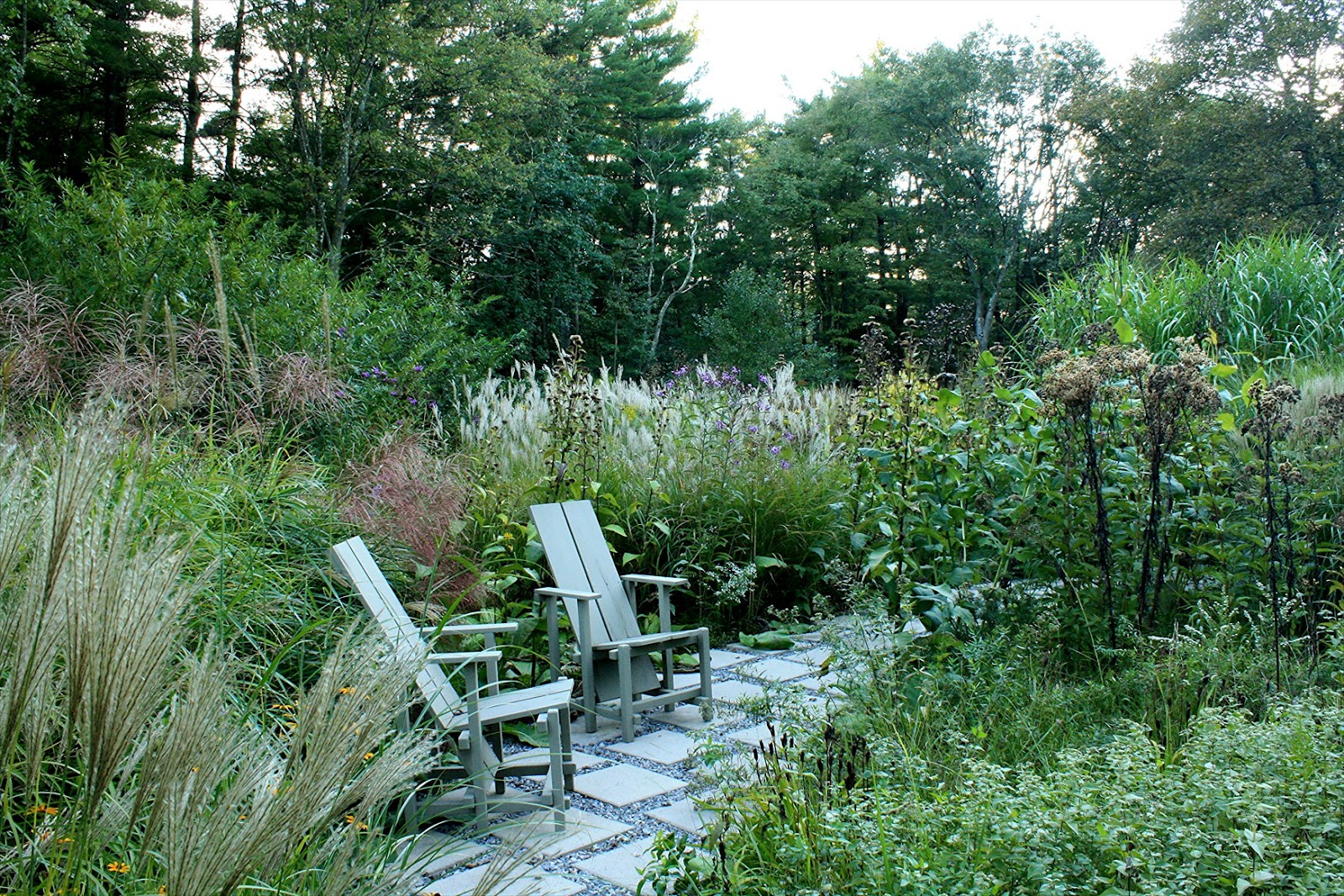
My garden exists somewhere on the edge between a wild field and a cultivated garden. Knowing the nature of this place and the difficult conditions I was presented with when I first started the garden, I chose an experimental, naturalistic approach combining plants already on the site with new plants, many large enough to dominate, literally smother, competitors, some native, some not. The chief criterion was whether a plant could thrive in this place, not place of origin.
 |
| Mounding shapes like heaving waves, suggesting tumultuous motion, and evoking some anxiety perhaps? |
But my intent was bedeviled by a tentativeness, by concern that this was contingent on a host of uncertainties, a risk, a bet, a gamble. It might not work. And I've worried about the wildness over the years, not knowing whether my garden would survive as garden, whether I could maintain that precarious balance between wild and cultivated.
Now I have enough years with it to know I can. Though I'm with the garden only a few days a week, and I don't particularly like standing in the pond pulling weeds or dripping with sweat in a pile of scratchy Miscanthus, I can from time to time intervene in the dynamic process of plant competition, make changes for the better. At times, rip out unsuccessful areas and make them anew. Now I feel much more at ease with the messiness, the lack of neat edges, the ungardened or partially gardened areas.
 |
| The long view - much more tranquil, especially with the strong verticals of the trees behind. |
Many people, I realize, don't see a garden at Federal Twist. Some see a field of weeds and large, strange plants. Some become uneasy walking through it. Others "get it."
Since I don't really care for the labor of gardening, should I call this a garden an object of aesthetic or philosophical contemplation? One gardening acquaintance has called it a "creative mess." Is it?
The answer to both questions is "yes."
 |
| White candles of Sanguisorba canadensis light up the twilight. |
It calls out to you to give it meaning.
You have to "find" the garden each time you look at it. I'm wary making comparison with paintings or photographs because they not at all the same, but it helps to look at the garden as an intentionally composed image. Simply taking a photograph does this, creating a frame that leads the eye to focus on individual details and find relationships within the framed image, and suggests the possibility of what lies outside the frame. It's a tool, so to speak, a way to learn how to look at the naturalistic garden.
Pattern and order ... in the first image you can see the mounding shapes of Miscanthus, Lespedeza, Oakleaf hydrangea, Joe Pye Weed, Filipendula and Golden rod, toward the back Miscanthus purpurescens in plumy flower. Added to this visual differentiation is the tumultuous emotional effect, a feeling almost of being tossed about by a sea of plants smashing together. A paradox, it seems, because all was quite still when I took that shot. Nothing is moving. The movement is only suggested by a seeming superabundance captured within that tight frame. The tumult and motion take place only in the mind of the observer, not in the garden.
 |
| With dense planting minor changes in position present new compositions. |
 |
| A bit of dark water evokes dark thoughts. |
 |
| Lespedeza thunbergii 'Gibraltar' veiled by Prairie cord grass, an alien and a native. Only the native is invasive! |
 |
| The central garden, with a bronze sculpture almost hidden by the plants, a pleasant visual association, and vaguely evocative - but of what? |
 |
| Raised planting of box extending back to the pond, joined to it by a mound of Oakleaf hydrangea, with irrepressible self-seeded Great Blue Lobelia and Eupatorium perfoliatum. |
 |
| Swamp aster, Chelone 'Hot Lips', Conoclinum coelestinum. |
 |
| The main path across the garden. Most of the verticals are Rudbeckia maxima. |
 |
| Panicum 'Shenandoah' and Rudbeckia maxima. |
 |
| Great blue lobelia (Lobelia siphilitica) naturalizing in grass. |
 |
| An area of naturalized planting in grass - the dry end of the garden. |
 |
| Walnut log circle, intended as a reminder of native inhabitants of this area. But such symbols don't really work. You bring your own meaning to it. |
 |
| In the photo this view looks rather chaotic, showing the garden teetering on the edge between order and chaos, but in three-dimensional reality you can move around. The sense of spatial definition brings the view back into balance. |
 |
| Rudbeckia maxima, a major theme plant, with my best ground cover, Miscanthus. |
 |
| The low house on the hill broods over the garden. |
 |
| A seating area for disappearing into the plantings. |
 |
| The bank going up to the house. |
 |
| Sanguisorbas. They self-seed well. I want other varieties. |