Pages

Showing posts with label Marc Rosenquist. Show all posts

Thursday, January 17, 2013

Ready for fire, but ice instead

Just reread Tom Stuart-Smith's The Barn Garden about his own garden in Hertfordshire--an intriguing book, a beautiful book, with several surprises. I mention it because Tom, in passing, tells of the damage done to perennials and grasses by voles one mild winter, damage that prompted him to start cutting back many plants much earlier than usual. That struck a resonant cord. Last spring I found the roots of many plants in the garden had been eaten, leaving plants dead or severely damaged. I really regret the loss of a large Baptisia australis that had several years of growth, and I even noticed serious damage to several grasses.

We're now having a second mild winter so I want to start cutting and burning early. Unfortunately, we've had icy rain and continuing wet. So instead of clearing the garden, I took a few photos of the ice cover yesterday morning. Growth is thin following last fall's hurricane, but it's astonishing what visual delights remain if you have a weather surprise.

Acer palmatum in ice with background grasses

Small pond brimming full with rain

Salix alba 'Britzensis' being trained as a pollarded specimen

Three large Salix sachalinensis 'Sekka' covered in ice behind grasses and bedraggled Filipendula remains

Marc Rosenquist's bronze amid the ruins

View across the desolation toward the house and new reflecting pool
And speaking of the reflecting pool, I find being away for a week has helped me put the many conflicting comments I've solicited in perspective. In my loose, serendipitous garden, so reliant on chance as much as planning, the structural detailing and geometry of the pool area simply do not matter that much in the larger scheme of things (not saying they don't matter at all). I still want to "get it right" (whatever form that takes), but the garden is about much more than this little piece. And I have other fish to fry.

Betula nigra 'Heritage' (River birch) beside the long garden walk

Salix sachalinensis 'Sekka' pruned high to show sculptural trunks


This willow has a striking characteristic. When pruned, some stems develop a flattened, fasciated form much desirable among flower arrangers, very beautiful detailing. Here are two close-up views taken last week on my mobile phone.


Here again is the River birch, which is just beginning to develop the white, peeling bark so distinctive of this cultivar--another ornament of winter.

River birch looking toward woodland garden

That Acer again

I still hope for dry weather by Sunday, so I can begin to cut and burn.

Monday, September 24, 2012

In another light


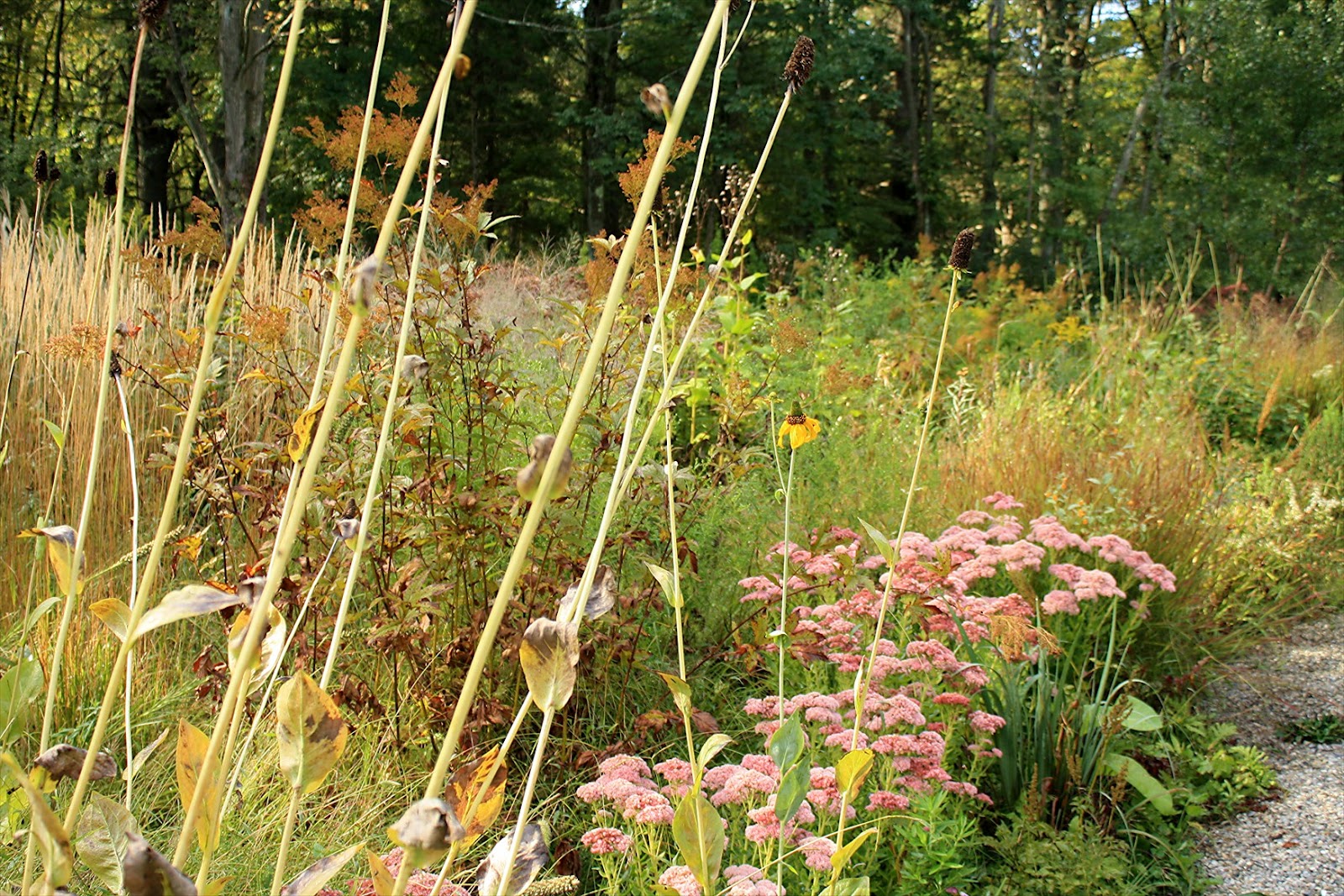
Fall arrived this past weekend. The sun was shining full at a low angle, bringing the first intimations of the season's glowing golds, yellows, oranges and reds, stippled by purple asters, black seed heads, fruits and berries that announce the end of the garden year. The fermenting fragrances of autumn soon will begin to rise from the earth.

This set of sun-lit photos contrasts with the twilight photos in the previous post. Click on this link to see that post.

Leaf-strewn terrace overlooking the garden. The worn blue stone paving dates to the mid-1960s giving the modest sitting area a patina of age.


Late blooming Lespedeza thunbergii 'Gibraltar'.


Geranium 'Rozanne'.

Steps down to the garden, of native argillite stone.

The small pond surrounded by mounds of debris just heaved out.

The bank up to the house, still a work in progress.

As the sun drops behind the trees, theatrical shafts of light create moments of transient radiance.


Panicum virgatum 'Shenandoah'.

Filipendula rubra 'Venusta' in its copper phase, asters yet to bloom behind.

The native Seedbox (Ludwigia alternifolia).

Rods of Rudbeckia maxima, Goldenrod, some of which I must pull out to control its spread.


Looking across the garden toward the east.


Tall Silphiums and Rudbeckias dominate here earlier in the season. More interesting ground level plantings are in the works ... orange daylilies in grass, Pycnanthemum muticum, Rudbeckia 'Henry Eilers'.

Serpentine wall.

Wave Hill chair with Miscanthus purpurescens on right.

Looking up toward the house. Is refuge in the house or is it in the garden?

Back path with partially planted area on the left. I just seeded Sorgastrum nutans, which is endemic to this site.

Miscanthus 'Silberfeder' and Inula racemosa 'Sonnenspeer'.


View across bracken toward six red walnut logs, with new Miscanthus giganteus making a partial wall behind.

Hidden path into interior sitting area.

Pycnanthemum muticum and Panicum.

A place to sit, like a nest among tall perennials.

Late blooming vernonia with asters and blue lobelia.


Pycnanthemum tenuifolium, naturally occurring on this site.

Vernonia seed heads.

Inula and Miscanthus purpurescens.


Looking toward the hidden terrace.

Mystical 'omphalos' of the garden.


The elevated box hedge slowly merging with the garden as perennials seed into the planting. I do have to control this.


Great blue lobelia randomly seeded in.

White Eupatorium perfoliatum and Great blue lobelia, with a large self-seeded Patrinia scabiosifolia between, randomly timed to grow tall and bloom next year. Hydrangea quercifolia behind.

Looking across to the woods. Patterns of light shift moment to moment.


LinkWithin

Related Posts with Thumbnails