Pages

Showing posts with label John Brookes. Show all posts

Sunday, January 15, 2012

Garden Diary: Reimagining the garden

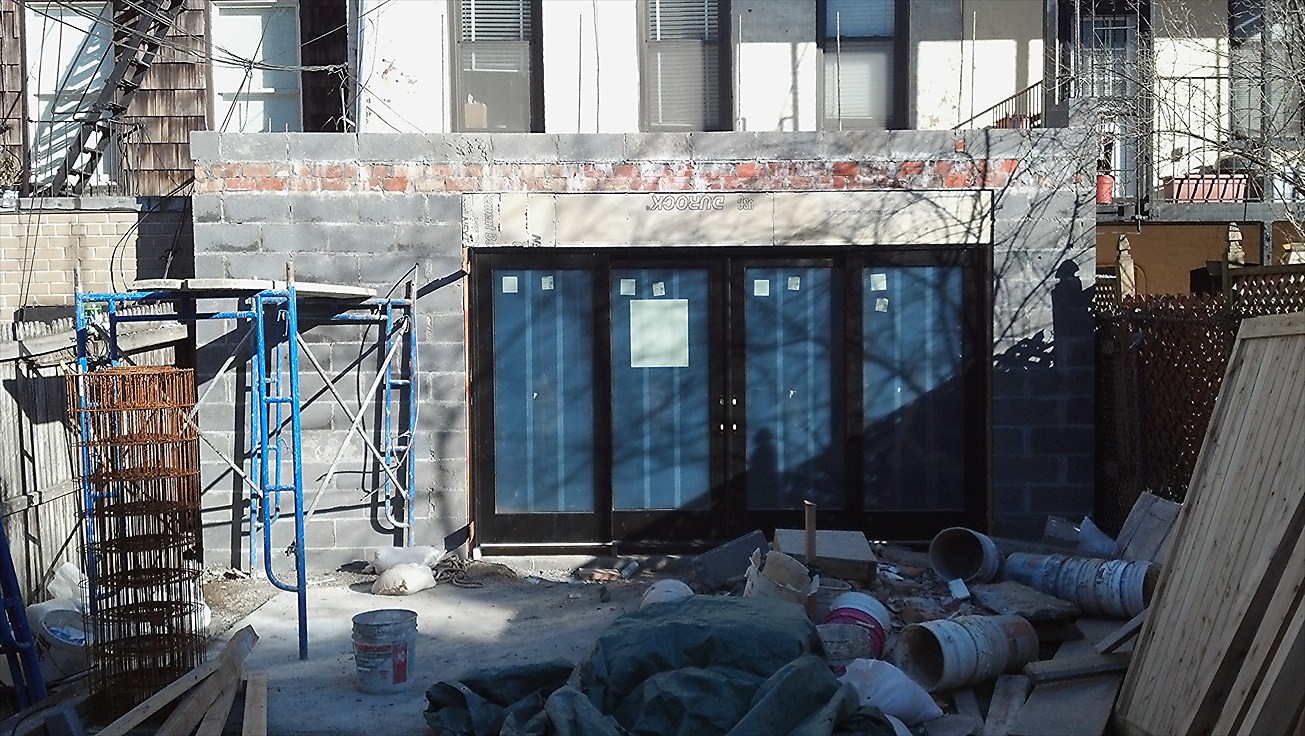
The external structure of the new room is up. Now I can see the pattern and geometry of the facade that will form the most prominent side of the garden--the entry side. The surprise is how very off center is the twelve-foot-wide door opening to the garden.  (The doors are black, and their sharp definition against the rough masonry facade has a lot of visual punch.) The scale of the back wall in comparison to the door opening creates a simple but powerful geometry I can't ignore. It will be a dominant element in the garden.

The grand revelation. Now I can see the back wall of the new garden
room, and it demands reimagining the garden.
I'm remembering what I learned in the books of John Brookes about using a grid derived from the dimensions of the house, or a significant component of the house, to define the garden space. It appears I need to work with a series of rectangles--the rectangle of a single door, the rectangle consisting of the unit of four doors, and the rectangle formed by the back wall of the extension. And, of course, the position of the door opening within the wall itself, which will determine how the body moves out of the house into the garden, which in turn sets certain spatial and aesthetic expectations.

The garden has to 'grow' out of this nest of shapes, and invite the human body to enter ... what? To be determined ...

I don't intend to abandon earlier concepts, those described here, and here, and here. But I do have some rethinking to do.

I'm quite happy about this. More challenges, more problems to solve. More fun!

Sunday, July 05, 2009

Natural Garden Style by Noel Kingsbury

"This book aims at introducing gardeners to a style of working that engages with a sense of place, uses plants that suit the place and manages the plant community that develops when different species are combined." - Noel Kingsbury

Yesterday, on the way back from the day lily farm, Phil and I stopped briefly at a roadside nursery. At checkout, the couple in front of us were buying plastic branches of flowering dogwood and a few annuals, little shapeless blobs of color. The impulse to take something of beauty from nature, even in the form of a plastic imitation, must be a sign of hope.

Noel Kingsbury's most recent book, Natural Garden Style: Gardening Inspired by Nature, is about making natural-style gardens. It too is a sign of hope - though of an entirely different order. Kingsbury has something of great value to say to that couple at the nursery. They certainly will never read about it in this book, but the ideas he is seeding about may eventually reach them via more indirect cultural influences.

This most recent work is a 'how to' book, but a 'how to' book of ideas, concepts and examples, not techniques. A list of the chapter titles tells much: Meadows, Prairies and Borders, Trees and Woodland, Sculpture and Ornament, Gardens and the Wider Landscape, Sun and Stone, Creating and Maintaining. Call it a 'how to' book of big ideas. You won't find a recipe for making a prairie. What you will find is a description of what a prairie is, how a natural prairie differs from the simulacrum of a prairie we may choose to make in a garden. You will learn about the incredible density of plants in a natural prairie - numbers and varieties of plants in a square meter, for example - and how that affects maintenance - by, for example, creating a stable matrix of plants that 'naturally' keeps weeds out because they can't find a place to put down roots.

Unlike the couple at the checkout counter, Kingsbury works from a highly informed position. From the start, he readily acknowledges the contradiction in the term 'natural garden': "No garden is really 'natural'. Leave a garden to the forces of nature and the result will nearly always be a tangled mess of vegetation that will give little joy ... We have to be honest. What we want from a patch of land and what nature would do with it, given half a chance, are very different. The nature we want in our gardens is a refined and tidied-up version, preferably one that is pretty and keeps us interested for as much of the year as possible."

Kingsbury's garden writing is among the best you will find in the English language. This book, like his others, is well organized, based in scientific research, aware of its historical context in the long line of proponents of naturalistic gardening going back to William Robinson in England and Karl Foerster in Germany, and generous in its use of photographic examples of the work of many of today's notable garden designers - among them, Dan Pearson, Wolfgang Oehme and James Van Sweden, Piet Oudolf, Neil Diboll, Isabelle van Groeningen and Gabriella Pape, Jinny Blom, Henk Gerritsen, Cleve West, Tom Vanderpoel, John Brookes.

I expect any new work by Noel Kingsbury to be a thoroughly enjoyable, nonstop read, and this one maintains his high standard. Kingsbury has established a worldwide reputation through his many works, though I do wonder how well known he is in the U.S. His signature themes of naturalism and sustainability are right on spot for the times, and his clear, well paced, and superbly organized prose is a pleasure to read.

Kingsbury has always recognized the importance of North American contributions to 'naturalistic' garden design as well as the importance of our flora as a source of many of the plants used to make such gardens. I have never seen another European garden writer give such prominence to the contributions of Neil Diboll, founder of Prairie Nursery in Wisconsin, to garden design. I hope more North Americans can overcome an aversion to British garden writing (because thought irrelevant to our climate) and buy this book.

Saturday, October 25, 2008

Statement of Principle

Late October 2008

What? With the world in virtual financial collapse, wars and cultural conflicts threatening the lives of millions, perhaps billions, I'm making a statement of principle about gardening? What sort of silliness is this?

I avoid using the words 'green', 'sustainable', 'sustainability'. They've already been appropriated by the world of business and capitalism, and are well along the way to becoming meaningless. Perhaps I should use 'stewardship' because this is about keeping the earth and enjoying the earth. Perhaps it's best not to use labels, keep quite, and just try to take care of my own bit of the land. I can do without labels, but I can't keep entirely quiet. So herewith, a statement of gardening principles, and a little of my local history.


The Future Garden in Late 2004

A Time for Taking Stock
As the end of the gardening year approaches, refocusing seems in order. Time for a gardening life checkup.
My garden on Federal Twist Road is an experiment.

Apart from clearing the land of close-packed weedy cedars to make space for a garden, I take the land as given - no soil improvement, no measures to change the heavy, wet clay, no mass extermination of existing plant life, no change in natural drainage patterns, no fertilizers. My goal is to make the most of what I have - to create an artificial wet prairie with a self-sustaining community of plants appropriate to this place and its environment, and a habitat for wildlife. Most of the plants are native, but there are also many exotics - because they will grow here, because they are appropriate for this environment, and for aesthetic reasons (and to satisfy the desires of a plant mad gardener).

The constraints of the site - very wet, saturated clay particularly in winter, surrounding woods that reduce direct sunlight, a cold microclimate that retards plant growth in spring - limit plant choices and force a lot of trial planting just to see what will thrive.

I don’t fool myself into thinking this experiment is a wholly idealistic, or scientific, endeavor. It’s a practical matter of time and money. I can garden only on weekends, and money to purchase plants and pay for labor is limited. My ultimate goal is a garden that is relatively self-sufficient.

Why Here?
We fell in love with the house and its location. A 1965 mid-century reminiscent of Frank Lloyd Wright in his Usonian phase, the house and its secluded location amid 19 acres of preserved woodland are what originally attracted us. Designed by a notable local architect, William Hunt, the house has a wall of windows at the back overlooking the main part of the garden and surrounding woodland. It clearly refers to both Japanese and Arts and Crafts design conventions, both of which are associated with naturalistic settings. Visually, the house is an unobtrusive presence from outside; its gray wood siding and low profile blend easily into the forested location. The house is so unobtrusive, one contractor we hired told me he had been driving past for 20 years but had never realized a house was here.
View Out to Garden

From inside, the ample fenestration brings the outside in, even in winter when a surrounding snow cover can provide special delight. The hope for a new future, the tranquility of the wooded location, and the immediacy of the experience of nature won out. We bought, and moved the four miles from Rosemont.
While we were thinking about moving, I did have doubts. What had been a view across an open field in 1965 had become congested with 50-year-old cedars, and the change to a mixed hardwood forest was immanent. I counted trees and guessed we would need to cut down 80 or 90, mainly weedy cedars, just to get less than an acre of open space.
I understood that making a garden in this place would not be easy, and I certainly regretted giving up my Oudolf-inspired garden in the nearby hamlet of Rosemont, but I felt up to making a change. An opportunity for a new garden!

Garden Practice
A naturalistic garden seemed most appropriate to the style and location of the house. Anything remotely formal, other than some topiary shapes to provide sharp contrast with the surrounding wildness or some kind of symbolic structure or artwork, would be out of place. I started by planting directly into the existing matrix of plants, figuring the weeds I already had would suppress potential new weeds lurking in the seed bank and maintain existing stable groundcover as I developed the garden over the next several years. (I quickly discovered that many of the existing 'weeds' consisted of highly desirable Carex communities, Scirpus, Juncus, Sysirinchium, Lobelia syphilitica, fleabane.) My aim is to develop communities of more desirable and ornamental plants that will form a new weed-suppressing matrix.
Planting Directly into the Existing Matrix - Summer 2006

I took help wherever I could find it, mainly from books. For sizing the garden area and establishing spatial relationships to the house, John Brookes' many books on garden design were extremely valuable. For approaches to plant selection and planting design my main sources were Oudolf and Kingsbury's 'Planting Design: Gardens in Time and Space', Kingsbury's 'The New Perennial Garden', Hansen and Stahl's 'Perennials and their Garden Habitats', 'Dynamic Landscape: Design, Ecology and Management of Naturalistic Urban Planting' edited by Nigel Dunnet, King and Oudolf's 'Gardening with Grasses', and Rick Darke's 'The American Woodland Garden: Capturing the Spirit of the Deciduous Forest' and 'The Encyclopedia of Ornamental Grasses'. There are many others, of course. Most of my sources were European simply because I could find the information I needed there, Rick Darke being one notable exception. (One might ask what this says about much of American garden writing.)

Plants remain standing over winter to provide visual interest and as a framework to display ice and snow. In the early spring I burn plants I can safely put flame to (historically appropriate prairie practice) and cut down the rest using electric hedge clippers, leaving the remains in place as a mulch and to gradually increase the organic content of the soil. This leaves a rather dismal view for a few weeks until the early irises and grasses begin to provide some visual interest.
The Garden after the Early Spring Slash and Burn

Results
After three years of work planting, building stone walls, and this year making a small pond, the garden is nowhere near completion but it does achieve moments of beauty, and it is thriving without the kind of intensive intervention typical of more conventional gardens. I have found that many perennials have a hard time getting established in my stressful environment; large plants, though they are expensive, have much greater success.

Moments of Beauty

Although my conditions are not conducive to successful seeding, I've found that many seeds do germinate in the second year following random broadcasting and I now have communities of iron weed (Vernonia noveboracensis), cup plant (Silphium perfoliatum), and Great Blue Lobelia (Lobelia syphilitica) established from seed. I'm still lacking sufficient groundcover plants to complete the matrix planting, and that is a challenge I will continue to focus on next year.

Some weeds do still make life difficult, especially Japanese stilt grass (Microstegium vimineum), which usually covers virtually the whole garden by season's end. This year I got the upper hand (I think). Using repeated cutting and hand pulling, I prevented most of the grass from seeding. Since it's an annual, I hope to see less of it next year, and to entirely eliminate it in in a few years.
Principles
So... these are the principles I'm using to develop my garden:
  • Consider the culture and history of a site before designing a garden
  • Use plants appropriate to existing ecology and environmental conditions
  • Establish self-perpetuating plant communities, keeping watch for overly competitive or invasive behavior
  • Intervene minimally
  • Don't use supplemental watering (except when needed to establish new plantings)
  • Don't fertilize - use only compost and allow organic matter from previous years to decay in place (unless diseased)
  • Make aesthetically appropriate design decisions (make it pleasing to the senses)
  • Provide habitat for wildlife
Please don't take offense. This list is for me, not you - to help me keep on track, measure progress, and decide when change is needed.
Thursday, March 27, 2008

Making Space

Here is the garden at Federal Twist from space, much thanks to Google Earth. The terrain slopes rather sharply from left to right, carrying tremendous volumes of storm runoff down to the Lockatong Creek, a large, rocky tributary of the Delaware about 1000 feet below the house. As a consequence, my garden is very wet.


The house (the brown roof is visible on the left) overlooks the garden in progress. An irregular oval path, the "great circle," partly hidden by trees and shadows on the right, delineates the central garden area, and is connected by linking paths to both ends of the house. The lower linking path is through a woodland area and is almost invisible in the photo.

When we moved to Federal Twist Road three years ago, the house was surrounded by first growth forest, about 40 years old, mostly of cedar (Juniperus virginiana). One thing was clear. Many of the cedars had to be removed to create space and light. After we cut the trees I didn't know how to define the garden in proportion to the house and surrounding forest. Then I remembered a device John Brookes recommends, and used a grid taken from the dimensions of the house to define the space. The crude drawing at the right shows the initial, and final, layout of the garden pathway using a grid based on the modular structure of the house - squares about 30 feet on each side.

This technique helped me recognize the need to remove additional trees to create more breathing room in the garden area. By giving me a firmer grasp of the spatial constraints of my land, forest-bound as it is, it also helped me understand how the garden can grow. The lower woodland path in the drawing, for example, will become the armature of a new woodland garden already begun. The back side of the "great circle" will, in the future, break through into a "cove" of open space (just visible in the photo) that curves down and away from the main garden, giving an area of privacy (mystery?) from which the house can't be seen.

The Google Earth photo looks so bleak I offer two more photos to show a real garden is actually emerging. First, a landscape shot into the "great circle."


Next, details of the evolving "wet prairie."


In a later post I'll write about garden elements that will quietly allude to the culture and history of this area - light touches, I hope, that will be so integral to the garden design only those who want to see will see.

LinkWithin

Related Posts with Thumbnails