Pages

Showing posts with label Bowmans Hill Wildflower Preserve. Show all posts

Sunday, October 22, 2006

Pycnanthemum muticum - a short history of an affair with a smelly plant


I've seen Pycnanthemum muticum for over two years at Paxson Hill Farm, a small specialty nursery just across the Delaware in Bucks County. It was always swarming with bees and other insects when in bloom, and I was definitely interested. But I never bought it.

Then I saw it for sale on the website of Bluestem Nursery in British Columbia, which advertises it among a selection of perennials called 'Wolfgang's Picks' (Wolfgang Oehme of Oehme and Van Sweden). I did order a substantial number a year-and-a-half ago, but only about three survived the transit. Looking at these now mature plants I can see that the silvered texture of a mass in bloom could be a pretty, and deer-proof, sight.

Michael King's Perennial Garden Design, which I highly recommend for its valuable information on such little known (in the U.S.), innovative planting designers as Heiner Luz of Germany, has two photographs that convinced me I needed to give this extraordinarily aromatic plant a try on a big scale. One photograph is of a large group of mixed pycnantheum and Petasites japonicus, backed by a wall of Miscanthus s. 'Silberfeder', designed by the Oehme and Van Sweden firm. The other was of a mass planting of pycnantheum alone.

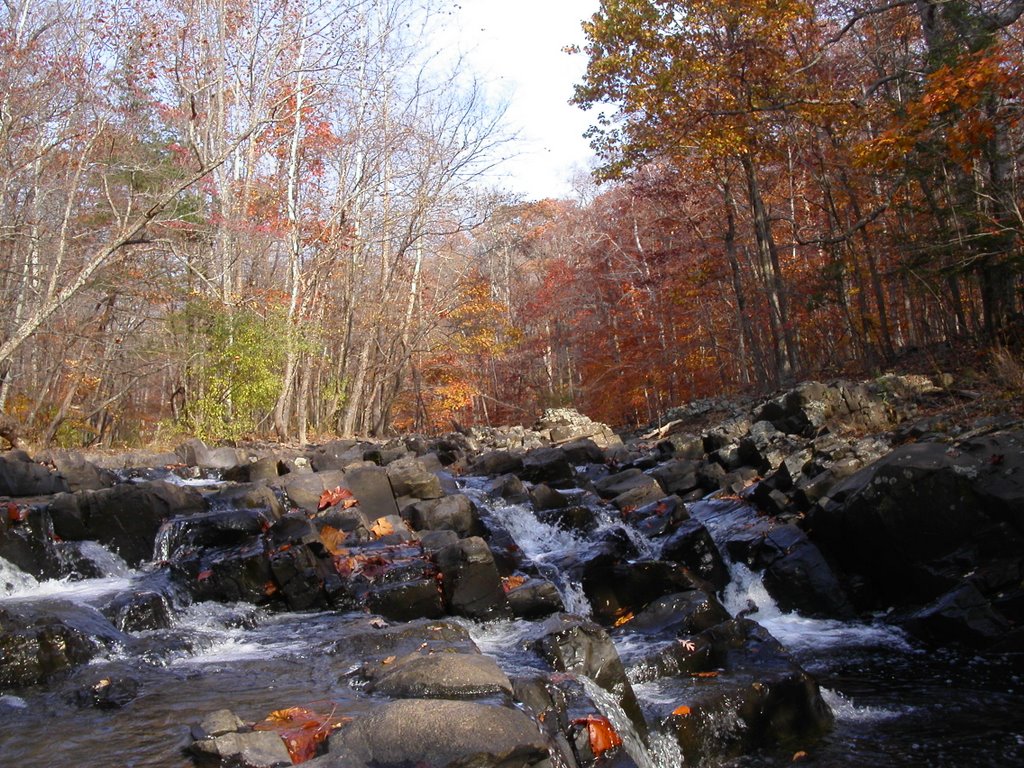
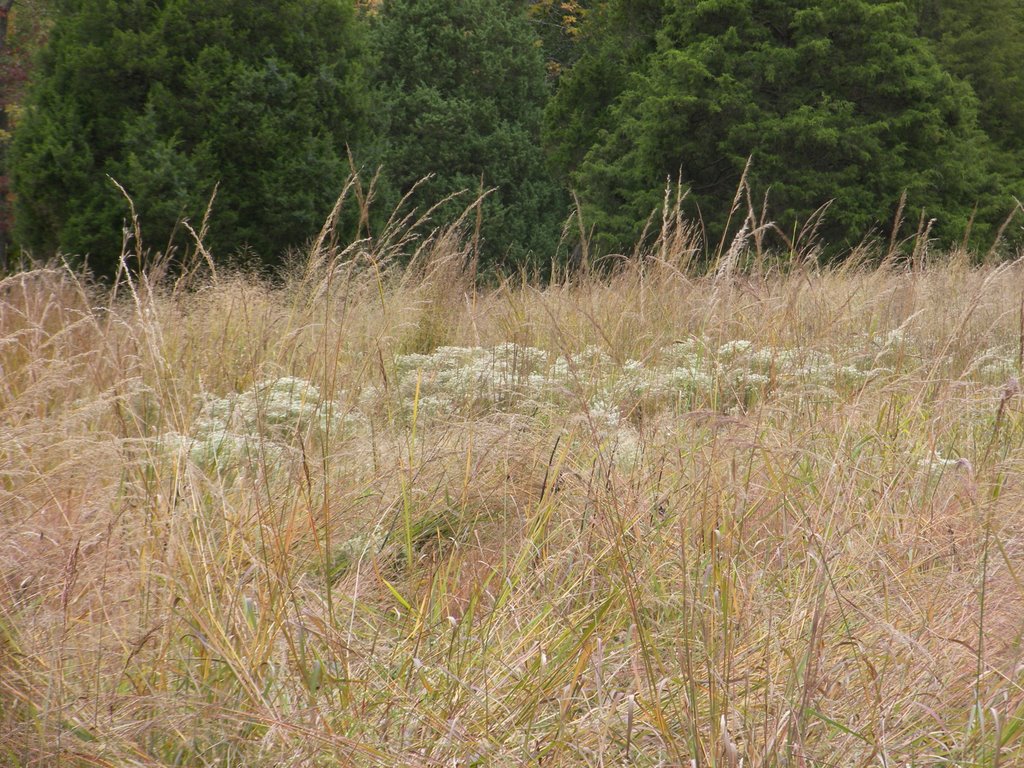
At Bowmans Hill Wildflower Preserve, I saw the plant in its natural setting, growing in tight communities in the open grass meadow (the photos above and below were taken at Bowman's Hill).

So I bought all the plants available at Paxson Hill Farm (only six or seven). In August, after Jessie and Brian's wedding, I traveled further upstate (New York) to Loomis Creek Nursery (you may have seen it featured in the lavish British magazine Gardens Illustrated a few months ago), where I had seen several gallon pots of Pycnanthemum muticum earlier in the summer. I bought 20. Later I found 10 more at Bowman's Hill.

They're all planted now, and I'm hoping for a rapid spread across my wet clay this winter. I know I have to wait a couple of years, at least, to get the effect I'm seeking. In addition to visual interest and a neat addition to wildlife habitat, I do hope the odor and taste of this plant will send deer fleeing. (I should know better).

I need about 30 more plants.
Friday, June 09, 2006

Plant Stewardship Index

Lokatong Creek


We went to the annual Native Plants in the Landscape conference at Millersville University last week. I attended two presentations on the Plant Stewardship Index.

The name makes you want to run for your garden spade? Don't.

Though I do not limit my plant selections exclusively to natives, I understand the value of preserving local, native plant genotypes, fighting invasive alien species, and saving natural lands from development. We have two exquisite watersheds in our little part of New Jersey - the Wickecheoke and the Lokatong. Both drain somewhere around 25 square miles, and share a rocky, picturesque plunge over their last few miles into the Delaware. These two watersheds, and the surrounding lands - particularly the sublime Rosemont Valley - need to be preserved.

Several local governments and nonprofit organizations are having success preserving farms and natural lands. But as more and more land is preserved, and development forces exert pressure to take the land for their own benefit (profit), it will become increasingly necessary to be able to show the value of preserving land, and to clearly demonstrate that preservation measures are improving the value of these lands.

Thus, the Plant Stewardship Index. This is a scientific tool that can be used to evaluate the value of natural lands, and to measure the efficacy of management measures used to improve the quality of these preserved lands. The PSI provides an index, a number, that indicates the quality of native habitat by measuring the numbers of plant species present.

It is a highly localized tool because its foundation is a list of plants that grow in a specific area, both native and non-native, each with a number assigned between zero and 10. Plants that are native, and that indicate a high quality habitat by their simple presence, have higher values. Such a list - consisting of over 4,000 plants - exists for New Jersey. It was developed by professional botanists meeting and coming to consensus on each plant's value as an indicator of high quality habitat. A similar list for Pennsylvania will soon be available.

A mathematical formula is used to calculate the PSI. It looks a little foreboding because it incorporates a statistical technique to assure more accurate results, but it's quite simple. Of course, calculating a PSI requires you to perform a survey of the land, and to be able to identify the majority of plant species living there. You don't have to actually count the numbers of individual plants in each species, just the presence of a species.

Bowman's Hill Wildflower Preserve (BHWP), just south of New Hope, Pennsylvania, has taken on the challenge of introducing the PSI to our area. This is a major undertaking for such an organization, and they deserve support. Many governmental and academic organizations have declined take on introduction of the PSI in New Jersey and Pennsylvania, so BHWP is doing a really good thing. They will soon make available on their web page all the information needed to calculate the PSI for a given piece of land. I understand this tool will be available to the general public. BHWP will also give a series of classes in use of the PSI and identification of native plant species. I intend to participate.

Here is the BHWP web address. Keep a watch for the PSI tool to appear in the very near future.

Bowman's Hill Wildflower Preserve

LinkWithin

Related Posts with Thumbnails