Nearing the end of April green is becoming the predominant color in the garden, finally beginning to cover the stubble left from burning and cutting last year's growth. The benefit of leaving the dried detritus of winter will, eventually, be a higher organic content in this mineral, heavy clay soil. It's messy to look at, but once the greening begins, it gradually disappears.
The woodland entrance to the garden above has been waiting for five years now. I've been focusing on development of the wet prairie garden beyond, the stone walls, most recently replacing the wood chip paths with gravel (the one on the left will be graveled this weekend). Other than a few scattered ferns and carex around the edges, this area awaits its future. I still don't know what it wants to be. Should I block the view beyond with taller woodies--willows perhaps, for coppicing? I do intend to extend the mass planting of Petasites in the middle distance back into the grassy area in the foreground, and to add Senecio aureus to start an early spring community when the plants arrive over the next few days.
To the left are the rough stone steps (Argilite, native to the property) up to the raised terrace area at the back (front?) of the house. Perhaps I should explain. The back of our house is the front, fully windowed, opening to the garden. What Americans call the traditional front (facing the road) is a rather blank slate. The house turns its back to the public eye. The internal life of the house, and most of the garden is hidden.
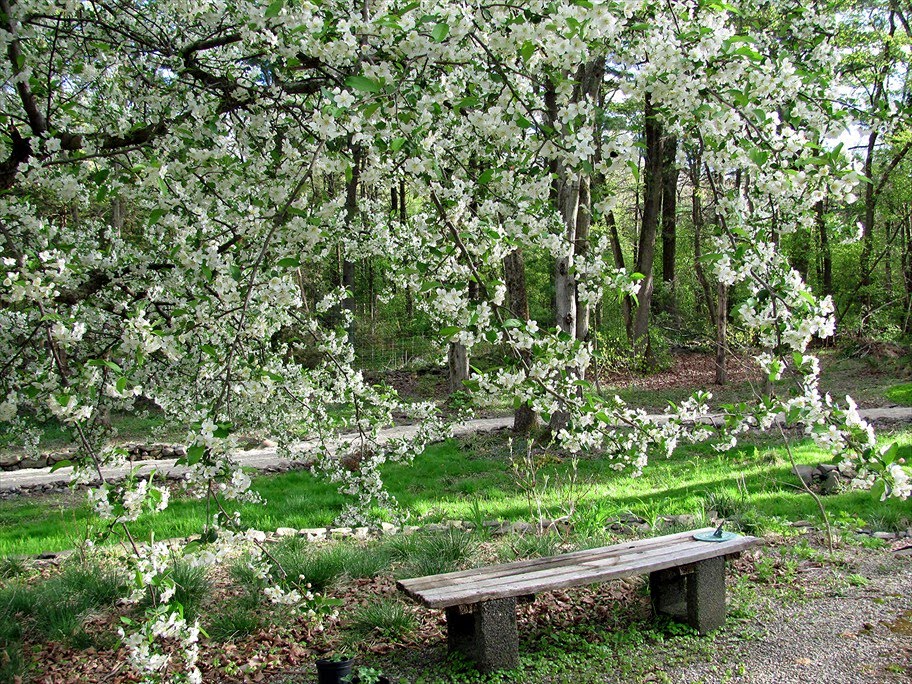
Amazing that this crab apple was planted in the late 1960's. It remains healthy and blooms profusely each spring. Its semi-weeping habit makes a pleasing veil through which to view the more distant garden.
The sitting area on the old bluestone terrace is surrounded by casual plantings. I do intend to add a slightly formal element with simple lines of boxwood outlining a small part of the stone perimeter, and underplanted with Bergenia. The aim will be to emphasize the linearity of the terraced area seen from the distance, and to add a contrast to the informal plantings all around. As time permits, I'm also adding plantings to obscure the view of the garden below, to entice visitors to venture out, and to add a sense of mystery.
In the far left center, above, behind the large maple, I've planted a Hornbeam hedge. It went in only last weekend, so I don't expect to see my eight-foot barrier for quite a few years. When it matures it will screen an unattractive stretch of deer fencing, forming one of several offset "layers" of vegetation.
In the middle right of the photo is a linear stone planting area, which you can see in the closeup below, filled with box and Bergenia. This stone structure echos and visually extends a linear pond off to the right. Another project I hope to complete this year was the idea of my friend, garden designer Peter Holt. Peter suggested I extend the visual line created by long pond and long planter, by adding a second raised stone planter across the path, carrying the eye back toward the large maple and new Hornbeam hedge.
This structural feature is much more effective when the garden is flat, as it is now and in late winter, and will add considerably to the garden's central structure, which strongly echos the drainage pattern across this wet land. The flow of water across this land dictates much of the garden's shape, character, and plantings.
Said planter with box and Bergenia ...
and the infant Hornbeam hedge ...
Taking the path back across the garden, you can see what I mean about drainage. Note the very sharp slope of the land to the left. Immense amounts of water flow across this area during heavy rains, and for hours afterward.
And at the far side (below), a different kind of hedge, just planted, of Alder (Alnus gultinosa), which I will keep cut in a version of a Piet Oudolf-inspired camelback hedge, also to hide the unsightly deer fencing. But more importantly, to create a human-scale edging of shrubby materials that emotionally distance the tall surrounding forest and help familiarize the garden space.
Below, a sure sign of wetness: Petasites hybridus x 'Dutch' in bloom across the path from the Alder.
And Darmera peltata in bloom, another lover of the wet ...
Showing posts with label European hornbeam. Show all posts
Friday, April 23, 2010
Sunday, April 04, 2010
Garden Diary: The prairie garden in black & white
This is the garden in early spring, after all the herbaceous plants have been burned or cut down. I rendered several photographs in black and white to emphasize the underlying structure of this wet prairie garden, and to help decide what to do to add meaningful structure at such bare times of the year.
The photo above shows a large network of intersecting lines that make the underlying structure of the garden: three stone walls on the right and left, as well as one at the base of the bank from which the photo was taken, another major diagonal formed by the narrow pond and its visual extension in a long stone planter filled with 'cloud' box woods and Bergenia, a diagonal line of Arborvitae (Thuja occidentalis) along the path on the right, and an evolving 'screen' of deciduous woody shrubs at the back.
Above in close-up you can better see the screen of the shrubs. Three high-pruned Salix sachalinensis sekka (Japanese Fantail willows) appear to be small blooming trees on the right (they are not). The lack of color, even without fine resolution, clearly reveals the varied structures, shapes and textures of the shrubs. Further to the left, in the center of the photo, are two thin twigged willows (Salix koriyanagi 'Rubikins'), all verticals, with a structure that waves gracefully in the wind. Yesterday, I took long cuttings and planted them further to the left to create a screen of five evenly spaced willows. These will stand immediately in front of a line of five Arborvitae. My intention is to extend the screen with a hedge of European hornbeam (Carpinus betulus) starting a few feet beyond the Rubikins willows and continuing for ten or twelve feet. After a further space, there will be a smaller hedge perpendicular to the longer hedge.
In the photo above you can see how the hornbeam hedges will form a corner that will visually terminate the garden at the far side, creating an enclosed space that I want to enhance with a 'forest' of various hydrangeas.
Above, a view of the far 'corner' taken from a position slightly to the right reveals how the right angle of hornbeam hedges will extend the line of the distant stone wall, then turn to the right to join with the rows of shrubby greenery across the back side of the garden.
Another shift in point of view to the right, above, almost shows another focal point--one not visible in the photo: a circle of dark red painted logs. The red, unfortunately, shows as black in these photos. And below, the main path, newly paved in gravel, has become a prominent geometric feature, far more so than when covered in wood chips.
A color photo, taken in July of last summer, just to show the dramatic difference when the herbaceous vegetation is at its full.
And next two more photos ... one in black and white taken today, contrasting with a color photo from last summer, taken from approximately the same position. Here you can clearly make out the dark red circle of logs in the distance.
Here is a photo taken from the opposite end of the garden, just inside the enclosure that will be formed by the hornbeam hedges. You can clearly see on the left the slant of the land, which becomes rapidly steeper as you near the Lockatong Creek about 1200 feet below the house. The rough, stubble field will soon be invisible beneath the wet prairie of the summer of 2011.
Below the three Japanese Fantail willows clearly show their high pruning. They require rather frequent pruning down below, where new growth continues to emerge throughout the season.
A view toward the house from the far end of the garden shows the need for embellishment of the view, particularly the wooden fence leading up to the house (made necessary to prevent deer from entering the garden). Cutleaf sumac on the bank will provide some interest. I've already dug holes for two new groups of Japanese Fantail willows, which will add visual interest as well as a feeling of intimate enclosure to that garden entry point.
Note the circle of red logs on the right above, and in the center below. This metaphorical feature will be a focal point of the 'private' space that will be formed by the hornbeam hedges and the 'forest' of hydrangeas between this viewpoint and the path.
The photo above shows a large network of intersecting lines that make the underlying structure of the garden: three stone walls on the right and left, as well as one at the base of the bank from which the photo was taken, another major diagonal formed by the narrow pond and its visual extension in a long stone planter filled with 'cloud' box woods and Bergenia, a diagonal line of Arborvitae (Thuja occidentalis) along the path on the right, and an evolving 'screen' of deciduous woody shrubs at the back.
Above in close-up you can better see the screen of the shrubs. Three high-pruned Salix sachalinensis sekka (Japanese Fantail willows) appear to be small blooming trees on the right (they are not). The lack of color, even without fine resolution, clearly reveals the varied structures, shapes and textures of the shrubs. Further to the left, in the center of the photo, are two thin twigged willows (Salix koriyanagi 'Rubikins'), all verticals, with a structure that waves gracefully in the wind. Yesterday, I took long cuttings and planted them further to the left to create a screen of five evenly spaced willows. These will stand immediately in front of a line of five Arborvitae. My intention is to extend the screen with a hedge of European hornbeam (Carpinus betulus) starting a few feet beyond the Rubikins willows and continuing for ten or twelve feet. After a further space, there will be a smaller hedge perpendicular to the longer hedge.
In the photo above you can see how the hornbeam hedges will form a corner that will visually terminate the garden at the far side, creating an enclosed space that I want to enhance with a 'forest' of various hydrangeas.
Above, a view of the far 'corner' taken from a position slightly to the right reveals how the right angle of hornbeam hedges will extend the line of the distant stone wall, then turn to the right to join with the rows of shrubby greenery across the back side of the garden.
Another shift in point of view to the right, above, almost shows another focal point--one not visible in the photo: a circle of dark red painted logs. The red, unfortunately, shows as black in these photos. And below, the main path, newly paved in gravel, has become a prominent geometric feature, far more so than when covered in wood chips.
A color photo, taken in July of last summer, just to show the dramatic difference when the herbaceous vegetation is at its full.
And next two more photos ... one in black and white taken today, contrasting with a color photo from last summer, taken from approximately the same position. Here you can clearly make out the dark red circle of logs in the distance.
Here is a photo taken from the opposite end of the garden, just inside the enclosure that will be formed by the hornbeam hedges. You can clearly see on the left the slant of the land, which becomes rapidly steeper as you near the Lockatong Creek about 1200 feet below the house. The rough, stubble field will soon be invisible beneath the wet prairie of the summer of 2011.
Below the three Japanese Fantail willows clearly show their high pruning. They require rather frequent pruning down below, where new growth continues to emerge throughout the season.
A view toward the house from the far end of the garden shows the need for embellishment of the view, particularly the wooden fence leading up to the house (made necessary to prevent deer from entering the garden). Cutleaf sumac on the bank will provide some interest. I've already dug holes for two new groups of Japanese Fantail willows, which will add visual interest as well as a feeling of intimate enclosure to that garden entry point.
Note the circle of red logs on the right above, and in the center below. This metaphorical feature will be a focal point of the 'private' space that will be formed by the hornbeam hedges and the 'forest' of hydrangeas between this viewpoint and the path.
Subscribe to:
Comments (Atom)