Showing posts with label Petasites hybridus x Dutch. Show all posts
Monday, April 18, 2011
Community in clay
After a day and night of heavy rain, the hybrid Petasites (Petasites hybridus) is making its weird emergence from the mud, accompanied by bits of Lysicachia nummularia and Equisetum arvense. This, along with its cousin Petasites japonica, is repeated in various areas of the garden, and is a major theme plant in several communities of competitive plants. The fallen leaves remain in place because these plants are not daunted by a matted leaf cover. And eventually, the leaves will decay and add organic matter to the heavy clay soil.
This is not a particularly appealing time of year, especially after heavy rain, but in a few weeks the foliage cover will form contrasting bands of shape, texture, and color with the adjacent Darmera peltata, Sagittaria latifolia, and Carex muskengumensis. Actually, the word "shape" doesn't describe the visual effect well, which is more one of contrasting, three-dimensional, geometric forms, not exactly "sculptural" in a traditional sense, but metaphorically so.
I know Petasites is considered a radically invasive plant, but not in my garden. The clay appears to put the brakes on; it actually spreads quite slowly. In a conventional garden, I'd avoid it, but at Federal Twist, I need its aggressive, competitive character. Okay, you're hearing it again ... right plant, right place.
Sunday, June 13, 2010
Walk about
A mid-day walk about the garden ... on Friday, June 11, about 1:30 pm ... Much too bright for photos, but there you are ...
Black gamecock iris, a Louisiana iris ... I think ... bought at a local farmer's market last year.
What iris? You've got me. It grows by the pond, and I anticipate a large clump in a few years.
Pond edge ... Lysimachia nummularia, Equisetum arvense,a baby Jewelweed (Impatiens capensis, wild impatiens) ...
Bold foliage, needed to bring definition to the haze of grasses, the matrix of grasses, shapes emerging from the background noise, order from chaos ...
Salix alba 'Britzensis' (below, not the River birch on the right above), which needs to be coppiced to get those colorful canes for late winter and spring, but I've grown so fond of the exuberant explosion of growth I delay, and delay ...
Filipendula rubra 'Venusta', which has naturalized with great vigor, Calamagrostis acutiflora 'Karl Foerster', Vernonia fasciculata (Prarie ironweed) in the background, a clump of Chelone 'Hot Lips' ...
The 'late prairie' or a simulacrum thereof, with emerging Rudbeckia maxima, Silphium perfoliatum, Silphium terebinthinaceum (Prairie dock), Physostegia 'Miss Manners', Inula racemosa, Panicum 'Dallas Blues', Panicum 'Cloud Nine', Calamagrostis a. KF, Pycnantheum muticum, and on and on ...
Foliage of Silphium terebinthinaceum ...
Eryngium yuccafolium (Rattlesnake master), soon to be underplanted with Sesleria autumnalis and Bergenia 'Bressingham Ruby'--will that work? If not, I'll replace the bergenia.
An evolving 'meadow' area ...
Looking back toward the house (yes, it's there).
Inula racemosa, which is seeding around, just as I want, next to Miscanthus 'Silberfeder.'
Bracken and the bank of M. 'Silberfeder'. I know bracken is supposed to be a bad invasive, but this colony has stayed in place for five years. It does grow into the path, but that's easily pulled out. The fall color is miraculous.
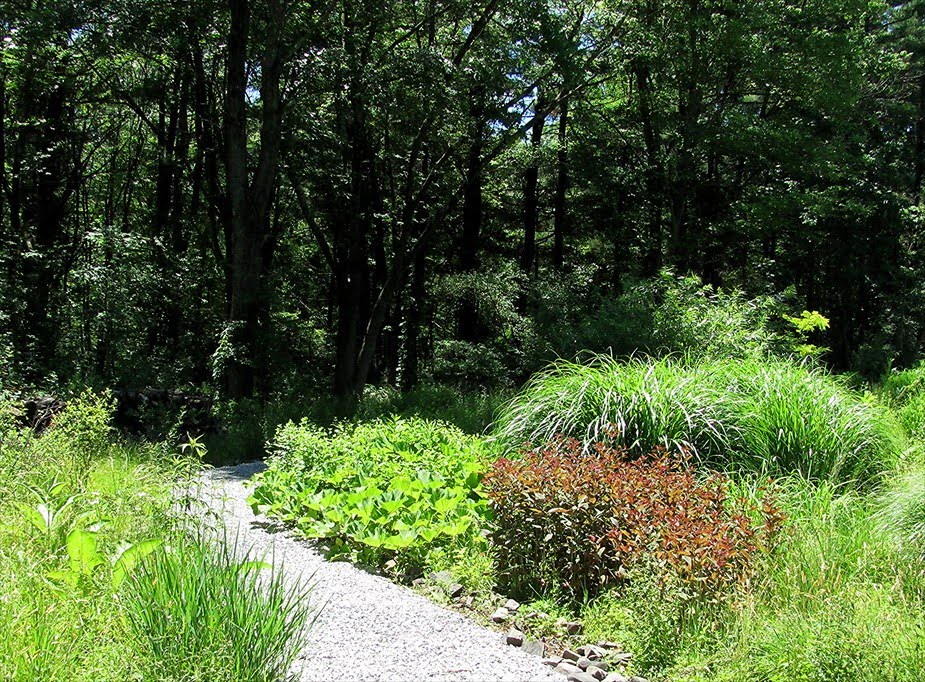
As the garden reaches a new stage of maturity, with small trees and shrubs now taking a more prominent place, and as I incorporate more shaded forest edge into the garden, it's developing a more complex character, and becoming a place to find a variety of different environments, with different emotional landscapes. Here, as we near the darker west side of the garden, trees cast heavy shadow at mid-day, lighting the foreground planting of Miscanthus s. 'Silberfeder', Petasites 'x Dutch', Pycnantheum muticum, and Lysimachia ciliata 'Firecracker' like a beacon.
The massed foliage shapes and textures are what make this planting. Later in the season, the Pycnantheum turns gray and white, creating an even more dramatic contrast of color.
The space below is where I intend to put a new raised stone planting area, a long and curvy one, to continue the line of the pond and existing raised stone planter nearer the house. In winter, this will appear as a broken diagonal snaking across the garden plain, almost a geologic feature. I've cleared the area of most large plants in anticipation of construction later in the summer.
Entering the woodland edge on the west side of the garden, one feels a cool respite from the sun drenched open garden.
Looking back across to the far side where the circle of red walnut logs signals its message - a metaphor of the life of the aboriginal people who once lived and hunted these hills. Next year I want to add Miscanthus giganteus behind to create a wall of complementary green and to screen the deer fencing (practical matters never go away).
A screen of Filipendula, approaching bloom...
And Silphium laciniatum (Compass plant), Silphium perfoliatum, Rudbeckia maxima, Vernonia ...
Ligularia japonica growing up through the gravel of the path, an exotic for sure, but appropriate to its place ...
Looking into the woodland garden (in progress) at the side of the house ...
And back toward the Ligularia japonica ...
Now looking across the width of the garden toward the tall cedars, and the circle of red logs ...
Black gamecock iris, a Louisiana iris ... I think ... bought at a local farmer's market last year.
What iris? You've got me. It grows by the pond, and I anticipate a large clump in a few years.
Pond edge ... Lysimachia nummularia, Equisetum arvense,a baby Jewelweed (Impatiens capensis, wild impatiens) ...
Bold foliage, needed to bring definition to the haze of grasses, the matrix of grasses, shapes emerging from the background noise, order from chaos ...
Salix alba 'Britzensis' (below, not the River birch on the right above), which needs to be coppiced to get those colorful canes for late winter and spring, but I've grown so fond of the exuberant explosion of growth I delay, and delay ...
Filipendula rubra 'Venusta', which has naturalized with great vigor, Calamagrostis acutiflora 'Karl Foerster', Vernonia fasciculata (Prarie ironweed) in the background, a clump of Chelone 'Hot Lips' ...
The 'late prairie' or a simulacrum thereof, with emerging Rudbeckia maxima, Silphium perfoliatum, Silphium terebinthinaceum (Prairie dock), Physostegia 'Miss Manners', Inula racemosa, Panicum 'Dallas Blues', Panicum 'Cloud Nine', Calamagrostis a. KF, Pycnantheum muticum, and on and on ...
Foliage of Silphium terebinthinaceum ...
Eryngium yuccafolium (Rattlesnake master), soon to be underplanted with Sesleria autumnalis and Bergenia 'Bressingham Ruby'--will that work? If not, I'll replace the bergenia.
An evolving 'meadow' area ...
Looking back toward the house (yes, it's there).
Inula racemosa, which is seeding around, just as I want, next to Miscanthus 'Silberfeder.'
Bracken and the bank of M. 'Silberfeder'. I know bracken is supposed to be a bad invasive, but this colony has stayed in place for five years. It does grow into the path, but that's easily pulled out. The fall color is miraculous.
As the garden reaches a new stage of maturity, with small trees and shrubs now taking a more prominent place, and as I incorporate more shaded forest edge into the garden, it's developing a more complex character, and becoming a place to find a variety of different environments, with different emotional landscapes. Here, as we near the darker west side of the garden, trees cast heavy shadow at mid-day, lighting the foreground planting of Miscanthus s. 'Silberfeder', Petasites 'x Dutch', Pycnantheum muticum, and Lysimachia ciliata 'Firecracker' like a beacon.
The massed foliage shapes and textures are what make this planting. Later in the season, the Pycnantheum turns gray and white, creating an even more dramatic contrast of color.
The space below is where I intend to put a new raised stone planting area, a long and curvy one, to continue the line of the pond and existing raised stone planter nearer the house. In winter, this will appear as a broken diagonal snaking across the garden plain, almost a geologic feature. I've cleared the area of most large plants in anticipation of construction later in the summer.
Entering the woodland edge on the west side of the garden, one feels a cool respite from the sun drenched open garden.
Looking back across to the far side where the circle of red walnut logs signals its message - a metaphor of the life of the aboriginal people who once lived and hunted these hills. Next year I want to add Miscanthus giganteus behind to create a wall of complementary green and to screen the deer fencing (practical matters never go away).
A screen of Filipendula, approaching bloom...
And Silphium laciniatum (Compass plant), Silphium perfoliatum, Rudbeckia maxima, Vernonia ...
Ligularia japonica growing up through the gravel of the path, an exotic for sure, but appropriate to its place ...
Looking into the woodland garden (in progress) at the side of the house ...
And back toward the Ligularia japonica ...
Now looking across the width of the garden toward the tall cedars, and the circle of red logs ...
Tuesday, May 05, 2009
Garden Diary: Competitors, Stress Tolerators & Ruderals
Having worked for several years to establish a matrix of plants that will be at least partly self-sustaining, I can see some progress this spring. At this stage, I'm still keeping pretty much anything that covers the ground and prevents random germination from the seed bank.
Thanks to Noel Kingsbury's books, I now know I'm trying to orchestrate a bunch of competitive perennials, stress tolerators, and those opportunistic ruderals, plants that take advantage of any open ground in the early stages of a planting, where they thrive until extinguished by larger or more competitive neighbors.
The picture below is of one of several Filipendula rubra 'Venusta' that have settled in well and are slowly spreading. I'd judge these to be moderate competitors; they are slowly covering more ground, but they don't self-seed at all.
Next is another sample of a matrix planting, primarily Petasites hybridus, native Equisetum arvense, native Lysimachia nummularia, and at the far edge, Carex muskingumensis, Darmera peltata, cimicifuga (actea), and thalictrum. The equisetum, though highly invasive and a competitor par excellence, will wither away in a month or so, leaving room for a really disgusting ruderal, Japanese stilt grass (Microstegium vimineum), to intrude.
The vertical wands rising from the petasites are flowers, which you can see more clearly in the next photo.

The next two photos show views turning clockwise about 150 degrees.

The more "finished" matrix above contrasts markedly with another garden view below. Here is where the filipendula I opened with grows, along with other large wet prairie perennials such as Eupatorium purpureum (Joe Pye Weed), Liatris pyncnostachya, Rudbeckia maxima, assorted wetland irises, sanguisorbas, miscanthus, panicums, and other plants too numerous to list. Obviously there are no early perennials to make an attractive matrix planting here. This area won't reach its potential until July.

Here is where I need to develop spring plantings that will give interest and good coverage early in the season, then disappear, or at least tolerate shade cast by the larger perennials later in the season (spreading stress tolerators is what I need). More bulbs (stress tolerators) can certainly help, especially daffodils. Native persicarias especially like this area as the season progresses, so some early persicarias, such as Persicaria bistorta 'Superba', may be helpful. And, of course, a blanket of astilbes would give both color and interesting, long-lasting structure.
I'm open to suggestions.
Thanks to Noel Kingsbury's books, I now know I'm trying to orchestrate a bunch of competitive perennials, stress tolerators, and those opportunistic ruderals, plants that take advantage of any open ground in the early stages of a planting, where they thrive until extinguished by larger or more competitive neighbors.
The picture below is of one of several Filipendula rubra 'Venusta' that have settled in well and are slowly spreading. I'd judge these to be moderate competitors; they are slowly covering more ground, but they don't self-seed at all.
Next is another sample of a matrix planting, primarily Petasites hybridus, native Equisetum arvense, native Lysimachia nummularia, and at the far edge, Carex muskingumensis, Darmera peltata, cimicifuga (actea), and thalictrum. The equisetum, though highly invasive and a competitor par excellence, will wither away in a month or so, leaving room for a really disgusting ruderal, Japanese stilt grass (Microstegium vimineum), to intrude.The vertical wands rising from the petasites are flowers, which you can see more clearly in the next photo.

The next two photos show views turning clockwise about 150 degrees.
The more "finished" matrix above contrasts markedly with another garden view below. Here is where the filipendula I opened with grows, along with other large wet prairie perennials such as Eupatorium purpureum (Joe Pye Weed), Liatris pyncnostachya, Rudbeckia maxima, assorted wetland irises, sanguisorbas, miscanthus, panicums, and other plants too numerous to list. Obviously there are no early perennials to make an attractive matrix planting here. This area won't reach its potential until July.
Here is where I need to develop spring plantings that will give interest and good coverage early in the season, then disappear, or at least tolerate shade cast by the larger perennials later in the season (spreading stress tolerators is what I need). More bulbs (stress tolerators) can certainly help, especially daffodils. Native persicarias especially like this area as the season progresses, so some early persicarias, such as Persicaria bistorta 'Superba', may be helpful. And, of course, a blanket of astilbes would give both color and interesting, long-lasting structure.
I'm open to suggestions.
Saturday, April 04, 2009
Early aliens

Gardeners are often warned to avoid Petasites. I've even had a nursery refuse to sell it to me, and I agree I've seen it growing with such vigor I want to either cheer or run. In my garden - so far - it's been willing to spread slowly but seems easily controllable.

I have two kinds. One, sold as Petasites japonicus 'Giganteus' (above), with great round leaves, and another, sold as Petasites hybridus x Dutch (below), with roughly triangular leaves. The flowers of both are in bloom now. They're small, no more than three inches high and less wide, for the Giganteus.
The inflorescence of the 'x Dutch' hybrid is much smaller and strikingly different in appearance. Long blossoming stems will rise from the cone-like flowering body in the next few weeks, then wither as the foliage grows. I have no idea what the Petasites x Dutch was hybridized with, but its flowering behavior is dramatically different from its cousin. The flowering stems are similar in appearance to those of Darmera peltata, so I do wonder if the cross was made with some form of Darmera.
Maybe you know the answer.
Subscribe to:
Comments (Atom)