Pages

Sunday, May 28, 2006

The Matrix


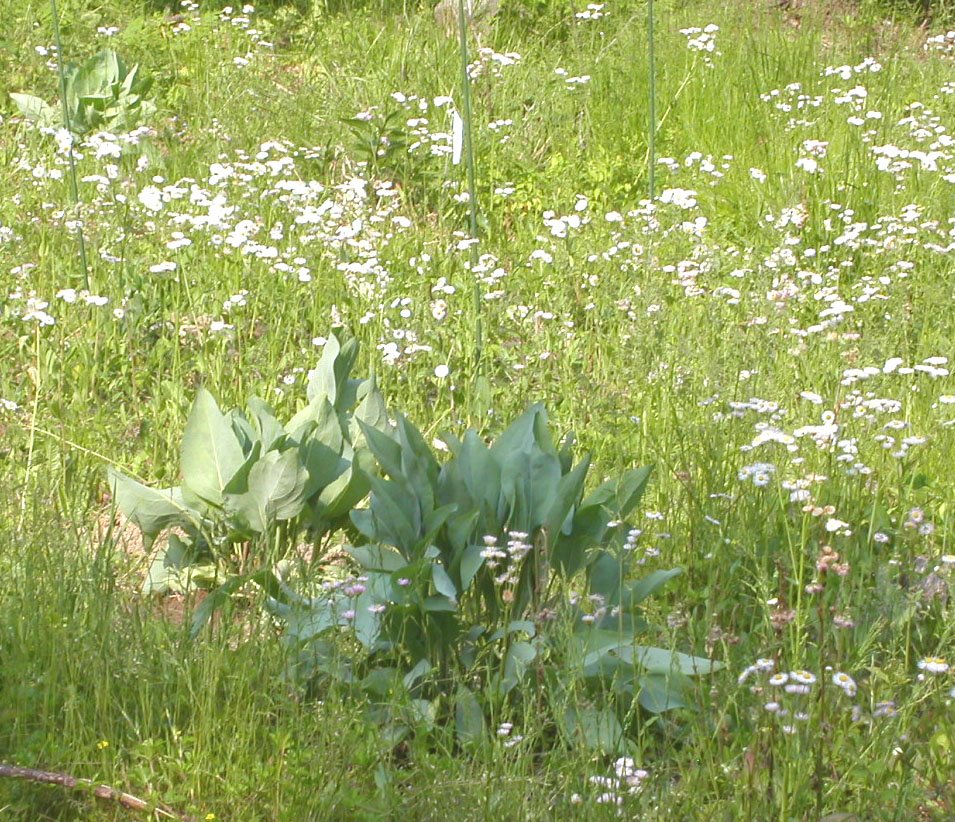
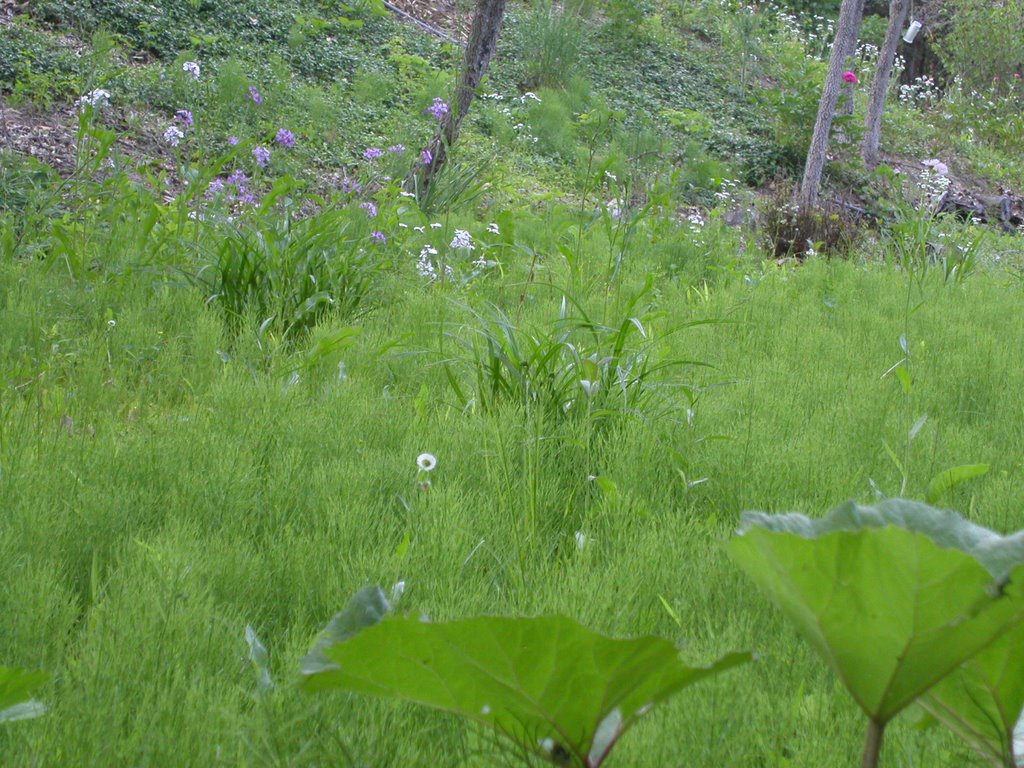
I'm planting in a matrix of native plants. Since I've cut trees to allow more light, I'm finding all sorts of changes in the "legacy" plants at Federal Twist. This week, I discovered Blue Eyed Grass for the first time since we moved here. I suppose it's emerged because of the brighter conditions. But the Blue Eyed Grass is only an incidental pleasure. The major components of the natural matrix are, at present, fleabane (Erigeron philadelphicus), a large, isolated colony of Equisetum arvense in a very wet area, numerous Carex and Scirpus species, and early season grasses I haven't yet identified. The matrix of equisetum is thriving and now forms an attractive blanket of soft texture that contrasts with the bulky form of Petasites japonicus and the sword-like spires of assorted irises that like the damp conditions.

I feel compelled to say a few words in defense of the fleabane. It's not the prettiest flower in the world, but in mass, it lights up the grasses and creates a lot of visual interest from a distance. I'm interested in using short-lived ruderals like fleabane to help prevent seeding of more pernicious weeds. I'm even hoping to displace some of the poison ivy and multiflora rose that keep so many visitors from walking in the garden. Over time, I expect the fleabane to gradually disappear as intentionally introduced plants become established and take up more garden space.

Placed amid the matrix of native grasses, carex, and sedges, plants with strong, easily "read" structure help give the emerging garden a recognizable intent and sense of order. Last year's planting was mainly experimental. Though I've researched plant selections, I really won't know what can grow here, in unimproved conditions, and what can survive deer browsing, without experimenting. One plant that came through the winter with flying colors is Rudbeckia maxima. The large, prominent, glaucous leaves are the main attraction. Planted in groups, and scattered in apparent random patterns, the rudbeckia will provide a strong visual interest throughout the year. The flowers, on tall spires, add vertical contrast, and with their long-lasting seed heads, remain attractive long into winter.


I ordered a flat of Silphium terebinthinaceum, which should thrive in my conditions. About half of them are growing. Their mature foliage, which is low but very large, should complement the rudbeckias, and their later bloom should add another feature later in the season. Do deer like to eat silphium? I'll let you know.

The verdict is still out on various Joe Pye Weeds, which I love. The emerging shoots have suffered some nibbles. Since this plant isn't a favorite of deer, I'm hoping the browsing damage is a result of the deer "taste testing," and the majority of plants will reach maturity and flower. Several Eupatorium cannabinum seem to be growing well with no damage so far.

The ornamental grasses, of course, are deer proof. More on that later.
Tuesday, May 23, 2006

Imagining the landscape


The future garden is a flat, rather featureless space, especially viewed from the house, which is situated on a raised mound about 15 feet above the surrounding land. Now that we're opening up the space - and the view - by taking down trees, the flatness of the land is more evident, even though there is a gentle, barely perceptible slope, moving away from the house, toward Lokatong Creek at the bottom of the hill.

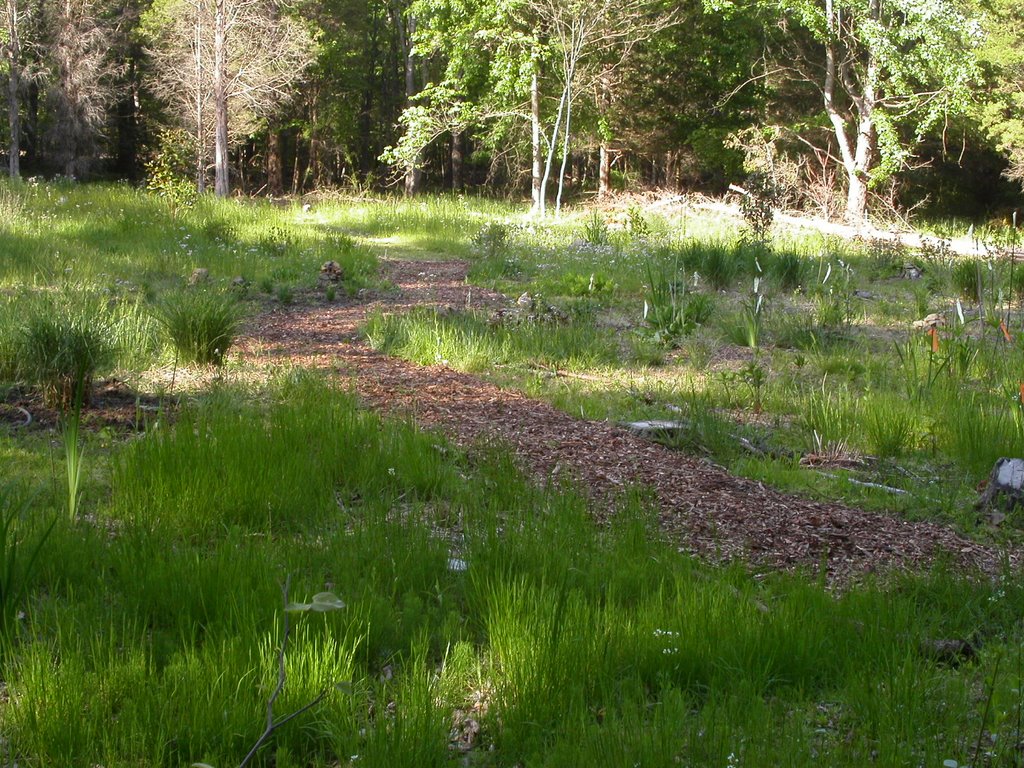
I'd already been aware of the need to divide the space with screening (small trees, shrubs, large perennials) and to create spatial diversity, interest, and a sense of scale. Last weekend, we started laying out the secondary path of cedar chips through the middle of the space. (The main path will circle around from one end of the house, to the back of the garden, then back to the opposite end of the house. It will be twice as wide as the secondary path, at about seven feet.)

We got the cedar chips about half way across the field, then I cut the rest of the path with a string trimmer. Even in this unfinished state, the secondary path has reorganized my perception of the space, making clear where various plant communities, shapes, and forms might be used to make the new garden. Like a line on a blank canvas, the path suggests its own landscape, drawing the eye to previously unseen features, small surface undulations, rocks, native rushes, carexes, and equisetum.

Barely visible yet, a garden is coming into view.

Sunday, April 23, 2006

Shaping the woods, opening the sky


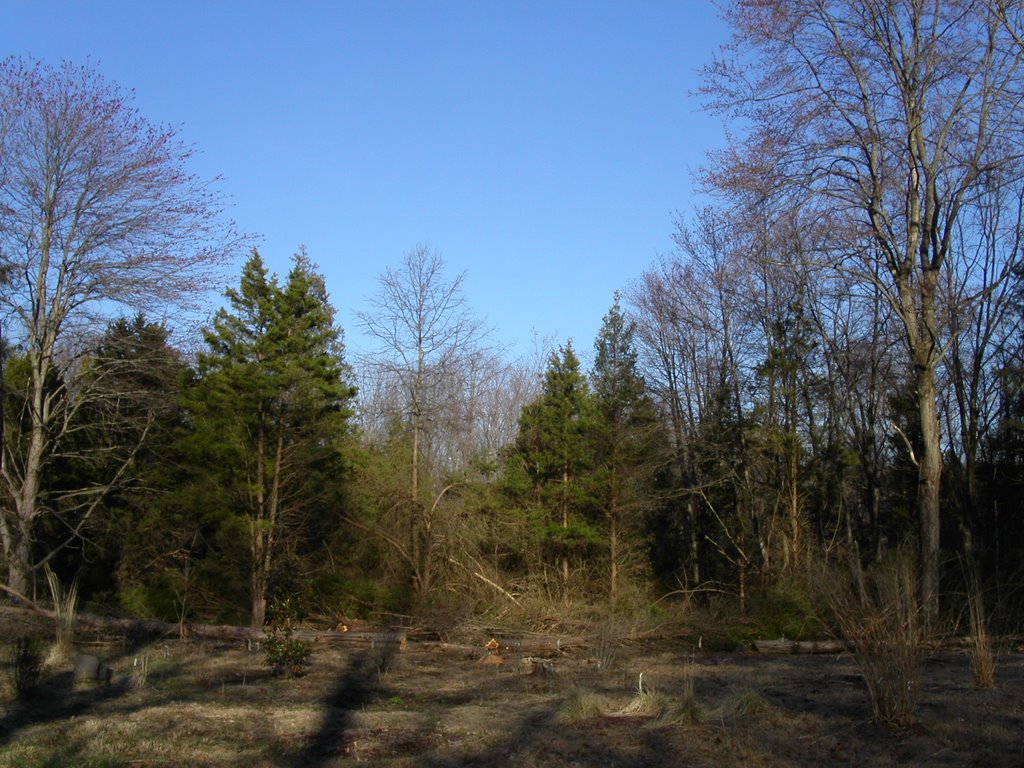
Here on this slope falling toward Lokatong Creek, the open field was left to grow wild 40 years ago. Small, randomly seeded cedars that look like pretty green sculptures in photos from the 1960s, grew into looming, scraggly, 60-foot trees coming right up to the house.

Cutting enough to create a ring of open space has been a costly and complicated chore. The ground is wet, very wet, through winter and well into summer, so felling the trees is the easy part. Moving them is almost impossible. No heavy equipment can get through the mud. Last year a crew manually moved and chipped 30 or 40 trees. I kept several truckloads of chips to create soft paths through the future wet prairie. This year I cut more cedars myself, then realized this 61 year old person doesn't have the energy, strength or time to do the rest of the job.

So I called in Tim and am waiting for his estimate. We discussed possibilities. Sustainable approaches appear to be the easiest to accomplish and the least costly. Fire is the easiest, and certainly appropriate for a prairie planting, but the danger of fire in the middle of the woods is too great. The plan is to cut up the trees into 30-inch logs, saving the largest ones for rustic seats, and to build a chevron-shaped wall of stacked logs on the back of the garden. This gives me a screened composting and utility area as well as hidden space to dispose of the tree limbs (good cover for wildlife too). The angle of the chevron relative to the house has to be just right, though. I hope it can follow the angle of the tree tops as they recede toward the vanishing point of the new perspective we're creating.

I'd seen stacked log walls in photos of other gardens and had already thought about using some such "natural" feature to help give structure to the wildness (think of Wallace Steven's poem - "I placed a jar in Tennessee and round it was upon the hill. It made the slovenly wilderness surround that hill").

Though the ground is a mess of fallen trees, the sky has opened like an eye above the emerging field and the back line of deciduous maples, oaks and chestnuts forms a noticeable circular border that appears to surround the house (an illusion). The woods are more open too, more like the older forest at the sides of the house, allowing the eye to move into the distance through the interstices between the trees.

I want to continue thinning out the cedars (I'll leave a few) over the coming years, making a more open, park-like area around the house, but there will be plenty of brush and undergrowth to encourage wildlife.

Sunday, March 05, 2006

Planting the wet prairie

Freeze and thaw, freeze and thaw. I'm thinking about what to do with all those plants arriving in April and May. With very wet clay in the back - wetland, really - I'm aiming for a wet prairie, and I'm using what I can learn from Perennials and their Garden Habitats by Hansen and Stahl (I finally found a used copy discarded by the Iowa City Public Library), and the little Noel Kingsbury has written on the subject. My plant list (partial):

Panicum virgatum 'Rotstrahlbusch' - 30
Spartina pectinata 'Aureomarginata' - 6
Molinia caerulea 'Strahlenquelle' - 25
Molinia litoralis 'Transparent' - 6
Eupatorium purpureum 'Coelestinum' - 10
Calamagrostis brachytricha - 15
Sesleria autumnalis - 12
Carex muskingumensis - 12
Darmera peltata - 15
Euphorbia palustris - 4
Matteucia pennsylvanica - 12
Kniphofia caulescens - 9

Eupatorium fistulosum, other panicums, a start of a hedgerow of Magnolia grandiflora, viburnums, ilex verticillata and other plants are already in the ground. I can't wait to see what thrives, what just survives, and what is dead.

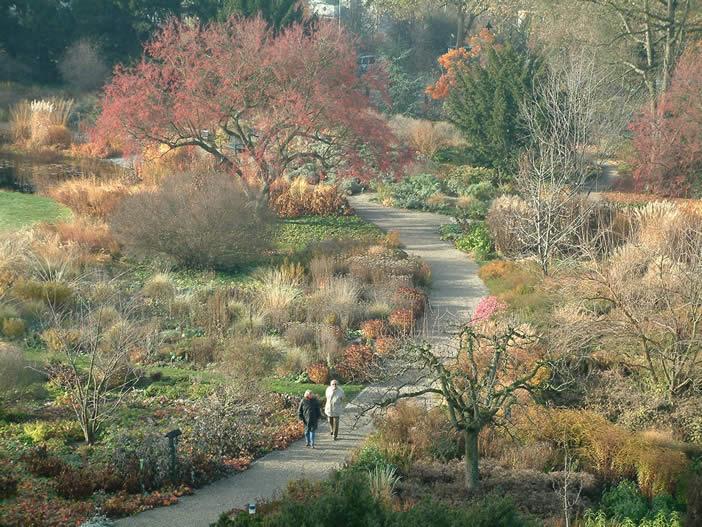
This is an experimental garden and I'm looking for every source of information I can lay my hands on. If I could read German, I'd be talking to the folks at Hermannshof (see the link below for an automatic translation into English).

Hermannshof Garden

Monday, February 20, 2006

Are we gardening yet?

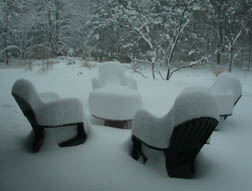
After an extraordinarily mild winter, we had a whopping snow storm last weekend. New York City, about 65 miles to the east, had the most snow ever recorded in a 24 hour period. Here's how it looked at Federal Twist.
Warm weather - again - the following week quickly melted most of the snow. The Lockatong Creek is running overfull, as are the little unnamed tributaries around us. I continue reading gardening books - now Dan Pearson's The Garden: A Year at Hope Farm - and ordering plants. As usual, I've reached the surfeit point and am feeling I'll never have time to build the stone walls I want to build, expand the front planting area, cut down the worst of the ragged cedars blocking the view of the sky, build the pond, and plant 30 Panicum virgatum 'Rotstrahlbusch', 25 Molinia caerulea 'Strahlenquelle', 15 Darmera peltata, and all the many, many other plants that will arrive, probably bare root, when I have only one rainy day left for gardening before leaving to get back to the City for work on Monday. Why do I do this?

As spring arrives, I'll remember, as in the past, all this will not get done in one year. And the better for it.

Saturday, February 04, 2006

Christopher Lloyd

My March copy of Gardens Illustrated arrived today. The cover features Christopher Lloyd as a new columnist, and inside is a continuation of an interview with him. Ironic timing and unfortunate since he died a few days ago. I remember when Phil and I visited Great Dixter in 1985. We passed him standing in the rose garden, talking to a young man. I was too shy to acknowledge him, much less try to start a conversation, but I'd been a reader of his books for a few years, and liked his prickly, opinionated style. He wrote about many plants I had no knowledge of, and that challenged me.

He changed the Great Dixter garden in many ways since I visited. Pulled up the rose garden and planted a tropical garden, I understand. And continued to make waves in the world of horticulture. In his first, and last, column in Gardens Illustrated, he writes of his interest in learning about the native flora in the places he visited - for example, learning that opuntias grow on the southern shores of Lake Michigan. "Nothing extraordinary about that you'll say, and possibly also add that many opuntias are extremely hardy," he writes. "But I wasn't born with that knowledge. The whole of life is a process of learning, which will only end with my death."

Great Dixter will continue through the efforts of The Great Dixter Charitable Trust.

Friends of Great Dixter
Great Dixter House and Gardens

Sunday, January 22, 2006

Complaint Department

Our mass market-oriented nurseries offer gardeners in the U.S. a far more limited choice of plants than our friends in the U.K. I'm looking for sanguisorba tenuifolia Alba - have been, on and off, for several years. Just try a Google search and see how many hits you get in Europe and the U.K. Either I can't find it offered on this continent, or no stock is available.

Monday, January 16, 2006

Garden Plans

I sometimes think garden plans should only be quick sketches - pencil lines and a few abbreviations on a scrap of paper. Once the actual garden-making starts, the plan is subject to change, for change it will. Landscape architecture, with its emphasis on built structures, rather than plantings or plant knowledge, seems to have a big financial impetus to promote elaborate, colorful, detailed plans - and a beautiful garden does not always result. But the plan itself may be pretty, or intriguing. The design drawing takes on a life of its own, and may hinder exploration of new ideas that arise in the process of making the garden. This is especially true when the client is paying many thousands of dollars for a design/build project. I once heard Rick Darke say he never drew a garden plan. He always works directly with the landscape and plants.

Thursday, January 05, 2006

Heronswood Nursery's New Catalogue

The new Heronswood catalogue came in today's mail. Glossy paper. Lots of color photos. Accurate, informative, descriptive text. All good in the usual nursery catalogue. But the sense of relationship with a unique person is gone, replaced by the anonymous voice of commerce. I'll miss Dan Hinkley's (or his helpers') wry, humorous stories of plant exploration in far-off parts of the world. The old catalogue left a lot to the reader's imagination. Browsing through it was a joy and a mystery. I'll miss that experience. It was a part of gardening for me.

Tuesday, January 03, 2006

Planting Design: Gardens in Time and Space by Piet Oudolf and Noel Kingsbury

About time for someone to take perennials so seriously they write a manifesto.

I've read all the books by Oudolf, Kingsbury (and occasionally others in changing combination with one or the other). I have to fess up to ordering this book several months before it was published by Timber Press (bless Timber Press for their wonderful selections). I'm a fan of these guys.

At first I found this book off-putting, distubing. It seemed to be trying too hard to make a point - or several points. Now that I've read it three times, I realize it simply contains so much information it's almost bursting out of its covers. Gardening is getting political. If you remember an article by Michael Pollan in the New York Times magazine several years ago, in which he ripped such authors as Ken Druse for promoting "natural gardening," a term which he and others have claimed as virtually meaningless, you know how political it can get.

If Planting the Natural Garden was poetry, this book is, indeed, a manifesto, but it is much more. Its focus is herbaceous perennials, and the art of designing with plants to make gardens, as opposed to landscape architecture, which is usually practiced with minimal use of plants and minimal knowledge of how they grow.

LinkWithin

Related Posts with Thumbnails