Pages

Saturday, December 03, 2011

Juan Grimm: a garden in Uruguay


The four elements:  fire, air, earth, water. Inspiration for many a garden, but especially appropriate for this garden by Juan Grimm, the Chilean garden and landscape designer, on the strikingly beautiful southern coast of Uruguay, a place that is made of fire (as brilliant sun), transparent air, sandy earth, and water everywhere.


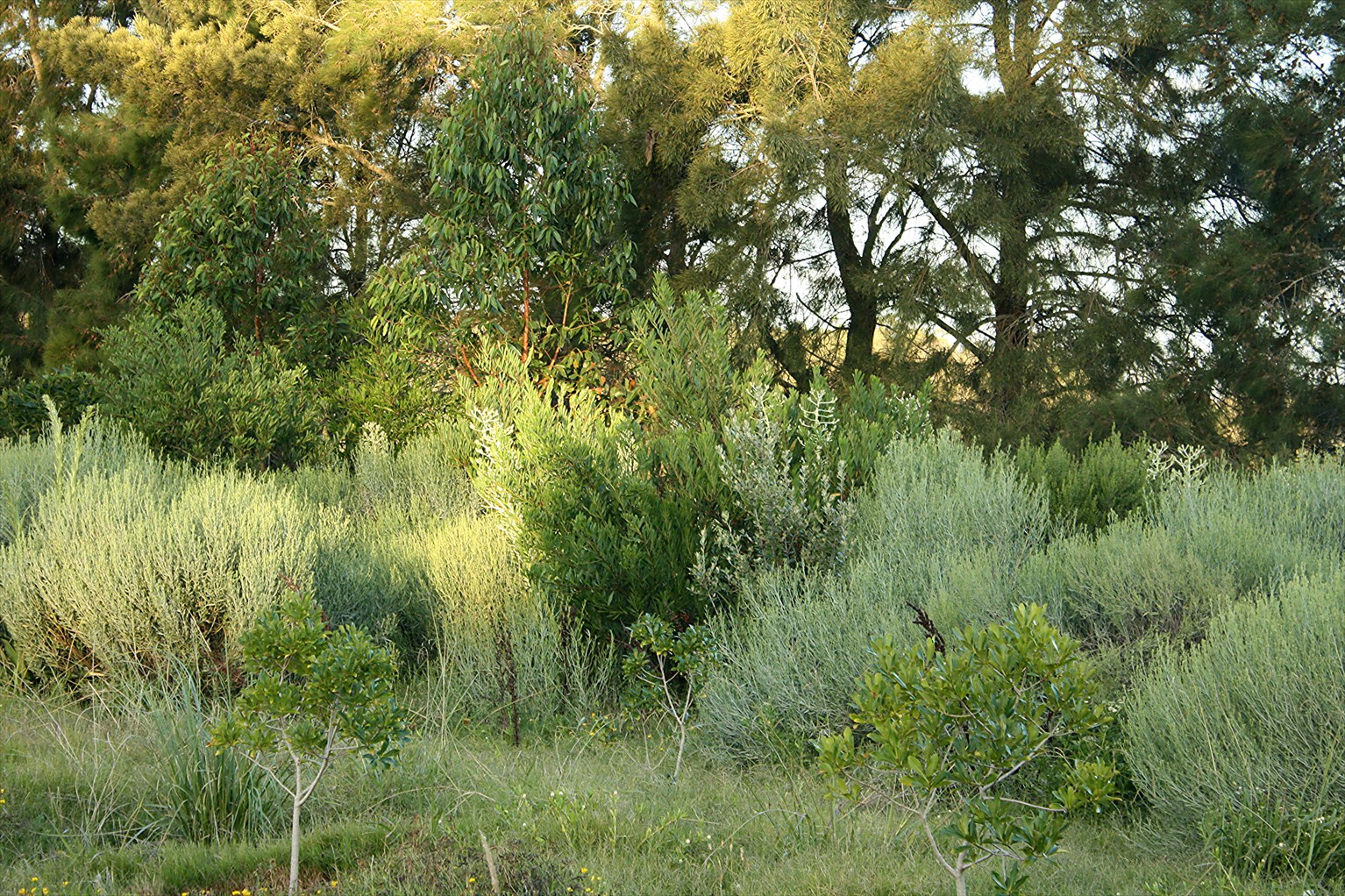
The sunny, open site in coastal Uruguay, with wetlands, eucalyptus groves, and sandy meadowland (actually, Monte psamofilo, roughly the Uruguayan version of a sandy meadow near the ocean) sets the expectation for a naturalistic garden in keeping with the nature of the place, and this is such a garden, but one with a surprise. Near the house, the naturalistic elements are abstracted in a strict, severe geometry. The plant pallet throughout is lean.

We were taken to visit this garden by Amalia Robredo, a Uruguyan landscape designer, on a late summer day in February of this year. The sun was low, but bright and fiery. Amalia, who I knew from blogging and previous internet contact, had encouraged us to visit Uruguay when I told her we planned a trip to South America. She invited us to see her garden and other gardens in the area. With Amalia, we were a group of eight.

The expansive lawn, with many coves edged by naturalized plantings and hedgerows.

The garden has a simple layout of three principal parts -- a "land" side with extensive lawn, curvaceously edged by naturalistic hedgerows (or the South American equivalent) and two large, prominent eucalyptus groves ...

... the house and immediate garden surroundings, which bifurcates the garden into two parts ...


... and the lake side with a broad view of wetlands, stone walls, wooden walkways, terraces and an infinity pool, all offering a view of the wide, flat landscape over which the sun sets.

The back lawn quickly gives way to the lake and the wild landscape.


Grimm's garden is a lean, elegant use of space, mass, and light to reveal the nature of a unique and subtle landscape. Its appeal is more intellectual than sensual or emotional, an Apollonian garden of light not a Dionysian garden, with a seeming hardness that resists an easy sensual appeal. Light, water, wood, stone, plants all are elements manipulated for aesthetic effect, and subservient to a rather focused conceit. I'd call it a conceptual garden, an abstract paean to the sun, the air, and the beautiful coast of Uruguay. Not much for the plantaholic here.

Grimm's gardens are usually about integrating house and landscape, and the courtyard at the entrance to the house is what does that. It gives this garden an aesthetic tension and a meaning. The courtyard is highly geometric; it abstracts elements of the larger landscape into a pattern of lines and grids. A pergola-like feature carries that grid into three dimensions and structures the space immediately around the house.

Light is the magical element of this garden. We are looking through the house, from the shady side to the sunset side with lake and wetlands, here out of view.


This courtyard is like the "hinge" of the garden, physically mediating between the lawn side and the lake side, and accomplishing that mediation through an abstract conceit.

The fountain (left) couldn't be less fussy--a simple stack of rectangles with water gently bubbling into the pool.
Grimm has created a formal abstraction of the site's natural features in this highly geometric design--the concrete pads with miniature grass "lawns" floating on the water, the thin, vertical Juncus, which is massed in the lake behind the house, growing here like a representation or "model" of the real thing in the sharp-edged reflecting pool, the minimalist fountain of stacked rectangles gently bubbling water into the pool. All very understated, literally an abstract of garden concepts. Whereas the rest of the garden is full of curves and wavy lines, this part plays with squares and rectangles, integrating the straight edges and right angles of the house into the landscape, moving from solid boxes to airy pergola, to open walkways.


On first impression, the square concrete "pads" seemed out of place, breaking up the reflections in the pool as they do, almost too self-consciously intruding, demanding to be interpreted. And one can't overlook their humor:  concrete lily pads with miniature lawns. It's clear they reference the lawn to one side of the house, as well as the lake and wetlands on the other side of the house. The concept is that simple. They're playful too. Convention would say you are invited to walk on them, but you can't. They are sized and spaced to make such an exercise very difficult (and you'd certainly damage the thin "lawn" beyond repair).


This abstract, gridded, model of a landscape gives way to informal naturalism on the lake side of the house. In contrast to the concrete lily pads, the pier extending into the lake is easily walkable. Here is our group taking the view back toward the infinity pool and the house.


A few eucalyptus trees relieve the severity of the landscape.
The infinity pool.
The passageways from one side to the other are more sensually appealing, lusher, suggesting more vigorous life, and it is only in these passageways moving around the structure of the house that the garden allows a feeling of profuse growth and seclusion to intrude. Here, a passage lined with a wall of planted ferns ...


And here the walkway out to the pool area.


I found this garden hard to warm to, and I've come to appreciate it more in retrospect than in the actual experience. It's a garden like none I've seen before. Walking it is like visiting a conceptual work of art, one that reveals little at first, like a puzzle asking you to tease out its meaning. It doesn't yield its rewards easily.

This garden is very different, at least in external appearance, from Grimm's more famous gardens on the rocky Pacific coast of Chile, with their precipitous verticals, houses nestled in rocks, dramatic changes in elevation, and distant views. But in both cases, there and here, in a gentle landscape characterized more by flatness than verticality, one can see the mind of a master designer at work, using materials at hand, materials appropriate to the place. And the result is challenging and rewarding.

Is it an enjoyable place to visit? Yes, through I do believe it offers its pleasures more fully to those who can experience it at different times of day, in different seasons, and especially at night under the huge starry dome of sky.

Saturday, November 26, 2011

Paley Park by mobile phone


Utter simplicity.

Paley Park is one of the great small urban spaces. A simple rectangle, a couple of steps up from the sidewalk of 53rd Street, the park is backed by a 20-foot high waterfall that drowns out the noise of midtown Manhattan, with ivy-covered walls on each side, and tall, elegant Locust trees reaching upward for the light. Hidden between tall buildings, the park is a visual stunner. As you walk by and glimpse it unexpectedly, the welcoming open space and the sound of the waterfall draw you in. The experience is like an epiphany.


I rarely pass it, but last week I attended a day long event at the Museum of Modern Art. That brought me by Paley Park, both coming and going. Cameraless on such occasions, I took these photos, near dusk, on my cell phone.

I first visited this park in 1973, discovering it during a lunch hour walk from my work place near the UN. I loved the park then and I still do now. I can't say it's changed much over those intervening 38 years. It's still magical.


Small tables and movable Bertoia chairs allow park users to arrange seating as they wish. It's informal, practicle, and beautiful.

The park was opened in 1967, a gift of William S. Paley, the chairman of CBS. Though it was designed by Zion and Breene Associates, Paley took a direct hand in the design.

Monday, November 14, 2011

Battery Bosque by mobile phone

Although construction has virtually cut off direct access to the Piet Oudolf-designed Battery Bosque from the Financial District at the southern tip of Manhattan, you can still get to it from either end, most pleasingly via the Gardens of Remembrance (also designed by Oudolf), a contiguous walking parkway that extends the New Perennial-style plantings around the Battery waterfront. Finding myself downtown with time to spare a few days ago, I stopped by to see how the plantings are doing after a summer and fall of unusually severe weather.

Rather well, it appears. Here are some pics I took with my mobile phone camera.

Trycirtis - Toad Lily

Chasmanthium latifolium

Symphyotrichum oblongifolium 'October Skies'

Amsonia hubrichtii

Salvia uliginosa

Persicaria amplexicaulis 'Rosea' with Trycirtis

Trycirtis - Toad Lily

Sesleria autumnalis and Hydrangea quercifolia

Symphyotrichum again, with switch grass and much construction in the background

Silphium terebinthinaceum, Eryngium yuccafolium, Symphyotrichum

View along Gardens of Remembrance toward towers of Jersey City, World Trade Center site off to the right


The Bosque and Gardens continue to be well maintained and a credit to the care of the Battery Conservancy and its staff. The construction is unfortunate but necessary, I suppose, and once it's complete the Bosque will regain the openness it originally had. I continue to be amazed that herbaceous perennials can maintain form and structure so well in this exposed coastal environment.

Thursday, November 10, 2011

Garden of Light

"We garden with light!" - Anne Wareham
 
I thought the heavy, wet snow storm of October 28 (an extraordinary storm so early in the season) would have destroyed the garden, at least for the rest of this season, and for the most part it did.


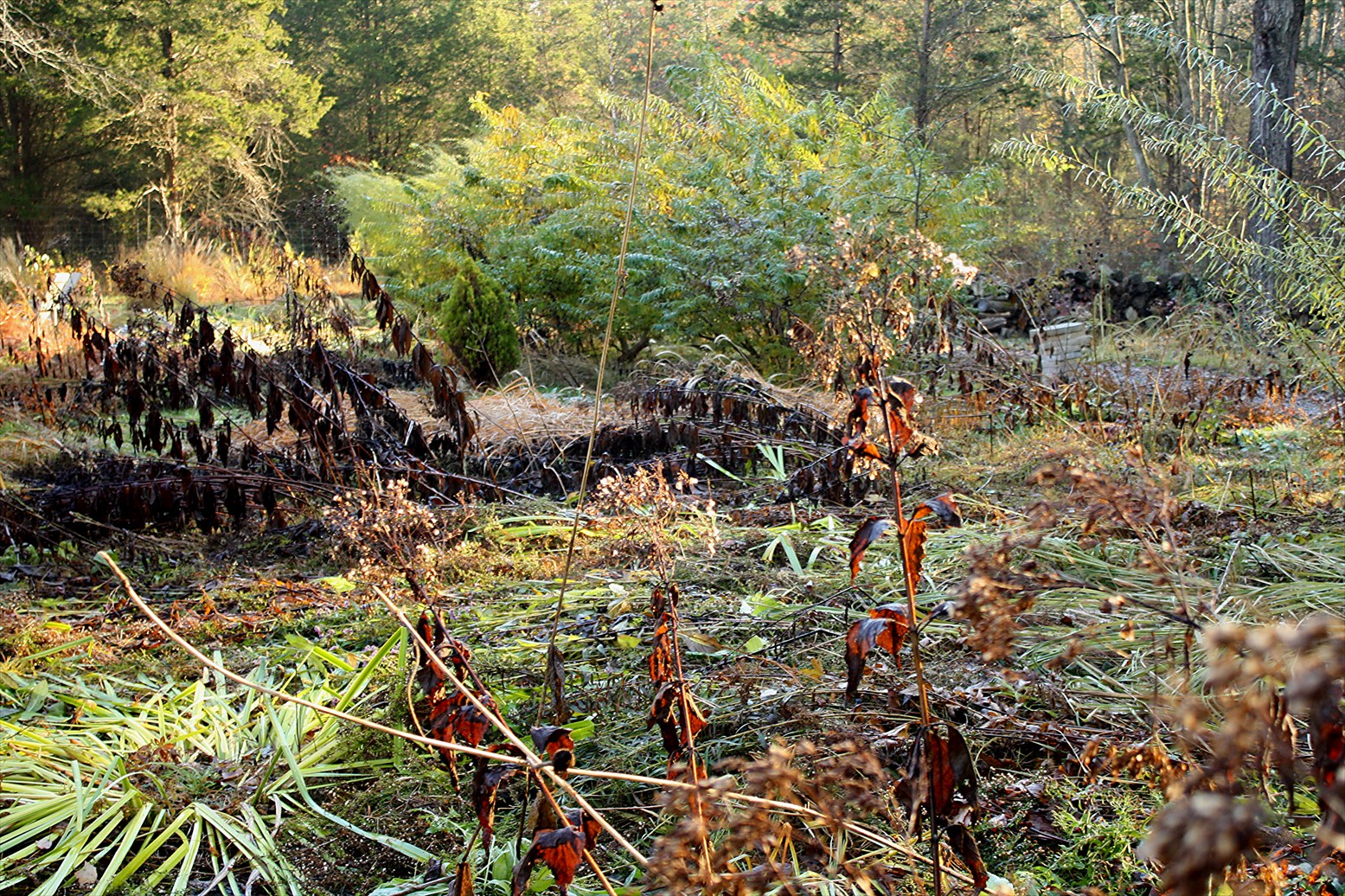
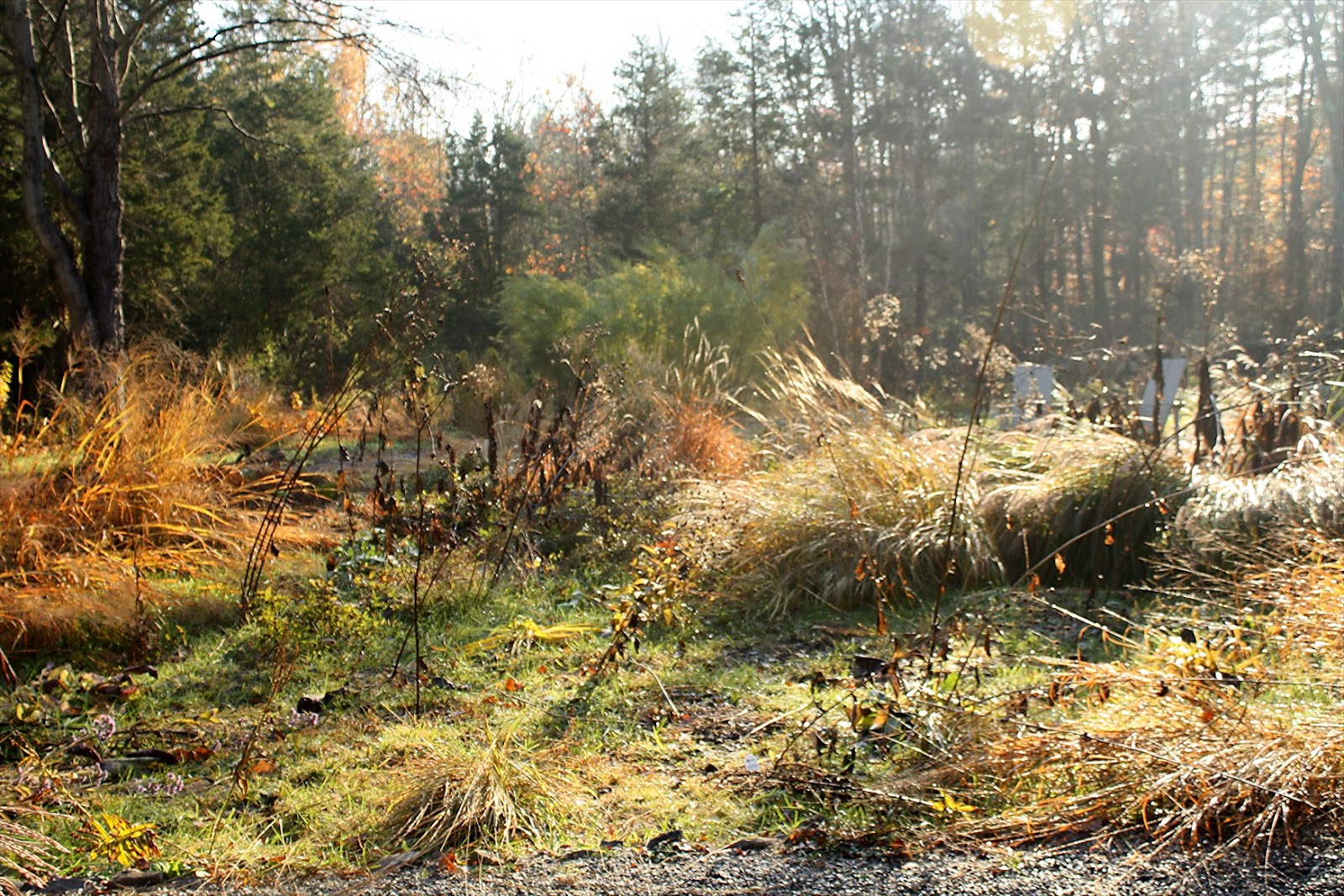
But the clear air and low sun yesterday morning showed the power of light to transform even a scene of ruin into a kind of beauty--light, and the frame of a camera, can create appealing pictures, even of colorful destruction, but a walk through the garden in the morning light was something much more special than I had expected, more than a series of pretty pictures; it was more about atmosphere, context, and illusion.


Certainly no one would call this a "flower garden."


A garden of light, perhaps?


Even this scene of apparent devastation has quite a bit of interest, for me anyway. A kind of botanical archaeology of the garden year. If you click on the image to expand it, you may see what I mean:  evocative contrasts of color, shape, and tone, like impasto on a canvas.

This morning encounter set me thinking about the limits many of us put on our use of the word "garden" because what I was experiencing, while certainly appealing to my senses and thought-provoking, wasn't typical of what most people seek in a garden visit. That is changing, I think, as more gardens imitate, or seek to replicate, the processes and "look" of wildness--gardens like the High Line in New York City or any of many gardens in the "New Perennials" style. As these new gardens become more popular, they may be leading to a gradual change in expectations.


The scene before me was of destruction in large measure--flattened plants, mangled grasses lying in heaps and broken spires, circles of green iris foliage looking for all the world like they had been exploded from their centers and laid out flat on the ground, leaning towers of rich leaden brown Joe Pye Weed, limber willows sprung back from their ice-covered flatness with feathery foliage still intact, the giant miscanthus badly battered but still mostly upright. It was a scene of colors and shapes clearly akin to a kind of abstract painting, some elements a result of intentional choice during planting of the garden, others completely random.


Grasses, even torn into such asymmetrical shapes, are one key to gardening with light. But not just any light; backlighting the tangled foliage makes such a damaged garden come to life. Grasses become like myriad and intricately shaped lanterns, catching the light, amplifying and transforming it through some process of inner refraction and building up of color effects into a bit of the ethereal, a hopeful glimpse into potential, the possibility of beauty in ruined things.


The opening of the woods as the leaves fall lets the light stream through in picturesque shafts of brilliance. Ironic though it may seem looking at these images, the pleasure of my garden is an old, and obvious, one, going back to the Picturesque tradition of the eighteenth and nineteenth centuries. Consider the effects of light, atmosphere, color, scene in the paintings of the Hudson River School, a vision of landscape, with a powerful dose of nostalgia for the past, that formed one of the most enduring myths of America. Much of my appreciation of the ruined garden is a similar romantic, even sentimental, feeling for  "nature," an old and very traditional sense of landscape characteristic of the American experience with the natural world--also my penchant for seeing the garden as a theatrical stage set, though one that takes years to make and that constantly changes. Smoke and mirrors, a human kind of seeming magic.


The spaces in the woods created by the fall of the leaves and the newly penetrating light bring a sense of release after a summer of profuse growth. This seems appropriate to the time of year. In summer, the focus is on the garden; the woods are simply a wall, an enclosure. Now, with the shortening days, the light of the sun streaming through the woods makes me raise my eyes from the low plain of the garden to the bright depths of the surrounding trees, to the wooded world beyond the garden, reawakening awareness of the interconnections of garden and natural world, of human culture with nature, present with past.


The smells were sweet that morning. The fragrances of autumn will soon become the odors of fermentation, rich, earthy, savory, but this day the early processes of slowing growth and decomposition were sweetly reminiscent of freshly mown grass or fresh cut hay.

So this is my goodbye to the garden for another year.

Tuesday, November 01, 2011

Rick Darke on the High Line

Rick Darke discusses the nature of wildness in a presentation sponsored by Friends of the High Line, in preparation for the start of work on Part 3 of the celebrated elevated park and garden in New York City. News was announced just today that Part 3, the most northern portion of the High Line around the West Side Rail Yards, will indeed move forward.


Rick Darke is one of the foremost writers on landscape design and horti-culture (with an emphasis on "culture") in the US, if not the world. He's also a superb photographer, and an exciting speaker and lecturer. Thanks to Friends of the High Line for sponsoring this series of talks, and especially for making a Rick Darke presentation available on the web.

Northern Spur in October 2010

These two photos of the Northern Spur Horticultural Preserve, taken a year apart, illustrate the complexity of wildness manifested over time. Watch the presentation for an explication of this process.


Northern Spur in October 2011

LinkWithin

Related Posts with Thumbnails