Pages

Wednesday, July 28, 2010

Connections: Trinity Root and a Visit to Fordhook Farm

Trinity Root 
by Steve Tobin
When I first discovered Steve Tobin's magnificent sculpture, Trinity Root, in front of Trinity Church on lower Broadway a few weeks back, I posted a photo and brief description. I wasn't aware of the happy confluence of events that would come to pass, resulting in an unexpected email, and a Sunday visit to Fordhook Farm, home of the Burpee Seed Company and the east coast display and test gardens for Heronswood Nursery, all only a short, 30 minute drive from our house and garden on Federal Twist Road.

George Ball, his face shining with his typical enthusiasm, making sure
Phil and I noticed the minute detail in one of his favorite 
Steve Tobin sculptures.
The email came out of the blue, from George Ball, president and owner of Burpee and Heronswood. He'd noticed the Trinity Root posting on my blog. George wrote me that few are aware Fordhook Farm, his home and headquarters of the Burpee Company, has one of the largest Tobin collections anywhere. He offered an invitation to come by anytime to take a look. So on one recent sunny Sunday, Phil and I drove over to see.

On entering the farm grounds we found gigantic metal sculptures at the entrance, part of a series named New Nature, which, to me, resembled Brobdingnagian seed pods, or perhaps giant pollen grains.


I'm also reminded of the serried ranks of pipe in a pipe organ, as well as--at the opposite end of the metaphorical spectrum--cannons, guns. One thing's for sure, these are energetic works and, like a conversation with George Ball, they can literally make your mind pop with ideas and new associations.

Further in we found a large field, a many acre expanse holding several large Tobin sculptures, some like quirky, playful, giant tools or machines for some as yet unknown purpose ...


... others, massive stylized tree roots, some with the grace of dancers, swirling with motion ...

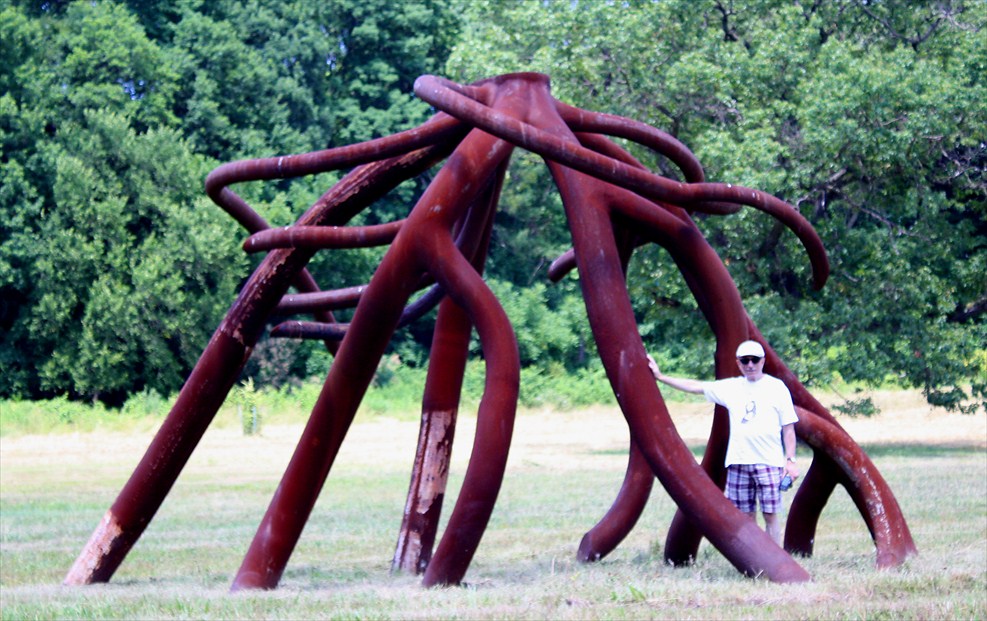


... lounging metal lozenges, like a group of seals lolling on their wet rocky perches, or perhaps suggesting an abstract version of Rodin's The Burghers of Calais ...


... and a highly abstracted tree root, its shining black catching the blue of the sky ...


Phallic, no doubt, and in conversation with one another ...


There is also a collection of more realistic portrayals of  tree root systems in bronze, this one reminiscent of Trinity Root ...


Partway through our visit, this big guy--George, but we didn't know who he was at the time--came out of the house with his dogs, gesticulating to us across the field and calling out to tell us to stop by when we finished -- all this from several hundred feet away. (As I said, it was a very large field.) When we got to the house, George introduced himself, invited us inside and gave us drinks. We joined him in his study for about an hour.

George is a large man, easily exceeding six feet by several inches, with a welcoming, quick, earnest manner, an almost unbounded enthusiasm, wide ranging interests, and a generosity of spirit that was quite unexpected (we were, after all, strangers, though his knowledge of my blog had been some kind of introduction). I, normally reticent and quiet around people I don't know well, found conversation easy, fascinating, actually. We talked about many things ... the book both of us were reading (Hybrid by Noel Kingsbury), the amazing basketball  talent of Native Americans, who George thinks are the best players in the world, Heronswood, and what is and isn't happening with that business since Burpee purchased it in 2000.

His take on Heronswood was an interesting one. As many in the gardening world know, George has been targeted as "the man who destroyed Heronswood" since his company purchased it. I suppose this is a risk inherent in taking over a business with such a loyal, almost fanatical, following. I felt much the same when I read of the purchase years back. My own fantasy was this:  big American corporation absorbs small, famous, world renowned nursery, yet another example of capitalism turning all things of value into commodities. I've since retreated from that attitude. As George pointed out, the owners of Heronswood were ready to move on to other things, and they made the decision to sell. In fact, George and company found that many of the plants that grew so successfully in the rain forest environment of the Pacific Northwest had to be painstakingly tested for their adaptability to climatic conditions in the rest of the U.S. So Fordhook Farm in Doylestown, has become one of the trialing grounds, where the plants are grown to determine how well they fare outside the native Heronswood domain on the Kitsap peninsula.

Unfortunately, we had to leave to return to a house guest we'd left at home. George insisted, however, that he give us a quick tour of a few areas around the house before we left, and we were happy to accept. One of the highlights was a prototype for Trinity Root.  Here George is explaining.

Notice his hands. He's rather the showman. He loves to talk, to teach, to show.


Nuff said?

Next we went up to the house to see his favorite work by Tobin, one of a group called Earth Bronzes on Tobin's web site.


These are rather atavistic-looking, sometimes disturbing, collections of animals and natural objects cast in bronze, roughly in the shape of grave stones (my image), and suggestive of some ancient religious purpose. Here, a detail shows Tobin's virtuoso technique:


Near the end of our tour was this piece, which was on loan and about to be moved, a 'Bamboo', certainly one of my favorites ...


Last was a new work called 'Syntax'. George explained that Steve Tobin in some way acquired a collection of metal letters, which he painstakingly fabricated into this patinated globe.


George Ball, in a rare quiet moment.
My one regret is that we timed our visit for mid-day, in glaringly bright sunlight, making good photographs impossible. To see beautiful, professional photographs of Steve Tobin's work, and learn more about him, click here.

It is possible to see the Burpee gardens and Tobin collection, though an appointment is necessary since Fordhook Farm is a corporate headquarters and private home. Call Linda, or leave a message, at 215 345 1766, fax 215 345 1791, if you want to visit.


Wednesday, July 14, 2010

High Line


Since I haven't managed a visit to the High Line yet this summer, I'm posting a slide show of a visit friend Judy Mann made in June, as well as a few closing photos in the park along the Hudson River. So take a look at how Piet Oudolf's plantings are fairing in their second year. Click here to see Judy's slide show.

Monday, July 05, 2010

New addition

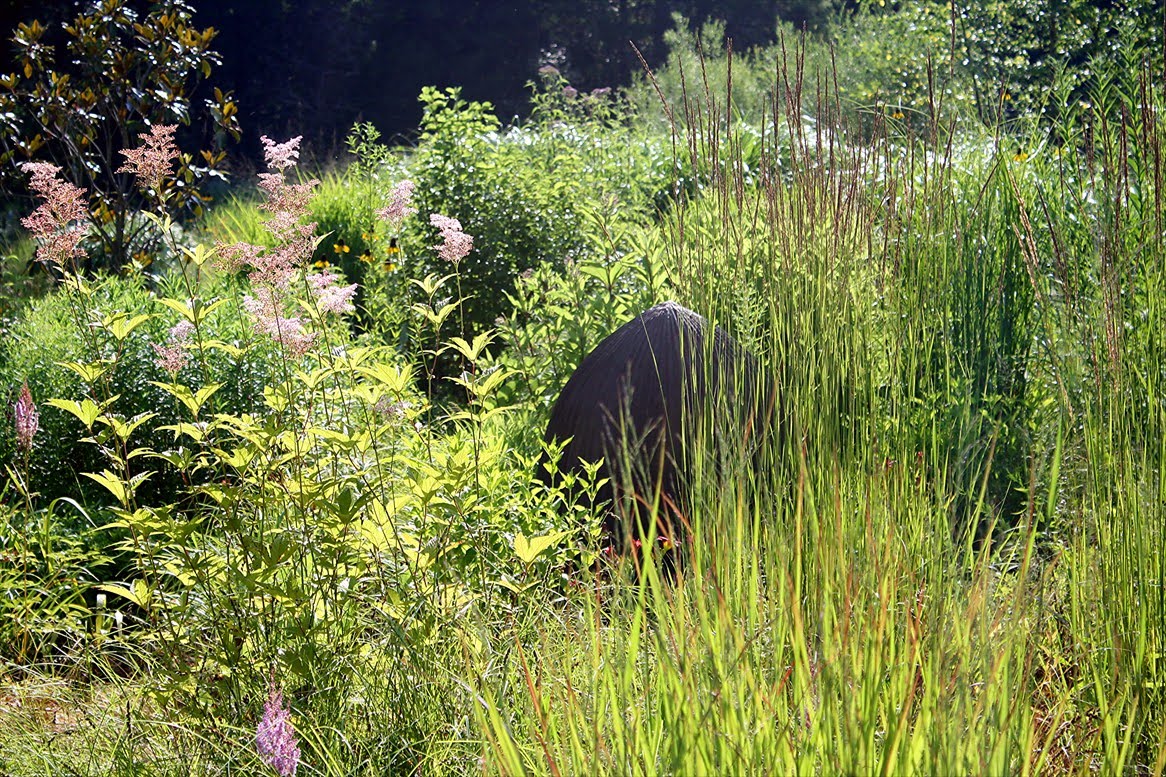
Phil and I first saw Marc Rosenquist's sculptures in his and Gail's garden a couple of months back and we immediately liked them. Gail said we should have one in our garden, so we went to look two weeks ago. It's in the picture below, though you can't see it, slightly to the left of center, at a focal point where the paths meet, a center of energy in the garden. (I'll tell the story of how it got to that spot in the garden in the future, when Gail sends the images of Mark and me maneuvering it into place, ...


... which wasn't easy. The piece is cast bronze, measures about 44 inches high and 36 inches across at the base, and must weigh in excess of 300 pounds). When I first saw it, a classical image of a beehive came to mind, thus the appropriateness to a naturalistic, pseudo-ecological garden, to use William Martin's (click 'Wigandia' if you don't know him) phrase, as adopted from someone (he thinks) in the UK. But the more I look at it in the garden, the less I think of a beehive. It's really quite abstract. Consider Marc's original name for it, 'Pay Dirt'.


Doesn't really look like this one, does it?


No. Abstract is better. Let it be suggestive of something else if you wish, or see it on its own terms.

It appears and vanishes as you walk around the garden. From some points of view, very prominent, from others, almost invisible.


All these photos were made in the bright light of morning, on a very hot July 5. Below it takes on a dark solidity in contrast to the brightly backlit Filipendula rubra 'Venusta', Panicum virgatum 'Shenandoah', and Calamagrostis acutiflora 'Karl Foerster'.


Or viewed from the other side, through Molinia caerulea 'Transparent'.


It appears to take on a blueish cast seen with the glaucous foliage of Rudbeckia maxima.


Or maybe R2D2 hiding in the bushes?


It's totally invisible from the path on the western side of the garden.


Even when it's not visible, the pictures provide useful context for an object that isn't garden, in the garden.


In hiding...


Completing the circle of the garden path, approaching the starting point, where it's only a few feet from the path... I have to say I feel this piece was made for this garden. Ironic, because Marc cast it 20 years ago, when this garden was a rough cedar wood.


And the rest is context.


Sunday, July 04, 2010

A talk with Beth Chatto

I'm late mentioning two new podcasts from Gardens Illustrated. I found myself in my own pond in waders this weekend, so I picked this photo as appropriate to the time.

In these two podcasts, Beth Chatto, the English model for gardeners devoted to using the right plant in the right place, to learning about where a plant originates, how it lives in community with other plants, and how to put that knowledge to use in the garden, talks with Alan Titchmarsh in a diverting conversation of a little over an hour. She describes the beginning of her interest in gardening through her husband's obsession with the origins of plants, and how her garden and nursery developed as an outgrowth of that passion. Click here for Part 1, and here for Part 2. You can download copies of the podcasts by right clicking on the links and selecting Save link as from the list (if you're on a PC). Or simply go to the Gardens Illustrated website.

Tuesday, June 29, 2010

Extensive gardening: making the best of necessity

Gardening a large area of over an acre, only on weekends, and on unpropitious heavy wet clay, allows no time for intensive gardening, for achieving perfect edgings, astonishingly designed set pieces, carefully manicured, intensively maintained lawns and perennial borders. My gardening is of the extensive kind, much more like farming, and the limited time I have available, what with the exigencies of variable weather, often means moving from one problem to the next, and learning to live with some roughness around the edges. Who said naturalistic gardening is not labor intensive? Here are some photos showing what's happened in the past week, along with visible signs of necessary extensive maintenance.


Never having attended to planting at the top of the stone wall, I needed to kill bindweed and poison ivy that had become entwined with the existing plants. No getting around general destruction. Roundup (used very judiciously, in targeted areas, shown below) killed all growth at the edge, though I did manage to save one large Sanguisorba tenuifolia. Now to wait and see if it killed the roots of these two pestilential plants.


Selective cutting of the meadow grasses has begun (below). I do this after the wildflowers have gone to seed, and to reduce competition with preferred grasses and perennials--panicums, Filipendula ulmaria, Japanese and Siberian irises, Silphium perfoliatum. When time permits and materials are available, I want to add a small, one-person path wandering through this area, giving access to the pond side off to the left, and keeping the feet above the ever present wet from fall through early summer. Here is another example of extensive maintenance: the cuttings are left on the ground, to decompose in place, and over time, to increase the organic content of my mostly mineral clay. No time for nasty neat.


View across the garden. A 30-foot-long planting of Filipendula rubra 'Venusta' is in bloom on the right; the pink color looks rather faded in the bright afternoon light, but I grow this plant mostly for the sharply angular, almost chartreuse foliage, and for its vigor in my difficult soil. Sanguisorbas, Joe Pye Weed, Iris virginica in the foreground, further back Rudbeckia maxima, Lysimachia ciliata 'Firecracker', more irises. Most of this will be burned in late winter--another labor saving practice, and it's good for the grasses.


Looking across the pond, obscured by plant growth, toward the miscanthus bank, with the strip of intentional devastation caused by glyphosate. In the foreground is Panicum 'Heavy Metal' and 'Cloud Nine', more Silphium perfoliatum, Ligularia Japonica about to bloom at the front. The miscanthus makes a very good, though quite large, ground cover, helping keep undesirable plants under control.


More views of the filipendula, since it's the floral "star" of the moment. I'll like it much better when the pink fades to more subtle copper tones.


We've had increasing heat, without much rain, which is sending these Silphium laciniatum rocketing skyward (these are about eight feet tall now). They must have put on three feet of growth in the past week. These plants always flop when they get too tall. I'm hoping the lack of water will make them strong enough to stand on their own this year. We'll see; thunderstorms are predicted for today.


The silphium with more Rudbeckia maxima and Vernonia fasiculata. The ground surface shows where I've cut a path for walking through the plants (wide enough for one lone person). Yet another project is to add a gravel surface to make the path permanent.


Close-up of the silphium ...


No time for raking gravel back into place after storms or other disasters, thus the borders of rock (native, of course) to keep all in place. Eventually there may be ground covering plants bordering the path, but only as time permits, and only if nature cooperates. I don't mind the grasses.


Another vigorous plant that helps with spotty maintenance. Eupatorium cannibinum, a European eupatorium, seeds itself around, eventually making large masses if left to itself, but easily pulled out if not wanted. It obscures a multitude of sins. Here it's just coming into bloom.


Another useful plant, for the water's edge, that makes a lovely mass of color, shape and texture--Pontadera cordata. It's vigorous enough to outcompete the weeds.


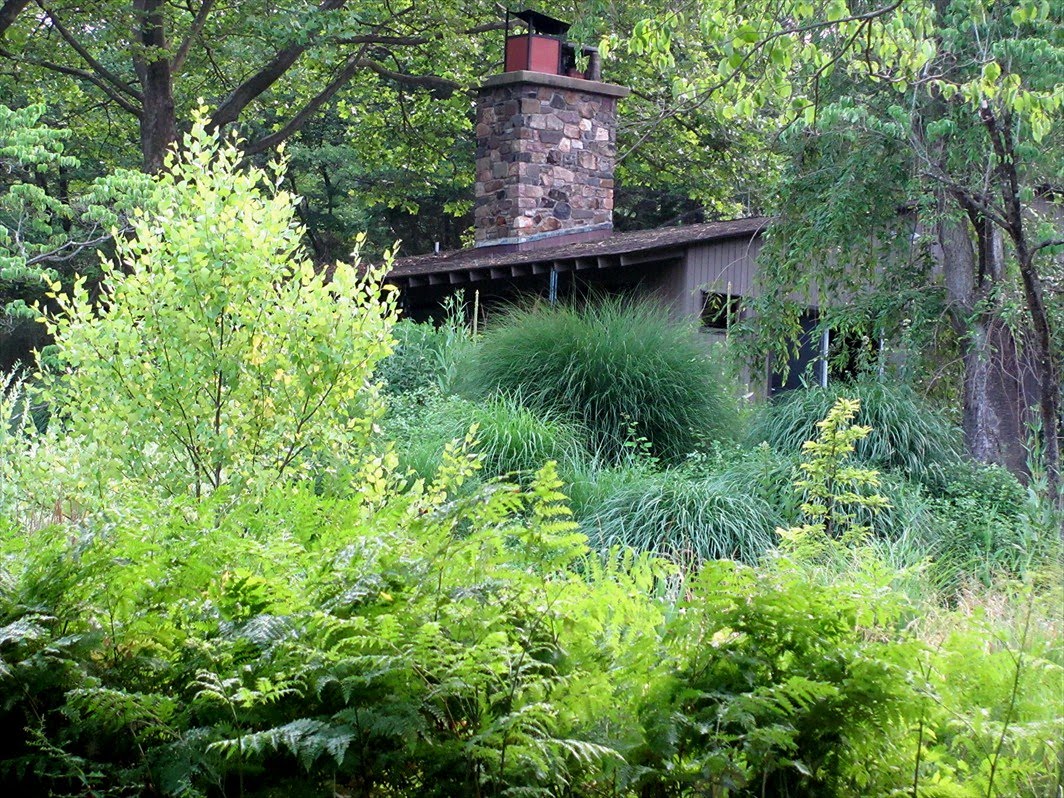
Much of my approach to extensive maintenance, in case you haven't noticed, is to use large, rather highly competitive plants, which just happen to be well suited to my conditions. Here the plants appear to be eating the house.


Miscanthus, willows, river birch - they cover a lot of ground.


LinkWithin

Related Posts with Thumbnails