Pages

Saturday, January 16, 2010

Garden Diary: Vanished


Glimpses of what I want the garden to be, of transitory phenomena, hints of mystery occur at unexpected moments.


Yesterday I spied a pheasant just outside the house. It was quietly pecking at the ground, on the first relatively warm day following a long spell of extremely cold weather. I tried to catch some images through the window, with limited success. When I went outside, the pheasant quickly ran to the stone row at the edge of the land, then vanished into the woods.


These unexpected and tentative encounters with wildlife evoke an ineffable sense of the hidden, the barely visible goings on, habits of life, things that are to me mysteries, hidden in the woods. They even recall those little known, almost lost lives and cultures that once existed in this place.

I want to capture this sense of mystery in my garden, and that's hard to do. Lack of knowledge of the past is one challenge. Another is topological. The problem is this. My house is on an elevated mound that overlooks the garden, which is flat and spread out in a way that makes it easily surveyed in a single wide view. I've added small trees and planted bulky and extremely large perennials, but the high main viewpoint and lay of the land still present a problem yet to be solved. In the summer, when I look back toward the house from down in the garden, I can capture that  feeling of  the half-seen, partially obscured - the sense of immanence I know is the nature of this place.

I may take a hint from these photos, which are not of the garden, but of the untouched woods in front of the house, where partial views, fallen trees, and the detritus of the seasons overlays the land.


Saturday, January 02, 2010

Great Gardens of America by Tim Richardson

Garden criticism hardly exists in America, and Tim Richardson is a British garden critic. What does Richardson have to say to us? If you read his new book Great Gardens of America, which I highly recommend you do, expect something new. This is one of those rare garden books of ideas. You will learn new things about gardens and the process of making and keeping gardens.

Great Gardens of America is a critical analysis of 25 gardens in North America. With many beautiful color photos by Andrea Jones and a large format, Great Gardens offers visual interest most of us seek in such books. But this is much more than a photo book of gardens. The text is more important than the pictures, which really serve to illustrate Richardson's points and pique the readers' interest. Tim has selected a disparate array of gardens, though he does find a unifying concept in all of them. He writes about how the gardens came to be, the interactions between owners and designers, cultural and historical influences of other gardens from other cultures and times, how successfully the garden designers achieved their goals, critical issues of garden maintenance and preservation. This is a book of ideas and - I mean this in the most complimentary sense - an educational book that will deepen understanding of gardens.

American Gardeners are no longer 'Poor Relations'
The place of American gardens within the cultural landscape of the rest of the world, especially Europe,was an issue of great concern and some embarrassment in the early days of our republic, and even well into the 20th century among such cultural icons as Edith Wharton and Henry James, who believed American culture lacked the maturity and depth of a great civilization, and who found it necessary to virtually "become European" to find the acceptance they required of themselves. Culturally, Americans had seen themselves as the poor relations of their western European forebears. This has not been the case for many decades now, and Tim Richardson's Great Gardens of America has put that question to rest yet again.

The Difference
Most Americans with gardening savvy know this already, so Richardson's survey of American gardens does not even bother making this point. The new thing Richardson brings to the table is an understanding of how American gardens differ from the gardens of Europe. That difference is both a cultural and a historical one. The European garden began with an enclosed space that offered protection from the dangers of wilderness and marauding strangers, the hortus conclusus, essentially a protected courtyard or small walled garden, and it has traditionally kept that sense of inward-lookingness, with a focus on garden structures rather than views into surrounding landscape, and with garden rooms, hedges and walls, borders, ha has that keep wilderness at bay. Even with the 18th century landscape garden, the sense of openness was achieved only by ownership of the entire visible landscape, undertaking vastly expensive manipulations -- moving entire villages, changing the courses of rivers, to achieve the illusion of natural vistas and scenes that were, in fact, highly contrived.

As Mr. Richardson points out, American gardens generally are outward looking, with an openness to the wilderness, in many cases even finding their origins in imitation of wilderness. Among wealthy classes with the resources to spend lavishly on their American gardens, and even when designing gardens highly derivative of European gardens, their Beaux Arts or Arts and Crafts gardens took on a character that was newly American, and in the end very different from their European models.

I'll quote directly from Richardson's "Introduction - What is it that makes American gardens 'American'?"

"So what is it that makes American gardens 'American'? The key difference between America's gardens and those of Europe can be traced back to this idea of a society's relationship with nature. Put simply, the American mode of gardening appears to be framed by the nation's historic embrace of the wilderness ideal. Using a necessarily broad-brush approach, it can be observed that American garden-makers have taken a much more open and embracing attitude to the concept and reality of wilderness. This is a theme that struck me time and again in American gardens, which are quite often clearly beholden to European design styles - styles which can then be seen to be have been decisively tweaked or tonally altered. In America, even in cases where the detail of the design was initially inspired by European examples, it seems that the beckoning natural landscape will often be harnessed to set the tone of the garden as a whole. Vistas in America, for example, can just as often be wide and general, as opposed to object- or building-focused, as they are in Europe. This lends many of these gardens an expansive, unbounded feel, quite at odds with the European tradition where an attempt is often made to fence out wilderness by means of enclosures. Even the English landscape park, an ostensibly 'naturalistic' approach to garden making, had as its object a highly particular version of the pastoral which often involved redevelopment of the existing topography. The view may have been expansive, but it was always clearly under control:  managed. The European mindset of enclosure was given its richest artistic expression in the cellular Arts and Crafts gardens of the early twentieth century. There are several examples in this book of the ways in which the enclosure instinct was usurped or altered by American garden makers.

These differing attitudes emerged from specific historical contexts. In Britain, for example, from the medieval period, another word for wilderness or unfenced land was 'waste'; it was considered the domain of bandits and dangerous wild animals. In America such places early on became synonymous instead with the idea of plentitude and potential, at least in the mind of the populace at large, as opposed to those who actually lived out their lives on the frontier."

The Critic
Richardson calls it as he sees it. While he finds a great deal to admire at Stan Hywett, a renowned Arts and Crafts garden in Akron, Ohio, he is very critical of the garden's management, which has let parts of the original garden fall into disrepair while using scarce funds unwisely to introduce an "unattractive new conservatory with gift shop and 'butterfly world', various poorly finished paths and roadways ... and a massive Great Garden, which was clearly over-ambitious in that the levels of maintenance needed to keep such a large area of intensive horticulture ... in pristine condition are, it would appear, simply not available at the property. It seems an odd decision, too, for the Goodyear Tire and Rubber Company to sponsor a new garden in front of the conservatory while those areas of Stan Hywett's landscape that were developed by the firm's founder suffer serious maintenance problems. One cannot blame the gardeners; this is a management issue. It is to be hoped that Stan Hywett's trustees - and a new chief executive who should be in post by the time this book is published - will in due course redirect such resources that they have away from ambitious new projects and towards core elements of the historic garden..."

This is an exciting book. It is a joy on a purely visual level, and it offers much more to those who want to learn something new about some of America's great gardens, who want to better understand why they are great, how they relate to their historic precedents in other parts of the world, and why they are unique to this continent and the places in which they exist.

Saturday, December 26, 2009

Sense of Place: Headquarters Farm


This place where we live lies at an intersection of many threads of culture, landscape, geology, climate, history, and geography. Passing through the hamlet of Headquarters last weekend, just as the big snow of the season was arriving, I stopped by Headquarters Farm, a rather imposing edifice in this modest place.


To my knowledge, this was never a grand residence, rather a home built by a well-to-do local farmer and entrepeneur. Its construction followed the building of a grist mill, the large stone building on the left in the photo above. The mill was built about 1730, and the house in 1757 by John Opdycke, a well-to-do merchant and farmer. It may be that John never lived in the house. Instead, it may have been occupied by the person he hired to run the mill, and half the house on the left may have been used as a store.


The origin of the name 'Headquarters' for both the house and the hamlet in which it is located comes from an apocryphal story of George Washington using the house as a headquarters during the Revolutionary War. Washington, indeed was in this area during the Revolution, and used a house in nearby Lambertville as his headquarters for a brief time (he was on the run), but never this house.

Opdycke, like many Dutch families in this area, probably owned slaves, who helped run the mill and support the local economy. We don't usually think of slavery as part of the heritage of this part of the US, but it definitely was. Not on the scale later found in the South, but it certainly existed.

So what does this picturesque scene in the New Jersey winter of 2009 tell us about our landscape, and our sense of place? How does our knowledge of the existence of slavery here affect our perception of the landscape and its man-made features? Does it recall the earlier devastation of the culture and the lives of the native Americans, the Lenni Lenape, who formerly called these fields, these hills, forests, and streams their home? How does past shape our understanding of the present, alter our understanding of the the place in which we live? How does it affect our choices in the garden?

(I'm indebted to Marphy Goodspeed's article in the Delaware Township Post for some of the facts in this post.)

Monday, December 21, 2009

Honest Scrap Award?

Susan Cohen at Miss Rumphius' Rules has tagged me with an Honest scrap award. I've procrastinated for over a week now.

These are the rules. You have to first list 10 honest things about yourself (and make them interesting). Second, present the award to seven other bloggers. I've been dreading this moment. In the interest of collegiality among garden bloggers and--just to see what I'll say since I don't know myself--I'll give it a try. Here goes ...


Ten Pieces of Honest Scrap about Me
  1. I grew up in Mississippi, descendant of generations of poor farmers who made their ways from Maine and Virginia over 300 years to the deep South, but I didn't become conscious of my own love of gardens and plants until I moved to ultra urban New York City at age 25.
  2. I want to live in Italy (who doesn't?).
  3. I'm unnaturally excited by good garden books by good writers--Noel Kingsbury (with and without Piet Oudolf), Rick Darke, Tim Richardson, Dan Pearson, John Brooks, etc.--and when I get them, read them three or four times, then refer to them forever.
  4. No, I'm NOT an anglophile, I just find the UK gardening culture richer, and more serious, than our own, which tends to be driven by a "how to" mentality. I know mine is an unpopular position in the US.
  5. I think the great American lawn is an environmental horror. 
  6. I always have a novel at hand, mainly for reading at bed time, something to take me away from the circling thoughts about work and the cares of the day. P.D. James right now. Before that, Richard Ford's The Lay of the Land.
  7. No one at my job--marketing in a large engineering/architecture firm--understands at all what a garden is. Well, few, if any.
  8. I'm firmly committed to gardening with a sense of place, using only plants that are suited to existing conditions. That's a hard game to play, especially where I garden, in a soggy, wet clay.
  9. I like just about any movie starring Anthony Hopkins.
  10. I'm gay and married to the same man for 36 years, and maddened that we don't have the civil rights the rest of US citizens do. We got married in Canada after 30 years together.
Now, I pass on the challenge (burden?) to seven other garden bloggers, with no obligation to do this. I think some of them have been tagged before and they may be over it. Forgive me, but you can pretend this didn't happen. The chosen ones:

Les at A Tidewater Gardener

Benjamin at The Deep Middle

Elizabethm at Welsh Hills Again

Susan at The Bike Garden

Nigel at SILVERTREEDAYS

Phillip at Dirt Therapy

Craig at Ellis Hollow

If you want to play, just list ten things about yourself, then tag seven other bloggers.

Thursday, December 10, 2009

A drive by Felder Rushing's


Over the past couple of years I've become quite fond of listening to podcasts of Felder Rushing's gardening program, The Gestalt Gardener, on Mississippi Public Broadcasting. Having lived in the Northeast for almost 40 years, I've lost my southern accent, so I really enjoy hearing the many variations of "southern" on Felder's weekly program. You can easily find The Gestalt Gardener on iTunes.

Felder's garden, in the trendy Fondren neighborhood of Jackson, Mississippi, is something to behold. The week before Thanksgiving, my sister Linda, Phil and I managed to find Felder's house. As you can see above, it's easily recognizable.


The image below shows a little more of the surrounding context. Felder's house is not on an isolated site. It's in a middle class neighborhood of modest, traditional houses. It's a statement and, perhaps, an implicit indictment of bland middle class landscaping, though I don't speak for Felder here. That's my personal opinion.


References to vernacular architecture and gardens in the rural south abound, particularly in the corrugated metal panels and the bottle trees. The corrugated panels used to make the wall and as roofing have been used as a cheap siding on farm outbuildings and for roofing on country houses throughout the south. Interestingly, I've discovered this to be a ubiquitous construction material throughout the world. Many houses in Iceland, perhaps the majority of them, use the same metal siding (lack of wood, you know) and William Martin, in his fabulous garden in Australia, Wigandia, uses the same materials for his garden walls.

Note Felder's truck garden in the photo below - literally a traveling garden in the back of his pickup truck. I didn't want to get too close, lest I be accused of tresspassing (you can see how close the neighboring house is on the right). Most surrounding houses have traditional front lawns and the standard American foundation plantings. But I believe I've heard Felder say his garden's influence is slowly spreading.


Sunday, December 06, 2009

First Snow


First snow this year arrived yesterday, December 5. A heavy, wet snow flattened my perennial prairie. Some of the grasses will rise again, once the ice melts, but I think I like the openness of a flat garden. Time for a change.


The morning after ...


And now I can see the new stone wall at the end of the garden.


(photos 1, 2, 3, 9 by Phillip Saperia)

Friday, December 04, 2009

Mississippi Delta Landscape: a Reading

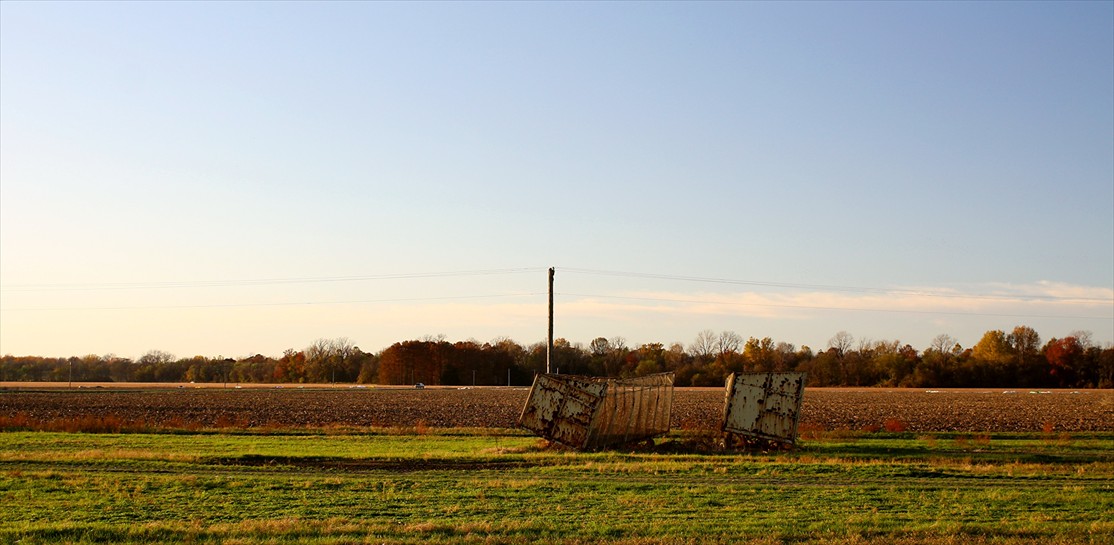
(These photos are very wide. Click to see the full panoramic view.)

The Mississippi Delta, so the saying goes, begins in the lobby of the Peabody Hotel in Memphis and ends on Catfish Row in Vicksburg, a distance of some 200 miles. It is really an alluvial plain, not a delta, and was flooded every year for thousands of years - until the U.S. Army Corps of Engineers built levees to keep the river in its channel and stop the flooding. The flooding, of course, made Delta soil among the richest in the world. In the days of plantations - and slavery - it was a source of great wealth for the few who owned the land. Today pockets of great wealth remain. The legacy of slavery also remains, and the Delta is among the poorest regions in the United States.

The cotton field above, though small for the Delta, is a typical landscape. The masses of color and texture, the patterns caused by mechanized farming and harvesting, create images of considerable visual interest, evocative images rich with possibility.


Apart from its history, the Delta landscape is extraordinarily beautiful, a vast flatness continuing for mile after mile. Because the land is so flat, the sky and the quality of light is an essential part of the landscape.

Here, a monster irrigation system moves across an already harvested cotton field with a sky tinted by the gathering colors of sunset.

This is a levee, gravel road on top, with a distant view of the Mississippi through the trees. The levee is very high, far above the level of the river, at least at this time of the year.

A closer view using the camera's optical zoom.

Getting to the river's edge wasn't easy. Here we found a road over the levee to a cement loading plant, one emblem of the commerce the Mississippi supports.

Loaded barges awaiting transport.

Close-ups of the opposite side, above and below.

Later, having left the river, we stopped on the side of a road to watch the sunset before heading into Clarksdale for dinner and a blues club. As has been said before, the camera always lies. I can't account for the varied visual effects of the sunset shown below. Phil was using a new point and shoot Canon; I was using a Canon Rebel.


Looking in the opposite direction, to the east, a hedgerow silhouetted against a background of changing pastels.


The Delta is a landscape where sense of place is palpable and complex - horrendous environmental damage caused by the Corps of Engineer's attempts to control an uncontrollable river, the horrors of slavery and a culture that built its wealth on that horror, the fantasy of the "Gone with the Wind" South, birth of the Blues, Tennessee Williams' Cat on a Hot Tin Roof - in an ancient land that still yields some of its primaeval past. Reading the landscape here is like archaeology, uncovering layer upon layer of history, geology, topography, ethics, art, and culture.

(Phillip Saperia contributed about half the photos in this post.)

Sunday, November 22, 2009

House and Garden in Delta

Making a garden "in tune with nature" means simply planting appropriate to place. But place can mean more than the physical environment. Consideration of metaphorical associations with history, geology, and culture add depth and richness to the experience of the garden. Place can be much broader than immediate physical surrounding; it can encompass a whole geographic region - even the entire earth - or the universe. Only consider the importance of astronomical observation among various cultures throughout history, or the many connections between gardens, theology, and spirituality.

This is my garden viewed from the narrow area at the side of the house where overland flow of storm water builds into a flood before opening into what I call the "delta." It's a metaphorical delta. The river of water flows down from above, gains speed and deepens as it rounds the house, then breaks out into the wide area of the garden, very much like a physical model of a river delta. Perhaps I push the metaphor a little too far, but there are physical similarities between the hydrology of my garden and a river delta.

Phil and I just returned from visiting my sister and her family in Mississippi for the Thanksgiving holidays. One day, we drove into the Mississippi Delta, a unique physiographic province of extraordinarily flat land that used to be annually flooded by Old Man River. The satellite photo below shows just how distinctive the Delta is from the surrounding land. Starting at the Mississippi River, the tangle of curves and curlicues on the left, the Mississippi Delta is clearly demarked by the light shade of green, which ends abruptly at the darker green mass on the right where the hills begin. In many areas, this change is quite abrupt and dramatic. As you move from the hills into the Delta, the roads drop quickly down sixty or seventy feet, into absolutely flat land for as far as the eye can see. This land was flooded annually for thousands of years, and that ancient sign is still easy to see from above.


Since the 1930s the U.S. Army Corps of Engineers has decided it can control nature and hold the river in with levees. Everyone now knows that this process is doing irreparable environmental damage, causing the southern coast of Louisiana to disappear under the waters of the Gulf of Mexico, and eliminating the wetlands that could help protect such cities as New Orleans from future weather-borne disasters. The river rises higher each year, the levees are built higher to contain it, and eventually the process will become unmanageable. The river will break through and all will be changed, at great cost - environmental, human, and financial.

Unlike the Mississippi Delta, my garden delta has no such grand implications for the future. Or does it? Water defines both, and its use or misuse is a subject of some interest, at least to me.

In my simulacrum of a delta, I garden in tune with nature. The plants that grow in the garden are well adapted to the saturated, heavy clay soil, frequent inundations during heavy rains, and standing water. Normally such conditions would create perfect breeding ground for mosquitoes, but the huge frog population eliminates that nuisance. There simply are no mosquitoes. Going with the flow, accepting existing environmental conditions, keeps nature in balance.

On a less practical, more aesthetic level, the garden complements the natural woodland environment surrounding it as well as the understated design of the house - its low profile, gray-brown tones, wooden construction, transparent glass, and massive native stone chimney towering into the trees. The house has low visual impact because the architect, William Hunt, designed his houses to blend into their environments, using natural materials and minimal ornament, and lots of glass to bring nature inside.

Out here, the sky is an important part of nature, and of the garden. Designed to complement its surroundings, the house is situated high, on a small man-made hill, where it is protected from the water and damp below, all the better to catch the light from the sky. In mornings and early evenings, it's flooded with natural light, as well as warmth from the direct rays of the sun.


Above, a piece of sky, with a Red Maple, and giant miscanthus (Miscanthus giganteus) in plumy splendor. Who is to say my garden ends at its physical borders or in this time? In my mind, it encompasses the distant Mississippi Delta, the farmers and millers who lived and worked these hills in the 18th century, the native Americans who looked up into this sky over thousands of years, the inexorable geological processes that formed these hills, these rocks, this clay.

(Delta photo courtesy Google Earth)

Sunday, November 15, 2009

Christmas Fern on Stompf Tavern Road


Christmas Fern (Polystichum acrostichoides) is an especially prolific native plant in our woods. Last weekend, driving down Stompf Tavern Road, an unpaved 18th century path, now road, that drops swiftly down to the Delaware from our perch on a ridge above the river, I found Christmas Fern growing in large colonies. It seems to have a fondness for steep banks, where it is well drained, though growing in heavy clay.


This is a view of the habitat carved by an intermittent, very steep, stream.

LinkWithin

Related Posts with Thumbnails