Pages

Friday, December 04, 2009

Mississippi Delta Landscape: a Reading

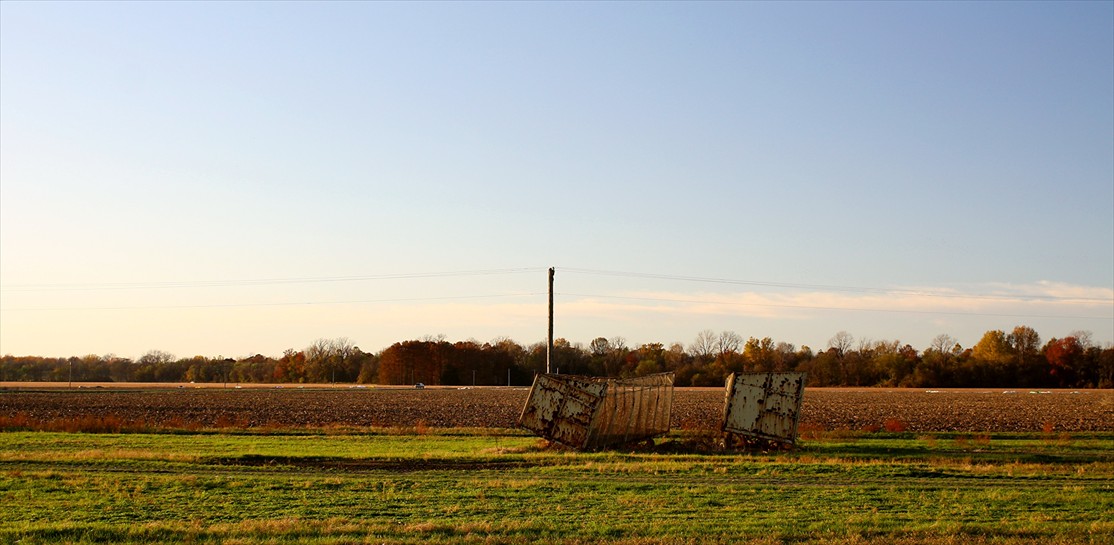
(These photos are very wide. Click to see the full panoramic view.)

The Mississippi Delta, so the saying goes, begins in the lobby of the Peabody Hotel in Memphis and ends on Catfish Row in Vicksburg, a distance of some 200 miles. It is really an alluvial plain, not a delta, and was flooded every year for thousands of years - until the U.S. Army Corps of Engineers built levees to keep the river in its channel and stop the flooding. The flooding, of course, made Delta soil among the richest in the world. In the days of plantations - and slavery - it was a source of great wealth for the few who owned the land. Today pockets of great wealth remain. The legacy of slavery also remains, and the Delta is among the poorest regions in the United States.

The cotton field above, though small for the Delta, is a typical landscape. The masses of color and texture, the patterns caused by mechanized farming and harvesting, create images of considerable visual interest, evocative images rich with possibility.


Apart from its history, the Delta landscape is extraordinarily beautiful, a vast flatness continuing for mile after mile. Because the land is so flat, the sky and the quality of light is an essential part of the landscape.

Here, a monster irrigation system moves across an already harvested cotton field with a sky tinted by the gathering colors of sunset.

This is a levee, gravel road on top, with a distant view of the Mississippi through the trees. The levee is very high, far above the level of the river, at least at this time of the year.

A closer view using the camera's optical zoom.

Getting to the river's edge wasn't easy. Here we found a road over the levee to a cement loading plant, one emblem of the commerce the Mississippi supports.

Loaded barges awaiting transport.

Close-ups of the opposite side, above and below.

Later, having left the river, we stopped on the side of a road to watch the sunset before heading into Clarksdale for dinner and a blues club. As has been said before, the camera always lies. I can't account for the varied visual effects of the sunset shown below. Phil was using a new point and shoot Canon; I was using a Canon Rebel.


Looking in the opposite direction, to the east, a hedgerow silhouetted against a background of changing pastels.


The Delta is a landscape where sense of place is palpable and complex - horrendous environmental damage caused by the Corps of Engineer's attempts to control an uncontrollable river, the horrors of slavery and a culture that built its wealth on that horror, the fantasy of the "Gone with the Wind" South, birth of the Blues, Tennessee Williams' Cat on a Hot Tin Roof - in an ancient land that still yields some of its primaeval past. Reading the landscape here is like archaeology, uncovering layer upon layer of history, geology, topography, ethics, art, and culture.

(Phillip Saperia contributed about half the photos in this post.)

Sunday, November 22, 2009

House and Garden in Delta

Making a garden "in tune with nature" means simply planting appropriate to place. But place can mean more than the physical environment. Consideration of metaphorical associations with history, geology, and culture add depth and richness to the experience of the garden. Place can be much broader than immediate physical surrounding; it can encompass a whole geographic region - even the entire earth - or the universe. Only consider the importance of astronomical observation among various cultures throughout history, or the many connections between gardens, theology, and spirituality.

This is my garden viewed from the narrow area at the side of the house where overland flow of storm water builds into a flood before opening into what I call the "delta." It's a metaphorical delta. The river of water flows down from above, gains speed and deepens as it rounds the house, then breaks out into the wide area of the garden, very much like a physical model of a river delta. Perhaps I push the metaphor a little too far, but there are physical similarities between the hydrology of my garden and a river delta.

Phil and I just returned from visiting my sister and her family in Mississippi for the Thanksgiving holidays. One day, we drove into the Mississippi Delta, a unique physiographic province of extraordinarily flat land that used to be annually flooded by Old Man River. The satellite photo below shows just how distinctive the Delta is from the surrounding land. Starting at the Mississippi River, the tangle of curves and curlicues on the left, the Mississippi Delta is clearly demarked by the light shade of green, which ends abruptly at the darker green mass on the right where the hills begin. In many areas, this change is quite abrupt and dramatic. As you move from the hills into the Delta, the roads drop quickly down sixty or seventy feet, into absolutely flat land for as far as the eye can see. This land was flooded annually for thousands of years, and that ancient sign is still easy to see from above.


Since the 1930s the U.S. Army Corps of Engineers has decided it can control nature and hold the river in with levees. Everyone now knows that this process is doing irreparable environmental damage, causing the southern coast of Louisiana to disappear under the waters of the Gulf of Mexico, and eliminating the wetlands that could help protect such cities as New Orleans from future weather-borne disasters. The river rises higher each year, the levees are built higher to contain it, and eventually the process will become unmanageable. The river will break through and all will be changed, at great cost - environmental, human, and financial.

Unlike the Mississippi Delta, my garden delta has no such grand implications for the future. Or does it? Water defines both, and its use or misuse is a subject of some interest, at least to me.

In my simulacrum of a delta, I garden in tune with nature. The plants that grow in the garden are well adapted to the saturated, heavy clay soil, frequent inundations during heavy rains, and standing water. Normally such conditions would create perfect breeding ground for mosquitoes, but the huge frog population eliminates that nuisance. There simply are no mosquitoes. Going with the flow, accepting existing environmental conditions, keeps nature in balance.

On a less practical, more aesthetic level, the garden complements the natural woodland environment surrounding it as well as the understated design of the house - its low profile, gray-brown tones, wooden construction, transparent glass, and massive native stone chimney towering into the trees. The house has low visual impact because the architect, William Hunt, designed his houses to blend into their environments, using natural materials and minimal ornament, and lots of glass to bring nature inside.

Out here, the sky is an important part of nature, and of the garden. Designed to complement its surroundings, the house is situated high, on a small man-made hill, where it is protected from the water and damp below, all the better to catch the light from the sky. In mornings and early evenings, it's flooded with natural light, as well as warmth from the direct rays of the sun.


Above, a piece of sky, with a Red Maple, and giant miscanthus (Miscanthus giganteus) in plumy splendor. Who is to say my garden ends at its physical borders or in this time? In my mind, it encompasses the distant Mississippi Delta, the farmers and millers who lived and worked these hills in the 18th century, the native Americans who looked up into this sky over thousands of years, the inexorable geological processes that formed these hills, these rocks, this clay.

(Delta photo courtesy Google Earth)

Sunday, November 15, 2009

Christmas Fern on Stompf Tavern Road


Christmas Fern (Polystichum acrostichoides) is an especially prolific native plant in our woods. Last weekend, driving down Stompf Tavern Road, an unpaved 18th century path, now road, that drops swiftly down to the Delaware from our perch on a ridge above the river, I found Christmas Fern growing in large colonies. It seems to have a fondness for steep banks, where it is well drained, though growing in heavy clay.


This is a view of the habitat carved by an intermittent, very steep, stream.

Monday, November 02, 2009

Garden Diary: October 24, a Day of Misting Rain

The diminished color of this season is fading fast. All the trees will soon be bare.


The sitting area overlooking the garden, leaf-strewn now. Kiringeshoma palmata, on right, is still green.


Moving out into the garden, which is starting to fall apart ...


Rain drops on lens ... wider views of a sea of vegetative wildness ...


I've always liked the leaden brown of dying Joe Pye Weed (left).

Aster tartaricus 'Jin Dai' (foreground above) is dwarfed by the wet clay environment, but it survives and even increases, adding late color, which isn't really visible in this photo.

A 'legacy' virburnum I cut down during the mass tree clearing almost five years ago, recovering now, and to be a small tree in years to come. Panicum 'Shenandoah', a favorite grass, beside it.


More Shenandoah, a Panicum 'Cloud Nine' behind.

More Shenandoah, blowzy Calamagrostis 'Karl Foerester' behind.

Eryngium yuccafolium - I planted several in a holding bed so they could grow to size before I place them out in their permanent locations. Now they've gotten so large, I'm afraid moving them will kill them.

View back toward the house.


Japanese fan tail willow (Salix sachalinensis 'Sekka') is holding its green very late, perhaps because it comes from extreme northern Japan.

Sunday, October 18, 2009

Death and Happy Talk

A dreary few days of rain is doing its bit to spoil what's left of melancholy autumn. The sun will certainly come out again and play across the dying garden, reviving opportunity for more uplifting views of autumn brew shot through with glittering shafts of light. But all that's left in my cold, wet clearing in the woods will be the textures and foliage colors of a flowerless season - quite unlike the late show of Garden Bloggers' Bloom Day.

Frankly, I tire of pretty pictures and happy talk so prevalent among American garden blogs; I think this has more to do with American culture and its denial of the facts of life (of sex, death, suffering, rot and dissolution, take your pick) than with gardens or gardening, which can be and often are routes to deeper understanding of our place in this universe. Instead, we find art talk in design magazines, craftsmanship as commodity (very expensive, that garden bench, at $7000 per), white gardens, blue gardens, rose gardens, "English" gardens, and, lowest of the low, the pristine desert lawn and Disneyland.

The focus of American culture on the frothy and the superficial, even the seeking after "sustainability," which has long ago been co-opted as yet another commodity, as has "organic," doesn't cure cancer, stop wars, end child slavery or work to prevent any of the many other horrors we wish to hide from our eyes. In spite of our diversions, we all ultimately find a path to realization of our own physical end. It's considered bad taste to write about sadness or the darker side of life, though that seems appropriate to our time.

Around the corner from us, a man has put out a sign announcing he's a landscaper. The bank at the front of his house is covered in black mulch. He planted a few perennials, sun lovers, in deep shade (they died), and at the side are several large, complicated, expensive machines for moving earth and carrying heavy loads. What does this landscaper cultivate? Certainly not life.

A first step to taking gardens seriously is to allow in the full range of human emotions. Until we begin to do that, gardens will continue to be relegated to the "hobby" category by the cataloguers of our lives. Gardening will remain a harmless diversion ... so long as the plants don't get too high.

Saturday, October 10, 2009

Great Blue Heron

Several times each year I see Great Blue Herons as I drive over Lockatong Creek on my way hither and yon ... but always from a good distance. Yesterday, working at home and pausing to look out the window, I watched a large, delicate creature, more gray than blue, with an astonishing wing span gliding across the garden, alighting at the pond edge just below the house. A frog plopped into the water and the heron jumped in to search.

I'm not sure what I felt. First surprise and excitement; I've never seen one of these wild creatures close up. Gratitude, curiosity, a little disappointment when it spied me and took off, rising in a long arc over the garden and into the trees. Admiration, wonder.

A couple of years ago one surprised me while I was doing some gardening chores. I heard a flutter and flapping above, and just caught sight of a dark, giant creature leaving the top of a Blue Atlas Cedar next to the house. And I remember thinking, had I lived in ancient times, I might have understood this as a visit by one of the gods, something wondrous, more heard than seen.

But we live in an age of reason, and I dismissed that wonder and surprise, knowing it was just a heron leaving a perch in a tree.

The pictures are of wild turkeys visiting my living room window (excuse the reflections on the glass). I didn't get a photo of the heron.


Monday, October 05, 2009

Dan Pearson's Spirit: Garden Inspiration

I've been waiting for Dan Pearson's new book since I first heard about it several months ago. What a surprise!

Dan, just about every one's favorite garden designer for the moment, has written a highly collaborative new book that has almost nothing to say about garden design. At least not directly. It is a beautifully produced book ... not a flashy coffee table tome, but a piece of fine, understated craftsmanship. The medium is the message, so to speak.

The book is about the source of inspiration for gardens ... a very romantic notion ... in sense of place. It's a book of stories, tellings of visits to particular people in particular places, bits of autobiography with emotional background - a book about feeling, sensitivity to place, memories, things learned.

I had anticipated not a "how to" of garden design, but a book about Dan's gardens (and I'd still love to see that book). But this one is so much finer for its difference from the expected. Spirit is quite Japanese in its method. It points a direction, like a finger lifted in silence, then leaves it to the reader to make the connections.

It's also an enjoyable read, one for contemplative moments, quiet times, but, surprisingly, it moves the reader along quickly, from story to story (who doesn't like a book of short, image strewn stories?).

If I may quote, since Dan gets the point across so well:

"Those gardens that use nature for their romantic gain, but strike that delicate balance between it being invited in and not quite having the upper hand are always in the balance. The most romantic moments at Painshill are those on the edge of being lost, the entwined stones in Nunhead Cemetery are the places with the most resonance. It is in this balance that I find the most evocative moments, the points where the magic occurs. I suspect that the ephemeral nature of these interludes is the greater part of their appeal, and for me, trying to capture them is part of the art of garden making."

If you want to know more about the stories of Painshill and Nunhead Cemetery, go get the book. It's finally out.

I understand from one of his associates that Dan Pearson will be coming to the US to lecture in January. He'll be at the Arnold Arboretum in Boston on January 19, at the New York Botanic Garden the morning of January 21, at Potterton's bookstore, 979 Third Avenue in New York in the early evening of the 21st, and the Chicago Botanic Garden on January 23. Perhaps his web site will provide details before January.

Sunday, October 04, 2009

Japanese Screen


The old ragged dogwoods around the house become like vibrant Japanese screens each fall, calling to mind the layered, abstracted images in some impressionist paintings.

LinkWithin

Related Posts with Thumbnails