I've been at this only a few months and continue to have questions about blogging, how to make it easier, how to make contact with others who have similar interests. Here's a link to Amy Stewart's help spot.
Dirt: Don't Get Dirt in the Keyboard, and Other Blogging Tips for Gardeners
Sunday, October 15, 2006


Saturday, October 14, 2006
Is planting Dahlia ‘Bishop of Landaff’ an immoral act?

Look closely through the fog; the red blossoms near the center are Bishop of Landaff.
I support use of native plants in gardening. But I can’t find the visual richness and expressiveness I want with native plants alone. In my Rosemont Garden, and in my evolving garden on Federal Twist Road, I’m using both natives and non-natives. Where I live, that’s taking a political stand.
As preface, I want to say I attend the Native Plants in the Landscape Conference at Millersville University every year, I am a member of the Bowman’s Hill Wildflower Preserve near New Hope, Pennsylvania, a member of the Hunterdon Land Trust Alliance, and a supporter of the Plant Stewardship Index (see June 9 posting below). I believe the American nursery industry should not sell plants known to be highly invasive in local habitats, and it should do much more to educate its own staff as well as its customers in the growth habits and needs of plants.
The native plant movement has accomplished important work — conserving local species, preserving remnants of vanishing habitats, creating awareness of the need to protect threatened natural resources, and educating people about their natural plant heritage. And by insisting on the importance of using plants appropriate to the environment, rather than trying to alter soil and other conditions to grow plants not naturally suited to a given site, the movement has had a pervasive influence on gardening.
The New Perennial Movement — as practiced by Wolfgang Oehme and James Van Sweden in the U.S. and Piet Oudolf, Noel Kingsbury, Henk Gerritsen and many other European and American garden designers too numerous to mention — grew out of a long European tradition. Designers have been riffing on the concept of naturalistic gardening for more than a century, perhaps starting with William Robinson in the 19th century, and probably going back much further. The Germans, in particular, have done very important theoretical and practical work matching plants to habitats and testing their behavior under controlled growing conditions over many decades. This movement toward ecologically appropriate gardening has paralleled the native plant movement, and helped set the trajectory of 21st century gardening (at least for a time). For now, native is good. Constructing a drainage system and replacing your soil so you can grow bearded iris and lavender in a wetland is bad.
But in the face of this success, many native purists appear to be boxing the movement into a dead end. (For more on this subject, read Michael Pollan’s Second Nature, and "The aliens have landed! What are the justifications for 'native only' policies in landscape plantings" by A.E. Kendle and J.E. Rose of Reading University, published in Landscape and Urban Planning 47 (2000).)
By most definitions, a plant is native only if it arrived in its environment without human intervention — on the wind, in bird poop, or in some other way not involving human intervention. In North America, many native plant enthusiasts accept only those plants that preceded the arrival of white Europeans. In the UK, which was pretty much wiped clean of all its native species during the last Ice Age, the Channel delayed the return of many plants that were previously native. Because humans accelerated that process of return in the UK, bringing back plants that had survived the Ice Age in the more favorable environment of the Continent, previously native plants are now defined as non-native invaders. They would have returned by “natural” means, but they didn’t arrive in time.
Now that the earth’s population has reached over 6 billion, it is very difficult to attribute the arrival of a new species in any environment to "natural" causes. Human influence is simply too pervasive. This is a bad situation because it means all the native plants that will ever exist, exist now. The time and geographic doors have been shut. No new plants will be admitted to the native plant lists (at least in the most conservative circles).
Why is this a bad thing? Because the climate is changing, and human culture is changing natural ecosystems, constantly, in huge ways. So the number of native species will necessarily decrease over time, as species after species succumbs to an altered environment. Regardless of current preservation efforts, only a minute fraction of the earth’s land area will actually be preserved in so-called pristine condition.
What is wrong with this picture? Have we defined native plants in a way that will result in extinction of most native species unless we create isolated “plant zoos”? Are we moving toward preservation of native species only in highly artificial preservation environments, on pieces of landscape preserved from human development? But even preserved areas are subject to changing climate.
Perhaps our definitions are wrong. Perhaps the human race is a part of nature after all, and we make a huge mistake to see nature and humankind in eternal opposition. In fact, the landscape the first Europeans found on arrival in North America was not pristine nature, untouched by human activity. Native Americans had been managing the landscape for centuries, and the landscape that was first viewed by European eyes was, in fact, a managed landscape. It just looked different from the one they left on the other side of the Atlantic. The endless prairies in the American Midwest are a notable example. The prairies remained prairies only because fire burned them and buffalo grazed them. The native Americans saw the natural result of fires started by lightening, and started setting fires themselves to revitalize the land for grazing and to prevent growth of trees, which would have turned the prairies into forest within a generation. There are many who now argue that the very idea of a natural environment untouched by human culture is a fiction.
Much of the impetus of the native plant movement stems from fear of the effects of invasive species, many from far away places. But many plants of foreign origin thrive in our environment without becoming a problem — while some natives are quite invasive. The Ohio Department of Natural Resources asks: "Are all exotic plants invasive? No, most non-native plants are not invasive in natural areas. Of the more than 700 non-native plants in Ohio, fewer than 100 are known to truly 'invade' their natural settings." (Ohio DNR link)
Some studies have even demonstrated that exotic species can enrich habitats, adding new genetic material when local plant populations become weakened by inbreeding, and providing useful habitat for a variety of insect life. Not to mention their aesthetic value.
The answer, of course, is knowledge of a plant’s growth habits in different environments, knowledge we have far too little access to.
The United States National Arboretum does not equate non-natives with invasiveness. "In many cases, plants from other parts of the world are welcomed, manageable additions to our gardens. In the worst cases," it adds, "invasive plants like mile-a-minute, purple loosestrife, and kudzu ruthlessly choke out other plant life. Ultimately, invasive plants alter habitats and reduce biodiversity." But the Arboretum does not make the error of equating non-native with invasive. (National Arboretum link)
As climate change continues — and we know it will — after all, we are only in a temporary warm spell between periodic glaciations — what is native or not may come to have less meaning. Better to know what will thrive in the changing environment and creatively adapt to coming changes. I admit there are serious problems with some non-natives. The preserved woodlands surrounding my house are dotted with Berberis, Euonymus alata, and Rosa multiflora. But the threat from these non-native species is very small compared to that of our prolific native deer population, which is the source of the greatest destruction of native flora.
I don’t mean to diminish the importance of preserving native species and local genotypes. We need to do everything we can to preserve the genetic diversity of our biota. Preserving native plant populations, and renewing them, is a part of that. But moving plants from threatened environments to other areas where they will thrive is another part of that story. In some cases, that may mean moving a species across an ocean as climate and growing conditions change in a plant’s native range. Consider the Franklinia alatamaha. If Bartram hadn't collected it and propogated it in his garden in Philadelphia, it would be extinct now.
If we see human ecology as a part of the world’s ecology, for better or for worse, we are in a better position scientifically to manage change. The potential for harm is great, great enough to inspire fear of some terrible consequence of human action. But it does no good to deny the part humans play in nature, and to abandon hope for responsible action. Simply defining nature to exclude the human race is not an answer we can desire. That’s a wish for return to some pre-human paradise.
Last summer I attended an all day workshop on identification of native grasses and carex. As we walked the Bowman’s Hill Wildflower Preserve identifying plants, one woman kept asking, “Is it good, or is it bad?” (Meaning is it of native or non-native origin?) Her question points to how value driven the native plant movement has become. And some ardent adherents believe with an almost religious fervor. I exaggerate, maybe, but in many cases, belief has replaced scientific inquiry.
So was planting Dahlia ‘Bishop of Landaff’ in my country garden in Rosemont a churlish or an immoral act? I don’t think so.

Monday, September 04, 2006
Rosemont recapitulated
The Rosemont Garden (see initial posts way below) received an Honor Award from the Perennial Plant Association at the annual symposium in Montreal in July. Here is a link to photos of the garden.
Monday, July 10, 2006
Cimicifuga racemosa

Just down Federal Twist Road is a community of Cimicifuga racemosa . I first saw it last summer, but this year it appears to have grown to over 20 well sized plants. They're at the front of a property someone is building on, but construction has been stopped for almost a year, and the new house is several hundred feet back. I'm hoping the plants will remain undisturbed.
Compared to the yellow green of the blackberry foliage in the picture below, the cimicifuga appears quite dark. Is this a natural genetic variation?
(I know it's been renamed Actea, but I haven't made that adjustment yet.)

Sunday, July 09, 2006
Burn
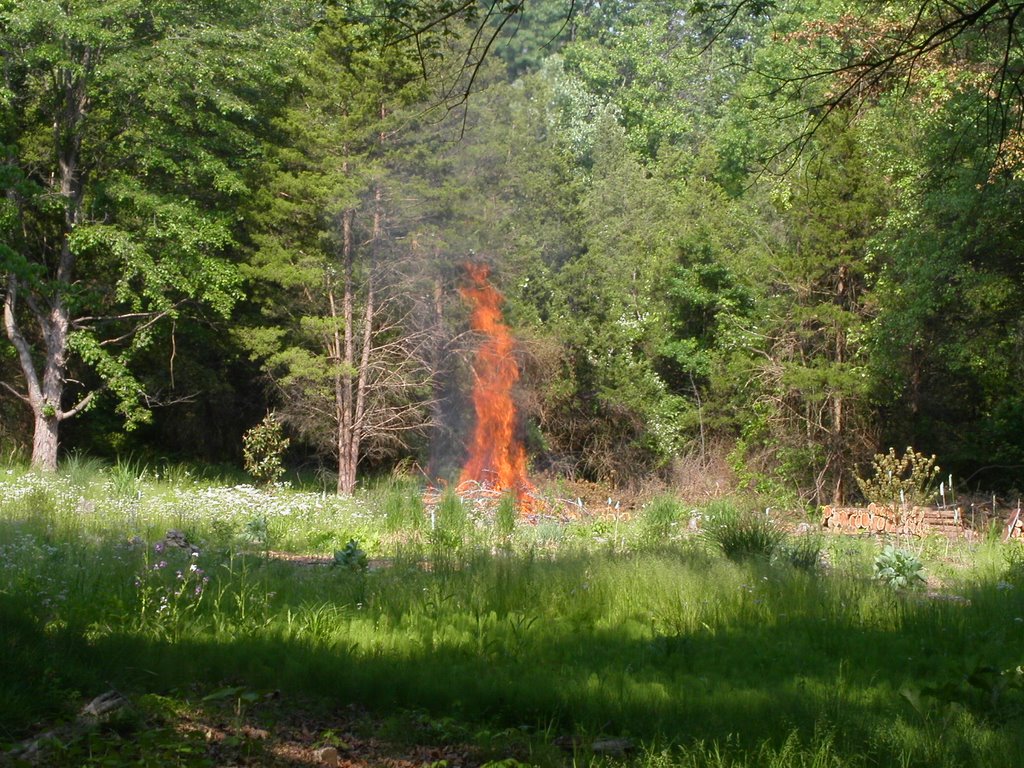
Speaking of solving the problems my site presents (see posting below), I have succeeded in opening the space and reclaiming some sky. After felling several more trees this spring, I had them cut into logs and stacked to make a naturalistic wall. But a huge amount of debris, mostly branches, was left. Here is one of the burns needed to finish the job.
Am I giving up?
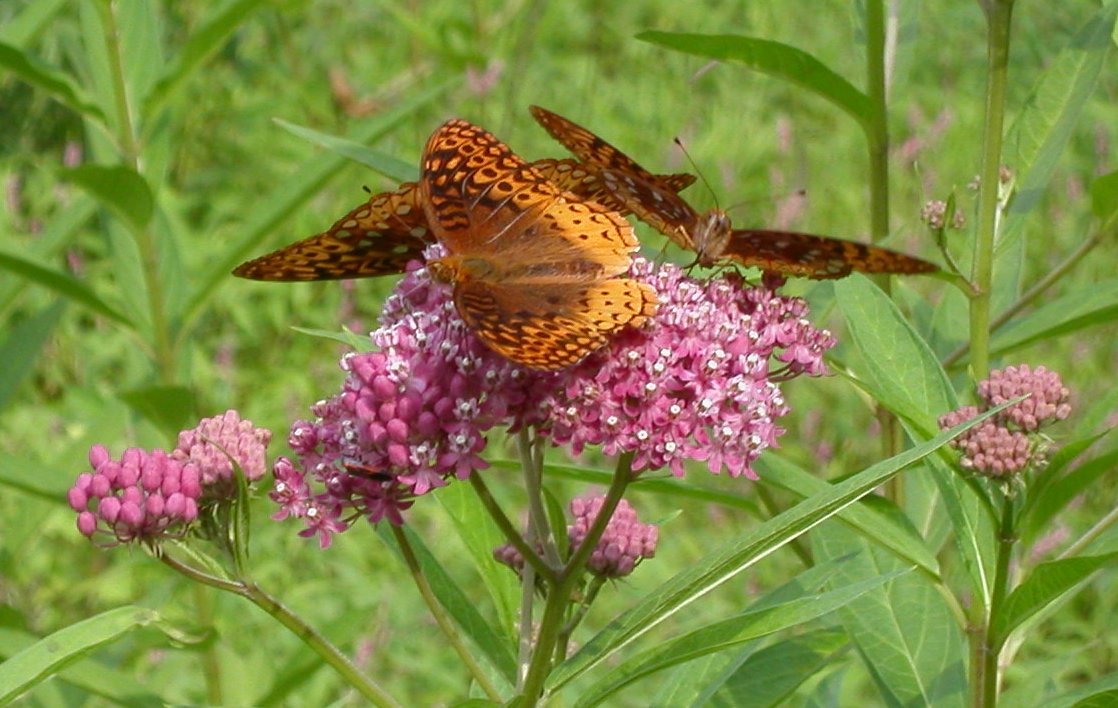
When I started making a garden on Federal Twist Road I understood the limits of the site: wet, heavy clay, thick juniper cover, no view, no space, no sky. And deer.
I'm working through these constraints and, I'm sure, if I continued to search out and test deer-proof plants I could eventually develop a satisfying garden. Ornamental grasses are safe. And 18 months of experience tells me two plants - Asclepias incarnata and Rudbeckia maxima - are keepers. I think Verbena hastata and Pycnanthemum muticum will pass the test. But almost everything else I have tried - including several new willows - have been damaged to various degrees.
I'm ready to give up on living with the deer. I want to grow plants deer eat, and I finally realize the compromises are too dear (sorry!).
I've discussed a deer exclusion with Phil, and he agrees. We probably need over 1,000 linear feet of fencing, and it must be as unobtrusive as possible. And affordable. Now to get some estimates.
Monday, June 26, 2006
Beneath the sea surface
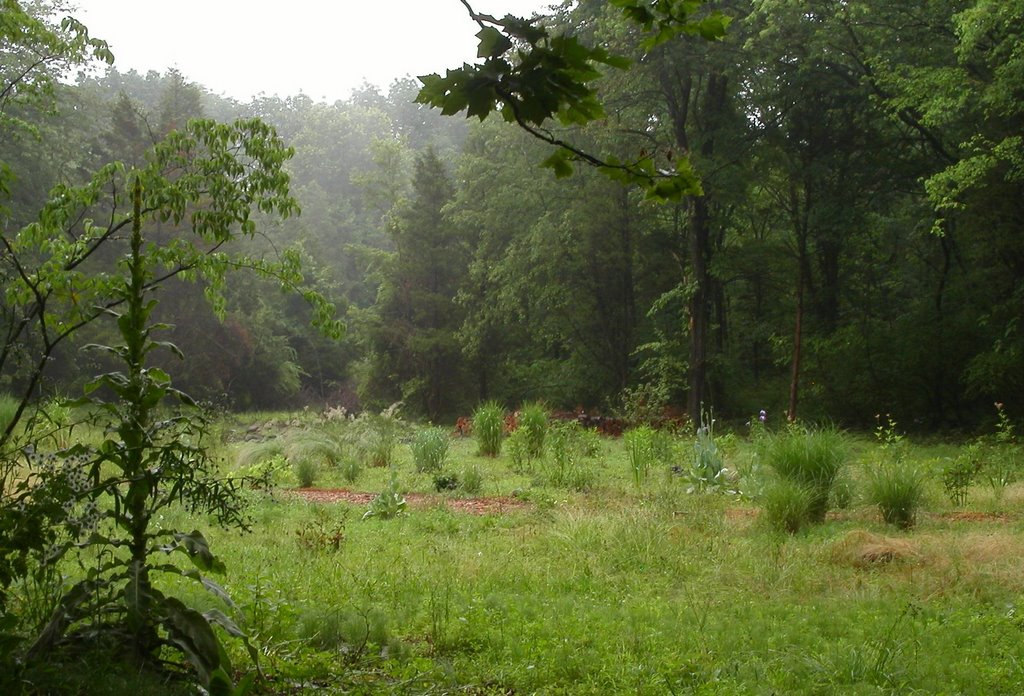
The house is built on an earthen mound, so I see the garden from a height of about 15 feet. At dusk, and in fog, when partially obscured, the garden appears to be under water, perhaps recalling a sea floor of exotic plants and stationary creatures like sea anemones (miscanthus shapes, panicums), odd, almost monstrous forms of Rudbeckia maxima (flower spires emerging from some fantasy castle, or misshapen sea creatures in glaucous greens), sharp water irises. This is an intriguing metaphor to make the best of a difficult situation.
What grows, and survives the deer, suggests a grass and willow garden might be the answer. Many Miscanthus gracillimus - because they grow extremely well in these wet conditions and their manicured, weeping shapes contrast well with the dark woodland background, setting the open space apart, Miscanthus 'Silberfeder' for a bit more wildness and informality, probably Miscanthus Adagio and Yaku Jima for variety of size and complementary form. Small willows, not large trees ... to vary shape, texture, and color - Salix sachalinensis 'Sekka', Salix purpurea, Salix elaeagnos. But more than just miscanthus and salix, also other suitable survivors like the Rudbeckia maxima, Asclepias incarnata, Magnolia grandifolia, Magnolia virginiana. And I will continue to try other perennials whose deer survival story hasn't yet been told ... Eupatorium purpureum (and its cousins), Verbena hastata, Petasites japonicus. Other grasses, too - Panicum 'Dallas Blues', Shenandoah, Heavy Metal, Cloud Nine. Near the back, a mixed planting of Miscanthus 'Silberfeder' as background to petasites and Pycnanthemum muticum (stolen wholesale from Oehme and Van Sweden via Michael King's new book, Perennial Garden Design) - will it work where I want to try it?
Time will tell.
Friday, June 09, 2006
Plant Stewardship Index
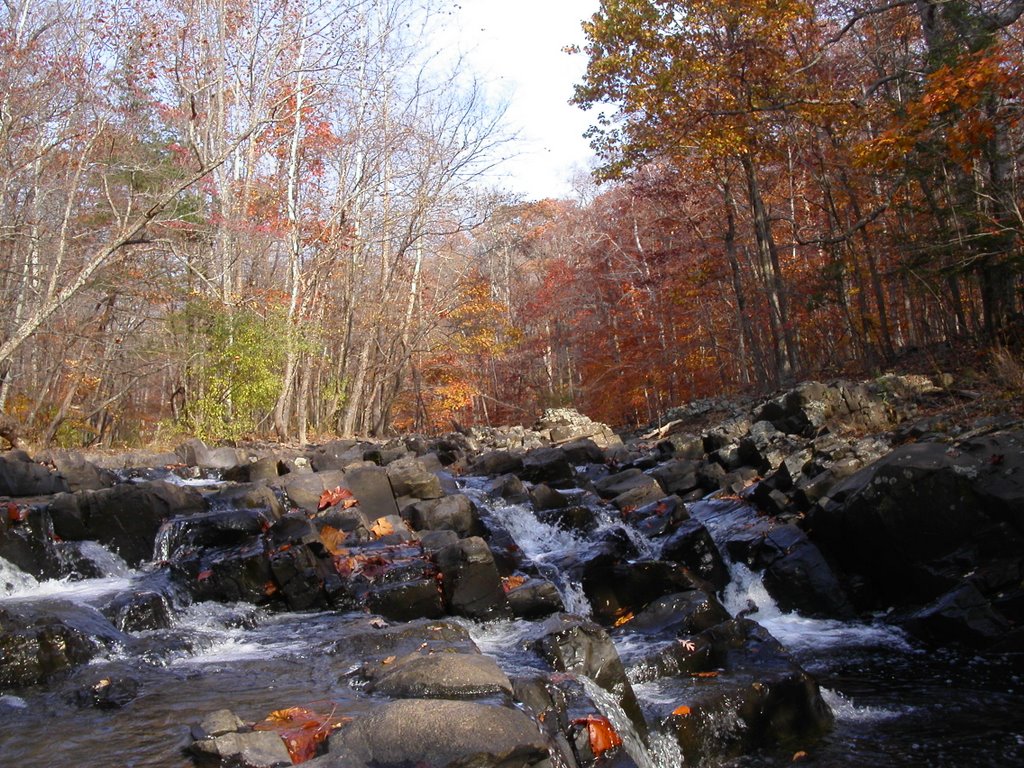 Lokatong Creek
We went to the annual Native Plants in the Landscape conference at Millersville University last week. I attended two presentations on the Plant Stewardship Index.
The name makes you want to run for your garden spade? Don't.
Though I do not limit my plant selections exclusively to natives, I understand the value of preserving local, native plant genotypes, fighting invasive alien species, and saving natural lands from development. We have two exquisite watersheds in our little part of New Jersey - the Wickecheoke and the Lokatong. Both drain somewhere around 25 square miles, and share a rocky, picturesque plunge over their last few miles into the Delaware. These two watersheds, and the surrounding lands - particularly the sublime Rosemont Valley - need to be preserved.
Several local governments and nonprofit organizations are having success preserving farms and natural lands. But as more and more land is preserved, and development forces exert pressure to take the land for their own benefit (profit), it will become increasingly necessary to be able to show the value of preserving land, and to clearly demonstrate that preservation measures are improving the value of these lands.
Thus, the Plant Stewardship Index. This is a scientific tool that can be used to evaluate the value of natural lands, and to measure the efficacy of management measures used to improve the quality of these preserved lands. The PSI provides an index, a number, that indicates the quality of native habitat by measuring the numbers of plant species present.
It is a highly localized tool because its foundation is a list of plants that grow in a specific area, both native and non-native, each with a number assigned between zero and 10. Plants that are native, and that indicate a high quality habitat by their simple presence, have higher values. Such a list - consisting of over 4,000 plants - exists for New Jersey. It was developed by professional botanists meeting and coming to consensus on each plant's value as an indicator of high quality habitat. A similar list for Pennsylvania will soon be available.
A mathematical formula is used to calculate the PSI. It looks a little foreboding because it incorporates a statistical technique to assure more accurate results, but it's quite simple. Of course, calculating a PSI requires you to perform a survey of the land, and to be able to identify the majority of plant species living there. You don't have to actually count the numbers of individual plants in each species, just the presence of a species.
Bowman's Hill Wildflower Preserve (BHWP), just south of New Hope, Pennsylvania, has taken on the challenge of introducing the PSI to our area. This is a major undertaking for such an organization, and they deserve support. Many governmental and academic organizations have declined take on introduction of the PSI in New Jersey and Pennsylvania, so BHWP is doing a really good thing. They will soon make available on their web page all the information needed to calculate the PSI for a given piece of land. I understand this tool will be available to the general public. BHWP will also give a series of classes in use of the PSI and identification of native plant species. I intend to participate.
Here is the BHWP web address. Keep a watch for the PSI tool to appear in the very near future.
Bowman's Hill Wildflower Preserve
Sunday, May 28, 2006
The Matrix

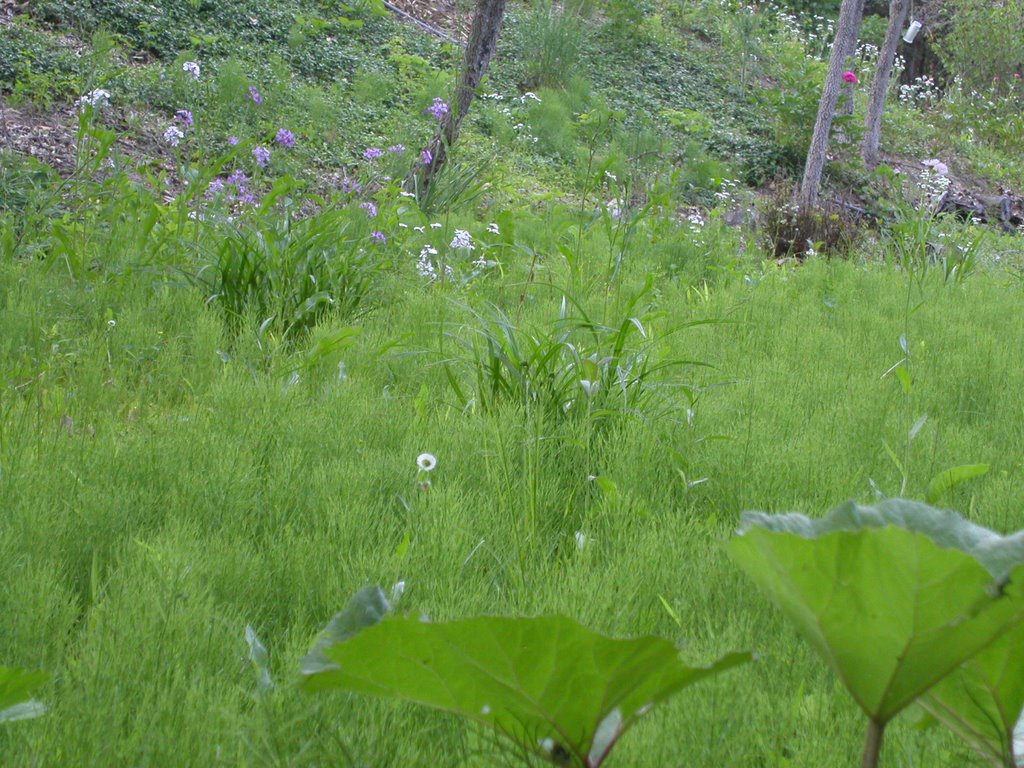
I'm planting in a matrix of native plants. Since I've cut trees to allow more light, I'm finding all sorts of changes in the "legacy" plants at Federal Twist. This week, I discovered Blue Eyed Grass for the first time since we moved here. I suppose it's emerged because of the brighter conditions. But the Blue Eyed Grass is only an incidental pleasure. The major components of the natural matrix are, at present, fleabane (Erigeron philadelphicus), a large, isolated colony of Equisetum arvense in a very wet area, numerous Carex and Scirpus species, and early season grasses I haven't yet identified. The matrix of equisetum is thriving and now forms an attractive blanket of soft texture that contrasts with the bulky form of Petasites japonicus and the sword-like spires of assorted irises that like the damp conditions.
I feel compelled to say a few words in defense of the fleabane. It's not the prettiest flower in the world, but in mass, it lights up the grasses and creates a lot of visual interest from a distance. I'm interested in using short-lived ruderals like fleabane to help prevent seeding of more pernicious weeds. I'm even hoping to displace some of the poison ivy and multiflora rose that keep so many visitors from walking in the garden. Over time, I expect the fleabane to gradually disappear as intentionally introduced plants become established and take up more garden space.
Placed amid the matrix of native grasses, carex, and sedges, plants with strong, easily "read" structure help give the emerging garden a recognizable intent and sense of order. Last year's planting was mainly experimental. Though I've researched plant selections, I really won't know what can grow here, in unimproved conditions, and what can survive deer browsing, without experimenting. One plant that came through the winter with flying colors is Rudbeckia maxima. The large, prominent, glaucous leaves are the main attraction. Planted in groups, and scattered in apparent random patterns, the rudbeckia will provide a strong visual interest throughout the year. The flowers, on tall spires, add vertical contrast, and with their long-lasting seed heads, remain attractive long into winter.
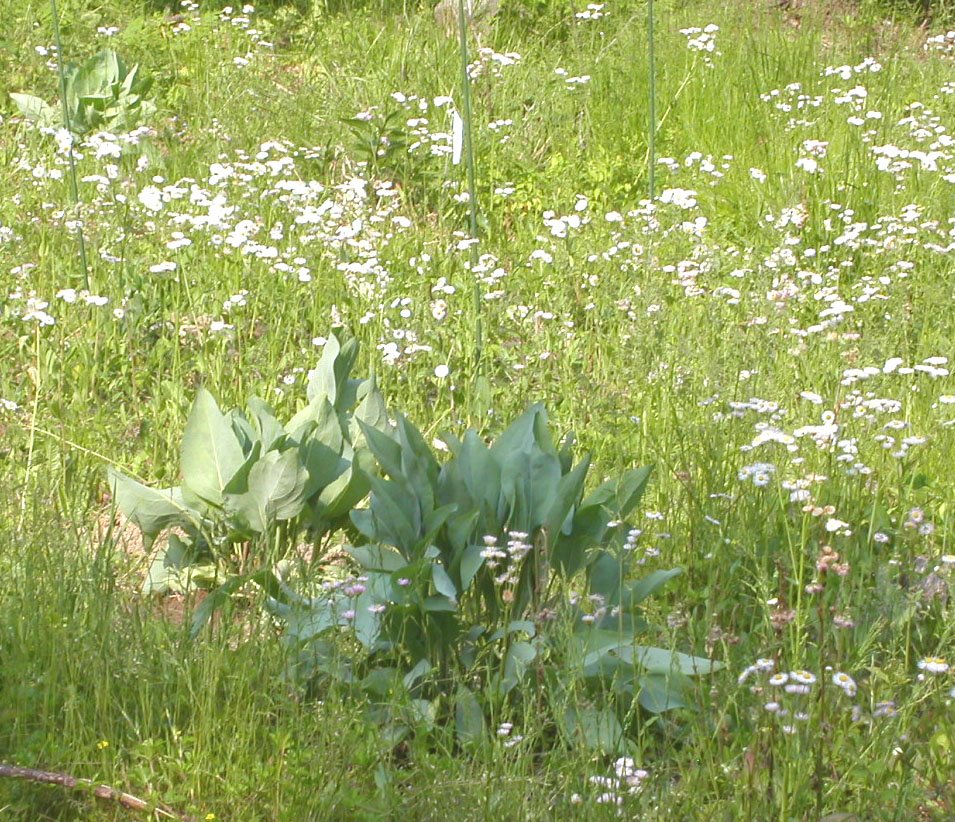
I ordered a flat of Silphium terebinthinaceum, which should thrive in my conditions. About half of them are growing. Their mature foliage, which is low but very large, should complement the rudbeckias, and their later bloom should add another feature later in the season. Do deer like to eat silphium? I'll let you know.
The verdict is still out on various Joe Pye Weeds, which I love. The emerging shoots have suffered some nibbles. Since this plant isn't a favorite of deer, I'm hoping the browsing damage is a result of the deer "taste testing," and the majority of plants will reach maturity and flower. Several Eupatorium cannabinum seem to be growing well with no damage so far.
The ornamental grasses, of course, are deer proof. More on that later.
Tuesday, May 23, 2006
Imagining the landscape
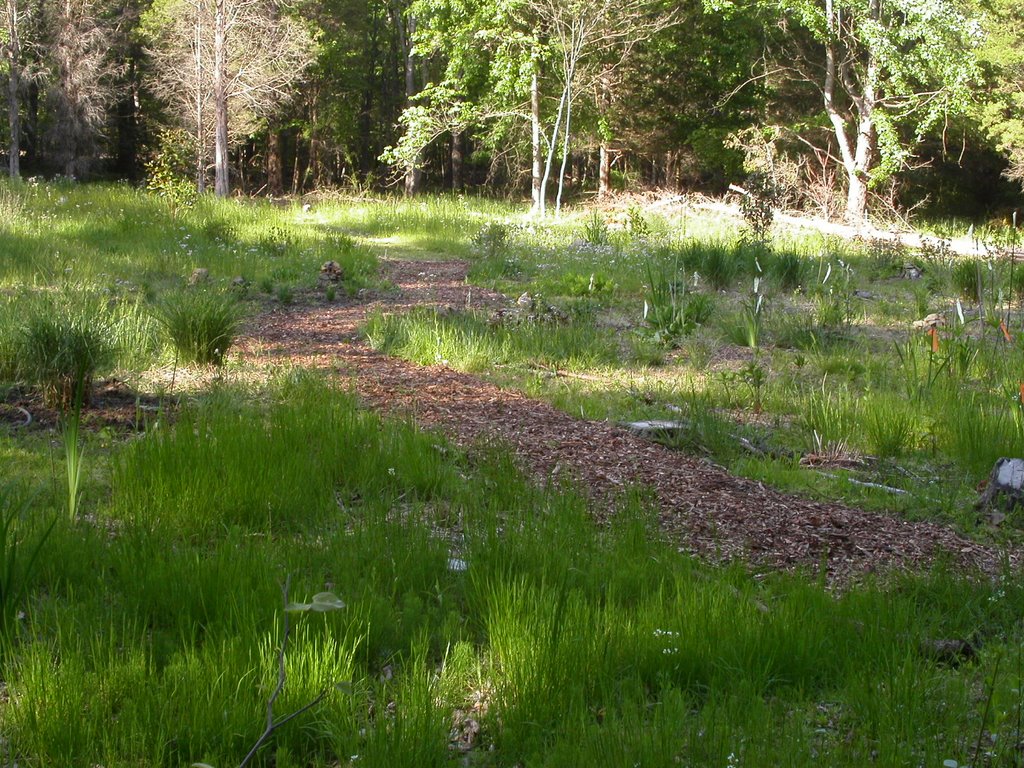
The future garden is a flat, rather featureless space, especially viewed from the house, which is situated on a raised mound about 15 feet above the surrounding land. Now that we're opening up the space - and the view - by taking down trees, the flatness of the land is more evident, even though there is a gentle, barely perceptible slope, moving away from the house, toward Lokatong Creek at the bottom of the hill.
I'd already been aware of the need to divide the space with screening (small trees, shrubs, large perennials) and to create spatial diversity, interest, and a sense of scale. Last weekend, we started laying out the secondary path of cedar chips through the middle of the space. (The main path will circle around from one end of the house, to the back of the garden, then back to the opposite end of the house. It will be twice as wide as the secondary path, at about seven feet.)
We got the cedar chips about half way across the field, then I cut the rest of the path with a string trimmer. Even in this unfinished state, the secondary path has reorganized my perception of the space, making clear where various plant communities, shapes, and forms might be used to make the new garden. Like a line on a blank canvas, the path suggests its own landscape, drawing the eye to previously unseen features, small surface undulations, rocks, native rushes, carexes, and equisetum.
Barely visible yet, a garden is coming into view.
Subscribe to:
Posts (Atom)
LinkWithin
