Pages

Showing posts with label Lysimachia ciliata. Show all posts

Tuesday, June 29, 2010

Extensive gardening: making the best of necessity

Gardening a large area of over an acre, only on weekends, and on unpropitious heavy wet clay, allows no time for intensive gardening, for achieving perfect edgings, astonishingly designed set pieces, carefully manicured, intensively maintained lawns and perennial borders. My gardening is of the extensive kind, much more like farming, and the limited time I have available, what with the exigencies of variable weather, often means moving from one problem to the next, and learning to live with some roughness around the edges. Who said naturalistic gardening is not labor intensive? Here are some photos showing what's happened in the past week, along with visible signs of necessary extensive maintenance.


Never having attended to planting at the top of the stone wall, I needed to kill bindweed and poison ivy that had become entwined with the existing plants. No getting around general destruction. Roundup (used very judiciously, in targeted areas, shown below) killed all growth at the edge, though I did manage to save one large Sanguisorba tenuifolia. Now to wait and see if it killed the roots of these two pestilential plants.


Selective cutting of the meadow grasses has begun (below). I do this after the wildflowers have gone to seed, and to reduce competition with preferred grasses and perennials--panicums, Filipendula ulmaria, Japanese and Siberian irises, Silphium perfoliatum. When time permits and materials are available, I want to add a small, one-person path wandering through this area, giving access to the pond side off to the left, and keeping the feet above the ever present wet from fall through early summer. Here is another example of extensive maintenance: the cuttings are left on the ground, to decompose in place, and over time, to increase the organic content of my mostly mineral clay. No time for nasty neat.


View across the garden. A 30-foot-long planting of Filipendula rubra 'Venusta' is in bloom on the right; the pink color looks rather faded in the bright afternoon light, but I grow this plant mostly for the sharply angular, almost chartreuse foliage, and for its vigor in my difficult soil. Sanguisorbas, Joe Pye Weed, Iris virginica in the foreground, further back Rudbeckia maxima, Lysimachia ciliata 'Firecracker', more irises. Most of this will be burned in late winter--another labor saving practice, and it's good for the grasses.


Looking across the pond, obscured by plant growth, toward the miscanthus bank, with the strip of intentional devastation caused by glyphosate. In the foreground is Panicum 'Heavy Metal' and 'Cloud Nine', more Silphium perfoliatum, Ligularia Japonica about to bloom at the front. The miscanthus makes a very good, though quite large, ground cover, helping keep undesirable plants under control.


More views of the filipendula, since it's the floral "star" of the moment. I'll like it much better when the pink fades to more subtle copper tones.


We've had increasing heat, without much rain, which is sending these Silphium laciniatum rocketing skyward (these are about eight feet tall now). They must have put on three feet of growth in the past week. These plants always flop when they get too tall. I'm hoping the lack of water will make them strong enough to stand on their own this year. We'll see; thunderstorms are predicted for today.


The silphium with more Rudbeckia maxima and Vernonia fasiculata. The ground surface shows where I've cut a path for walking through the plants (wide enough for one lone person). Yet another project is to add a gravel surface to make the path permanent.


Close-up of the silphium ...


No time for raking gravel back into place after storms or other disasters, thus the borders of rock (native, of course) to keep all in place. Eventually there may be ground covering plants bordering the path, but only as time permits, and only if nature cooperates. I don't mind the grasses.


Another vigorous plant that helps with spotty maintenance. Eupatorium cannibinum, a European eupatorium, seeds itself around, eventually making large masses if left to itself, but easily pulled out if not wanted. It obscures a multitude of sins. Here it's just coming into bloom.


Another useful plant, for the water's edge, that makes a lovely mass of color, shape and texture--Pontadera cordata. It's vigorous enough to outcompete the weeds.


Much of my approach to extensive maintenance, in case you haven't noticed, is to use large, rather highly competitive plants, which just happen to be well suited to my conditions. Here the plants appear to be eating the house.
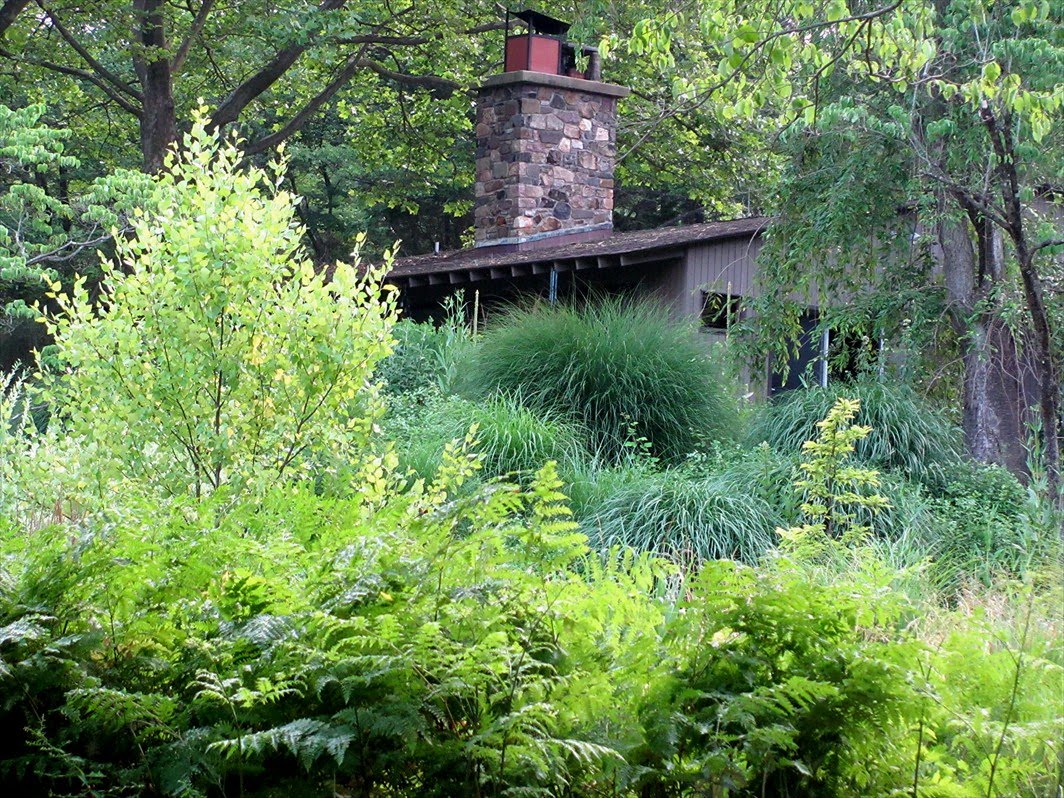
 

Miscanthus, willows, river birch - they cover a lot of ground.


Sunday, July 26, 2009

Morning, July 25

A morning garden walk, nearly August, yet the usual heat and drought of summer hasn't come. The cool, rainy days we've had since spring are warmer now: highs this week will be in the mid-80's and the rain will come as thundershowers, not lingering drizzle. Communities of plants, their time come round, bloom in successive waves, a phenomenon magnified for me because I see it only on weekends. Morning light is still bright, muting colors, but some of the haze and fog so typical of fall is beginning to briefly settle in.

Rudbeckia maxima in full bloom with Physostegia virginiana 'Miss Manners' (Obedient plant) as a low background (below), and Pycnanthemum muticum (Mountain mint) just turning silver behind it ...

Rudbeckia mixing with the tall, heavily budded stalks of Silphium terebinthinaceum (Prairie dock) ...

From the opposite end of the garden, looking toward the area of the photos above ...

A closer view ... bright pink of Filipendula rubra 'Venusta' has faded to a more acceptable copper-pink color ...

The Joe Pye Weed has begun to take on color (right). I'll cut the floppy Lysimachia ciliata 'Firecracker (left) next weekend.

A closer view of the Filipedula flowers as they fade from pink to copper ... the foliage, particularly its angular shape, is an asset to the end of the season.


A distant view from above, the early morning haze presaging season's end ...

Friday, June 05, 2009

Garden Diary: What the rain can do

We're had so much rain this spring - gentle, consistent rain over two or three days at a time - that I'm thinking this must be what an English spring is like. The perennials are larger than usual for this time of year. My garden - a wet prairie - develops slowly, starting as almost a blank slate, progressing through a green rubble phase, then gradually developing distinguishable shapes and colors as the large perennials add height. All the rain has accelerated this process. I'm hoping there won't be a down side to this: floppy plants that will get too tall too fast, then fall over. I don't like staking.

The quality of light that comes with this weather is just about perfect for garden viewing. On these cloudy days, some plants literally glow against the dark background of the woods. Filipendula rubra 'Venusta' is especially beautiful with its jagged leaves like shards of bright green that catch what little light there is, working some internal refractory magic, and transmitting it to the eye as a strange chartreuse ... almost radioactive, with the glow of Vaseline glass, given an unearthly radiance by addition of uranium oxide. You can see the Filipendula above and below with Iris versicolor.

The garden's a study in green possibilities this year. Here the big floppy glaucous leaves of Rudbeckia maxima in the foreground contrast (clash?) with the Filipendula. In a few years, the row of Thuya occidentalis behind will make a dark screen to hold the exuberance of the garden planting.


Iris pseudacoris and Lysimachia ciliata 'Firecracker' below... This image was taken in light rain; note the blue reflecting off the upper surfaces of the Lysimachia foliage. Nestled beside it is a Sanguisorba canadensis, which will take over in late summer when the Lysimachia tends to collapse.

Last year a few Coreopsis grandiflora appeared on a small elevated area the original owners used as a vegetable garden. I leave this uncut to develop as a meadow, cutting it only after the wildflowers have gone to seed. It's working; there are many more Coreopsis this year, and probably other self-seeded rovers to come.

In these two views across from the back of the wet prairie you can just make out the Coreopsis in the far left corner. The large tussock-shaped grasses - mostly Miscanthus - are beginning to add more visual interest and color to the scene. The verticals of Silphium terebinthinaceum and Inula racemosa 'Sonnerspeer' will be visible over the next two months, as will tall Panicum 'Cloud Nine' and 'Dallas Blues'.


Stepping a little further back, a planting of Miscanthus 'Silberfeder', a hybrid Petasites, and Pycnantemum muticum (not yet visible) comes into view. I 'stole' this combination from a photo of an Oehme and Van Sweden design I saw in a book, and I'm very pleased with it so I give them credit. Here, again in the Petasites, is that screaming green of the Filipendula.

Moving around to the opposite end of the garden, the Thuya hedge to be, like the stroke of a pen, contains the wildness. The center area is filled with Filipendula, though the resolution of the photo doesn't clearly show that. Click on the photo to enlarge and you can see it.

In the next view, you can just make out a circle of six red logs (from a fallen walnut tree). This is intended to be a reference, a memorial if you will, in memory of the Lenni Lenape, the native Americans who inhabited this area over the past several thousand years. You can see it better if you enlarge the photo. I wanted this feature to be subtle enough to fade into the background, but I also want it to be visible enough to lead a visitor to ask, "What is this." I have some anecdotal evidence most visitors get the point. The red color also makes a practical focal point.


Next a photo of Angelica archangelica (bought as Angelica gigas; beware labels), which I hope will seed and make a colony. You can also make it out in the photo above.


One final note ... I took these photos in the rain yesterday. Today it's still cloudy but the rain has stopped, and the colors are not nearly as brilliant as yesterday. I've always known gardens look good in the rain. What I didn't realize is that the rain actually changes the quality of light and color

Saturday, November 03, 2007

Garden Diary: Slow Gardening

This garden is slow to take shape. I have to compare photos from 2006 and 2007 to realize the progress. The first photo from late June last year shows a rather desolate area, with the spot where I burned debris from tree felling clearly visible at back.


This year, with a deer fence up, another year's growth, and another long season of planting, the picture is dramatically different.


Closer views show the plant matrix clearly emerging and, for the first time, giving a substantial show of texture and color. (Click on the photo above to see the detail.) The Joe Pye Weed, Rudbeckia maxima, water irises, and Lysimachia ciliata 'Firecracker' have come through two seasons with great tenacity in this difficult environment...


while the monardas (Blaustrumpf and Jacob Cline) and Liatris pycnostachya are new and only next spring will tell how they survive or thrive.


Think of the garden as the bottom of a bowl, with surrounding dark forest - a darkness that seems to "swallow" color. Brightness is needed to stand out against the dark trees, and the monarda do that well, especially the red Jacob Cline.


Even better for contrast against the dark are Rudbeckia maxima, with bright yellow blossoms on 6-foot stalks. And their large glaucous blue leaves are a plus. I added 14 more this fall. If the Silphium terebinthinaceum, planted as plugs 18 months ago, flower next year, they should add to the mid-summer brightness.


The lysimachia 'Firecracker' thrives, and I believe can outcompete the most aggressive weeds (not the rushes!) so I plan to add a substantial new planting next spring.


Here it contrasts with rudbeckia stems in the foreground and various panicums further back. All of this in heavy clay, wet for 10 months out of the year.

LinkWithin

Related Posts with Thumbnails