Pages

Showing posts with label Noel Kingsbury. Show all posts

Wednesday, January 09, 2013

Moving to WordPress


After six years with Blogger, I'm having serious technical problems and I'm no techie. Perhaps Blogger bogs down after several years of use?

I've decided to move View from Federal Twist to WordPress.

I'll provide a new address within the next few weeks. Meanwhile, posts will continue here, and the old blog will remain accessible.

Now for some diversion:

Anecdote of the Jar

I placed a jar in Tennessee,
And round it was, upon a hill.
It made the slovenly wilderness
Surround that hill.

The wilderness rose up to it,
And sprawled around, no longer wild.
The jar was round upon the ground
And tall and of a port in air. 

It took dominion every where.
The jar was gray and bare.
It did not give of bird or bush,
Like nothing else in Tennessee.

  - Wallace Stevens

From Wikipedia:  'This famous, much-anthologized poem succinctly accommodates a remarkable number of different and plausible interpretations ... Helen Vendler ... asserts that the poem is incomprehensible except as understood as a commentary on Keats's "Ode on a Grecian Urn", alluding to it as a way of discussing the predicament of the American artist, "who cannot feel confidently the possessor, as Keats felt, of the Western cultural tradition." Shall he use language imported from Europe ("of a port in air", "to give of"), or "plain American that cats and dogs can read" (as Marianne Moore put it), like "The jar was round upon the ground"? [He vows] "to stop imitating Keats and seek a native American language that will not take the wild out of the wilderness."'

Has American gardening also been in the same predicament? Should we continue to use models "imported from Europe" (oh, how many times have I read that Americans want English gardens!), or "seek a native American [garden] that will not take the wild out of the wilderness"? 

Noel Kingsbury and many others have noted that many American gardens are surrounded by woodlands, and this is one distinguishing characteristic.

I don't mean to be abstruse (though I'm doing just that) but when I stumbled upon Helen Vendler's comments on this old favorite poem, I was struck by a parallel concern in American gardening.

Saturday, October 27, 2012

Garden visitors


Surprised, I was, a few weeks back to get an email from Noel Kingsbury saying he would be in the Philadelphia area for several days, and would like to drop by.


When we moved to Federal Twist in 2005 and I recognized I'd be gardening in a very difficult place, my hope for the future came from two books by Noel Kingsbury--The New Perennial Garden and Planting Design: Gardens in Time and Space (written with Piet Oudolf). In the first, I learned about naturalistic gardening, in particular about planting into rough grass. In the second, about the three kinds of plants--competitors, stress tolerators, and pioneers or ruderals (more accurately, three primary growth characteristics shared, to various degrees, by different plants) and about prairies--the enormous numbers of plants in a square yard of natural prairie, for example, compared to the much smaller number of plants in a square yard of cultivated garden. My selection of plants was, of course, also affected by his popularization of the Oudolf plant selections.

Noel Kingsbury and me (the one in the cap with his mouth strangely open) accompanied by towers of dried Inula racemosa "Sonnenspeer."

Kingsbury is a scientist, and an extraordinary writer, so rather than oversimplify, I refer you to his books for more details. Needless to say, they were of enourmous value to me making a garden in the woods of western New Jersey.


So I was certainly gratified to have Noel Kingsbury visit last weekend. We had a walk around the garden, then lunch, then a second garden walk. In between, Noel got out his computer and showed me images of the amazing plant communities in Kyrgyzstan, where he visited this past summer.

Checking out the asters.

Just before Noel's visit to Federal Twist, I attended the 29th annual Perennial Plant Conference at Swarthmore, where he was the first presenter of the day. I had read and referenced his books so many times I had little to learn, but I hope others "got" his message--that we need to pay attention to how plants grow in nature to have more successful gardens, that we, in effect, can create artificial ecosystems that make our gardens more self-sufficient and, though not labor-free, certainly lower maintenance. (By the way, the Swarthmore conference is a tremendous conference, and the Swarthmore campus, also known as the Scott Arboretum, is extraordinarily beautiful. I give it the highest recommendation.)

Amphitheater at Swarthmore

I also met a neighbor from nearby Frenchtown at the conference. Well, I didn't know we were neighbors, until I heard a woman behind me mention Frenchtown, and on asking discovered she was Helen Grundman, also a garden designer. Helen and her husband Bill, a forester and organic plant care expert, dropped by for a garden tour mid-afternoon.

The conference was full of surprises. During a break, while I was looking at a dried plant arrangement on the stage, a guy approached me saying, "James?" It was Michael Gordon, a cyber friend who I've been in touch with for several years via the blogosphere but had never met. Michael, from Peterborough, New Hampshire, has a blog called The Gardener's Eye. An optometrist by profession, Michael is also an accomplished garden designer; he designed all the public gardens in Peterborough, as well as his own very polished garden. Michael was traveling with his friend and well known garden writer Tovah Martin, and with garden designer Maude Odgers, also from Peterborough. So several hours after Noel left, Michael, Tovah, and Maude arrived to see the garden in a beautiful just-before-twilight light. It was almost dark when we got back into the house and had coffee, drinks, and cookies, and a warm, pleasant conversation before they left for the long drive back to Connecticut and New Hampshire.

So my unusual day of garden visiting leads me to two conclusions:  (1) I think I should attend more good garden conferences (and meet more people of a like disposition) and (2) I should have more garden visitors, preferably from midsummer to fall, just before sunset.

Is the Garden Conservancy listening?

*Photos of Kingsbury and me were taken by Phillip Saperia. Unfortunately we forgot to take pictures of our other delightful visitors.

Wednesday, January 11, 2012

Garden Diary: Down on River Road

Hey! Look at this... yet another post on my city garden to be. I'll try to remember to label these "Garden Diary" so potential readers will know obsessive navel gazing continues in this quarter.

I caught sight of this clearly man-made planting driving by on the river road a couple of weeks back--a grove of sycamores underplanted with boxwoods.


Another thought for the city garden. But instead, I'd have a small grove of Sunburst Honey Locust (Gleditsia triacanthos 'Sunburst') underplanted with box. With one important addition ... spots of randomized perennial planting worked into the box matrix. The surface might be gravel, or gravel with stone.

Not exactly copied "from nature" since this is a utilitarian planting in a nursery, but one example of the place of chance and contingency in garden making.
I'm recalling Dan Pearson describing the planting technique he developed for the newly landscaped area in the enormous Millennium Forest project on Hokkaido in Japan. On a Gardens Illustrated podcast, he described the development of "modular" planting groups that were used to cover a large area of newly created garden, filling the space between the public entrance facilities and the more distant forest.

The hosts of the discussion, Tim Richardson and Noel Kingsbury, had brought up the idea of random planting, which is having a great surge of interest among gardeners in central Europe, and they asked the panel of Dan Pearson, Cleve West, and  Andy Sturgeon what they thought about this concept, and were they using it in their work.

The following is my attempt to transcribe spoken dialogue and it tends to ramble a bit, but I think you get the point. Describing the making of a meadow of cultivated plants that took inspiration from regenerating woodland floor at the Millennium Forest, Dan said, "We made about 18 zones, which were large drifts ... that may have only had 5 or 6 plants ... and then I worked out what I thought [would work] ... a guess, because I didn't know what this climate was going to do with this plant combination I was putting together ... I'd choose maybe one emergent plant that would be very tall and fine ... and one plant that would be a groundcover, something for early in the season, something for late ... I came up with this system whereby the plants were put together in this very random arrangement that was an absolutely fascinating exercise ..."

The important point is the use of random planting combinations, and having the willingness and knowledge to follow the changes in the plantings as they thrive or not in their various microclimates. Here are some images of the Millennium Forest project on the Dan Pearson Studio web site.

So this concept I'm thinking about for my new city garden is very much not about the crude, ugly  layout I will show below, but about a process whose outcome is uncertain, and demands continual engagement and willingness to commit to working with what comes. (Does this really differ from any other kind of gardening, I ask myself. Not really.) I realize the process Dan Pearson describes is taking place on an extremely large scale, not in a small garden, but I'd like to think about how random planting might work in the smaller context.

I suppose it's best to define what is meant by "random" in the context of a small garden. In this case, not a totally random distribution of plants, but a selection of plants "right" for the conditions and then a kind of ad-libbing, grouping and positioning plants without a preconceived planting plan in mind, working in the moment. This is more easily said than done, but an interesting way of engaging with the garden design process.

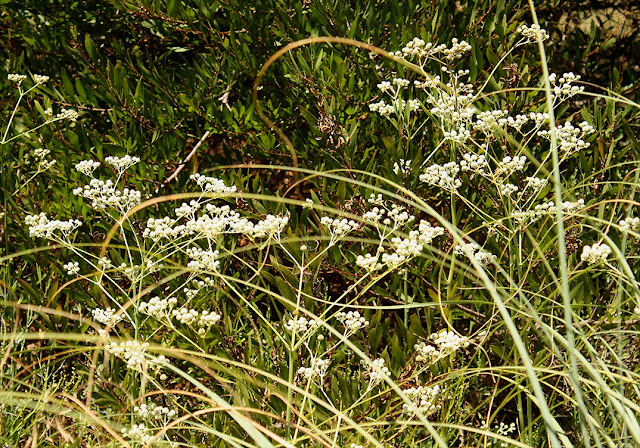
My intent would be to use a limited pallet of durable, long-season plants grouped with box balls to create a unified visual effect. For a start, the list might include tough plants I've had success with in the past--Bergenia, Helleborus foetidus, Epimedium, various Carex and ferns, even an occasional tall plant--Thalictrum, Angelica gigas, Inula sonnenspeer, Sanguisorba tenuifolia alba--if I could work them in.


I'm no graphic artist or draftsman, and I'm limited by my use of Excel as garden drawing software, but here is a crude representation of the concept I'm talking about. The groupings and distribution are not intended in any way to represent a final design. Only to suggest a concept.


Two or three small chairs, Bertoia chairs as one example, might be moved around the garden as wanted, so the gardener and visitors can sit in private, where neighbors can't see through the tree canopy. The chairs would need to function as sculpture.


Vines and groundcover plants, plants I probably haven't even yet imagined, might go into the narrow strips along the fence lines.

Though this is in no way a garden "design," I find it an interesting concept to contemplate during the coming cold months. I'm thinking this would involve continuous change to more or less degree, room for lots of trial and error, or simply change or not, as desired. Not so much a garden concept perhaps as a way of living.

And of course all this could be brought to a full stop and fixed to some degree, whenever necessary or desired.

Tuesday, October 18, 2011

Talking Gardens

Tim Richardson and Noel Kingsbury lead a talk with Dan Pearson, Cleve West, and Andy Sturgeon on the latest Gardens Illustrated podcast. This is GI's annual lecture held at the end of last spring's Chelsea Flower Show (where Cleve West's garden won Best in Show).

I find this discussion fascinating because I've become quite comfortable "translating" the British garden world into the world I know here in America. The conversation ranges from the application of the New Perennials style to small gardens (and whether that can even work ... Dan Pearson makes a case for it), how availability of plants has changed (the selection of shrubs is much more limited and they are harder to find; perennials are far more available), to Cleve West's interest in the so-called Sheffield School of gardening (scientifically selected seed mixes for randomized planting), and Dan Pearson's clear description of the benefits of layered planting (an imitation of natural layering of plants ... starting with trees and shrubs, down to the understory of sun loving and shade tolerant perennials).

We have little offering this richness of subject matter and intellectual stimulation available on our side of the Atlantic. Perhaps, because our country is so large and diverse, it's just not possible for such ideas to make it into the American media, which isn't friendly to garden-related subjects, except in "life style" or "how to" formats. Listen and see what you think.

Sunday, March 20, 2011

Amalia Robredo: New Directions in South America

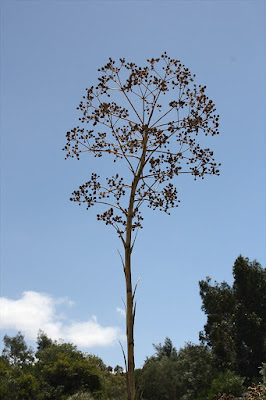
Delicate and graceful Eryngium elegans, one of the many Eryngiums native to La Pasionaria, Amalia Robredo's naturalistic landscape garden on the coast of Uruguay.

Recently reading Tovah Martin’s article on New York’s High Line in Horticulture magazine, I did a double take when I read this: “Some may argue that it’s too wild and free to be a real garden...” I don’t know why I continue to be surprised when reminded how ubiquitous is this conventional view of gardens. I don't think Tovah Martin intended to say the High Line is not a garden—in fact, I'm sure she meant the opposite—but she did give voice to an opinion among the general public that is much too common—and wrong to my mind.

View across a prairie of Cortaderia selloana to the monte and house crowning the hill.

Last fall, when a visiting friend commented that my garden wasn’t really a garden, that it was, in fact, too wild and naturalistic to be a garden, I was surprised enough to write a post on often overly conventional, and complacent, expectations of gardens. I felt a bond with a kindred spirit when Amalia Robredo, a landscape and garden designer (paisajista) in Uruguay, told me about her reaction to the post. “I couldn’t stop laughing,” she wrote, “as I felt so much the same! It happens to me ALL the time.”

So this conventional view of gardens appears to be multicultural, to say the least!

Built of local stone, the house rises from the monte of native trees, shrubs and other successional vegetation, suggesting stone fortresses that lined the coast in early colonial times.

Amalia Robredo’s Garden: La Pasionaria

All of this is preface to the story of my recent visit to Amalia Robredo’s landscape garden, La Pasionaria, in Uruguay, a large, 5 hectare—more than 12 acre—garden of prairies, meadows, and native dwarf shrub and small-tree woodland called the "Monte." The monte is a signature feature of the landscape in this part of Uruguay and, though now protected by law, it continues to be endangered by farming, commercial development, and simple ignorance of its important ecological functions.

As Amalia explains it, the monte is an association of trees and shrubs that has evolved over hundreds of years. In the sandy soil of the Uruguayan coast, grasses first take root, protecting the soil from erosion and gradually building up organic matter. As the soil becomes more fertile, new pioneer plants take root, these are replaced in turn by new generations of plants as soil conditions improve, gradually leading to formation of the monte, the climax stage of vegetation in this coastal area.

Amalia's garden sets the standard for preservation of the monte, and it demonstrates a highly successful, relatively easily maintained, and beautiful solution to preserving this aspect of the area's culture and ecological heritage.

This is highly naturalistic garden, unlike the more traditional gardens ("yards") most North Americans expect, and I know from personal experience that some if not many U.S. gardeners may well question whether this garden—or the High Line, or my own garden, for that matter—is a “real” garden. I raise this point here simply because Amalia says she hears the same comment "all the time." In both cases, in North America and in South America, the comment is heard from those who come from cultures that value other kinds of gardens (small gardens, formal gardens, gardens with lawns and flower borders, gardens with fountains and elaborate ornamentation, you make your own list...), or from those who are simply not aware of the variety the word "garden" can encompass.

In early February, I traveled with my partner Phil and several friends to Argentina and Uruguay. I had read about Amalia and her work in Uruguay on Noel Kingsbury’s blog over two years ago when traveling with friends to Argentina on a previous visit. At that time, I hadn’t been able to find any information on gardens there, so I sent an email to Amalia—a shot in the dark, just to see if she would help me. I was amazed to get not just an answer, but to receive a generous offer to help in any way. So Amalia acted as a kind of “cyber tour guide,” answering my questions, and suggesting areas I might want to visit.

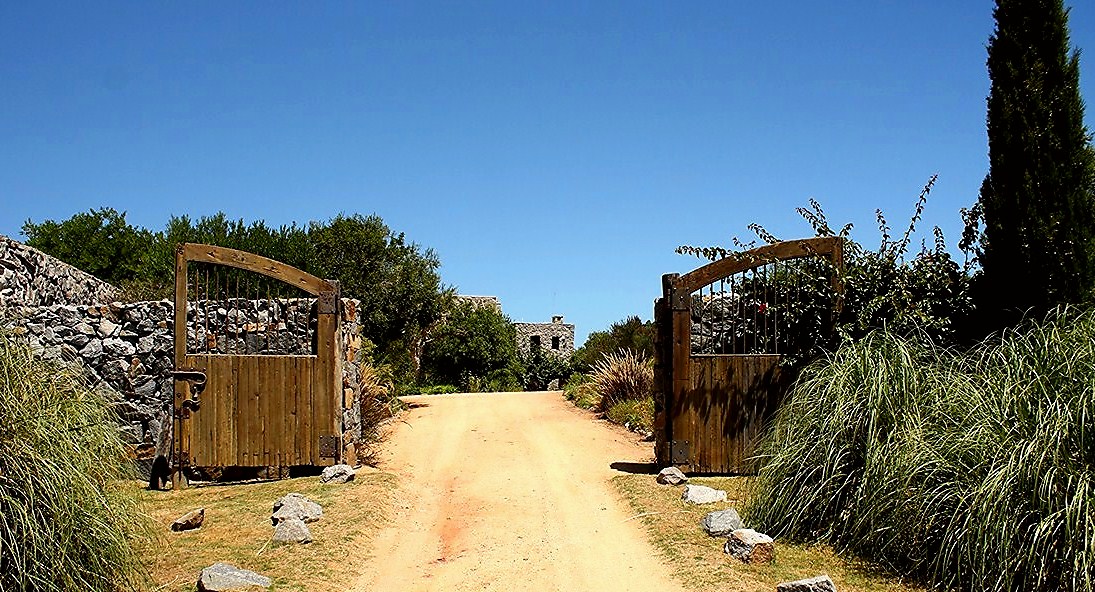
The entrance is designed as a traditional, culturally appropriate structure that might be found on a
rural estancia. There is whole-hearted welcome, but no room for grandeur or ostentation here.

An Invitation to Visit Uruguay

Last summer, Amalia and I had been in touch for over two years when I mentioned to her that the same group of friends and I were planning a return trip to Argentina. She encouraged us to visit her part of Uruguay (close to Buenos Aires), near the small, and now very trendy village of Jose Ignacio. She remained undaunted when I told her we would be seven. She promised a time not to be forgotten, and she certainly delivered in spades, with long visit to her house and garden, a walking tour, introductions to her children and her husband, and an al fresco lunch in the garden for eight, in the shade of the monte surrounding her house.

Lunch in the shade and coolness of the monte.
She had much to show us, other gardens and extraordinary landscapes, among then a garden designed by the Chilean designer Juan Grimm, a beach covered by thousands of geophytes in bloom, and two striking landscapes associated with her uncle (more about these at another time).

Amalia named her garden La Pasionaria, for the Passion flower, a plant native to the area, and passion is an appropriate word for her depth of feeling for this landscape, its history, culture, and its botanical heritage. With her work, Amalia is breaking new ground in South America, where there has been little interest in naturalistic gardening using native plants. Most public gardens, and many private ones, are still heavily influenced by the 19th century Beaux Arts public gardens and traditions inherited from Europe—with, of course, some major exceptions; Roberto Burle Marx in Brazil, for example. There is a nascent movement, but this kind of garden isn't widely appreciated, or understood.

Only a few minutes into a walking tour of the garden, Amalia and I were excitedly speaking in botanical Latin, much to the consternation of my traveling companions. Amalia had sent me information in advance—references, photos, PowerPoint presentations—so I was already familiar with some of the plants native to her area of Uruguay, and was able to recognize many plants—Colletia paradoxa, Eryngium pandanafolium, Eryngium  eburneum, Eryngium sanguisorba, even some genera familiar to a visitor from the northern hemisphere such as vernonia and eupatorium. But there were quite a few new “mystery” plants to be seen.

Colletia paradoxa is a pioneer plant, part of the plant succession that prepares the way for development of the monte. Even though we visited at the end of a summer of drought, an amazing variety of native plant life was evident.

I describe this background because Amalia’s hospitality and generosity were very much a part of our experience of the garden. That passion extends far beyond just her garden. Amalia is working with others throughout the academic and nursery community in Uruguay as well as other South American countries to identify native plants with potential for garden use, to trial promising cultivars, and to help move them into commercial production. In Uruguay there is no tradition of using native plants in gardens, in fact, no established recognition of native plants as having value in a garden. Many haven't even been identified. Noel Kingsbury has been helpful, and has introduced her to others, including Piet Oudolf in the Netherlands and Cassian Schmidt of Hermannshof in Germany, who also have an intense interest in finding new, garden worthy plants, and putting them to use in sustainable, low maintenance gardens. Here, Amalia is breaking new ground. She has even sent seed of grasses to Neil Lucas in England for trialing at Knoll Gardens.

Andropogon lindmanii, a native grass, in bloom.

Theoretical, Cultural and Aesthetic Concerns

To better understand why this garden is an important one, it might be helpful to look more closely at some of its spatial, horticultural, ecological, cultural and aesthetic attributes. Amalia's is a garden of contrasts, of light and shade, wind and stillness, wide views across to the ocean and intimate spaces near the house, of rounded, dome-like shapes—of the monte and rounded masses of various Baccharis species—contrasting with the verticals of Cereus uruguayensis, the spear-like flower spikes of Cortaderia selloana, and tall Eryngium pandanafolium (some of these plants aren't likely to be familiar to you, but there are photos below).

The verticals of Cereus uruguayensis contrast with the rounded forms of the monte.

Another powerful vertical, Eryngium pandanafolium, the largest of
several highly decorative eryngiums native to this part of Uruguay.
It can grow to eight or ten feet.

Eryngium eburneum, another native eryngium.

This is a landscape garden. It uses space, openness to the surrounding environment, lack of boundaries, undulating topography, easily differentiated landscape features (areas of trees and shrubs, meadows, water) to suggest a narrative of a idealized farm anchored in a particular place and a particular culture—and to suggest a journey, one that pulls you inward to increasing levels of detail.

View to the ocean from the edge of the monte.

Across the lake.
As shown on the drawing below, you enter opposite the house, and travel along a road winding in a long curve around the periphery of the property ...

... a drive (or walk) that provides constantly changing views of  the landscape—intermittently revealing then hiding the lake and its wetland plantings, a prairie of species Cortaderia selloana adjacent to the road, across the lake a Baccharis prairie in the mid distance, behind that a lawn then more prairies and meadows—these are in essence very large garden "rooms"—and in the distance a view of the house, built of local stone, thrusting mysteriously up from the monte. The entrance journey ends as you arrive at the residence opposite the entrance to the property.

The entrance drive provides changing views of the 12 acre garden of prairie, meadow, and monte.
This is a complex landscape, more complex than it first appears, and it could easily have become a formless mass of conflicting elements in less skillful hands. Instead, we see  a design done with elegant restraint, using almost exclusively a palate of plants native to the sandy monte community (Monte psamofilo), relying on historically and culturally appropriate features ...

Reclaimed rusted wrought iron embellished by a
planting of Paspalum quadrifarium and Paspalum plicatulum.
... such as stone walls, antique wooden doors, restrained use of old ornamental ironwork, gravel drives and paths—for the garden's structural elements.

I use the word “elegant” in the way a physicist would describe a theory that accounts for many complex phenomena in the simplest way possible as an elegant theory. Amalia’s elegant and refined composition is successful as much for what she left out as for what she put in. It is a restrained and subtle garden. She has used a very light hand, carefully editing preexisting parts of the landscape. Even where major new features have been created—the house and the whole residential complex, a large lake, massive stone walls and gates separating the residential and utility areas from the wider landscape—they look as if they always existed.

The garden entices the visitor by drawing the eye to nearby plant textures and shapes, then carries the view to the forms, shapes, colors and textures of the distant landscape. This is especially evident in the two images at the top of this post—in the close-up view of Eryngium elegans and the landscape view across to the monte and the house.

Near the end of the entrance drive, a tall stone wall and heavy wooden gates announce your arrival at the house and its immediate precincts ...

The entrance to Courtyard, residence, and utility areas is marked by heavy wooden gates and stone walls that look as if they might be centuries old, but they are new. Such garden structures are simple and culturally appropriate.

... where the garden is realized on a smaller scale, incorporating areas for recreation, pleasure, and utility in an ordered counterpoint of stone, water, light, shade, and ornamental ironwork—all carefully planned but with a relaxed. informal feeling.

The Courtyard
In the Courtyard is an area of domestic garden borders for trialing various native plants in a controlled environment ... below is Pterocaulon balansae, which promises to be an attractive vertical accent plant.

Pterocaulon balansae
  ... and below, my favorite new plant discovery, the graceful, airy Eryngium elegans ...

Eryngium elegans

Eupatorium macrocephalum flowering in the trial border.

 The Courtyard is quite large. Here, in a lighthearted moment that captures something of the spirit of her garden, Amalia is playfully pointing to a grasshopper on a Spartina ciliata ...


... and the grasshopper ...


 The Courtyard also makes room for parking and garages, a stable for horses, a playground for the children, and on the other side of an inner wall, through an ancient door salvaged from a prison in Montevideo,  a "summer kitchen," pool and lounging area, and a dining area—all are efficiently and unobtrusively organized within the shelter of the monte.

An old wagon-mounted carriage at the entrance
to the children's play ground.
Lounging area beside the pool.
Outside the monte is all sun, light, air, distant views of the blue ocean; inside is shade, shelter and privacy. Our walk through the garden took us on a journey through shaded monte, sunny prairie and meadow, elevated prospects with ocean views, sheltered low areas, the lake and wetland plantings, as we moved away from, then back toward the house in a great circle

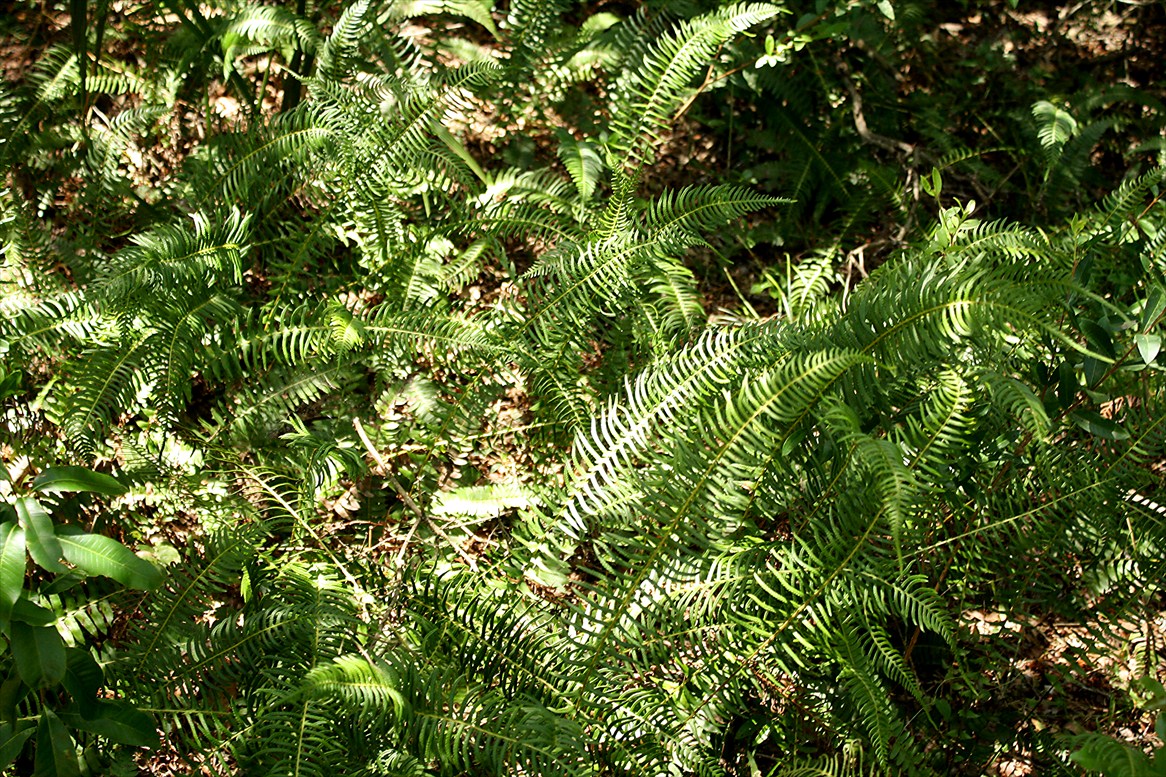
Even the monte has its own unique vegetation adapted to more protected, fertile and shady conditions. Amalia has made paths through the monte so you can walk in seclusion, observing the different plant communities that live in the shade, such as these ferns ...
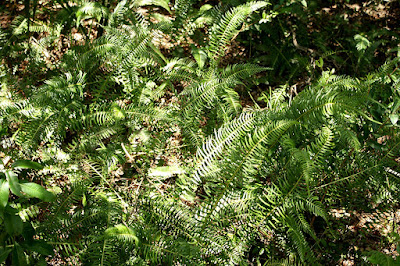
Blechnum australe ssp. auriculatum.

... in other parts of the monte openings to the wider landscape dramatize the contrast between dark and light, shade and bright sun.


At a maximum height of probably less than 20 feet, the monte has an intimate, human scale. You can stroll on shaded paths throughout the Coronillas (Scutia buxifolia) and Canelones (Rapanea laetevirens), the small trees that predominate in the monte, walking at full height, with ample room to move about. Amalia refers to the "green rooms" within the monte as giardinos segretos (secret gardens).


 Other paths reveal the sky while completely hiding the landscape outside the monte.


But a few steps can take you into a different world, the bright sunlit countryside ...


... and a stroll across the lawn, past meadows and prairies. According to Amalia's maintenance regime, a prairie is cut once a year or less, while a meadow is cut more than once a year, the frequency depending on the makeup of the plant community. Well timed cutting is necessary to allow desired grasses and flowering perennials to mature and seed, while preventing less desirable plants from getting out of hand.

The lack of boundaries gives the garden a tremendous feeling of openness and endless space, here enhanced by the downward slope of the terrain as it drops away toward the beach and the sea. The low, dry laid stone wall, called a pirca locally, divides the lawn from the meadows and prairies beyond.


Although it was extremely dry following the summer drought, the prairie still revealed a rich community of plants. Here you see the seed heads of Eryngium sanguisorba amid grasses ...


When I jumped over the pirca to take a closer look, Amalia quickly called me back. It seems snakes frequent the high grasses, so it's safer to keep to the closely cropped lawn when taking a sunlight stroll.

A walk down the gentle slope brings you to the lake and a pathway across the dam ...


Here, a view from the other side of the lake, magically capturing a piece of the blue sky.


Unlike gardens that start with a blank landscape (if there be such a thing; I doubt it), La Pasionaria does not impose a design on the land. The existing landscape, and in particular the monte, takes center stage.

Amalia's approach is one of enhancement and preservation and it is, I think, probably the garden of the future. In a world of increasingly scarce resources, lack of access to labor, financial constraints, water shortages, and environmental degradation, this kind of sustainable garden offers an attractive and viable solution to both resource constraints and preservation of the environment, genetic diversity, botanical heritage, and culture—one that can serve as a model for larger and more encompassing preservation efforts that will be needed—a way of maintaining beauty in an increasingly tarnished world.


(Selected photos courtesy of Amalia Robredo and Phillip Saperia. Drawing courtesy of Amalia Robredo.)

Thursday, November 11, 2010

Garden Diary: October 24 - Coming Home

View of the garden at Federal Twist - just as the sunlight began to break through,
completely changing the mood of the garden

A certain level of disorientation is a good thing in a garden, at least at the start of a visit. A feeling of being a bit lost sets the stage for a new way of seeing, a receptivity to new perceptions, exploration and discovery.

On Sunday, October 24 I got up early enough to see the sun rise; once it was light, I went out to record the progress of autumn in the garden.


The cloud cover muted the colors. The garden appeared to be in a state of stasis. The clock had stopped. The slide toward winter was temporarily suspended, leaving me with an ominous feeling of disappointment, dissatisfaction, a wish for change.


For most of my life I've lived with the illusion that "emotions" are a mental state, all in the head, so to speak. But that's not true. Emotions are a bodily response. They arise in the body, and in a very real sense,  are physically "felt" before the conscious mind names them. This is the old saw about the head and the heart, the conscious and the unconscious.

Before an emotional impulse is named, before a label is applied, one experiences a state of unknowing, of being lost, and the start of a journey toward understanding--a journey that may last a millisecond or a lifetime.


I have difficulty naming emotions, and my own inclination is to seek meaning in metaphor, or in narrative--using images and stories to explore the world of feeling.

Look at the photo of the small pond below: on this dreary morning the reflective surface, largely obscured by dying growth, called to mind an eerie scene out of Edgar Allan Poe--the "dank tarn" in The Fall of the House of Usher--an image that carries associations of abandon, decay, withdrawal of life, a suggestion of some ominous potential.


Although I don't particularly care for the work of Poe, he's a part of my culture and the images and metaphors contained in his stories are ready to hand, so I saw the scenes below with a sense of the "dark and drear" Poe evokes so powerfully. Glistening wet, dark, perhaps even threatening. I was telling myself a story, though the story seemed to be telling itself, arising spontaneously as I simply observed. But I know that wasn't so; I was participating in the process.


Then things changed; the sun broke through the cloud cover (photo below), scattering light into the garden, and my mood lifted, my emotional response changed. All thought of Poe vanished.


Suddenly the garden was full of warm golds, reds, browns, tans, the backlighting dramatically silhouetting the individual plants, and reflective light revealing surface textures and color. I had been lost, musing on images from Poe, then I found what I didn't even know I was looking for. As the sun sparked the garden into life, my response was visceral, a sudden flood of anticipation, an aching tension in the body like a lover's response to the beloved.

This was more than appreciation of a pretty picture, more than painting with plants. The closest I can come to expressing my feelings is to say the change was like coming home.


My garden is clearly of a type, heavily influenced by the so-called New Wave or New Perennials style that grew out of a naturalistic garden movement in Europe, Germany and Holland in particular, and that began to influence gardening in the UK around the mid-1990s. It broke onto the American scene about ten years ago, prominently in books by Piet Oudolf, Noel Kingsbury, Michael King, and Henk Gerritsen, and was already making its mark in the work of our own Oehme and Van Sweden.

This new approach to garden design and planting is usually described as "Romantic," almost always with a capital "R". When I hear that word used, I hear a pejorative. It is too easy to dismiss this style as a nostalgic retreat from reality, as dreamy-eyed picture painting while our world seemingly tumbles into the chaos of terrorism and political fragmentation.


I think we've misnamed the look and the feel of these naturalistic gardens. "Romantic" isn't the right word;
it paints with too broad a brush, and it's been so overused it has little meaning.


Though it may look Romantic, my own garden was very much conceived as a rational, clearly thought-out response to the nature of this place, to difficult soil conditions, to poor drainage, to the surrounding wood that casts deep shadows, to the presence of a low mid-century house overlooking it all.


When I recall my feelings looking at this land six years ago, before the heavy growth of cedars and assorted brush was cut and removed, I think of Poe again. It was a dreary place, full of fallen trees and the detritus of decades of neglect.


But I brought with me five years of experience in my Rosemont garden, where I had first tried my hand with a garden in blatant imitation of the gardens I saw in the books of Oudolf, Kingsbury, Gerritsen, King, and, of course, our Americans Oehme (naturalized American from Germany) and Van Sweden, who himself was trained in Europe. The list could go on, but these are the bright lights in my memory.


So faced with this place I knew was not a good or easy place to make a garden, I approached the situation with the knowledge and tools I had learned from these men (why not women, an interesting question?).


I knew I also needed some very specific advice about the appropriateness of plants to my challenging habitat, so I got a copy of Hansen and Stahl's Perennials and their Garden Habitats (Die Stauden und Ihre Lebensbereiche), translated into English. Based on decades of research conducted in central Europe, this book contains exhaustive lists and descriptions of plants suited to various habitats. It was extremely helpful in selecting plants to match my garden conditions.

I don't see my garden as a result of plant painting to create a "Romantic" picture, not at all. It's the result of a very rationale process of design and planting, as well as a lot of practical experimentation to see what would die, what would only survive, and what would thrive. It is a very practical response to a difficult situation.


Certainly, for me, emotion is at the heart of my experience of this garden. And in a sense, any emphasis on the importance of emotional response might very well be called romantic. But what we have in the New Perennials movement isn't a retrograde or reactionary way of seeing the world, but is a synthesis of the rational and the feeling, a search for a way forward in a world that has experienced the degradation of overuse, pollution, and an out of control (human) population, and of course limited resources. Labor is expensive today, and most gardeners need to manage their gardens with minimal paid help (very practical).


But I do not mean a "return to nature" in any sense, and I have certainly not tried to create a native plant garden.

Note the liberal use of Miscanthus, a Japanese grass, not native, for sure, but one that looks right in this situation, and it thrives. Mixed in you will see several native plants: Pycnanthemum muticum (Mountain mint) in low silvery masses, scattered Physostegia virginiana (Obedient plant) in buttery yellow, dark seedheads of Rudbeckia maxima, and the almost black stems of Joe Pye Weed (Eupatorium purpureum).

This is an American prairie--not a real prairie certainly, but a simulacrum of a wet prairie, adapted to my local conditions and to my personal preferences.

So where does emotion fit into this picture? That depends on the observer. To someone familiar with the New Perennials style, there is an immediate recognition and connection with an established palette of feelings associated with appreciation, or critical observation, of this style. To the less knowledgeable observer, the uninitiated, a state of confusion may result. Some simply see wild, uncultivated land. Some actually experience discomfort, possibly even fear, and want to quickly return to the high ground near the house, or even retreat inside the house.

I've observed this many times, and I don't see this reaction as bad. My garden has, in a sense, ambushed such visitors, attacked their preconceptions of what a garden should be, and this attack occurs at an emotional, possibly unconscious, level. Perhaps it will set off a longer term rethinking and future change in attitude.


Below, Panicum virgatum 'Shenandoah', a native plant, but its attraction for me is a sensuous pleasure, not an intellectual satisfaction or an ethical statement on use of native plants.


Another merging of the native and the non-native into a naturalistic prairie planting--native Pycnantheum muticum surrounded by Miscanthus sinensis 'Silberfeder', a grass of Japanese origin, with a German cultivar name.


The "transparent" tall grass below is Molinia caerulea 'Transparent', another European.


In the case of my garden, the style of the house overlooking it, and the situation of the house at an odd angle to the border of the property (to make it face south) also dictated a naturalistic, informal style, without a perceptible grid or axis. Again, this was not a romantic impulse, but a practical decision to keep the garden in a style appropriate to a modernist house built in the mid 1960s.


A small, secluded sitting area in the middle of the plantings.


I've said a lot, perhaps too much, so the rest will be silent.


(well, almost silent)

Postscript

The New Wave has been much in the news recently--that is, the horticultural news--and I imagine we will soon be seeing magazine articles and books about this garden design phenomenon. With a "Dutch Wave" exhibition at the Garden Museum in London, blogs by Noel Kingsbury and Darryl Moore, and newspaper articles about this perennial-intensive, naturalistic, emotional style of planting, we appear to be in for some retrospective, and reassessment, as the media makers look back over the past 15 years.

LinkWithin

Related Posts with Thumbnails