|
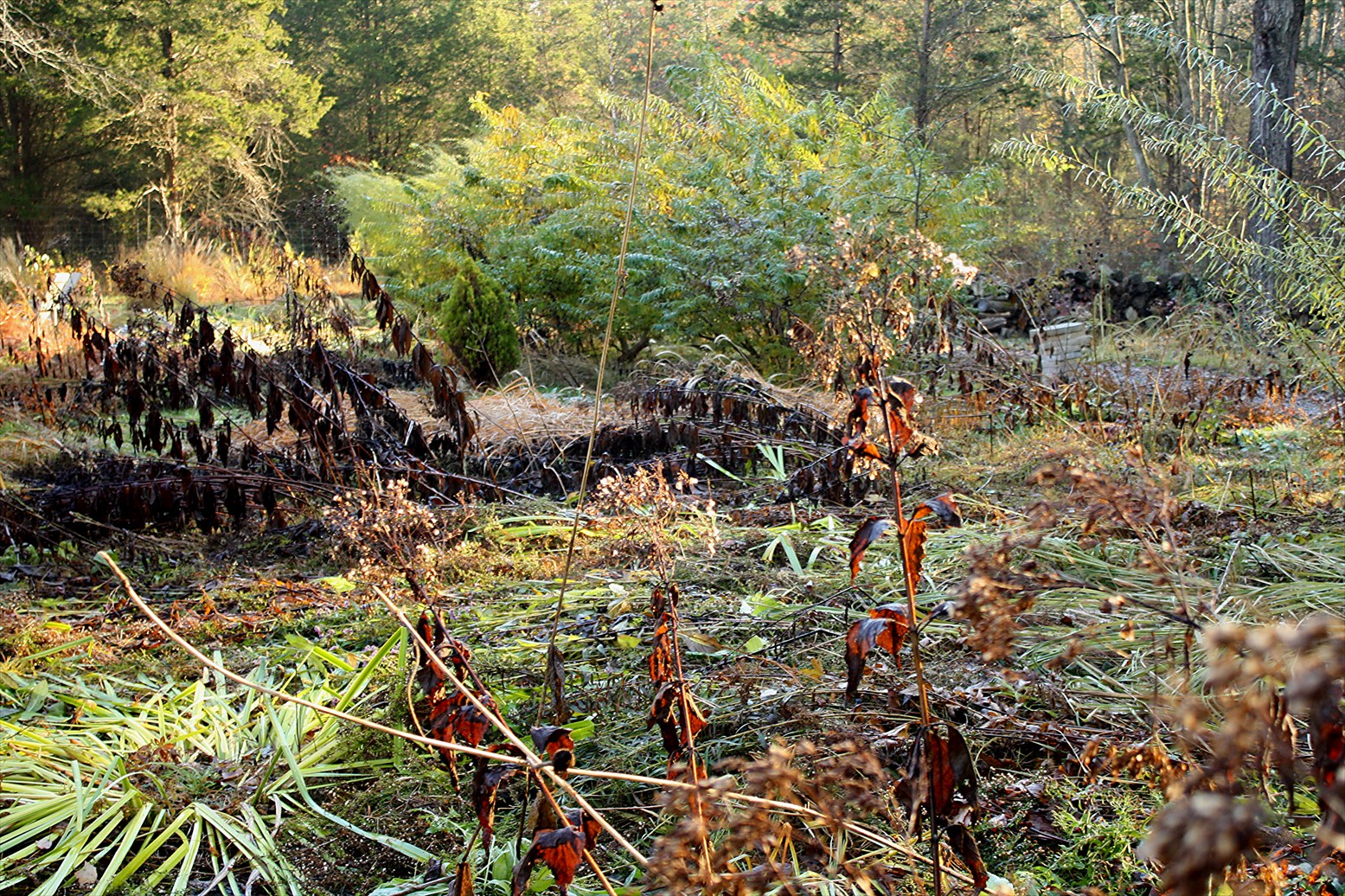
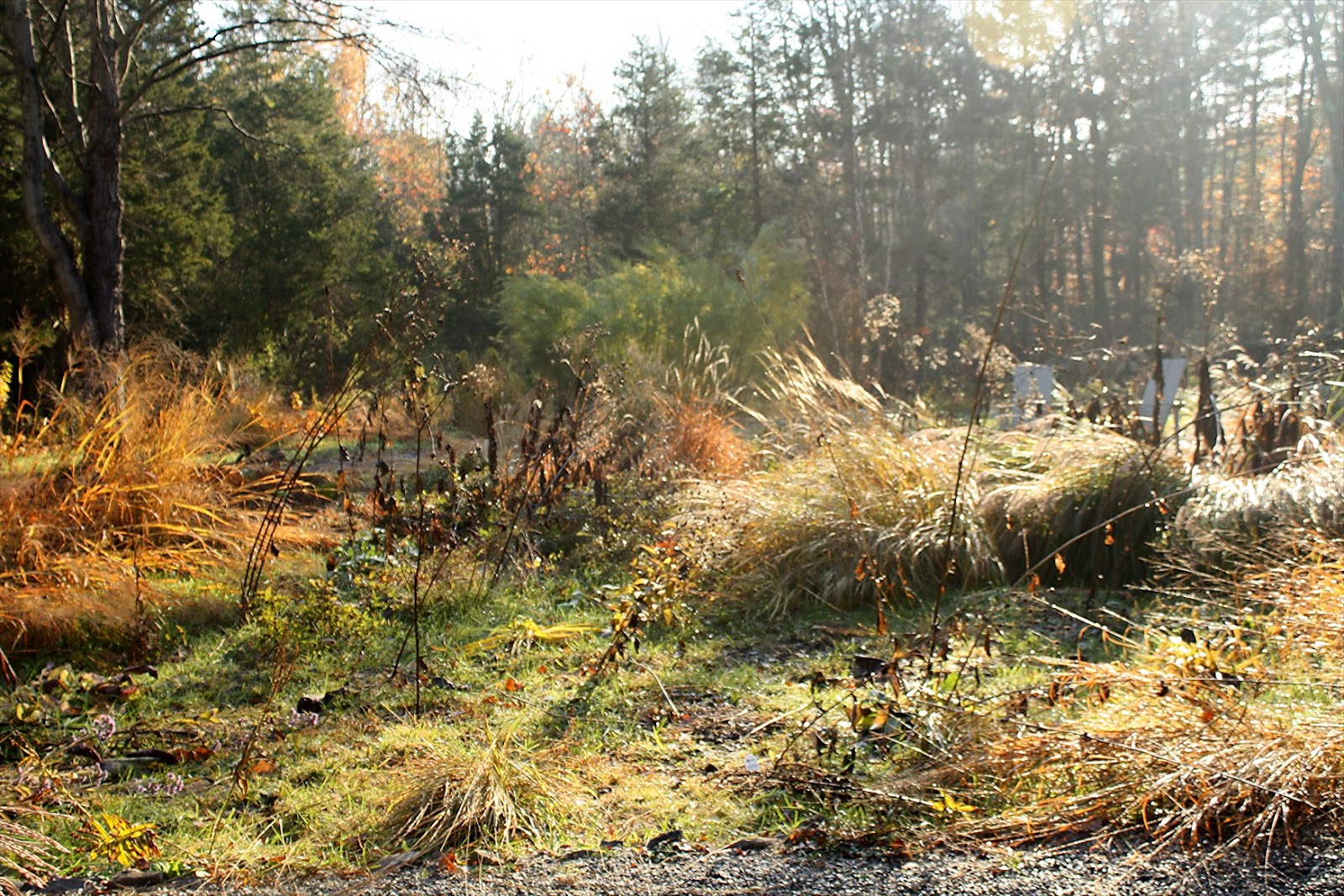
View of the garden at Federal Twist - just as the sunlight began to break through,
completely changing the mood of the garden |
A certain level of disorientation is a good thing in a garden, at least at the start of a visit. A feeling of being a bit lost sets the stage for a new way of seeing, a receptivity to new perceptions, exploration and discovery.
On Sunday, October 24 I got up early enough to see the sun rise; once it was light, I went out to record the progress of autumn in the garden.
The cloud cover muted the colors. The garden appeared to be in a state of stasis. The clock had stopped. The slide toward winter was temporarily suspended, leaving me with an ominous feeling of disappointment, dissatisfaction, a wish for change.
For most of my life I've lived with the illusion that "emotions" are a mental state, all in the head, so to speak. But that's not true. Emotions are a bodily response. They arise in the body, and in a very real sense, are physically "felt" before the conscious mind names them. This is the old saw about the head and the heart, the conscious and the unconscious.
Before an emotional impulse is named, before a label is applied, one experiences a state of unknowing, of being lost, and the start of a journey toward understanding--a journey that may last a millisecond or a lifetime.
I have difficulty naming emotions, and my own inclination is to seek meaning in metaphor, or in narrative--using images and stories to explore the world of feeling.
Look at the photo of the small pond below: on this dreary morning the reflective surface, largely obscured by dying growth, called to mind an eerie scene out of Edgar Allan Poe--the "dank tarn" in The Fall of the House of Usher--an image that carries associations of abandon, decay, withdrawal of life, a suggestion of some ominous potential.
Although I don't particularly care for the work of Poe, he's a part of my culture and the images and metaphors contained in his stories are ready to hand, so I saw the scenes below with a sense of the "dark and drear" Poe evokes so powerfully. Glistening wet, dark, perhaps even threatening. I was telling myself a story, though the story seemed to be telling itself, arising spontaneously as I simply observed. But I know that wasn't so; I was participating in the process.
Then things changed; the sun broke through the cloud cover (photo below), scattering light into the garden, and my mood lifted, my emotional response changed. All thought of Poe vanished.
Suddenly the garden was full of warm golds, reds, browns, tans, the backlighting dramatically silhouetting the individual plants, and reflective light revealing surface textures and color. I had been lost, musing on images from Poe, then I found what I didn't even know I was looking for. As the sun sparked the garden into life, my response was visceral, a sudden flood of anticipation, an aching tension in the body like a lover's response to the beloved.
This was more than appreciation of a pretty picture, more than painting with plants. The closest I can come to expressing my feelings is to say the change was like coming home.
My garden is clearly of a type, heavily influenced by the so-called New Wave or New Perennials style that grew out of a naturalistic garden movement in Europe, Germany and Holland in particular, and that began to influence gardening in the UK around the mid-1990s. It broke onto the American scene about ten years ago, prominently in books by Piet Oudolf, Noel Kingsbury, Michael King, and Henk Gerritsen, and was already making its mark in the work of our own Oehme and Van Sweden.
This new approach to garden design and planting is usually described as "Romantic," almost always with a capital "R". When I hear that word used, I hear a pejorative. It is too easy to dismiss this style as a nostalgic retreat from reality, as dreamy-eyed picture painting while our world seemingly tumbles into the chaos of terrorism and political fragmentation.
I think we've misnamed the look and the feel of these naturalistic gardens. "Romantic" isn't the right word;
it paints with too broad a brush, and it's been so overused it has little meaning.
Though it may look Romantic, my own garden was very much conceived as a rational, clearly thought-out response to the nature of this place, to difficult soil conditions, to poor drainage, to the surrounding wood that casts deep shadows, to the presence of a low mid-century house overlooking it all.
When I recall my feelings looking at this land six years ago, before the heavy growth of cedars and assorted brush was cut and removed, I think of Poe again. It was a dreary place, full of fallen trees and the detritus of decades of neglect.
But I brought with me five years of experience in my Rosemont garden, where I had first tried my hand with a garden in blatant imitation of the gardens I saw in the books of Oudolf, Kingsbury, Gerritsen, King, and, of course, our Americans Oehme (naturalized American from Germany) and Van Sweden, who himself was trained in Europe. The list could go on, but these are the bright lights in my memory.
So faced with this place I knew was not a good or easy place to make a garden, I approached the situation with the knowledge and tools I had learned from these men (why not women, an interesting question?).
I knew I also needed some very specific advice about the appropriateness of plants to my challenging habitat, so I got a copy of Hansen and Stahl's
Perennials and their Garden Habitats (
Die Stauden und Ihre Lebensbereiche), translated into English. Based on decades of research conducted in central Europe, this book contains exhaustive lists and descriptions of plants suited to various habitats. It was extremely helpful in selecting plants to match my garden conditions.
I don't see my garden as a result of plant painting to create a "Romantic" picture, not at all. It's the result of a very rationale process of design and planting, as well as a lot of practical experimentation to see what would die, what would only survive, and what would thrive. It is a very practical response to a difficult situation.
Certainly, for me, emotion is at the heart of my experience of this garden. And in a sense, any emphasis on the importance of emotional response might very well be called romantic. But what we have in the New Perennials movement isn't a retrograde or reactionary way of seeing the world, but is a synthesis of the rational and the feeling, a search for a way forward in a world that has experienced the degradation of overuse, pollution, and an out of control (human) population, and of course limited resources. Labor is expensive today, and most gardeners need to manage their gardens with minimal paid help (very practical).
But I do not mean a "return to nature" in any sense, and I have certainly not tried to create a native plant garden.
Note the liberal use of Miscanthus, a Japanese grass, not native, for sure, but one that looks right in this situation, and it thrives. Mixed in you
will see several native plants: Pycnanthemum muticum (Mountain mint) in low silvery masses, scattered Physostegia virginiana (Obedient plant) in buttery yellow, dark seedheads of Rudbeckia maxima, and the almost black stems of Joe Pye Weed (Eupatorium purpureum).
This is an American prairie--not a real prairie certainly, but a simulacrum of a wet prairie, adapted to my local conditions and to my personal preferences.
So where does emotion fit into this picture? That depends on the observer. To someone familiar with the New Perennials style, there is an immediate recognition and connection with an established palette of feelings associated with appreciation, or critical observation, of this style. To the less knowledgeable observer, the uninitiated, a state of confusion may result. Some simply see wild, uncultivated land. Some actually experience discomfort, possibly even fear, and want to quickly return to the high ground near the house, or even retreat inside the house.
I've observed this many times, and I don't see this reaction as bad. My garden has, in a sense, ambushed such visitors, attacked their preconceptions of what a garden should be, and this attack occurs at an emotional, possibly unconscious, level. Perhaps it will set off a longer term rethinking and future change in attitude.
Below, Panicum virgatum 'Shenandoah', a native plant, but its attraction for me is a sensuous pleasure, not an intellectual satisfaction or an ethical statement on use of native plants.
Another merging of the native and the non-native into a naturalistic prairie planting--native Pycnantheum muticum surrounded by Miscanthus sinensis 'Silberfeder', a grass of Japanese origin, with a German cultivar name.
The "transparent" tall grass below is Molinia caerulea 'Transparent', another European.
In the case of my garden, the style of the house overlooking it, and the situation of the house at an odd angle to the border of the property (to make it face south) also dictated a naturalistic, informal style, without a perceptible grid or axis. Again, this was not a romantic impulse, but a practical decision to keep the garden in a style appropriate to a modernist house built in the mid 1960s.
A small, secluded sitting area in the middle of the plantings.
I've said a lot, perhaps too much, so the rest will be silent.
(well, almost silent)
Postscript
The New Wave has been much in the news recently--that is, the horticultural news--and I imagine we will soon be seeing magazine articles and books about this garden design phenomenon. With a "Dutch Wave"
exhibition at the Garden Museum in London, blogs by
Noel Kingsbury and
Darryl Moore, and newspaper
articles about this perennial-intensive, naturalistic, emotional style of planting, we appear to be in for some retrospective, and reassessment, as the media makers look back over the past 15 years.