Pages

Showing posts with label Snow. Show all posts

Friday, January 04, 2013

Snow

The garden seems to be evaporating before my eyes; the very substance of the grasses and herbaceous perennials, most of what's left, seems thinner, more fragile, week by week. As the garden reveals more and more of its underlying structure--largely invisible in the high season of growth--this is a good time to take stock, to look for underlying problems, if "problems" is the right word. Perhaps better to think of opportunities, to evaluate, to fine tune.

So I'll continue to mull over the newest part of the garden--the reflecting pool, which does indeed present a "challenge." It doesn't seem to fit where I put it!


Snow last weekend, four inches of light fluff, just enough to cover the garden in a clean sheet, showed the pool in a new way, laid out in splendid isolation from its previously messy environment. In snow, the pool fits better, but only temporarily.


Judy Mann, a friend, was visiting and took these photos in the morning light while I was away at the gym (one of my few disciplines in life). As I look at them, they confirm, but by contrast, the approach I've decided to take to better integrate the pool into the garden.

Here (above and below) the snow erases the gravel bed, the blue stone coping around the water, other extraneous details. Truth be told I'm tempted to try for a similar effect without the snow, to take a minimal approach, though that would be very difficult since, without great expense, I can't level the surrounding area to make an ample, smooth surface for the pool to rest in luxurious isolation. 

So of the two possible directions I could take in this part of the garden--toward openness, cleanness, simplicity, or toward enclosure, height, romantic fuzziness--I take the latter, which can be implemented incrementally, making it easier to manage cost.


And to be honest, a minimal landscape feature would likely be out of character with the blousy naturalism of the rest of the garden. So perhaps my pocketbook and my aesthetics agree.

Below you can see the snowy outline of concrete pavers I've laid out in a trial pattern. I like this curve and the way it frames one side of the pool. The curve is an encompassing, welcoming gesture ...


... that focuses attention on the pool and on the garden beyond ... and begins a circular pattern that will be completed by the new plantings I plan around the pool area.

The key will be in the planting ... shrub spires, box balls, tall perennials like Joe Pye Weed and Inula, urn-shaped Miscanthus ... all forming diaphanous, three-dimensional screens that make the pool area like a circular room, a room with transparent walls through which you can catch glimpses in and out, as described in the previous post.


The Miscanthus giganteus, standing high and quite distant from the pool, illustrates how the interplay of vertical and horizontal will work. As with the tall, ragged Miscanthus and the flat, clean-edged pool, my plan to juxtapose verticals of Thuja occidentalis and grassy spires with the flat, two-dimensionality of the pool will create a sense of a secret place nestled amid dense plantings. The interplay of circular patterns, square pool, height, depth, sharp edges and soft, round shapes will make a pleasant place for contemplating reflections in the pool and appreciating the forms and colors of the surrounding plants.

The contrast of flatness and height will also emulate, in smaller scale, the contrast between the garden clearing and the tall trees of the bordering forest, more fully integrating the garden with its surrounding landscape.

Friday, January 21, 2011

Sunrise on new snow: watching from inside

Another four or five inches of light snow fell last night. Being born in the south where snow might be seen once in five years, I still delight in it, even after several storms in a row. But I haven't wanted to walk through this. Instead, I watch from inside the house.


The garden is almost gone, buried under layers of ice. The surrounding forest trees are much more prominent now and will have to carry the bulk of interest until spring. Even the structural elements--the gravel paths, stone walls, the pond--are invisible until the spring thaw.


The dark, leaden scaffolding of Baptisia australis (below) is still holding its own well against ice and snow, but the grasses are getting ragged and are ready for burning. The disappearance of most of the vegetable garden points up need for more structure at this time of year. The hornbeam hedge I started last year will make a strong winter statement, once it attains its "hedgeness."


And some other structural elements (columns, mounds, geometric shapes--of pruned shrubs, wood, stone, perhaps) may give just enough entertainment to the eye--strong, simple shapes contrasting with the busy, almost chaotic lines of the forest trees--without interrupting the view into the woods.


But on a day like today, the ethereal tracery of the trees, the washes of early morning sun light, the glimpse of the hill on the opposite side of the valley, just visible through the forest, are enough.

Saturday, February 13, 2010

Garden Diary: Snowy Revelations


We weren't hit nearly as hard as others to the south, but with 9 inches last weekend, and almost 20 more inches this week, the garden is virtually invisible. The few things that show reveal directions for the future, as does the blank white slate presented by the deep snow cover. I can better speculate where to place the structural shrubs and trees I've ordered for this spring.


To the right of the photo above is an apparently empty area. It's actually full of plants, all dormant now. In the distance is the farside path. As Peter suggested, I'm thinking of starting a pleached hornbeam hedge on this side of the path, with plentiful open space at each end but still carrying the eye from the Thujas to the left, toward two large Salix sachalinensis (also virtually invisible from this distance).


This is a view of the 8-foot-high deer fence (not really visible in this photo). The snow brought down several cedars, so I'm thinking about cutting them into logs and building a series of structures made of two uprights about 7 feet tall, with a curved (downward bending) cross piece at the top. This could create a screen along the fence side, adding a powerful visual rhythm, with a suggestion of Japanese design, in all native materials, and in keeping with features of the house (not Japanese, but clearly designed using Japanese motifs). Of course, they could just as well suggest lean-to structures that might have been made by native Americans ... a multicultural symbol. They will be in too much shade to grow flowering vines, but Virginia Creeper would look good on them, and I may find other vines suitable to the situation. Further to the right, I fantasize intermittent hornbeam hedges rhythmically placed to either side of the path. But best first to confirm hornbeam will grow in this place.


Siberian irises, grasses, a Magnolia virginiana, and a 'Heritage' River birch seem to have strong enough structure to weather the heavy, wet snow. The Siberian irises are especially notable. I love the seed pods (often used in Arts and Crafts art work) and would like to plant more. They bring a lot of color interest early in the season then provide continuing visual interest all the way to spring. They are actually at their best in snow, when most other plants have been submerged.


The little humps above are box, planted in an elevated stone structure. Interesting. I wonder what I'll find when the snow melts.


The real visual star in this white blankness is the newest stone wall (native Argillite, known locally as blue jingle or blue jingler), happily situated where its side captures the sun from late morning on, bringing a warmth and sense of protection to that end of the garden.


One of the few grasses that hasn't been completely buried by the snow. And last, the oncoming of evening.

Monday, February 20, 2006

Are we gardening yet?

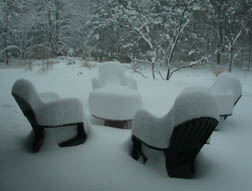
After an extraordinarily mild winter, we had a whopping snow storm last weekend. New York City, about 65 miles to the east, had the most snow ever recorded in a 24 hour period. Here's how it looked at Federal Twist.
Warm weather - again - the following week quickly melted most of the snow. The Lockatong Creek is running overfull, as are the little unnamed tributaries around us. I continue reading gardening books - now Dan Pearson's The Garden: A Year at Hope Farm - and ordering plants. As usual, I've reached the surfeit point and am feeling I'll never have time to build the stone walls I want to build, expand the front planting area, cut down the worst of the ragged cedars blocking the view of the sky, build the pond, and plant 30 Panicum virgatum 'Rotstrahlbusch', 25 Molinia caerulea 'Strahlenquelle', 15 Darmera peltata, and all the many, many other plants that will arrive, probably bare root, when I have only one rainy day left for gardening before leaving to get back to the City for work on Monday. Why do I do this?

As spring arrives, I'll remember, as in the past, all this will not get done in one year. And the better for it.

LinkWithin

Related Posts with Thumbnails