"You should see his garden. Well, it’s not really a garden. There are all of these plants, and he’s built paths so you can walk around and see everything.” That’s what he said, or words to that effect.
This was a house guest last weekend, talking about my garden to his friends. At first I felt a little miffed …(yet another person who defines a garden in such a traditional way, he doesn’t see my garden as a garden), but I quickly got over that. Later that afternoon, I asked him about the remark, really out of simple curiosity. I don’t believe I ever succeeded in convincing him that I wasn’t offended, that I only wanted to know what he meant. After several starts and stops, I came to understand that he sees a garden as a clearly delineated space, usually not a very large space, with plantings that are regular, possibly patterned, certainly discernibly structured--a space existing in visible isolation from its surroundings, perhaps surrounded by a fence or a wall. Perhaps something with a more traditional, gardenesque selection of plants--dahlias, roses, mums, for example. He would probably be very comfortable in the Medieval garden, the hortus conclusus, at the Cloisters museum in upper Manhattan. I would too. I love that garden, but that’s not what would suit my modernist house in the woods of western New Jersey.
My garden’s lack of clearly demarcated boundaries, large size, and amorphous shape left him a little uncertain, perhaps uneasy too. After I pressed him, he told me my garden was more a “landscape” because it was so large, so naturalistic in contrast to his usual sense of garden. I can’t say I disagree, though I do think it’s still a garden. To use an analogy, mine is more a Richard Strauss tone poem than a J. S. Bach fugue.
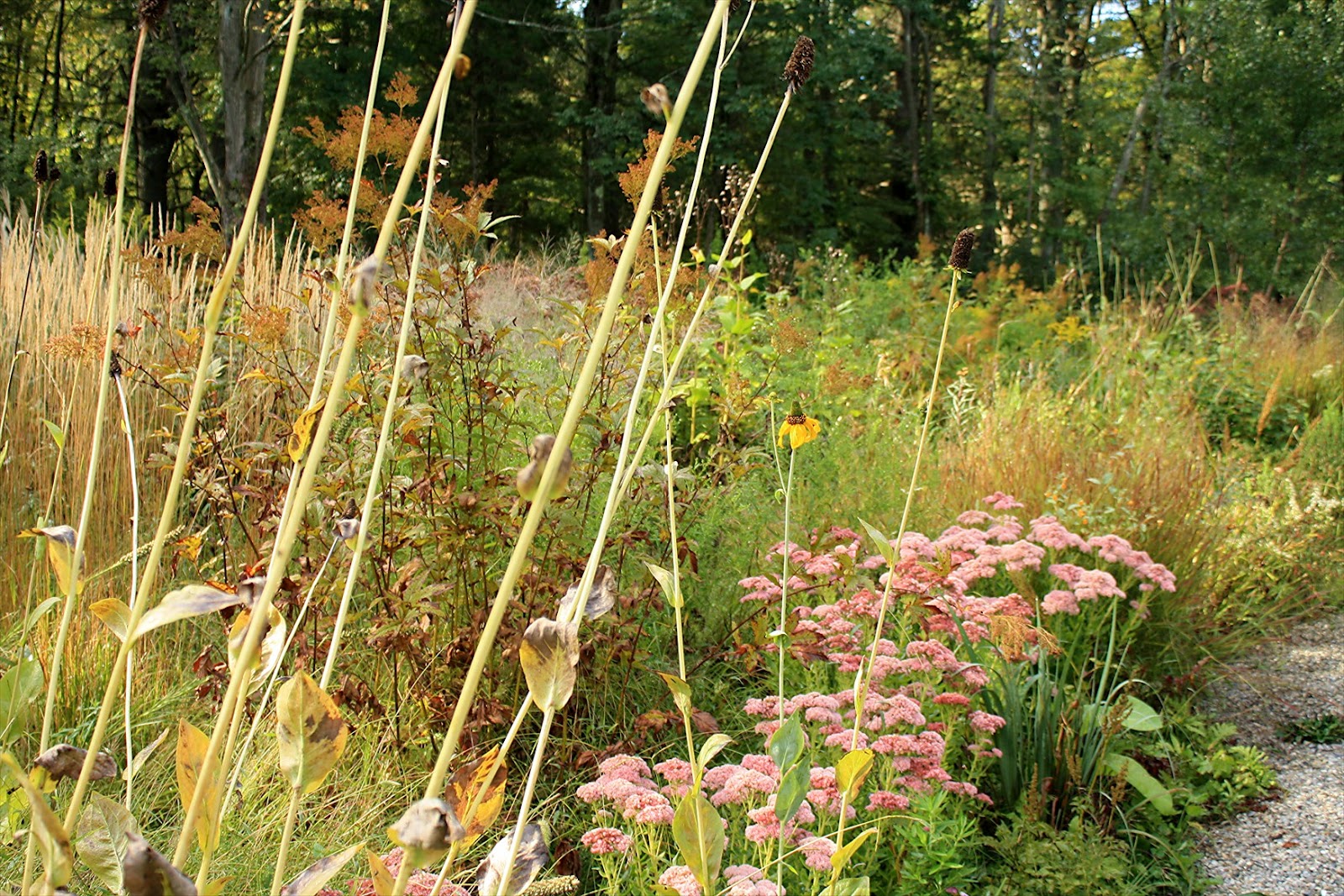
There is pattern and order, order emerging from what could have been disorder, in my garden. In the photograph at the top of this post, particularly if you look at it as a two-dimensional picture, you can see repeated fan shapes, repeated patterns almost like layers of scenery on a stage. The Japanese fantail willow at the background sets the motive, a fan shape repeated by the massed grasses, Joe Pye Weed (Eupatorium purpureum) and, in the foreground, Miscanthus and Lespedeza, all fan shapes in this two dimensional view ... Of course, the wind blows, the rain falls, and patterns disappear, others appear ...
Order too, in placement of plants, not at regular intervals, but to create groupings, communities of plants of the same kind, to echo shapes, to achieve an aesthetically pleasing distribution of forms, textures, colors.
So, as to what was visible last weekend ... here are two prominent natives in this area, Boneset (Eupatorium perfoliatum) and Wool grass (Scirpus cyperinus) ...
... bold textures of large, brassy foliage (below), Viburnum mariesii, Joe Pye Weed, Filipendula rubra, contrasting with whisps of Panicum 'Shenandoah' and more Boneset seeding around, the Boneset a reminder of the importance of chance in this garden; if it works, keep it, if not, move it or just pull it out.
I'm sure elizabethm at
Welsh Hills Again would see this as a mess; I like her blog, but she doesn't like prairie gardens. At this small scale, not being able to focus in on the detail, I have to say it appears to be. But if you're in the garden, you can see more detail, and more subtle variations in texture and color, perceive movement, the force of air stirring emotion.
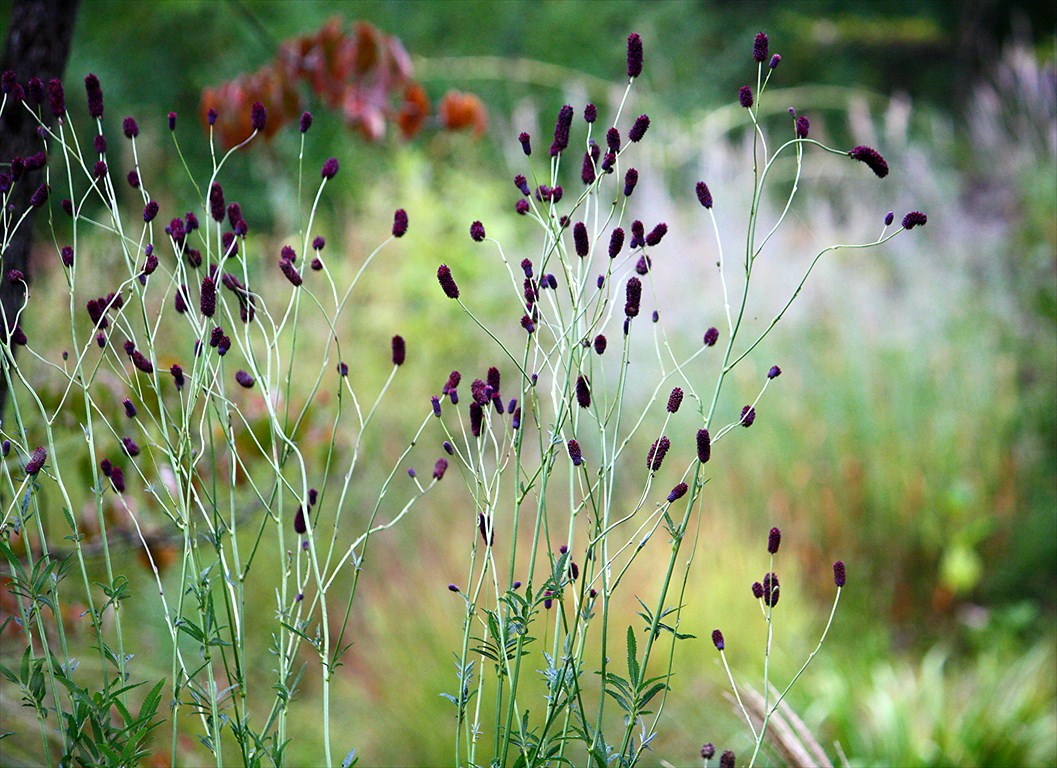
One way to sort it out visually: look at detail and throw the background out of focus. Here Sanguisorba tenuifolia ...
... silken flowers of early blooming Miscanthus ...
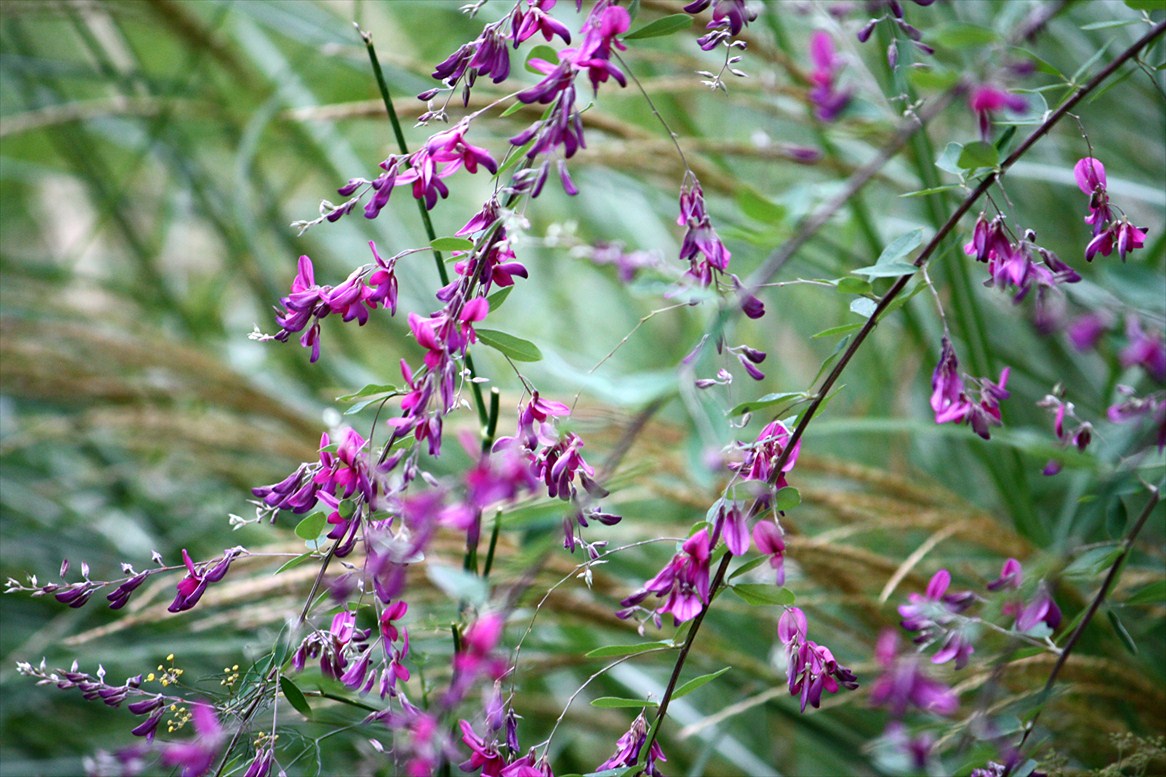
... bruised blues and purples of Lespedeza thunbergii 'Gibraltar' planted last fall ...
... mounding miscanthus and Patrinia scabiosifolia on the terrace overlooking the garden, and purposely blocking the view ...
... I suppose this is that jumble time of year ... everything growing to the max ... with a few cones of Arborvitae (Thuja occidentalis) holding the line, so to speak ...
... then suddenly, looking at the ancient crab apple (it must be over 40 years old) I'm into fall. Clearly this is a sign the year is nearing its end.