Some German parks and gardens have small paths, just wide enough for a single person wandering alone, to allow a more intimate experience of plants. These networks of narrow passageways are separate from the major garden paths. Their entrances are sometimes hard to find and the paths tend to be invisible from outside the garden.
My garden is wide and long and densely planted. I'm quite used to walking through my plantings, but others, particularly those a little intimidated by large plants, wouldn't even think of venturing across the garden. Besides, they might step in the wrong place and hurt themselves or do damage.
I got out my small mower the other day and started a network of small paths. Now I've opened up new opportunities for planting - for more work too. The thing is, the small paths now need to be paved in wood chips or gravel, and their edges need to be refined and integrated with surrounding parts of the garden by adding small-scale plantings to define (and decorate) the newly opened spaces.
I have to admit I've never seen such paths, never been to the German gardens I'm describing. All I know of this I've read in various books by Noel
Kingsbury, who does the service of making German gardening concepts and practices available to those of us who don't read or speak German. But he doesn't provide detailed instructions, so I'm winging it.
First take a look at the large scale in the photo below. The path I cut starts off to the left of this photo. It's a very wavy T shape with the top of the T - the crossbar - running in a curvy line across the garden out of view on the left, and the main vertical line of the T running horizontally, left to right, across the field of view in the photo, roughly in front of the bank of
miscanthus glinting in the sunlight about two-thirds of the way back. Actually the vertical line of the T is split into two parts so once at the end on the right, you can either exit, or double back over a slightly different route and out via the right-hand side of the crossbar of the T.

Three entrances make it easy to enter the paths. One is shown below, about three feet left of the tall
glaucous blue
Rudbeckia maxima.

Next, the actual entrance. I had to cut between a Switch grass (
Panicum 'Shenandoah') and a white Obedient plant (
Physostegia virginiana), leaving a messy area of dead vegetation. I'm sure some of this damage will take care of itself over time, but a little attention to a walking surface, to tell a visitor where to go if nothing else, and some cosmetic edging would make me happier. (The big leafed plants are
Silphium terebinthinaceum with flower stalks two to three feet high and growing rapidly. Making these "walkable" may be a challenge.)

Continuing on through in the next photo, the path makes a turn to the right, with a larger resting space just beyond the
miscanthus, then a turn to the left. Remember the T-shaped model for the path? In spite of all the turns, this is all still part of the crossbar of the T.

The next photo is of this turn from outside the garden, showing how well the screening of plants hides the internal path network.

The crossbar path continues into the bright sunlight to the opposite side of the garden. Just within the area of shadow is a sharp turn to the right. This is the start of the long vertical line, or descender, of the T, which goes across the wide part of the garden shown in the opening photo.

The first view is of
Miscanthus purpurescens,
Veronicastrum virginicum and the smoky tops of
Calamagrostis 'Karl
Foerester' in the distance. Stepping forward ...

emerge the
gwaky stalks of
Silphium laciniatum (also lots of
vernonia,
Rudbeckia maxima, other tall verticals), a blue
Zenobia pulverulenta in the lower right, a golden arborvitae standing gnome-like in the mid-distance and the beacon of a Sunburst honey locust at the end.
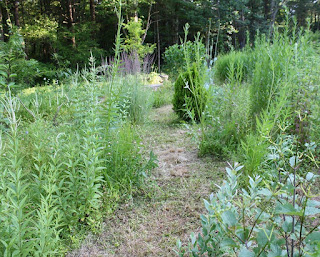
The final few feet, pictured below, show the need for some quick attention to planting to make this a welcoming destination. And I have to cut that old cedar root, which is a tripping hazard.

Here you may exit, having traversed about 40 feet of interior garden, or make a turn to the left and retrace a slightly different path back to the crossbar of the T. If you turn left, this is the path you take through a group of
Inula Sonnenspeer, a bank of
Miscanthus '
Silberfeder', and on the left a
Vernonia gigantea (from Alan
Armitage's Plant Delights nursery). Moving forward ...

you can see the giant leaves of the
inula in more detail - rather scratchy plants to brush against. But this path is only for people who want to see such plants in detail, and close up. It's not for the casual viewer.

Moving onward into the sunlight, you enter the crossbar of the T again, making a right turn which takes you to the exit near a sitting area under a maple.

As always, "just doing it" without further thought leads to new discoveries (actually, I've thought about doing this for two years at least; just never got around to it, then plunged in). I had thought I'd only need to attend to providing some "paving" to preserve the outline of the paths. Now I foresee need for very careful attention to maintenance if I'm to avoid damaging the surrounding plants. I may even have to move some. And what of those that decide to topple over - staking? cutting? And how to clean up the rough edges?


