
With the coming of August 1, we're at the peak of a hot, very dry summer, stressful in the extreme. But most of the established plants have required no supplemental water. They've been established long enough to weather these difficult conditions, even though most of them are water lovers, or at least tolerant of a lot of moisture. Right now I have to remind myself I have a "wet" garden, a "wet" prairie because it's do damn dry. Only perennials newly planted this year, and a few shrubs, hydrangeas mostly, planted in dry areas, have shown obvious signs of wilting, though a few perennials in open, exposed areas have died.

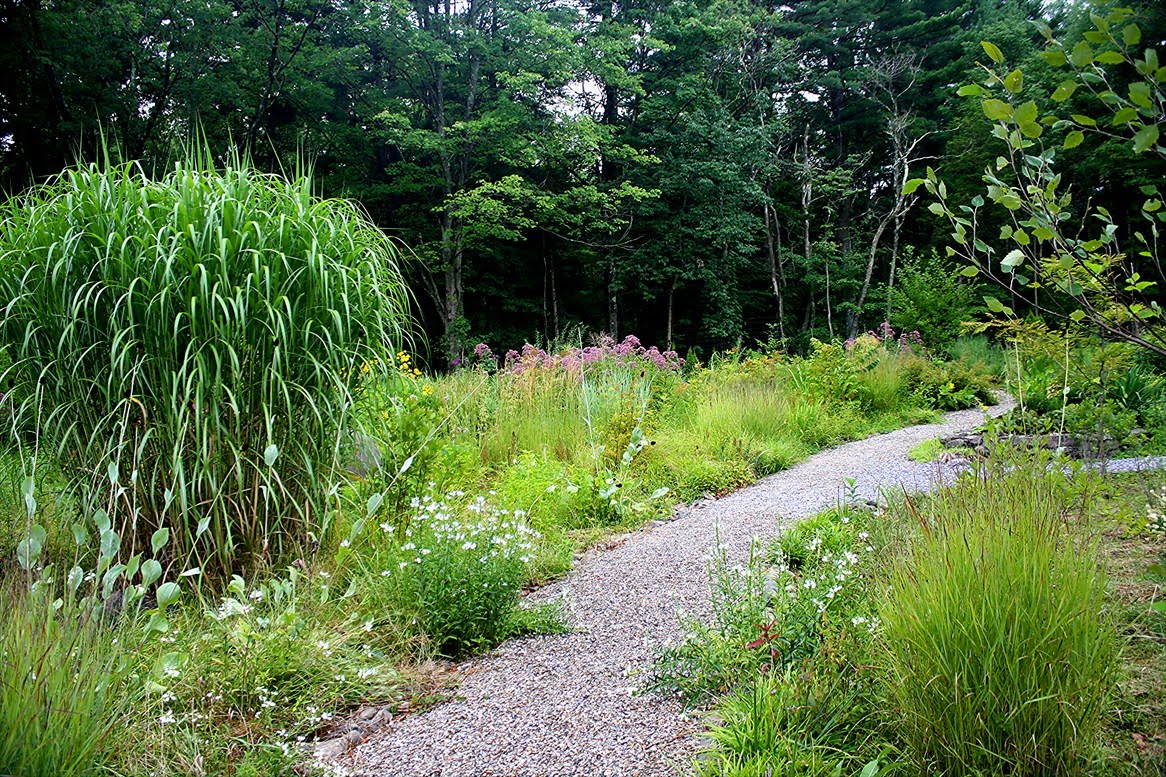
Along the main path, plants are most exposed because they don't have the shelter of other plants on all sides, but even there, most damage occurred during one period of 100+ degrees. So what has fared well, and what not so well? Certainly the Miscanthus giganteus below is doing fine, as is the Rudbeckia maxima; though some seed stalks are rather horizontal, that has nothing to do with lack of water.

Continuing along the path, various Panicums (switch grasses) and Physostegia virginiana (False Dragonshead, Obedient Plant) are at their prime. No obvious signs of stress so far.

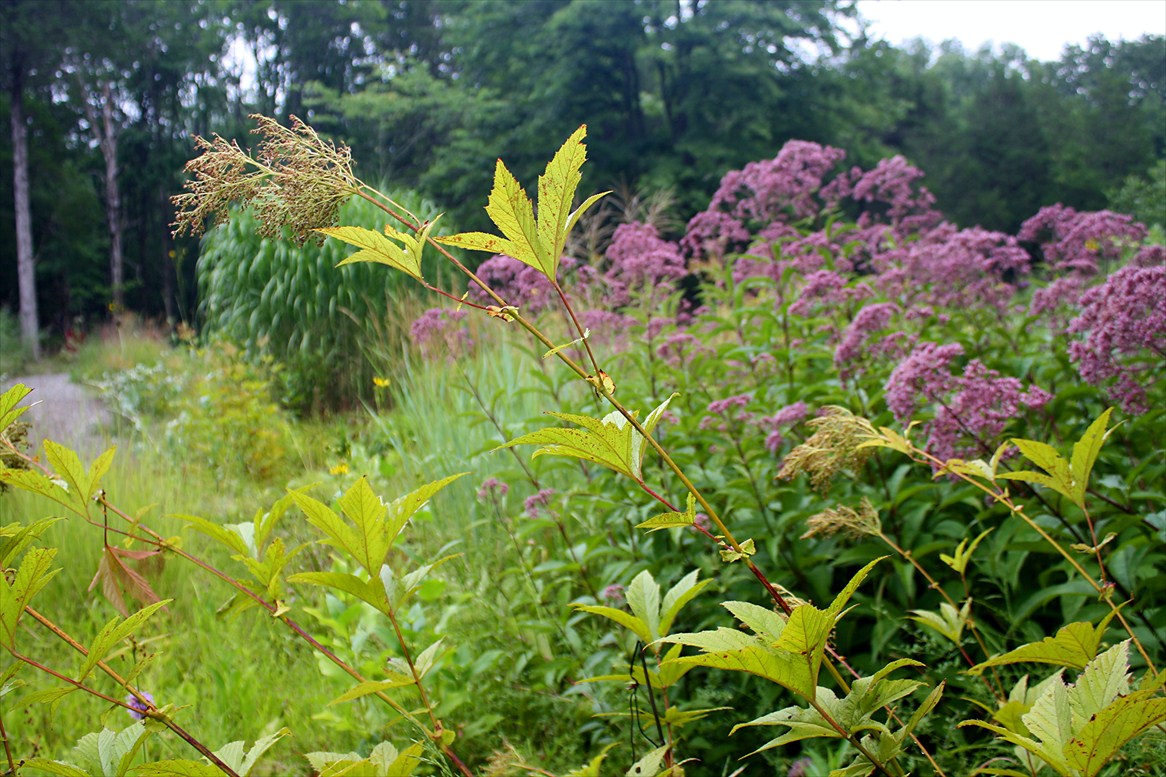
Looking back along the path, you can see a thriving community of Joe Pye Weed (Eupatorium purpureum) in the distance, along with more panicums and other plants not visible. Some small, newly planted Hemerocallis, obscured on the right, are looking bedraggled (downright ugly), but will likely come back larger next year ... Hemerocallis is, I find, a fine stress tolerator. It simply disappears underground if conditions get bad, but almost always returns ...
... another view back toward the paths on either side of the pond, converging at the end of a raised stone-walled planting bed with boxwoods and bergenias. And, unplanned, thriving Patrinia scabiosifolia and Lobelia syiphilitica that self-seeded and will be moved at the end of the hot season. (You'll see those clearly in photos below.)

Looking in the opposite direction, and moving clockwise around the garden, another view of the driest area, located over the extremely well drained wastewater leaching field, filled with Panicums, Pycnantheum muticum (Mountain mint), Rudbeckia maxima, Silphium terebinthinaceum (Prairie dock), all getting by on the brief, occasional rain showers we see at two to four week intervals (sometimes longer) ...
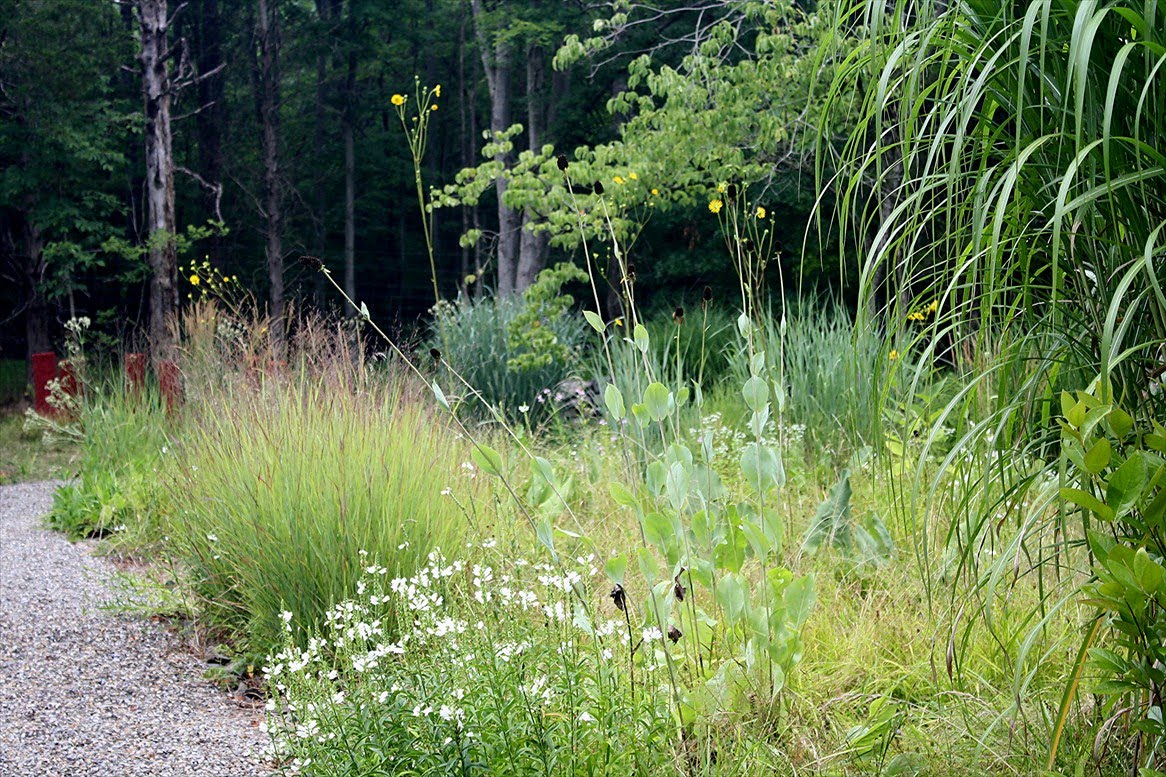
One of my favorites, in the foreground, Filipendula rubra 'Venusta' (Queen of the Prairie) looking its best in its aging gold, weeks after its pink cotton candy blossoms have faded, more Joe Pye ... both doing very well in spite of drought, probably because the planting is so close here the ground is completely shaded ...
One of the interlopers in the stone planter with the boxwoods and bergenias, Lobelia siphilitica, just coming into blossom ...

And the other interloper, Patrinia scabiosifolia, at peak bloom for about 10 days now ...

Back on the path beside the pond, where I'm gradually planting the bank, which looks full here (cameras lie), with Hydrangea Annabelle, a golden Catalpa, Miscanthus gracillimus and, in the distance, a Japanese maple. Only the hydrangea has suffered, but it was planted in high summer and has no established root system. Plants like this one require lots of spot watering.

More views of the "wet" end of the garden. Not really wet now, but certainly very wet for three out of four seasons ... Horizontal bands of Spartina pectinata 'Marginata', Filipendula in its late summer gold, and Joe Pye Weed towering in the background ...

Light pink spots of the European Eupatorium cannibinum, Inula racemosa 'Sonnerspeer' tall with yellow daisies running up its vertical stem, Miscanthus purpurescens on the right, and Miscanthus 'Silberfeder' on the left ... come fall, this will be an area of high color, the M. purpurescens in flaming colors (well, usually, we'll see) ...

The shiny silver flowers of Pycnanthemum muticum in bloom, the old stalwart Joe Pye again, and Vernonia fasciculata (Ironweed) at the dry end; notice this Joe Pye is much smaller and less vigorous than its counterparts at the "wet" end of the garden ...


Self-seeded Silphium perfoliatum (Cup plant) ...


Back side of garden--the big mass of Miscanthus 'Silberfeder', Pycnantheum muticum, and low to the ground, a hybrid Petasites for big foliage effect ... the Petasites, a water lover, is showing damaged leaves from the dry heat ...


I don't know where that white phlox came from, but it returns larger every year. If I wanted to plant an area in phlox, it would probably die en masse. I attribute this one's success to the protection and shaded roots of the surrounding plants.

An interesting combination that demonstrates the value of foliage colors--blue of Panicum 'Dallas Blues' on left, green of Joe Pye Weed, right, gold of Filipendula behind. Look closely and you'll see a Miscanthus flowering at the back edge of the Panicum. If I don't cut this out, my Panicum will be gone in two or three years. Miscanthus is much more competitive and will completely take over. At back curving to the left are high stalks of Silphium lanciniatum, so tall they lean precariously, even with some staking.

Shifting the view to the right brings more Filipendula into view ...

... then Eupatorium perfoliatum (Bonset), one of my favorite native wild flowers, about to burst into umbelliferous clouds of white. This Eupatorium has seeded about this year, I think because or our early warm, wet spring. If it's naturally this agressive, I'll have to resort to hand pulling selected plants--"weeding like a cow" as Henk Gerritsen so aptly put it. At front with the Filipedula is the one remaining Liatris pyncnostachia, a beautiful plant, and appropriate to this plant community, but I fear, not competitive enough to survive in the long term. It seems to want less competition, so I may give it another try in more open areas.

The new Marc Rosenquist sculpture through a screen of Calamagrostis and Panicum ...

Some day I must do a post on humorous plants. Rudbeckia maxima climbs toward the sky with a single upward facing daisy flower, then becomes this lanky, gawky plant cartoon for the rest of the season, and many of the seed stalks remain erect throughout winter ... humorous, but a lovely color and a delight throughout the entire year ...

A giant bouquet ...

Here a native rush in all its complex beauty. These have been here from the start and continue to appear year after year. I haven't identified it with any specificity (it may be Scirpus cyperinus--wool grass, marsh bulrush, cotton grass bulrush), not being a native plant expert, but it's probably the most reliable native plant in the garden, and looks like a delicate piece of vegetable jewelery at the height of its blooming season, which is now.

Just a pretty detail with willow (Salix 'Rubykins', Eupatorium perfoliatum, Vernonia fasiculata, Filipendula, Liatris) ... remember, the camera lies ...

Same scene, broader view, slightly different point of view ... see how the camera lies?

What a peaceful scene Joe Pye Weed can make ...

Another camera lie, catching colors and forms through a small aperture ... lie, yes, perhaps a little lie, a bubbameister, a little lie that, perhaps, has a story to tell, even a bit of truth, something for the gardener to learn ...

That's it for August 1. Next diary entry is in the works.


